

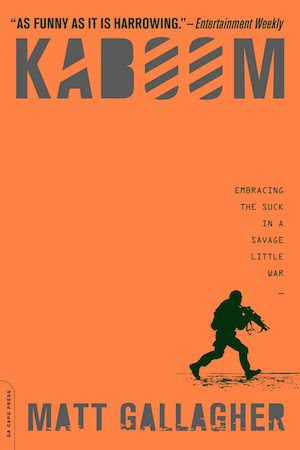
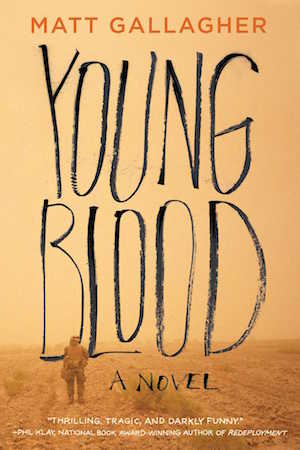
Matt Gallagher has quickly established himself as one of the most distinct and distinguished literary figures coming out of the wars in Iraq and Afghanistan. A veteran of a fifteen-month tour in Iraq during the Surge, Gallagher wrote a well-received memoir on his experiences in counterinsurgency warfare (Kaboom: Embracing the Suck in a Savage Little War), edited a collection of short stories written by his fellow veteran writers (Fire and Forget: Short Stories from the Long War), and continues to publish widely. His Iraq novel, Youngblood, is due out in February of 2016.
***
The Rumpus: I remember when I first learned of you, it was on the front page of our local newspaper in Reno, where you and I are both from. I was surprised: here was this writer from Reno serving in Iraq and criticizing the institution from the inside. How did you get on that front page?
Matt Gallagher: I was a Scout platoon leader with a Cavalry unit out of the 25th Infantry in Hawaii. We deployed as a part of the Surge to a small town north of Baghdad in late 2007. I started a blog because it just felt natural. I’d grown up reading and writing as a way to process the world, and right before we deployed I’d done a lot of research of my own, including reading military blogs as a way to try to understand the human side of everything that was going on with the switch to counterinsurgency. You get a lot of Powerpoint briefings before you deploy, but it is usually in this inhuman, distant lingo that just wasn’t connecting with me. So, I was doing this research to try to find a human element that maybe I could understand and hopefully maybe explain to my soldiers, because even the grizzled NCOs who had deployed before almost certainly hadn’t done so doing counterinsurgency.
It was also a way of keeping in touch with family and friends. The war was very political then, still is, and I had friends all over the spectrum, from die-hard liberals who were very anti-war, to conservatives who thought that this was the best thing that has ever happened to the Middle East. So I thought that this was a place for family and friends, if they are interested they can check it out, and if they don’t want to they don’t have to.
So I started blogging, and initially it was a very small readership, mostly family and friends. I wanted to be very honest and forthright that so much of counterinsurgency is not just combat, but the beat policing that is inherently trial and error. But then it got shut down.
Rumpus: Why did your blog get shut down?
Gallagher: Six months in, May of 2008, I was told by my Battalion commander that they wanted to promote me to executive officer, which is a good thing, and it would have been an honor and a privilege, etcetera. But like any platoon leader worth a damn, I fought it. I wasn’t expecting to win, but I fought. The right thing to do was to point out that I wasn’t planning to make the Army a career, which was true, but it might have also allowed me to stay with my guys. You get very close when you are deployed together. We had a very serious incident with one of my guys getting seriously wounded in a non-combat incident, so I felt like stability within the platoon was important. I wasn’t expecting to win at all, but I didn’t want to be the guy that just rolled over, either. In a weird way, I thought my superiors would respect my fighting a little bit more.
That didn’t happen. My battalion commander was pretty upset that I pushed back. Looking back on it now, I realize that he was under immense pressure after I told him that I was getting out because part of the way they were being evaluated was officer retention. But all qualifiers aside, he was a complete asshole. So, he chewed me out in a way that can only occur in the military, with all kinds of colorful four-letter words, and he basically said, fine, if you don’t want this position we’re going to give it to someone that does, but you are X, Y, and Z for even expressing that you might have an opinion about this.
I probably should have just swallowed it and saluted and said, “yes sir,” but I did what I had been doing the previous six months when confronted with a complex situation I didn’t totally understand, I wrote about it and I posted it. Very naively at the time, I didn’t think it would even get back to him. I mean, a junior officer being upset that he was chewed out by a superior, that’s like every day in the military. But you can’t write about being upset with your boss in any vocation, whether you are in the military or not. So it got back to him in a few hours and the blog got shut down. The Washington Post and the Reno Gazette-Journal both did a story on it. There was a Congressional inquiry into whether the blog was illegally shut down, too.
It was silly. It was wild. It was all very surreal. I was promoted to captain about a month later by the same battalion commander. He did punch in my bars, but he still put them on, to his credit. The military newspaper, Stars and Stripes, wound up re-running the Washington Post story, so I remember signing copies of the article in Iraq. It was kind of a joke. I am sure there were people who were taking all of this more seriously than I do, but it was just ridiculous compared to our day-to-day life on patrols, or our counter-IED missions at night. Compared to that, this was sort of surreal bullshit. The blog itself, when it was up, was surreal bullshit. It was a distraction and one that was helpful to me personally, but after it got shut down, I just kept journaling privately.
Rumpus: Why do you think they responded so aggressively?
Gallagher: A lot of it was a generational disconnect within the Army. My generation of officers and soldiers had been trained to be adaptable, ready for a counterinsurgency environment like Iraq, while most of our superiors had spent most of their formative years preparing for World War III with the Soviets. In a broader context, most of my generation, myself included, grew up in divorced households. I have a good relationship with my father, but I am not going to instinctively trust an older male just because he tells me to. That just wasn’t how a lot of Millennials were raised. There were definitely elements of that creeping into it.
Rumpus: After the blog and the journal, you decide to write your memoir, Kaboom.
Gallagher: Yeah, once the blog was shut down there was the Washington Post story and various literary agents and publishers reached out to me. I said, thanks for writing, I’ve always dreamed of being a writer, but I have nine more months in Iraq and another year left in the Army, maybe we can be in touch down the line. Most agents never got back to me, but it did end up working out with Da Capo. When we returned to Hawaii in February 2009, I decided I was definitely getting out of the Army in June of that year, so why not? It was an interesting time and place and people, so why not try to turn my blog and journal entries into a book? So that’s what I did. When you get back from a deployment, especially one that is fifteen months long, you have a lot of free time on your hands. I’d go to formation and workout every morning, and I was usually done by noon. My friends would go surfing, and I would go with them and sit on the beach, drink a piña colada, sit under an umbrella, and just try to write it all out.
Rumpus: What were you trying to convey with writing your memoir?
Gallagher: I just wanted to communicate what counterinsurgency looked like on the ground, based on the experiences of one Scout platoon. We were on the sectarian fault line, right on the border between Baghdad Province and Anbar Province, so a lot of interesting things were going on. It wasn’t necessarily the bombs and the gunfights that I was drawn to as a writer, although you get a little bit of that in any war memoir. I wanted to humanize not just my soldiers because they were so important to me and I knew how stereotyped and caricatured they could be from places that I had been through in my life, Reno or Wake Forest. I also wanted to humanize the Iraqis. I had read a lot of different Iraq and Afghanistan nonfiction books at that point, and many were good, many were not, and I think I just wanted to bring full life and characters to that side as well. Even the sheikh I didn’t necessarily trust, I hope that I was able to eventually convey his three-dimensionality.
Rumpus: What’s an example of those complexities?
Gallagher: One thing that has always stayed with me from that deployment was one of the sheikhs who I admired greatly, we were in his sitting room, and he pointed to the wall. It was a picture of his great-grandfather, and he said that he worked with the Turks. And then he pointed to another photo and it was his grandfather, and he said that he worked with the British. Then he pointed to the photo of his father, and he said that he had helped the Ba’athists overthrow the first Iraqi King. The point he was making was, this isn’t temporary for us. You say all of these nice things, we are sharing a meal together, and we get along personally, but this is our home. Maybe that isn’t super sexy or have a big explosion in it, but for me at least, that was more indicative of what our time in Iraq meant more than anything.
Rumpus: One of the characters that I remember you spending a lot of time on was your interpreter, who was somehow caught between the Iraqi society you discuss and the temporary American society that was there.
Gallagher: Yeah, Suge Knight. He was nicknamed after the rapper because he was a big black guy originally from the Sudan who had learned English from British missionaries as a child. He was such a vital part of our deployment. He was just so brave, loyal, and fierce. It was sad. He was one of us, then we said, oh sorry, you’re going to have to stay here while we go home. Granted that is his home, he lived in the Little Sudan neighborhood of Baghdad. And we left when it seemed like things were pretty good in Baghdad, given the context, and even then it felt a bit like abandonment because he wore a uniform, he wore a unit patch, he was there for every patrol. So writing about him in a full, vibrant way seemed the best thing I could do to honor his service.
Rumpus: What other Iraq and Afghanistan memoirs and books do you think capture that empathy and that personal story?
Gallagher: Nate Fick’s One Bullet Away is a really interesting story. Generation Kill is a really interesting piece of journalism. I’m a big fan of Kayla Williams’s two books, Love My Rifle More Than You and Plenty of Time When We Get Home.
Jim Frederick’s Black Hearts is one of the darkest, most disturbing accounts of Iraq, but it is also a fascinating example of humanity gone wrong. It’s about three soldiers murdering an Iraqi family and raping a teenaged daughter, and how we digest these things in a vacuum rather than see that it was the last domino to fall in a unit where literally everything that could have gone wrong did go wrong. What brought these three soldiers who had no business supervising one another to be isolated at a traffic control point, and 300 other things that allowed this story to come together. It’s just such an incredible piece of journalism, as well as narrative. Saying that I love that book feels wrong, but it is definitely one of the best books about these conflicts. Dexter Filkins’s The Forever War is another one.
One of the things that I find so interesting about all of these accounts is how many of the same mistakes are occurring despite the strategy, despite the friction between what is occurring on the ground and what the bureaucracy demands is occurring on the ground. You’d think in a post-Catch-22 world we’d all be beyond that, but it’s even more grotesque. John Crawford’s The Last True Story I’ll Ever Tell is another memoir from the early years of the war. I think I read that when I was still in college, and I was thinking, man, I guess I am going to miss the war, which seems like such a crazy thing to think now, but at the time was a very real thing. Colby Buzzell’s memoir, My War has this raw, unfiltered voice. He’s both a poet and a Joe’s Joe, if that makes sense. Brian Turner’s memoir, My Life as a Foreign Country, has this amazing immersive technique. I mean, there was a piece of that memoir where he actually becomes a bomb-maker, which was brilliant. For all my talk of empathy and trying to get out of a traditional worldview, I wouldn’t even try that. And he does it beautifully. One more is Brian Caster’s The Long Walk. PTSD, trauma, all that jazz can have this weird, corrosive effect on literary readers. They sometimes say it’s just trauma writing, or whatever. But Brian’s memoir is what The Hurt Locker should have been. It’s smart and savvy but it’s also sad and potent.
Rumpus: So there is great nonfiction from these wars, but in 2011, you wrote an article for the Atlantic asking where all of the war novels from Iraq and Afghanistan. Where were you as a writer when you wrote that?
Gallagher: I wanted to read fiction, but I think it was a question for me, too. I think I wanted to write fiction, but I wasn’t sure I wanted it to be about the war. But I was pretty sure that people should be writing about it, whether they are veterans or not. I think The Yellow Birds came out about a year after that, and it was the first breakthrough novel, though not the first novel about the wars. Historically, protracted wars like Iraq and Afghanistan produce interesting works of literature. It’s often described as ironic that something as brutal as warfare produces great works of literature, but I think war is part of the human condition. I’m not happy about it, but peace is just so rare. Ignoring our impulse to destroy each other isn’t going to make it going away, so it makes sense that people, whether they directly experienced war or not, seek to write about it and seek to understand it. I think that is where I was. I was seeking to understand my own experience.
Rumpus: Were you surprised by 2011 when you started to see books like The Yellow Birds and Siobhan Fallon’s You Know When the Men are Gone coming out?
Gallagher: I was pleasantly surprised. I discovered a small veteran writer cohort here in New York. It included Phil Klay and Roy Scranton and Jake Siegel and some others. And these were questions we were asking ourselves. I didn’t know Kevin at the time but I’d met Siobhan at a writers’ conference hosted by the Air Force Academy right before her book came out. There was a real question about whether there would be a fiction readership for these wars due to the political, polemical nature of these wars, because of the post-Vietnam hangover that the country never seems to have kicked. Coming out of World War II, it makes sense that Norman Mailer publishes The Naked and the Dead in 1948. We just saved the world from fascism; who doesn’t want to read that story? Iraq and Afghanistan are playing out rather differently. It defies the narrative that America wants to hear, which means it’s necessary reading, I think, but it is also a business, so there really was this question of whether there was going to be anything resembling a readership. I hope when it is all said and done that people like Kevin and Siobhan and Ben Fountain get the credit they deserve (for their books’ success) because had their books been flops it would have been bad for our entire community of writers. But it would have also been bad for American literature because these wars happened, they mattered whether they played out the way we wanted to or not. They deserve a literary treatment, and thankfully, we are starting to see that now.
Rumpus: What do you think that was different about the literary fiction we are starting to see and memoirs that preceded them?
Gallagher: I think good literary fiction, in general, but especially on subjects like war and conflict, can provide a perspective that memoirs written so close to the moment generally can’t. They just don’t have the emotional distance from the subject. They also don’t have a deeper emotional texture that fiction does. I could end Kaboom with a Mai Tai on the beach, and it was important for me to end my book that way because that was the truth. Good fiction demands more than that. It demands, if not meaning, texture and resonance, it can’t just be “there was thing and this is the story of that thing.” Fiction needs to be the story not of the thing, but of the people, of the time, of that time’s meaning and inheritance. You don’t necessarily have to provide answers, but good fiction better damn well try to provide something more than the 5 Ws. I don’t think it is surprising that it took a while for The Yellow Birds to come out. Not because it took Kevin that many years to write the book, but because it required some distance to be written.
All this very neatly matches the trajectory of Vietnam literature. You have someone like Tim O’Brien who comes out with a memoir if not during the war then shortly after. Then you have a couple of short stories, and then Going After Cacciato comes out in the late 1970s. It’s not just because Tim O’Brien needed that time, it was because the country needed that time and that distance. That’s not to say that fiction can’t be written in the moment, but for a very practical example in Iraq, if you had written a novel in 2009 that in some way resembled a happy ending, how false would that read now? It betrays not just history, but it is defying the principles of realism. That matters.
Rumpus: Your novel comes out next year, right?
Gallagher: Yes, February 2016. It’s called Youngblood, and it’s set a few years after I was there during that American withdrawal I just referenced. I wanted to write a novel that was not just about the Iraq War but had a wide breadth. I was fascinated by the inheritance of the war, not just as a whole, but how American units replace one another every year, but every year the Iraqi civilians remain the same, and how myths could evolve in that situation. You know, the previous units did it this way, this unit had a legendary soldier.
Youngblood has a bi-level narrative. It’s both the story of the American withdrawal, but it is also a ghost story of a legendary soldier who preceded the narrator and his unit in the same town. He may or may not have struck up a relationship with a daughter of a sheikh, so it sort of has a bit of a Romeo and Juliet story as well. That’s because it interested me as a person and I had hoped that it would interest readers as well that there were so many sub-parts that was the American part of the Iraq war. You could have soldiers who deployed there three or four times, but the only people that really dealt with every part of that were the Iraqi civilians who survived. Though it is told from an American perspective, there are a number of strong, full Iraqi characters because they were there for all of it, for the invasion, the pre-Surge, the Surge, the withdrawal, and for the whole war. These are all neat terms for us to separate the war cleanly, but for them it was all part of the same mess. And still is.


19 responses
Terrific article
Suge Knight raps? I had no idea! And Gallagher gave his Sudanese interpreter this nickname why? This is unclear.
My real question though goes out to all these profiteers off murder in the names of GWB and DC: Why did they join up in the first place? To get some good life experiences to write about?
@ GA Read the interview again. Gallagher says, “He was nicknamed after the rapper because he was a big black guy…” As to your real question, I can’t answer, but my idea of a war profiteer is someone like Dick Cheney or one of his cohorts who are selling the bullets, the uniforms or the rations, etc… without being in harms way. Would you include Hemingway or Robert Stone in your cheap swipe of a remark?
Yes, because he was a big black guy. Why not Ice Cube (actually a rapper) or Mike Tyson or, I dunno, Richard Roundtree? It just seems a bit reductive, “because he was black,” no? Not much of an explanation.
Sure it’s a cheap swipe of a remark. But why are we valorizing the experiences of soldiers who volunteered for an unjust and unwarranted war? There was no reason to go to Iraq. Thousands of us protested the vile war that killed over a million Iraqis by one estimate. And now we have ISIL. Gee thanks guys.
So I should sit back and while these guys are worshipped as heroes? Hemingway was fighting fascism. Stone was drafted. This guy volunteered. He did not have to power of perception to know he was bing lied to by those in charge, and now we have to read his writings?
Why did Gallagher call another soldier Virginia Slim? Most of the people he worked with had nicknames. By the way, no one in Gallagher’s unit (including Gallagher) killed Iraqis. I don’t think anyone sees him as a hero, unless they feel that way due to his humanizing the day to day brutality on both sides during the counterinsurgency. Valorizing? The answer to your last question (…and now we have to read his writings?) is No. Get your facts straight before you start whining or trying to shame someone into whatever racist guilt trip you are superimposing on them. P.S – Suge Knight is not a rapper, he is a criminal. I agree with you on that point. And yes, the invasion of Iraq was unwarranted.
Maybe Virginia Slim was from Virginia? Maybe they were skinny. Or fat, for comedic effect.
Lots of rappers have been criminals. Suge Knight was never a rapper.
I have all the facts I need: The guy volunteered.
I have not promulgated one falsehood.
“I have all the facts I need: The guy volunteered.”
Who’s being reductive now? The soldier-blaming crowd is so deeply mired in Vietnam-era stereotypes and online outrage they can’t bother to actually read the articles above the comments sections they’re so devoted to flaming.
As for the Suge Knight thing, if you bothered to read Gallagher’s book, you’d know it was a nickname given to the man by other interpreters, not soldiers or Gallagher. Gallagher didn’t publish his name (or the name of any Iraqi) because there are still people in Iraq who want anyone who worked with US forces dead.
What are you doing to bring an end to war, other than posting dense comments on a literary website? If these wars are going to happen – and yes, Iraq happened, stop whining about 2003 – I for one am glad to have sensitive idealists like Gallagher going over there in our name.
Obviously you are right. I should honor the heroes and thank them for their service. Very unAmerican of me. What was I thinking?
Actually I think many of the new veterans you’re attempting to mock would be the first ones to suggest doing something more thoughtful than that. Just consider that the “THEY ARE ALL MERCENARIES” argument you’re presenting is just as simplistic and intellectually lazy as “THEY ARE ALL HEROES.” The world is much more complicated than either of those positions.
Are you implying the “new veterans” are different from the old veterans?
Who said anything about mercenaries?
“New veterans” = the volunteers you keep citing.
Mercenaries = “profiteers.” If you prefer the second word, fine, doesn’t change the oversimplification and intellectual laziness of the argument presented.
Excuse me. I mean profiteers who sell books based on their war experiences. Not mercenaries.
You use language like “in our name.” That, I argue, is intellectual laziness. I would never expect the US gov’t to do anything “in my name,” therefore I would never use such a simple catchphrase.
The intellectual laziness displayed by the American populace since 911 is unfathomable. Now I’m arguing with an Iraq-war apologist who accuses me of being intellectually lazy? Ok, thanks Judith Butler.
Reckoning with the horrors of war is nothing new. The simple thing to do is not sign up for them.
Ahh, writer-blaming instead of soldier-blaming. Very profound. Books about things that happen in the world should just go away? Is that what you’re really advocating here?
If you paid your taxes, you’re part of the American war machine. Don’t like it? Be willing to go to jail to stand up for what you believe in. That’d actually be doing something. Or keep whining on the Internet.
I am not an Iraq War apologist. It was unjust and a mistake we’ll be paying for for decades. But I do recognize that whining about what happened in 2003 is usually just sanctimonious BS spouted by people more interested in maintaining their own moral purity than dealing with the pragmatics of the world.
“Reckoning with the horrors of war is nothing new. The simple thing to do is not sign up for them.” This is amazingly dense. If only soldiers went away, so would the wars! This is dorm room foolishness. Grow up.
Why are you so angry? What stake do you have in this writer’s work?
You misread my words, then you call me lazy. All I said at the beginning is Suge Knight is not a rapper. And I don’t understand why we treat these writers as heroes.
Nothing I have said can be disputed. I’m so sorry you so disagree with me, but again: Why are you so angry? What stake do you have in this writer’s work?
Not angry at all. Just calling it as I see it. I notice you keep making vague, sweeping stereotypes (profiteers, heroes, apologists) then change the subject when called on it. So yeah, that’s intellectual laziness, but I shouldn’t be surprised at that considering you’re trolling the comments section of an interview whose work you’ll gladly never read because it might challenge your fixed view of the world.
What stake do I have in Gallagher’s work? I’m a fan, and have walked some of the same ground as he has. Was excited to find and read this interview, then scrolled down to find a pit of vapid “arguments” beneath it.
And yes, much of what you’ve said can and has been disputed. That is why we are going back and forth.
I now I know where you’re coming from.
Please point out where I’ve changed the subject.
This guy’s making a living retelling his war experiences. Is that not true?
Suge Knight is not a rapper. Fact.
You are not apologizing for Iraq? Sorry if I misread you.
I guess my one misstatement was when I said thousands protested the war. Obviously it was millions.
My view of the world is not fixed. I don’t understand how you can presume to know everything I think and believe. I certainly don’t think that way of you, friend.
Where did you change the subject? Let’s count the ways. Harry calls you on the Suge Knight thing. You start waxing eloquent about heroes. Harry makes the case that no one has said you need to call them heroes. You start in on volunteers. I present the case that your “argument” (cheap swipe is more like it) is just as shallow as as the heroes view you are mocking. You call me Judith Butler. You ignore the obvious point that all citizens are part of the American war machine and call me angry.
So yes, there has been a lack of focus to your posts, and a lack of substance.
Making a living retelling his war experiences? Probably not. You think writers other than Stephen King make money?
God, let go of the Suge Knight thing. Everyone but you understood the connection.
Who in 2015, other than Cheney, apologizes for Iraq? You didn’t misread. You presumed.
Oh yay, another 2003 reference. That was over a decade ago. What about now? Iraq is still a mess. Any suggestions for ways going forward, or is cheap hand-wringing from afar the only thing you can offer?
To clarify: Cheney doesn’t apologize for Iraq, though he should. He still attempts to justify it, though. Even Bush is smart enough now to not talk about it.
Click here to subscribe today and leave your comment, or log in if you’re already a paid subscriber.