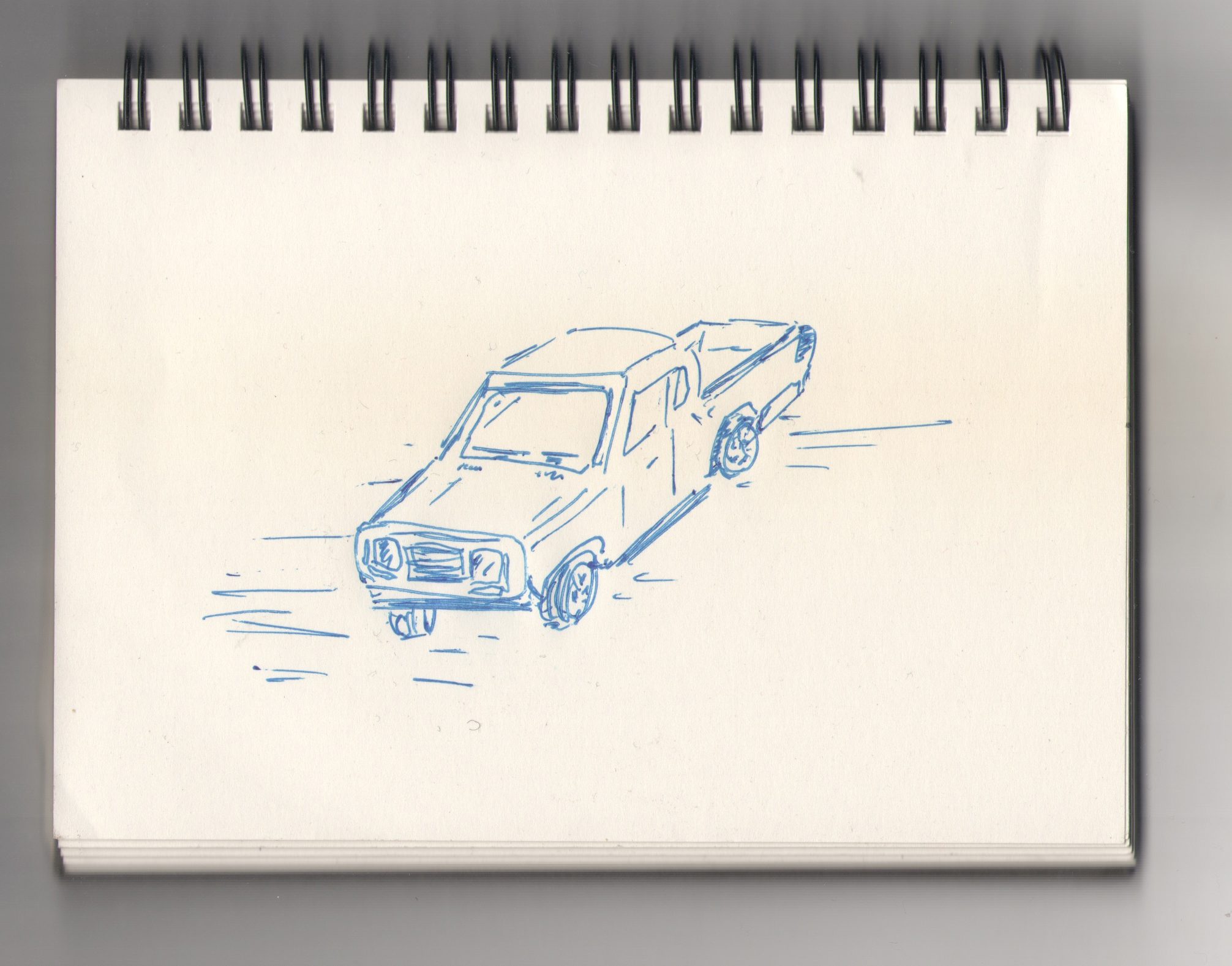
D— was dreamy in the precise manner of Neil Young circa 1974. Long, dark hair; green eyes; great butt; nice smile. He was sweet, funny, just tall enough. Wore a felt hat with a hatband he’d beaded himself, and a feather. Drove a forty-year-old turquoise-and-white Ford pickup with a broom and shovel in the gun rack. He was the lead breakfast cook, a job he could have done in his sleep, at a downtown café, a Missoula institution he’d worked at for twenty-five years. Every year that café won the community award for Best Breakfast because of D—. His house, over a hundred years old and possibly haunted, had great bones, shiny wood floors, built-in bookcases, stained glass. It also had a huge yard; a young daughter (part-time) who liked me well enough; and a very good dog, a yellow lab sort of mutt named Buddy.
I’d returned to Montana after an eighteen-year absence, much of it traveling the planet. I met D—’s not-quite-yet-ex-wife in an antique store. She was done with him and had moved out but still thought he and I should meet, that we’d have something in common, seeing as we’d both been peripherally attached, back in the eighties, to the creative writing program at the university in Missoula, seeing as we were both early October babies, seeing as we looked something alike.
The first time she told me about him was in the early fall of 2001. She’d left him in the spring because he was a high-functioning alcoholic who, it seemed, had no desire to become a sober one. She was younger; she wanted something better, and I don’t blame her. She told me she was tired of waking up mornings with one person and going to sleep at night with someone entirely different. A defective clone.
Hear that, sweetie.
But.
Even though I knew exactly what she was saying, I was intrigued, and ultimately, I was going to be the one to fix him. That had always worked so well for me in the past, hence why I was still available for trying, again, halfway into my forties.
Once we met, the preliminaries to a full-blown love affair lasted about three days before we were off to the races, in it for four years. We didn’t stop to have doubts because we knew—he was going to be my keeper and I was going to be his.

I loved to watch him fish, to watch him play softball down at McCormick Park. He was the shortstop, good at it until he got too clumsy and wasn’t anymore, but that took a while; it took years. I’d sit in the bleachers with his daughter, and we’d cheer the team, and even though they hardly ever won they were the nicest guys in the world and D— was one of them.
Mornings, I loved nothing better than to wake up to pale sunlight through stained glass, to smell coffee brewing and potatoes frying, to get out of bed and put his bathrobe on, to walk to the kitchen straight into a sleepy bear hug. I felt safe there with him like I never had with anyone before.
I tried like mad to overlook all the red flags waving on the horizon, the dog food bags full of crushed Rainier cans out in the garage. Twelve to eighteen of those babies daily, starting at three when he came home from work, or an hour or two before noon on his days off. It usually took at least a six pack before it started to show and the lug nuts started coming loose. The blankness. The droning recitations of all the same tired philosophies, rules to live by, so charming the first few times I heard them.
Despite the flags and the dog food bags and the droning, I tried to believe, to count my blessings, to not admit defeat or even consider it, to ignore the gut punch every time I heard a beer can pop open, to get used to the smallness of his world—work, home, fishing at Kelly Island and the Red Rock, cigarettes and beers on the back porch, basketball on TV, camping twice a year at Corick River Bend—all of it, over and over like a broken record—not even an LP but a 45—when my world had for so many years by then been ever-expanding.
There were extenuating circumstances, of course. I’d been in and out, more than once, of a variety of addictions, including drugs of nearly every available kind and cigarettes and alcohol, though I’d quit the first two, and my drinking was a shadow of its former self. My main, unshakeable, still-active addiction was to broken men. D— fit the bill perfectly, as nearly all his predecessors had, with one major difference: He was good to me, and not just on special occasions or when he wanted something or when I was walking out the door.
Low bar? Sure. But, god, it was nice.
There were times, enough of them, when we clicked so sweetly and it felt so right, so perfect, so long as I didn’t look too closely or think too much. This was 2001, 2002, 2003, 2004. The whole country was messy; we were a shambles. I know a lot of people who got into and stayed in ill-advised relationships those years, not realizing how ill-advised they were. We needed comforting. We put up with a lot and lied to ourselves to get it. The sweetness and rightness, which were real, kept me there until our fourth year, when I got this job teaching at a traveling high school, the primary purpose of which was not academics but whitewater kayaking.
I set off in a twelve-passenger van towing a boat trailer, followed by a second van towing all our gear in a cargo trailer, both packed with thirteen rowdy kids and four other teachers. We traveled all over on the hunt for big rapids: to both U.S. coasts and Ontario, Canada; to South Africa; overland from Zambia to Uganda; to Ecuador through riverine jungles to the beach. The kids and the other teachers kayaked while I shuttled. (I was not then, and still am not, a whitewater kayaker. Could not roll up on a river to save my life, which everyone knows is the whole point of rolling.)
The easier part, from all those thousands of miles away, was to imagine life would be different and better, when someday I went home for good to find D had kept the promise he’d made when I left, that things would change while I was gone, that he would. Everything would be fine and fixed and forever, and I’d stay in one place mostly, and when I traveled I’d always be ready and happy to return. My trips would be shorter and fewer and further between because I’d want to be home.
So, in late October, on my first break between touring the east coast and flying to Johannesburg, and going on nothing but faith of the blindest kind, we got engaged. It was early in the process of him changing, so I could ignore the fact that nothing whatsoever had changed. And I wanted to be married or thought I did or wanted at least to be able to tell people it was something my future held. The students, when I told them about it at the airport in Atlanta (just before we boarded a twenty-two-hour flight on which I thought they’d all kill and cannibalize each other) were happy for me. They wanted to come to the wedding. I said of course they could; they had to. All the way through Zambia, Kenya, Tanzania, the Serengeti, and the Ngorogoro Crater; all the way through the wildebeests and the warthogs, the lions, hyenas, rhinos, elephants, zebras, and giraffes; the campfires and rivers and savannah sunsets and the stars, I was going to get married. I was going to be someone’s wife.
By the end of the school year, I was worn down to the point of broken, broken to the point of smithereens, even after I’d figured out my place on that crazy pilgrimage and the kids had come around to loving and respecting me. They’d started calling me Mar Dog, sometimes Mad Dog, started bringing me their teenage angst, read what I asked them to read, reported back, learned a thing or two. They’d been a kick to travel with even if they had been a pain in the butt, and a few of them had almost died but didn’t. It was a grand, survivable adventure, and I was stronger and braver because of it, but I was so tired, so done. I didn’t think I could do another year, even though it would have meant New Zealand and Patagonia, two places I’d always wanted to go. I decided to not re-up my contract, decided to stay in Missoula and settle down, to get hitched, to live in a two-dog house (when I got a dog of my own), to learn to be content in that small, small world. Grow old with someone who loved me and was good to me. Be happy.
That was the plan until I landed back in Missoula. I’d left my car at D—’s house and got dropped off while he was at work. I let myself in, curious, hopeful, sick with already knowing. I greeted Buddy and didn’t even make it to the kitchen before I broke down. There was something visceral—not a smell or any particular messiness. But I could feel it like a fist to my solar plexus. No change. No attempt to fake one. Beer cans. Dog food bags. In the garage, but still. No flowers. Flowers would have been nice but would not have been enough. And it’s not like I hadn’t been able to hear it in his voice from the road.
I sat on the kitchen floor and buried my face in Buddy’s neck. Cried so hard I nearly threw up. And left. A few hours later, when I knew he’d been home from work a while and was two or three beers in, I called.
“I can’t do this anymore.”
“Can’t do what?”
“Us.”
Silence. Then, “What do you mean?”
He should have known, of course, but denial is a powerful drug.
I don’t remember how we ended the call, how the rest of it went, but I know it sucked. I’d blind-sided him, but I’d been blind-sided too. Because I didn’t really know until I walked through that door, didn’t know that of all the hard things I’d ever done, and how entrenched the knowledge had become in me that I could do hard things, going back into that relationship would finally be a thing—so much easier, on the face of it, than some—that I simply couldn’t do anymore. Nothing had changed but me.
It took six Al-Anon meetings before it sunk in for good. I can’t fix broken men. I got it. I stopped going to the meetings. I didn’t go back to D—. I stopped hooking up with broken men. I stopped hooking up with anyone at all.
Looking back, all these years later, I realize he didn’t want to change. Some addicts do, but he really didn’t. It’s not that he didn’t want to marry me, to keep me. He loved me a lot. He just hoped that I would come around and stop wanting him to do the impossible. He was happy there, in his little world. Everything worked. Everything stayed the same. I was the problem.
We stayed friends. I got my own dog, Tupelo, and D— and Buddy helped me raise him. I hung out on the back porch many evenings, and we watched the dogs race around the house, watched Buddy outfox Tupelo by stopping and lying in wait for him to come barreling around the corner. Ambushed. Sometimes we’d go to the river and D— would try to teach me, again, how to flyfish, but I was too impatient, too uncoordinated. I watched him try out a few new relationships, but nothing took. He was falling apart, as one does, drinking fifteen beers and smoking a pack of Camel Filters a day. It catches up. It always catches up.
Five years after we broke up, I went off to Madison for my belated MFA. When I got back to Missoula the next summer, he was in terrible shape. He’d pretty much stopped eating. His arms and legs were those of a famine victim, his skin a gray shade it is not supposed to be. Me leaving and him not eating had no connection; he’d just reached a point so many alcoholics do—the beer was everything. Somehow, he kept working, and when I came back again a year later, he’d pulled out of it a bit, put some weight back on and returned to a fairly normal color. But the lights were going out; I could see them flickering. He’d stopped connecting in any real way to the world as it was, and everything, everything, was a repetition, a tape stuck in the deck all the time, not just late in the day.
Then my mother died, and when I called to tell him he went into some rambling jag about how his mother just refused to die. She was in her nineties and just kept plugging along. And now he had a grandkid, so he’d have to go visit his mom in Ohio, a place he hated, the place he’d grown up, and he really didn’t want to go, but his sister, also in Ohio, had a creek running through her property, so at least he could go fishing, so that part wouldn’t be so bad, and on and on and on.
I said, “I have to go now,” and he said, “Why do you only call me when you have to go?” And I didn’t say, You dumb shit, my mother died and all you can talk about is how inconvenient it will be to see your mom when I’d do anything in the world to be able to see mine again.
I didn’t say it then, at least. I hung up and called back a few days later when I knew he’d be at work, and I left that message followed by this: You were tone deaf and insensitive and it hurt, and you shouldn’t act like that. I don’t know what your problem is.
But of course, I did.
He never called me back, and I tried to reconcile being done with him. It was time. I couldn’t help him. We were over. Best to get on with things.
The next summer, D—‘s daughter called, wondering if I’d seen him. I don’t know if she knew we hadn’t spoken in all that time, but he was missing; he’d left work and disappeared, and she was calling everyone she could think of trying to find him. I said I hadn’t seen him but would let her know if I did, and she said she’d keep me posted. The next day called to say he’d been found down the Bitterroot, a place he never went, a place far from his usual trajectory. Found by the cops and arrested for DUI, but when he sobered up in jail he wasn’t making any more sense than he had while drunk, so he was over at St. Pat’s under psych observation. “Wet brain” is what the common term is for drinking yourself right into dementia.
Meanwhile, Janice, my next-door neighbor and one of my favorite people, was busy dying of leukemia, also at St. Pat’s. I went to see her, and it was bad, so to make it even worse I got on the elevator and went up a few floors to see D—. The corridors were dim and there was some sort of tether across his doorway, but it was just a piece of strap or cord that wouldn’t have kept anyone in or out. It was weird.
D— was in his hospital gown, still wearing his hat with the beads and the feather, not particularly surprised or happy or unhappy, to see me. He was mostly concerned about not being at work, wondering what his schedule was, what day this was, where he was, what he was supposed to do next. The nurse brought a menu so he could decide what tomorrow’s meals would be. We spent an hour on that, then tried to do a crossword puzzle, but it didn’t go so well. Outside his window was a panoramic view of the mountains, and we both knew where the river ran, how it followed the path of those mountains, even though, from where we were, we couldn’t see it. It’s where he wants to be.
He kept asking if he had to work tomorrow, and I kept saying, “No, you don’t have to go in.” Finally, I wrote it down: No work in the morning. Breakfast at seven. He clutched that piece of paper like a lifeline, like something that finally made sense. When I left, I ducked under that tether across his doorway, but he wouldn’t get near it. He looked at it like he was a pony who’d already tried, and failed, the electrified fence test.
I went back to see D— at St. Pat’s one more time before his beautiful house was sold and he was sent to a nursing home in Hot Springs, ninety miles away, the closest one that had a place for him. I went back to see D—, but I didn’t go into his room. He was standing at the window, looking out, perfectly still, like a statue of a wasted life. He didn’t know I was there. So I left again.
After the first year, they got him into a place back in Missoula. I’ve visted him twice there. The first time, he lit up. He hugged me like he’d done all those sleepy mornings all those years ago. He said, “Where have you been?” The second time we talked about his brother and how he’d died, but D— had it wrong; he thought his brother had died in a car wreck in California but it had been in a trailer in the Colorado mountains in winter.
Once, after we’d broken up but before he’d lost his mind, D— came to my house for a backyard party. He was perfect that day: funny and sweet and sober enough that you wouldn’t know he had a problem. We joked and laughed, still having our connection, our shared language. Afterward, my friend Ann said she no longer wondered why I hadn’t found someone new. He was the love of your life, she said. Anyone could see it.
I don’t know if I believe that or if I’m just being stubborn. I’m still not drawn to men who aren’t broken, but I have learned that there’s no future in messing with the broken ones.
Though I don’t live in Montana anymore, I return every summer. This year I did not visit D—, though I’d planned to. It’s just too fucking sad—he’s cognizant enough to know that place is his entire life now, smaller than ever, and that whatever fatal thing gets him will get him there, and all he has to look forward to is his hourly cigarette. I don’t think he even remembers he used to drink. The nurse keeps everyone’s cigarettes in a box on a table and doles them out. Thirty people sit in a circle outside and smoke. D— turns his chair around, facing away from the group. He smokes and looks out at the mountains. He knows exactly where the river is, but he just can’t get there from here.

***
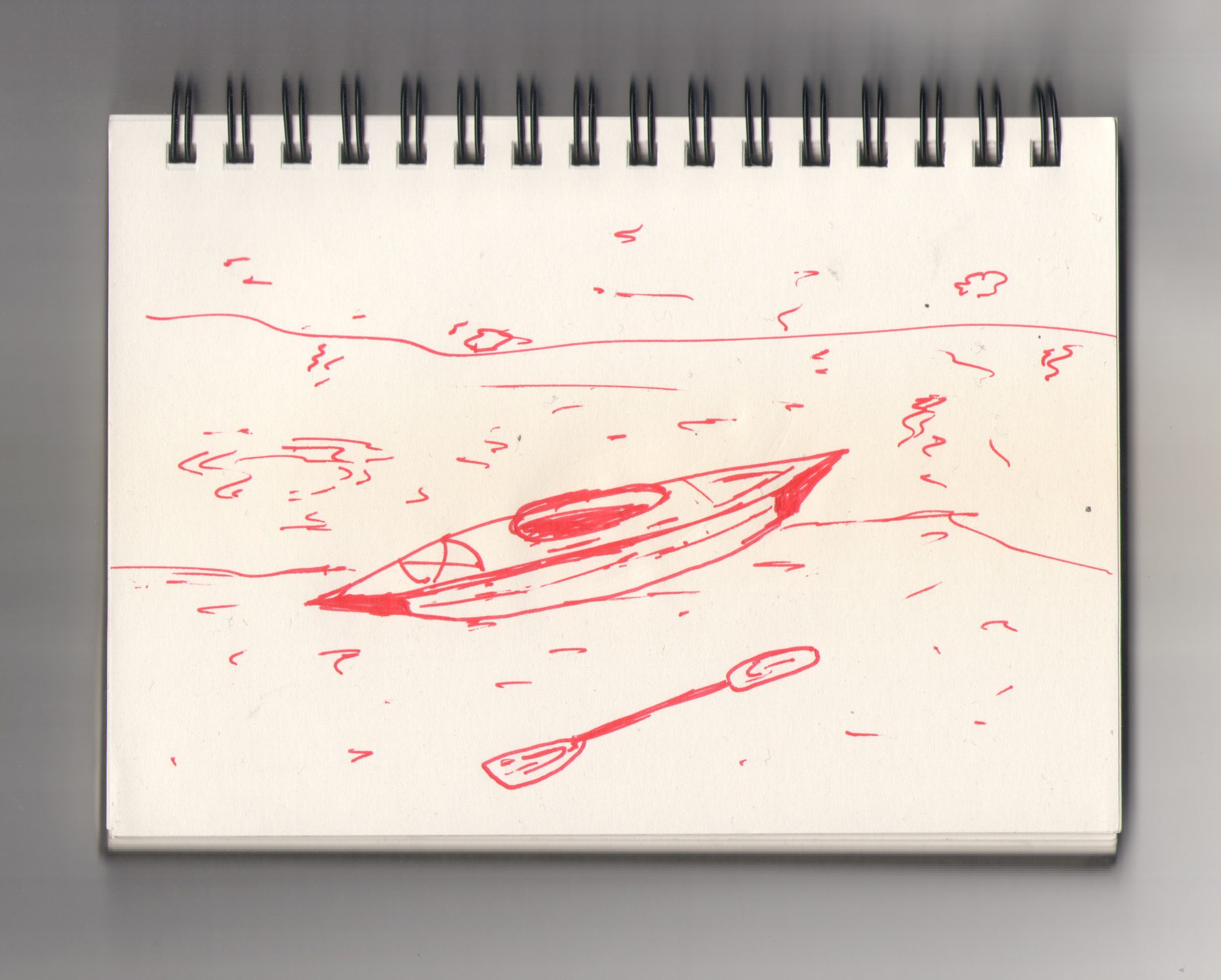
Rumpus original art by Ian MacAllen
***
Voices on Addiction is a column devoted to true personal narratives of addiction, curated by Kelly Thompson, and authored by the spectrum of individuals affected by this illness. Through these essays, interviews, and book reviews we hope—in the words of Rebecca Solnit—to break the story by breaking the status quo of addiction: the shame, stigma, and hopelessness, and the lies and myths that surround it. Sisters, brothers, mothers, fathers, adult children, extended family members, spouses, friends, employers or employees, boyfriends, girlfriends, neighbors, victims of crimes, and those who’ve committed crimes as addicts, and the personnel who often serve them, nurses, doctors, social workers, therapists, prison guards, police officers, policy makers and, of course, addicts themselves: Voices on Addiction will feature your stories. Because the story of addiction impacts us all. It’s time we break it. Submit here.