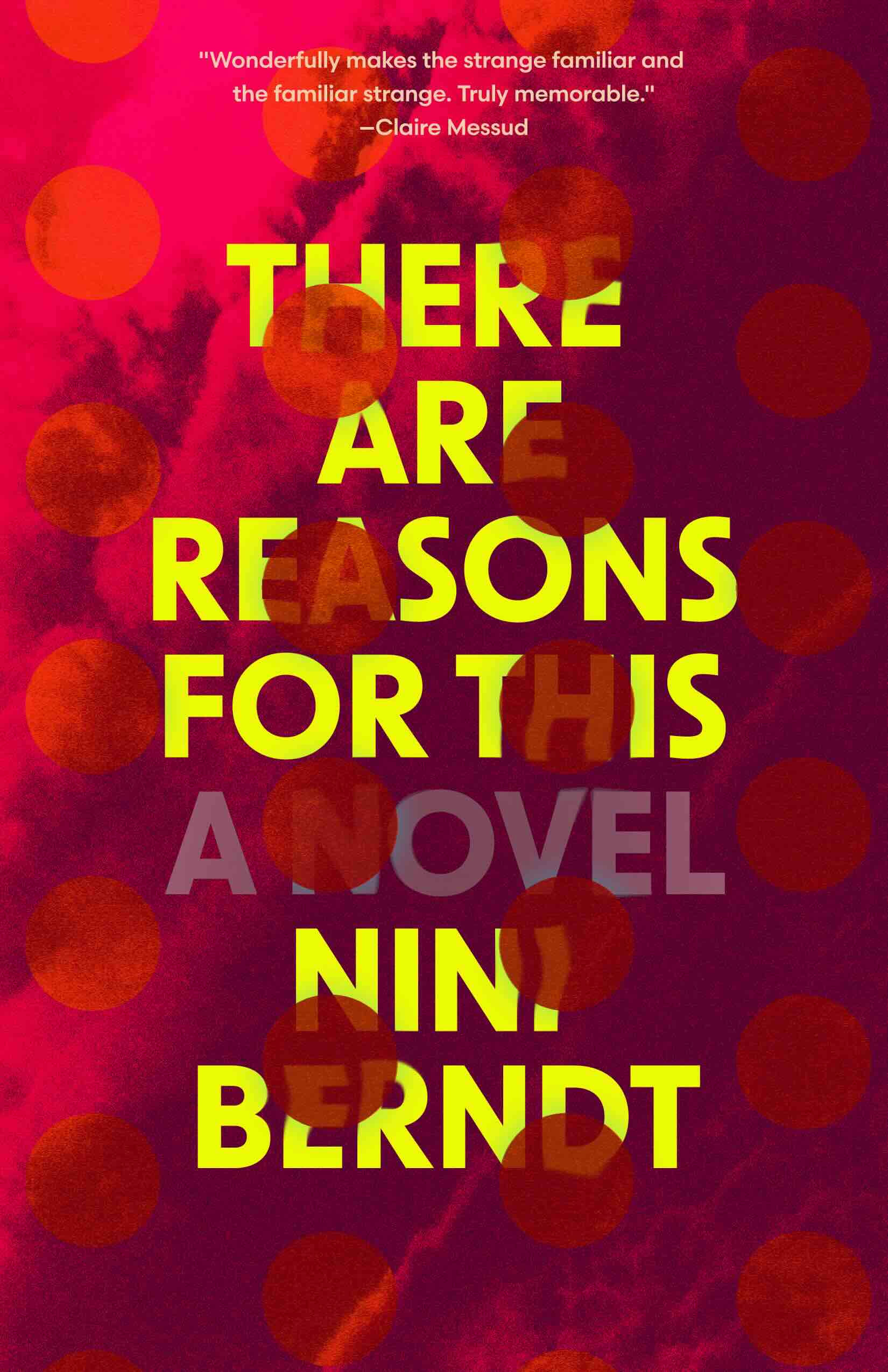
In a near-future Denver, infrastructure crumbles and weather systems are unstable. A man called “the Jumper” prowls the streets, and an omnipresent “Air Monitor” predicts the fates of those in the city and beyond. Mikey is dead. His sister, Lucy, has come from Eastern Colorado looking for answers, watching Helen, who was once Mikey’s best friend, through the peephole of her door. As time passes and the two women become involved, the secrets surrounding them grow larger—Lucy hides her identity, and Helen reckons with her own role in Mikey’s death. Haunted by grief and the consequences of desire, There Are Reasons for This is a love story for the people and places we’ve lost and those we’ve yet to lose. Called a “queer gut punch of a novel” by Kristen Arnett, Berndt tackles what makes a family, and what, too, can break it.
For this interview, I chatted with Denver local, Nini Berndt, about post-COVID Denver, the changing nature of plot in twenty-first century fiction, writing the gig economy, and how her debut novel, There Are Reasons for This (Tin House Books, 2025) came into existence.
***
The Rumpus: In your acknowledgments, you mention the influence your agent had on this novel. How did There Are Reasons for This come to be?
Nini Berndt: This book really and truly wouldn’t exist without Rebecca. When I first showed her this book it was a collection of linked stories, Lucy was still threaded throughout, there was still the loss of her brother, but the house—St. Catherine’s Home for Working Girls, a real building in Denver—was occupied by lots of other women and girls, each of them doing their own version of “women’s work,” and it was much more about each of these women. Rebecca really helped me shape this, find the throughline of Lucy and Helen and Mikey. It’s hard to imagine those early drafts now, because it is an unrecognizable book. Some good stuff in there, but this book exists because Rebecca is a phenomenal editorial agent and was patient and brilliant and knew how to coax this story out.
Rumpus: I knew that I wanted to interview you when I read the section in chapter twelve on City Park [a neighborhood in Denver] overgrown. I could feel the high plains heat of this novel. There Are Reasons for This truly feels like a near-future. Can you talk about your choice of an apocalyptic Denver for your setting? How’d you get there? How’d it impact the characters, themes, and movement of your book?
Berndt: Pre-COVID Denver and Post-COVID Denver are really different places for me. I grew up here, I’ve lived here most of my life, and the city has changed tremendously in that time. I went to grad school in Florida from 2013-2016 and when I came home to Denver, the city was this shining, glorious beacon. We’d had legal weed and marriage equality for years, everyone was beautiful and fit, there was money and promise and people just kept moving here. It was hard to imagine a better city in those few years.
Something changed substantially during COVID. Housing skyrocketed. Our unhoused population skyrocketed. The opiate crisis was in full display. My wife and our son and I were living in an un-air-conditioned apartment in Cap Hill and marching in the George Floyd protests and listening to helicopters circle our neighborhood and trying to teach our kid to ride a bike off this formerly incredibly busy street where suddenly no one was driving and the cumulative effect of that was that the city transformed into this dystopia almost overnight. There were horrible wildfires. We would walk around and everything was boarded up, everything was closed, ash was falling from the sky. It was so easy to imagine the city just collapsing in on itself, this glittering millennial haven of beautiful weather and bearded microbrewers and rock-climbing tech bros was suddenly this strange expanse of lonely, half-faced people sadly typing away in their bedrooms, trying to keep their jobs, wondering how their rent had suddenly gone up five-hundred dollars. The bridge to dystopia has been easy to traverse for a while.
Rumpus: So much of the momentum in There Are Reasons for This circles around an event we know will happen—Mikey’s death. He haunts the story. And yet, in spite of the secrets attached to this, there’s a straightforwardness to the novel. Can you talk about how you accomplish this tightwire act of withholding and revealing? Did you land it on the first draft, or was it teased out over time?
Berndt: It most certainly did not land on the first draft, but I do think that broad framework of who was keeping which secrets was always there. We would always know right away that Mikey was dead, that was never going to be a secret. But who Helen knew Lucy to be, who Helen was to Mikey, what her culpability was in his death—those would be secrets. Like so many secrets, the longer you keep it, the more crucial it becomes to keep it. The stakes of that secret become higher. If Lucy had told Helen only days after they met, instead of weeks, the secret’s power would dissipate. But because she keeps the secret, and never is the one to tell it. Helen has to find out on her own, from the worst possible person. We’re waiting for that moment, when Helen finds out, and to know how that changes things for them. And this all comes to a head during a literal storm. That convergence and friction between internal and external threats was central to this book.
Rumpus: Your book made me think a lot about Laura Mulvey’s famous, “Visual Pleasure and Narrative Cinema,” which outlines how women in film are constructed as passive objects, made for the purpose of eliciting pleasure for the male gaze. In There Are Reasons for This, this gaze is flipped. Mikey is the one looked at. I want to know more about the “gaze” of this novel. Did you set out to write from a queer feminist gaze?
Berndt: Not explicitly, no. I don’t think I’m ever writing from any specific vantage point. But I think this gaze is very central to my work as a whole—who is being objectified, and often the woman as aggressor, as predator. Because that is the woman as agent. They are not passive objects, they are in control of their desire, they are centered in their pleasure. But that also means that their desire has the potential to harm, it leaves room for deviance in female sexuality, in lust, in want, it leaves room for female desire to be willfully aberrant. Helen is a womanizer. If it were not this shy twenty-one-year-old girl, we would likely feel differently about Lucy watching Helen, listening to her have sex, waiting for her outside her door. They are both a little predatory. Raena [a rich woman involved with Helen and Mikey] is absolutely predatory, and Raena has power, and she uses that power to exploit both Mikey and Helen. And so, Mikey is acted upon. Helen is in complete control when she’s with her cuddling clients. I guess from a queer feminist perspective I am interested in the gaze of female desire. I want that gaze to be complex and vital, because it is. I want it to deconstruct and disrupt.
Rumpus: I’m always impressed when fiction utilizes a rotating and at times omniscient narrator without feeling tongue in cheek. What about this story made you feel like you needed this narrator? Was this always the case? What were the struggles and joys of writing a rotating third that bleeds into the omniscient?
Berndt: I love a close-third narrator. It gives you so much room. I tried writing Lucy in first-person and it never really worked. Close third allows space for each character’s voice, each character’s interiority while also allowing for narrative control, that overarching narrative voice and presence means you can shift what is being seen, and when. So, the reader is seeing something the character does not, cannot. It also means, and this is the especially fun part for me as a writer, that I can say something a character wouldn’t say, I can say something in a way they wouldn’t say it. I have a different license over language, and that is such a joy to me.
I like thinking that at times that omniscient voice is the Air Monitor, the Air Monitor who assumes this ever-watchful presence in their lives, this diligent voyeurism, appearing and disappearing at will, who in some ways is this puppet master, telling them what they are and are not allowed to do. And in this way the Air Monitor is actually a much more significant, much less benign presence. The Air Monitor’s agenda and influence is greater. I like the idea of that.
Rumpus: Grief is central to There Are Reasons for This. It requires both Helen and Lucy to hide—for Helen, this means shoving every reminder of Mikey away in a drawer. For Lucy, this means not telling Helen that she is really Mikey’s sister. I found myself confounded by the question of who we are when we grieve. What inspired you to write a novel centered on grief?
Berndt: I wonder about this sometimes, because the truth is I have been extremely fortunate not to have very much grief in my life. But my brothers have all struggled with addiction, and there have been many moments where it felt like this was almost inevitable, the slipperiness that Mikey talks about, one of them succumbing to that, sliding all the way out of this world. So, I guess when I began this it was in some way an attempt to confront the possibility of grief before it even happened. I don’t think that will ever happen now, thank god—to my brothers. They’re all doing so well. But we grieve all the time. We grieve those parts of ourselves we no longer are, a life we no longer have, we grieve people who are simply no longer in our life. I had a best friend, very much the relationship that Helen and Mikey have, and that person simply disappeared from my life. He was my family, for so many years the most important person in my life, and then suddenly he was gone. That sadness is so acute, the knowledge that this person is still around but doesn’t want to see me. That I can’t actually do anything to pull them back. But there is almost an embarrassment in this grief. It’s hard to share it, hard to do anything with. Which is also why we shove it down, away, put it in the drawer. Who can I explain that grief to?
Rumpus: For Lucy, Helen is how she tells time: She’s a promise, a dream. The novel starts by alternating between Lucy and Helen. I love the moments where this pattern breaks, and we’re forced to sit with Helen longer, or go back in time with Lucy. I love, too, how we meet people more than once, through Helen, then Lucy, and vice versa. Can you talk about the temporality of the novel, and queering it? What were some of the difficulties of moving through time like this?
Berndt: That meeting people more than once is interesting, I’d never really considered that before, but they do have to, which means the meetings have to be intentional, they have to be placed really strategically or it just sort of feels like the wheels are spinning. But it also gives you the ability to see these characters very differently. Helen’s meeting of Raena and Lucy’s meeting of Raena and the way they see and respond to this woman are so different. They offer differences in who Helen and Lucy are, but also in Raena, who she is, how she is perceived, what she represents.
I always like when a book teaches you how to read it and then breaks that somehow, but it doesn’t feel jarring, it feels right, it feels like in upsetting whatever structure it had previously laid out, something new is opened. The weaving of both Lucy and Helen’s past and presents creates this dream structure, I think, where everything is happening almost on the same plane, a flattening of time, so that Mikey almost remains alive, just hidden, sometimes, just off camera.
Rumpus: It’s hard not to feel swallowed by your novel. Part of this is because of how time and grief work, part of it is the impending climate collapse, and a big part is the novel’s investigation of class and the gig economy. I find the rich in this novel so embarrassing. Throughout the novel, especially my second time reading it, I kept screaming: “Why doesn’t anyone tell Raena to stop?!” Do you ever get frustrated with your characters? What inspired you to write a novel so centered on late-stage capitalism and the gig economy?
Berndt: Oof, how to not write about late-stage capitalism. I think about work a lot, and particularly right now, about how horrifyingly and rapidly work is changing. My day job is in tech, and I am genuinely concerned we are only a few years away from so, so many jobs being replaced by robots. And when that happens the consolidation of power and wealth will be astronomical. This, like all of the near-future elements of the book, feels so close, feels like tomorrow, the necessity of the gig economy, the lack of trust or viability even in traditional employment, in economic stability. But I think what’s happening here, the embarrassment of the rich, is in that conquest, that the conquest of wealth is actually so boring, and so the conquest has to be transferred elsewhere. Raena makes her conquest Helen and Mikey. And they understand that to acquiesce to her is to their advantage. She is in many ways their employer. We are being told constantly right now in my sector, in so many words, that if we don’t like it, this fast track to AI, we can just leave. And you can’t leave, you have to feed your family, you need health insurance, so you sit down and shut up and take it, sort of whatever they throw at you. Because what alternative do you have.
I always like when a book teaches you how to read it and then breaks that somehow, but it doesn’t feel jarring, it feels right, it feels like in upsetting whatever structure it had previously laid out, something new is opened.
Rumpus: I’m kind of obsessed with Lucy’s gig as a professional granddaughter. I want that job. (I’ve also, in different iterations, had that job.) When I was introduced to Mrs. McGorvey’s character I did not like her, but by the end I’d fallen for her the way that Lucy does. What was your reasoning for including a character like Mrs. McGorvey?
Berndt: I love Mrs. McGorvey so it always sort of hurts my feelings that people don’t like her. She’s a nut. I love a nut. She’s also in so many ways my grandmother, who was a very complicated British woman who spent her whole life with my grandfather. They had one of the great love stories of all time, and she was, when seen through his eyes, the most adored woman in the world. But she’s beautiful and funny and smart and well-read and could also be genuinely cruel. So that is certainly coloring her for me. But this Mrs. McGorvey softens, in a way my grandmother didn’t at the end of her life. She lets Lucy and Helen in, she realizes the necessity of their companionship. Lucy and Mrs. McGorvey’s relationship, like Helen and Mikey’s relationship, quickly moves from one of transactional necessity, to one of genuine affection.
Rumpus: After I’d finished this novel, I found myself returning to your epigraph from Donald Barthelme, in particular: “some people have forgotten how to want.” So much of this novel’s tension feels tied to misplaced or unfulfilled desire, specifically desire forced off course by climate collapse and end stage capitalism. In our era, what we want is increasingly unattainable. This is a question I’ve been mulling over with friends, but how do you feel like the role of “momentum” and “tension” and “plot” is changing in twenty-first century fiction?
Berndt: Damn, incredible question. Because yes, wanting right now feels so hard, feels so futile so much of the time. And the wants feel so big, and the stakes feel so high, and we feel so helpless. Yes, there are things we can do, but my god, I do not feel like I’m moving the needle. How do you keep up the human necessity to want, then? The need to continue to strive, to dream, when our desires all feel so foolish, or selfish, or impossible. We have to though. The alternative is death.
I know every generation has likely felt some of this, but the fears are so deeply existential right now, the myriad of ways we’re harming the planet, each other, so profound. The shape then of plot and tension becomes survival. The need to stay alive, both literally and figuratively. And it becomes so much more obvious that we’ve always wanted the same things, all of us, as a species. To be loved. To be seen. To be held. To be safe. To be known. Fiction has always used the lens of identity to do this, to create a sense of being seen, of reaching across time and space and making someone say, “Oh, yes, you understand being alive like I understand being alive.” The simplicity of knowing you aren’t alone.