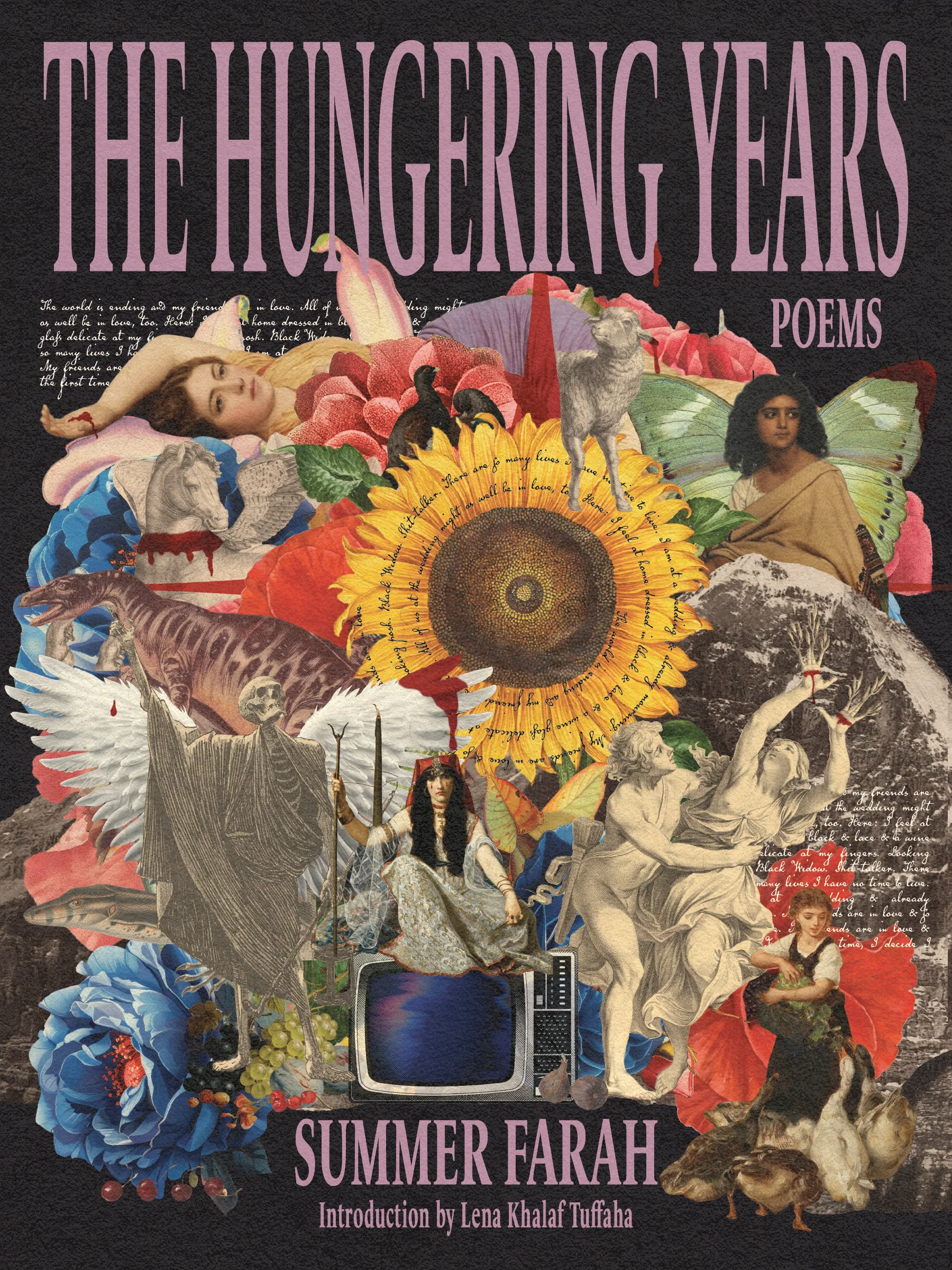
To hunger is to live, and Summer Farah is a writer whose appetite knows no bounds. “READING MARY OLIVER IN LA VERNE,” the opening poem of Farah’s debut collection The Hungering Years (Host Publication, 2025), makes the stakes of the speaker’s titular hunger immediately clear: “For months, I ate as if it was performance. / Watermelon, overripe figs, anything to attract / a wasp, anything to incite panic, anything to start my heart.” Throughout this breathtaking debut, Farah hungers voraciously for belonging, for recognition, for hunger itself, as well as for things that are far more tangible and dire—Palestinian liberation, an end to genocide and colonialism, a way to live amidst the heartbreak and violence of the world. It is easy, while reading these poems, to get swept up in the enormity of the speaker’s hunger, to succumb to the same longing to see oneself reflected in the art of (in Farah’s terms) “prophetic women” like Etel Adnan and many others, to become intoxicated by desire. From the second poem in the collection:
“a desire for what you create to
 not consume you, a desire to create through the consumption, a desire to live
past the consumption, a desire for death, a desire for desire, a desire, a desire,
a desire,”
This repetition evokes an incantation, signaling the recursive and often reverent nature of the speaker’s desire. For Farah’s speaker—and for many living in diaspora—longing is an ongoing ritual, an inheritance. Ending the poem with a comma, Farah leaves the reader to imagine what might follow the poem’s silence, a move that she repeats several times throughout the collection: “saying Palestine, saying Palestine, saying Palestine,” “Again, and again, you said, again, and again, I say, again, again,” “this time, this time, this time,” she writes, denying her readers the clean resolution that a period might provide.
Repetition reverberates throughout the collection, both within and across poems. Language repeats and builds upon itself; words and motifs recur and accumulate layers of meaning; poems are written and rewritten, with multiple poems appearing under the same titles. For Farah’s speaker, repetition is a way of reaching towards the objects of her longing, despite knowing that her longing may never be fulfilled. Perhaps this reaching is the point.
When examining the repetition in The Hungering Years, it’s hard not to see it as mirroring cycles of grief, trauma, and colonialism. Reading “POEM FOR AKKA BEFORE SETTLERS TORCH PALESTINIAN HOMES, MAY 2021,” and its subsequent erasure, “POEM FOR AKKA AFTER SETTLERS TORCH PALESTINIAN HOMES, MAY 2021” reminds readers that the Israeli displacement, ethnic cleansing, and genocide of Palestinians did not start on October 7, 2023; it has been ongoing for decades, with waves of violence ebbing and flowing but never ceasing. History relentlessly, brutally repeating. And yet, repetition can also be an invocation, a way to call in that which is most precious to us. Perhaps the most central form of repetition in this collection is a series of poems with titles beginning with “I TELL ETEL ADNAN ABOUT…”
I confess, I came to the work of Etel Adnan—whom poet Lena Khalaf Tuffaha names “our matron saint of Arab American poetry and Mediterranean landscapes” in her introduction to The Hungering Years—too late. I first encountered her work when I learned of her passing in 2021. It’s tragic to share overlapping time on this earth with someone so singular and only realize it once they’re already gone. Seeing Adnan’s life and legacy celebrated by so many writers I admire in the wake of her passing brought me to Adnan’s work, first with her 2020 book Shifting the Silence, and then with her 1989 book The Arab Apocalypse, which Farah wrote about in a brilliant essay titled “From Witness From Speech From Image: On Etel Adnan’s The Arab Apocalypse and Theresa Hak Kyung Cha’s Dictee,” published by Poetry Northwest in 2024. Though The Hungering Years and The Arab Apocalypse are formally and thematically disparate, they both employ repetition and recurring symbols to testify towards life and against war, colonial violence, obliteration. Adnan looms large in the canon of Arab American art and literature, and Farah is one of her most rigorously devoted students.
With a legacy as formidable as Adnan’s, some writers may find it intimidating to put themselves in conversation with her and her work. Farah does this in a very literal and intimate sense: with a series of epistolary poems addressed to Adnan in which her speaker confides in Adnan about the things at the forefront of her life and mind, from The Legend of Zelda to Supernatural to her “pussy problems.” There is nothing frivolous about these conversations; there is an urgency that reaches beyond their apparent subjects, a vulnerability to the speaker’s admissions to the imagined Adnan that makes a reader feel like they are eavesdropping on something they should not be privy to. “I will admit, I am using you, Etel,” confesses Farah’s speaker, later acknowledging, “I am failing the spirituality I inherit when I talk about In the Heart of the Heart of Another Country.” It is clear that Farah’s lineage with Adnan is a responsibility that she takes very seriously, a commitment to spiritual and political principles that she strives to live up to in her life and poetics, one that we might all benefit from undertaking.
In her essay on the works of Cha and Adnan, Farah writes, “In both Dictee and Arab Apocalypse, moments loud in their clarity feel like they must be clung to; there is something unallowed to be obscured, too urgent.” This sentiment could just as easily apply to many moments in Farah’s own poems. Although her poems often luxuriate in the lyric, with lush imagery and deft use of metaphor and simile, Farah never shies away from saying what she believes clearly and with certitude. “solidarity is not sympathy it is work,” she writes, a reminder that reorients me to what really matters as I witness, via the internet from the safety of my home, ICE agents kidnapping civilians in Minneapolis, the IOF murdering Palestinians in Gaza, militias brutalizing and killing protestors in Iran. All my heartbreak and rage means nothing unless it moves me to action.
Adnan is not the only figure who plays a major role in Farah’s book and her poetics. “I have loved so many prophetic women,” Farah writes, and these women can be found in every corner of the landscape that Farah creates through her poems: Mary Oliver, Mitski, Carly Rae Jepsen, Olivia Rodrigo, her beloved friends. In Farah’s poetic world, a prophetic woman is one who expands, through their art or their living, what is possible, one who “dream[s] any tomorrow that could mundanely be.”
In “(DEAR ETEL ADNAN) I DON’T THINK OF CARLY RAE JEPSEN,” Farah describes listening to Jepsen’s music while reading Adnan’s work, writing, “The beauty of this experiment is that I will connect even the furthest of dots.” Farah does not attempt to justify these connections to skeptical readers who might be eager to discount the merit or seriousness of her subjects; she places those she loves together in conversation freely and with delight. The earnestness of Farah’s devotion is admirable and even enviable in a cultural moment so steeped in cynicism and fearful of cringe. Farah loves what she loves wholeheartedly, in a way that inspires me to be more unabashed about my own obsessions. Her poems remind us that devotion, like hope (to adapt the words of Mariame Kaba), is a discipline: an essential practice against apathy and nihilism. “What can you do for the art you love in return? How can I honor you? How can I honor you?” asks Farah of Adnan, her adoration of Adnan urging her to better herself, to live more closely in alignment with the politics and poetics that Adnan espouses.
Still, Farah’s relationship with her obsessions is not uncritical—her speaker interrogates the objects of her obsession and obsession itself with an unsentimental eye. In the first of two poems titled “I TELL ETEL ADNAN ABOUT MITSKI,” the speaker sees herself reflected in the music of singer-songwriter Mitski, and is seduced by that feeling: “And so I listen to her sing; I am fulfilled by the knowing / another recognition.” Yet recognizing oneself and one’s experiences in another’s art doesn’t mean that the relationship is reciprocal—in the second poem of the same title, Farah writes, “Forgive me, for confusing recognition for solidarity. I am simple. It feels good to know someone feels bad in just the same way.”
Here is where I make another confession: I, too, have a parasocial relationship with Mitski, with my favorite poets, with the characters in my favorite films and books and TV shows. I, too, want to believe that the artists I admire believe in the same things that I do—a free Palestine, an end to capitalism, liberation of all oppressed peoples. Like Farah’s speaker, I have been so enraptured by the feeling of seeing myself reflected in art that I have imagined a relationship that was never really there. This impulse is one that I often feel ashamed about succumbing to, one that feels naive and sometimes even dangerous, as Farah points out. But she also reminds me that, while we must remain vigilant and critical in our adoration, devotion is a big part of what makes life worth living: “But I will be the one you need / The way I can’t be without you,” sings Mitski in “Geyser,” addressing the act of artistic creation itself. “To watch. To create. To need this in order to be,” writes Farah. The Hungering Years is a book haunted by unanswerable questions: what does it mean to be from a place? What is the cost of the narratives we create? What can we ask of art, of each other, of ourselves? These questions continue to reverberate through me as I read and reread this collection, as I celebrate and interrogate my own obsessions and how they fuel me. In the book’s final poem, Farah considers, “I wonder about the life stolen / from me. Would I love what I love if I loved it from Palestine?” To answer this question would require inhabiting another life, another world, altogether, but the act of asking provides new pathways towards possibility and futurity. “There is a hunger only satiated by death,” Farah writes. In this hunger, we find a way to move forward, to live.