A few years ago, the bookstore where I worked while I was writing my first novel closed. It was a strange and good place, the passion project of an owner who was so resolutely indifferent to making money that he would not stock a bestseller or indeed any book by a major publisher: we specialized in obscure poetry, translated fiction and experimental literature only. The store was fantastically effective at attracting starving writers to serve as booksellers, perhaps largely because the owner had a very lenient policy about reading on shift. You were free to come in and spend eight hours reading The Anatomy of Melancholy or Extracting the Stone of Madness or The Faggots and Their Friends Between Revolutions behind the front desk, as long as you said hello to customers and the store was reasonably tidy at the end of the day.
At the closing sale, I talked a bit with one of my former coworkers (now a beloved cult novelist) about Helen DeWitt. DeWitt, for those not already acquainted, is the patron saint of beloved cult novelists: brilliant, convulsively funny, cerebral, occasionally pornographic, and with the kind of incredible bad luck in publishing that makes you want to wail and tear your hair out. I had just read Lightning Rods, which had come out a decade earlier. Had I heard, my old coworker asked, of the PDF?
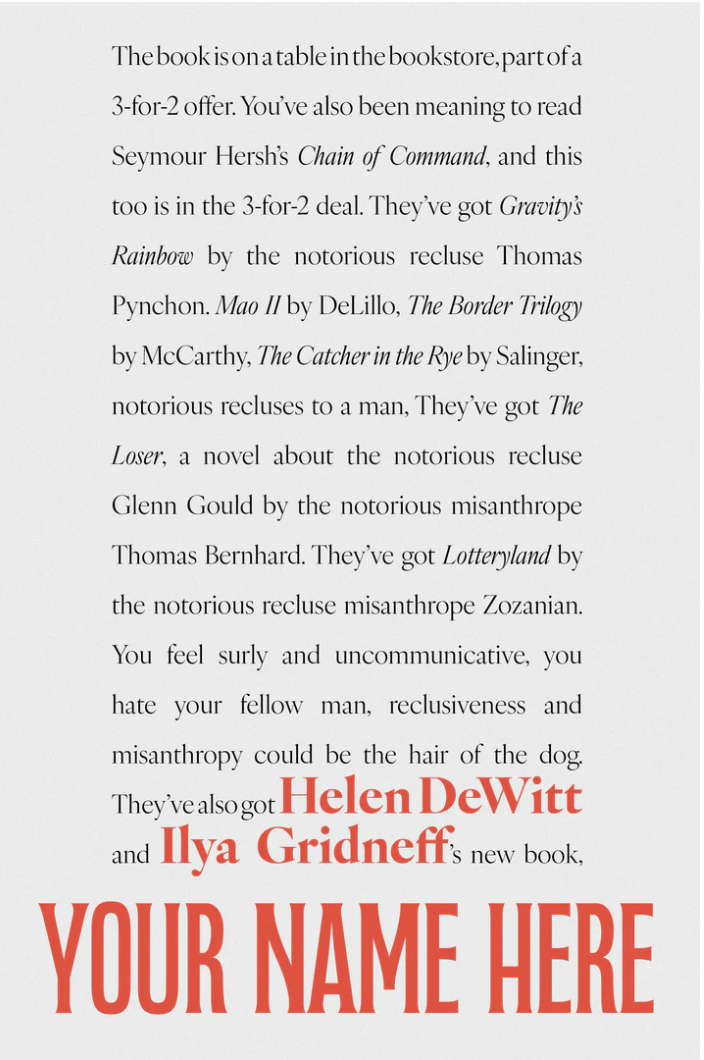
The myth of the PDF is this: it is an unpublishable novel, circulated online after DeWitt despaired of getting it out by conventional channels. When I talked to my old coworker, it seemed shrouded in mystery. He didn’t even refer to it by name. He had gotten it and hadn’t read it yet, although he had heard a rumor that maybe there might be a publisher interested in it. This year, after a decade and change in digital purgatory, it has been re-released the usual way, by Houston-based small press Deep Vellum. Its title is Your Name Here.
***
DeWitt’s previous work is full of a cheerful, hypnotic iconoclasm that is simultaneously a joy to read and deeply committed to being unmarketable. Her first novel, The Last Samurai, is the kind of indescribable book that tends to inspire a similar devotion as Infinite Jest. It deals with Sibylla, an autodidact who finds herself pregnant after a one-night stand with a self-absorbed and pitiable writer, and her resulting son, Ludo, on whom she tests her theories of how one ought to live.
The Last Samurai is often billed as a novel about a child prodigy. In fact, it’s something stranger. Although Ludo learns ancient Greek and Japanese and solves Fourier transformations before he can legally drive a car, the book is concerned not with his particular genius, which DeWitt insists is not the point, but with the kind of upbringing that might create a person so rigorously dedicated to truth and knowledge—without access to the wealth and privilege that usually facilitates this kind of classical education. Before he’s of the age to go and seek his fortune, Ludo’s schooling occurs mostly on London’s Circle Line, which he and his mother ride for hours during the weekend, because they can’t afford to keep the heat on at home. To call Ludo and Sibylla’s intellectual life an escape from the poverty of their circumstances would also, however, be a mistake. Instead, DeWitt insists that this exactly is where the most important parts of life are lived: inside the head, in the purity of the pursuit of truth and knowledge.
The Last Samurai was published almost by accident, several years, according to DeWitt, after she’d stopped working on it due to the vast amount of rejections she’d received—only to have her final and only copy of the manuscript returned to her covered in Wite-Out, forcing her to rewrite the destroyed passages from scratch.
Her second novel, Lightning Rods, is a cheerfully savage satire of the Horatio Alger up-by-your-bootstraps story that asks if, misogyny being an unavoidable constant in our current society, it might not be possible separate a woman’s top and bottom halves like a stage magician, so that the head can get on with the enjoyable business of “thinking” and “being a person,” while the legs and pussy deal independently with the task of managing sexual harassment in the workplace. But the novel’s anger is paired with a utopian vision. This is the furious question that’s at the heart of all of DeWitt’s work: what if you didn’t have to fucking live like this? The situation is so bad that any solution, no matter how absurd, is worth trying.
Talk Miramax, the publisher of The Last Samurai, took the unusual step of buying Lightning Rods, paying DeWitt her advance, and then simply not publishing it. It spent more than a decade in limbo, before finally being acquired and published by New Directions in 2011.
Your Name Here, the famous PDF and DeWitt’s collaboration with journalist Ilya Gridneff, is intimately concerned with this artistic situation. What, it asks, can an artist do to push her work through a hostile system and retain her vision? What are the qualities that make people want to read a book? And what, in the long years spent waiting for success, is she supposed to live on?
A confession: A while ago, when DeWitt released the PDF on her website, I downloaded a copy. And then, like my friend, I didn’t read it. I think there’s a fear that gets me sometimes, when a writer I love puts out a new book, that I’ll open it and discover that they’ve lost the magic that animated their previous work. It’s usually a wrong fear, but sometimes it’s right. Sometimes I do in fact open a book by someone whose work I’ve loved and realize, ah, no, they don’t have it anymore. If you are yourself an artist, that fear is connected to the fear that one day you’ll look at your own work and realize that you don’t have it anymore. With DeWitt, you wonder how someone so brilliant can spend decades in purgatory, trying to get her work into the world, and come out intact as an artist. Maybe, you think, she can’t. So I put off reading this book, until I saw Deep Vellum’s publication announcement. Then I thought: I guess I’d better find out.
Your Name Here is not, exactly, a book. It’s that mysterious object, the PDF. Not a title, not a novel, not even a manuscript, but simply a file format: the PDF. The PDF is an unpublishable novel, released by DeWitt on her website after being told no publisher would have it, or after a war over typesetting. The PDF is a work of genius, or else it’s a rather messy documentation of the author disappearing up her own ass. The PDF has a mystique, it is samizdat, it was available for a limited time only in return for an $8 donation (suggested) to the author’s Kofi. The PDF is not, strictly speaking, for sale.
It also would be stretching the bounds of truth to say that this mystical electronic document is a novel, exactly. It reads instead as if its author were inventing the novel from scratch, using the detritus of our digital medium, circa about 2003. Its plot is fragmentary and discontinuous. In it, DeWitt meets and is enchanted by a young tabloid journalist, Ilya Gridneff. Their emails to each other, fictionalized under a variety of different aliases, make up one thread of the text. Another thread reimagines DeWitt’s career, such that, instead of being an obscure cult writer, she is a famous airport novelist, whose post 9/11 bestseller started a craze for Arabic language learning that’s swept through popular culture. In this imaginary timeline, DeWitt has an alter ego, Rachel Zozanian, an obscure cult novelist who meets a young tabloid journalist named Alyosha or Misha or Dmitri or one of several other aliases, and is enchanted by him, and wants to further his career or perhaps write a novel with him. A third thread transcribes Rachel’s beloved but obscure novel, Lotteryland, about an alternate England where every basic good—housing, education, employment, goodwill—is distributed on the basis of a rigged lottery system, which the story’s protagonist desperately hopes can be gamed.
Interwoven with these linked plots is a series of readers, who are reading DeWitt’s current novel, and mostly hating it, and who seem to be constantly on the edge of discovering that they are characters in a series of nested novels-within-novels.
As a reader outside of the novel, I found keeping track of which timeline I was in more or less impossible. Why does Ilya’s name keep changing? What on earth is in this bestselling novel of DeWitt’s that various passing narrators keep reading (beside a practice exercise in Arabic script)? At a certain point in this series of boundary-blurring, overlapping timelines, I did a little careful Googling relating to Gridneff, a person who I had rather naively assumed to be real, but who I began, 400 pages or so in, to have doubts about. The internet turned up a Twitter account, a wife, and a number of quite real bylines for publications including The Baffler and The Financial Times. This seemed like enough evidence of existence to assume that DeWitt probably hasn’t simply invented him (although Your Name Here’s embattled publication history does mean that if she had, she would have had at least a ten-year head start for establishing his Twitter persona).
Like Italo Calvino’s If On A Winter’s Night a Traveler (which is one point in the constellation of references to which DeWitt returns again and again in this book—another is Fellini’s 8 ½, a work equally concerned with the problem of making art), Your Name Here dwells on the details of its medium. But where Calvino’s disappearing novels are subject to a series of printing errors that are slowly revealed to be the work of a master thief, DeWitt’s are larded with the artifacts of the early digital age. Advertisements for MSN Messenger appear in email signatures (and are ignored), IP addresses clutter up the page, and forwarded emails end up having all their I’s replaced with Y’s—good practice, overall, for transliterating the passages of the book that appear in Arabic script. Additionally, Ilya cannot spell and is writing from the pre-autocorrect era.
This ought to make for a miserable reading experience, but instead it’s strangely propulsive. DeWitt’s prose in Your Name Here deliberately eschews the beauty of her previous works: it’s plain, full of abbreviations and German loanwords and in-jokes about everything from Star Trek to Diderot, but despite every surface-level attempt to announce that no, in fact, she doesn’t want you to keep reading this book, the sentences drag your eyes onward. As I read, I was reminded with incredible precision of the experience of having the kind of internet friend to whom you can write long emails about nothing in particular: life, art, writing, sex, Arabic grammar. I have a dear friend of this type who once wrote me about her feeling that the screen of her phone had become a prosthetic limb, the device into which she plugged her mind and transmitted it to other people.
In this uncanny internet landscape, Ilya sells celebrity tabloid stories, DeWitt (the fictionalized version) sells pseudointellectual thrillers, and Rachel Zozanian (DeWitt’s alter ego) desperately tries to come up with something, anything, that she might be able to sell. Literature—at least her kind of literature—has no market value. Selling sex is also problematic, less because of its physical aspect than because of Rachel’s skin crawling aversion to small talk. And the era when the CIA could be tricked into funding cultural programming is over. Ideally, Rachel would like Ilya to sell the tabloid story of her planned suicide in order to boost sales of her novel, but this plan is complicated by the fact that she isn’t really famous enough to carry her own headline. In this, Rachel’s icy use of her life and death mirrors DeWitt’s own: several details of Rachel’s suicide note and attempted death are taken quite directly from DeWitt’s biography.
Rachel is equally mercenary when it comes to selling the painful episodes of Ilya’s life. When he confesses that he often drinks to the point of blackout, she thinks it’s wonderful: all kinds of terrible and interesting things could be happening to him during those intervals of unmemory. It must go in the book. “perhaps it’s all a sham and i never existed,” Ilya writes to DeWitt, about halfway through the novel. “i am a constucktion of dewitt’s brilliance.” He wants, it seems, to disappear into someone else’s creation. Instead, Rachel Zozanian rereads the emails that he sends her and fantasizes about stepping into his world or stealing his voice:
There is a film by Mizoguchi, Five Women Around Utamaro, about the artist of the floating world. Utamaro lives in the pleasure district of Edo, a world of prostitutes, gamblers, thieves, tattooists; he draws constantly, snatching the moments of this bright fierce world in a thousand woodblock prints. The e-mails of the stranger in a bar were like prints with the ink still wet.
When I met him I thought I had stepped into that violent world, that world where every minute may be the last.
It’s a kind of unconsummated artistic love affair (Rachel will, at one point in the novel, place a personal ad that reads “JOCASTA SEEKS OEDIPUS”). In between their brief in-person meetings, Rachel rereads Ilya-Alyosha-Dmitri’s emails over and over again, reacts with resentment when he wants to meet in person, concocts schemes as to how to make him write her back more quickly. Meanwhile, she repeats the same sentences over and over and dreads phone calls because they may require her to speak out loud. “The sentences,” she thinks, “had dried up.” She introduces Ilya to publishers and agents. She repeats that voice to herself in her stilted sentences, as if it were a magic charm. No one else seems to see quite what she sees in him—not even Ilya himself, who reflects at one point that all the changes he asks for to his character go horribly wrong.
Beyond Rachel’s inability to communicate, Your Name Here is intimately concerned with the more literal problems of language learning. What vistas and modes of thought might be opened up, it asks, by speaking a language other than one’s native one? The novel desires language, desires languages, a desire that is met with a deep lack.
In her fictional airport bestseller, DeWitt declares her intention to teach the reader Arabic. The author’s stated hope is that this introduction will spark an interest in Arab culture and history, which will be good for diplomatic relations with the Middle East and possibly even open up new avenues for CIA-funded artistic work (the novel is set just after 9/11). Also, (if you believe our narrator) learning Arabic is fun, the sort of thing that one can do at an airport to while away a few hours while one is waiting for a plane.
DeWitt’s instructional program involves transliterating English words into Arabic script: banana, Kafka, Beckett, Titicaca. This technique, in the imaginary timeline in which DeWitt is a bestselling novelist, is so successful that it sparks a fad. Readers in chic cafes write Beckett over and over in Naskh script, and various bestselling authors like Dan Brown and Ann Tyler put out revised editions of their most famous works, now updated with the sort of Arabic phrases that a paranoiac American post-9/11 reader might find useful (“Do not kidnap me.” “I am a mother.”). A breathless and irritating press release by Rachel Zozanian’s absentee sometimes-agent puts it this way:
And then there’s the engagement of the characters with Arabic, something that would have been unthinkable 50, even 10 years ago. But what we see these days is that readers have a desperate longing for authenticity, something the beancounters simply hadn’t the imagination to recognize. One can’t say it too often because it’s the simple truth — September 11 changed everything.
Italics aside, one is skeptical of the idea that a phrasebook consisting of a transcription of banana and the sentence do not kidnap me constitutes genuine engagement with Arabic. That, of course, is the joke: the desire for language is not shared. The same old English will have to do, sentences recycled into the press release until they reach the point of parody. It is (to paraphrase a line from one of DeWitt’s short stories, “Brutto”) enough to make you want to vomit.
But there’s also another, sadder turn to this joke. In a blog post of 2007, DeWitt describes giving a similar puzzle to a friend who had been “traumatised as a child by being sent to Hebrew classes in which they were permitted only one letter a week.” He learned ten letters of Arabic script over lunch, began writing simple words, and went immediately afterward to purchase an introductory grammar book. “Wouldn’t it be great,” DeWitt writes, “if the public at large, rather than random individuals personally acquainted with me, could make the same thrilling discovery about Arabic?…Sadly, everyone is not so susceptible.”
And so, in Your Name Here, what should be the first step into discovery—you can learn this script, you can learn these simple words, you can learn a whole language in these small steps, and thus get access to its history and poetry and culture—becomes instead a thought-terminating cliché that begins at banana and ends at do not kidnap me. What power is it that wields this profound negative alchemy? There must be some way, some secret trick, some learnable method for surviving in a world that doesn’t value the things that you value. Maybe it’s not too late to bring it into being. Maybe we can invent a better world.
Your Name Here dramatizes the failure of this invention. But maybe all hope isn’t lost. On her blog, DeWitt writes, of herself, of other writers:
…we believe in what we can’t see. We believe in what does not yet exist. We believe in it the way a parent believes in the miracle of birth. How can we possibly not? Time t, a room contains the following: man, table, paper, pen, ink. The man is Coleridge. Time t+n, the room contains the following: man, table, paper, pen, ink, Kubla Khan.