Like Catherine-Esther Cowie, who grew up in St. Lucia before departing to North America, my family hails from Guyana, while I was born and raised in the U.S. A commonality our West Indian households share is the pervasive silence surrounding the past generations, growing ever more muffled the further up the family tree we ascend. In our communities, we encounter significant undocumentation in the previous generations—the roots of our histories—and their invisibilization, which has been deafening. On social media, I watch as numerous Caribbean-history-focused accounts record old documents crumbling to ash. These documents once held the names of my Indo-Caribbean ancestors, transported across the Kalapani, which enslaved Africans were forced to endure in the Middle Passage. The ashes of that history now blow like tumbleweeds across my iPhone screen, long ago deemed unworthy of preservation by a self-adulating colonial system. Cowie’s nation and mine share histories that are perpetually dismissed. Thus, our questions become the one constant of a precarious past.
We begin to wonder how this past might become vivified in our hands. An heirloom might serve this purpose. Or it should. Is an heirloom not typically an item of great value, cherished and preserved to be passed on to the next generation with care? The connotation of descendants is apparent, nested within the term “heir,” but the “loom” upon which the overall word hangs is an invitation to pause and assess: Is therein implied the interlacing of a family by means of concrete objects? Or a clandestine linking across the generations through the invisible thread of hushed stories? While this thread may be birthed on the loom, “loom” may also reference that which is obfuscated. In considering such a distant shape that never quite attains clarity, a final question arises: how might we cope with the harm of an heirloom formed in ire?
For Cowie, the heirlooms she has inherited are composed of lingering reticences, the residue of a family trailing behind, ghostly, like a newborn bearing the veil of a caul. This is a fitting analogy, as Cowie’s debut poetry collection Heirloom stitches together the histories of the women who both precede and include her, mothers and daughters lassoed and bound by the umbilical cord and all that it transmits. Four generations of women, beginning with Leda, a distant matriarch with her own invisibilized history. Heirloom begins and ends with Leda and all that she has borne.
The collection begins with the poem “Manman : Tifi,” Kwéyòl for “Mother : Daughter,” a fraught relationship for both Leda and her daughter, Marie, who was conceived from sexual assault. It serves as an introduction to a life spent running away from harm, the living result always standing right before you, always demanding nourishment to keep living, to do so at your own hand. The mother figure says to the daughter:
“I am the god filling your breath,
a threadbare story I give arms
and legs to—
Move. Live. Speak”

And here we observe the push-and-pull of the dynamic: a relenting and unrelenting. Of a body, your body, that you can’t stop from nourishing the unwanted, living thing that grows within you. The body's relenting becomes a self-betrayal. And then the unrelenting trying to preserve some sense of yourself as separate from this product of your sexual assault, by withholding emotional connection and affection, while continuing to care for the physical needs of the child.

I am reading this collection from my residence in Florida, three years after the U.S. Supreme Court’s 6–3 dissolution of Roe v. Wade, and Florida’s 15-week abortion ban became effective barely five business days later. I can’t emphasize enough the number of pregnancies that have since been unwillingly, helplessly, brought to term or the percentage of these conceptions that were a result of rape. I think of my own grandmothers in Guyana, forced to lie beneath my grandfathers, child brides with no autonomy over their own bodies, and the 8-12 (or more) children they were made to conceive. How do you deal with the legacy of being the product of rape?

“Manman : Tifi” echoes a later poem in the collection, towards the end of Heirloom, titled “Mother: Frankenstein,” in which we view the mother this time from the perspective of the daughter who attempts to animate a long-dead connection with an absent mother. Prosodically, the daughter intones:
“Raise the dead. The cross-stitched
	face. Her eye-less eye. My long
longings brighten, like tinsel, the three-fingered
hand. Ashen lip. To exist in fragments.
	To exist at all. A comfort.”

Leda is the cross-stitched, eye-less figure creeping in the shadows, chanting back “Only a little of me remains, a fixture, / Madwoman locked in a downstairs room” resonant of the rupturing of a mind that has endured sexual assault and revisits it daily with the breaking of the dawn, a cruel aubade (“Mimorian”). Here, again, is the loom and its demand to assemble. Instead, the unrelenting threads sew Leda into a demented form, one striving to live as she attempts to lose herself in her Englishman, the rum, the calypso that makes her shake up her breasts just so. Marie looks on as she also attempts to weave the scattered pieces of her mother into a sensible form from what she observes, intuits, and imagines to fill in the gaps of this lost relationship. She begins to shift in form and, in turn, spreads herself, a motley collage, upon the next generation. The thread snaps. And each generation, each heir, thus inherits this incantation of resurrection across the lineage—each mother and daughter locked in an impassionate embrace of intergenerational trauma: Leda, Marie, Marie’s daughters, and finally, Catherine-Esther Cowie.

A taboo subject in West Indian households, mental illness is nonetheless prevalent and often elicits fear and derision from onlookers. For Leda, it is a lonely experience rendered crippling by a lack of understanding and community. She imagines the ghost of her lover in shadowed corners, on the ceiling, while the music in her head grows louder and louder. She is kept shushed indoors; no one is invited over, and all attempts are made to prevent the spectacle of Leda’s detangling mind from being witnessed. Here, the loom relents, creating an ever vaguer shape of this ancestor. One which now begins to creep in upon Cowie’s vision articulated in “Head Malady”:
“But what of the shadows
that peek at the corner of your eyes?
The sound of your name, called
when no one else is around?
Glitches.
The brain glitches”

The field of epigenetics teaches us that intergenerational trauma can be inherited by descendants, allowing the past to germinate anew. Cowie assures herself that all is well and that she will not be subjected to the same relenting endured by Leda. After all, she has not undergone the straitjacket nor courses of Clozapine treatment. “Those troubling genes / lie listless, mute,” and thus there is no dark wonderland in which Cowie similarly becomes lost. However, the threat of the unraveling is terror enough.

Consider the additional complication of the mother-daughter bond per the presence of a third in utero: the nascent granddaughter. While the mother’s womb gestates the unborn daughter,  the unborn daughter’s unfertilized eggs also develop within her. All experience secondhand what the pregnant mother endures, which is then passed on to the next generation. While Cowie may not have resided in Leda’s womb, her female ancestors did, and across their bloodline each has thus become heir to Leda’s pain, vigilant to the possibility of Leda’s mental illness arising once more, this time within one of them. The uterus becomes further implicated as a site of the body's betrayal.

For me, answering the question as to how I must process being the product of rape is rhetorical. I don’t think I’ll ever really have an answer. I cannot imagine what my grandmothers, great-grandmothers, and beyond withstood: their helplessness, horror locking them in their minds as their bodies eventually relented. Nor can I imagine the site of torture their bodies became for them. I have the privilege of hoping that, in their days, there was still some form of unrelenting. That they were somehow able to piece themselves back together on a loom of their own making, if only within their minds, a space no one could take from them and no invasion of the body could reach. I do know they were a silent generation, a large quiet surrounding the toll. In “Poem in which I am Nèg Mawon,” Cowie mourns:
“What happened after, I don’t know.
	Of her suffering, do not tell me.
	I only know that she gave me up.

	Now, we sit together in the asylum’s white-walled room,
	her tongue swole and chewed through”
With her reference to “Nèg Mawon,” Cowie highlights the enslaved in St. Lucia who fled bondage. The additional harm suffered by the women, with so much more at stake to lose in being recaptured. Cowie incorporates archival materials to salvage and piece together a hybrid history—pulling words from scholarly texts and lines from Caribbean songs—including a reinterpretation that allowed Cowie to sit with long-distant ancestors and resurrect them as both embodied and heard.
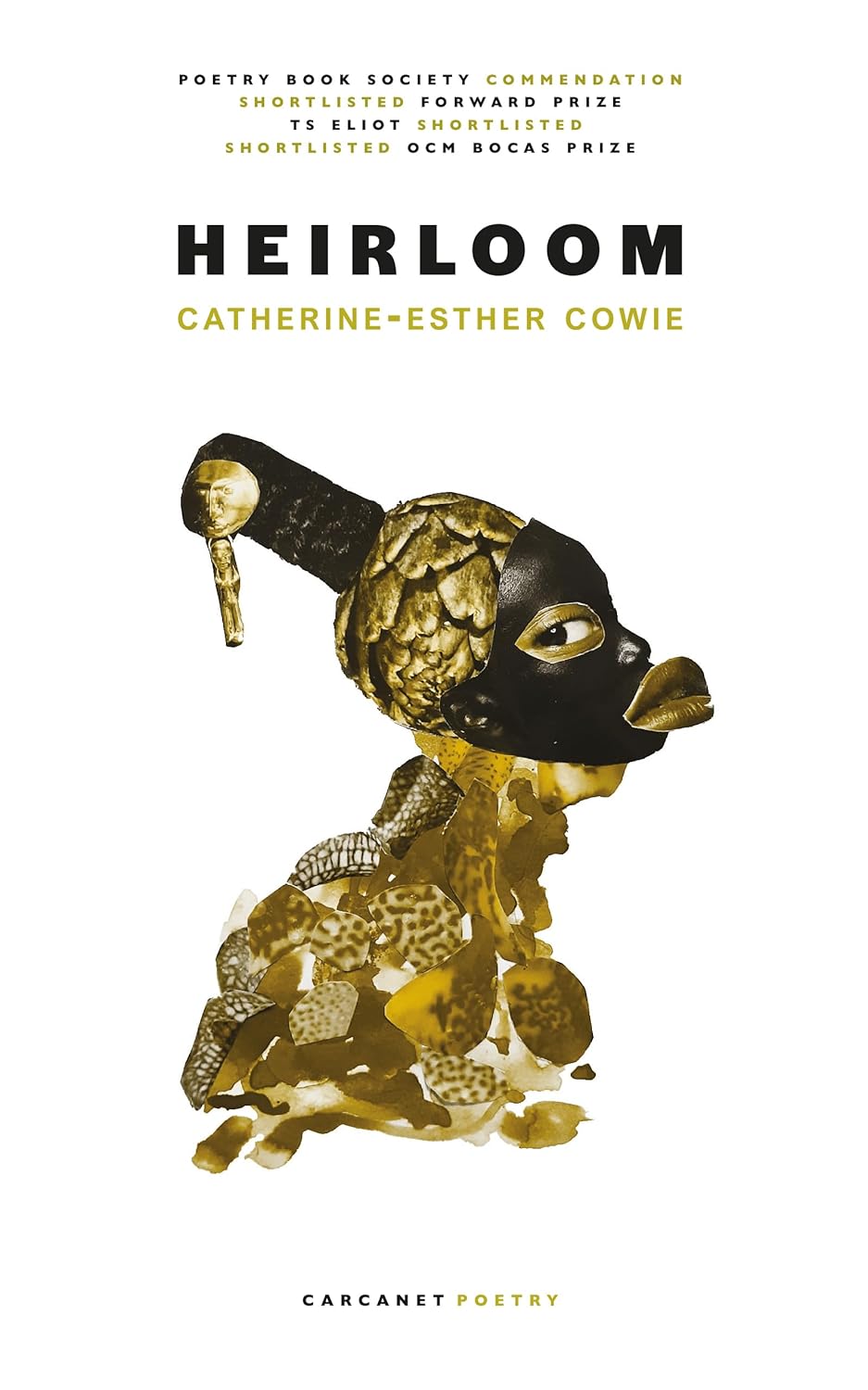
Heirloom, the mixed-media collage that graces the cover of Cowie’s eponymously titled collection, reflects these attempts. As Cowie says in the artwork’s original feature in Aquifer: The Florida Review Online, “I seek to map the emotional landscapes of my subject matter, women, immigrant women, Caribbean women and the complexity of emotions/states that simultaneously exist: shame and pleasure, loss and strength, beauty and ugliness.”1 The artwork pieces together scraps of animal prints and an assembly of body parts. Considering the art as an archival compilation in the context of the collection, documentary poetics thus becomes an avenue to enter these ancestral silences and make meaning of these past histories. With activism at its core, documentary poetics becomes a tool for descendants to enact justice upon a marginalized past. An heirloom in its own right.
1 https://cah.ucf.edu/floridareview/article/heirloom/