When the world shakes, when powerful people dominate to bolster self-interest, when the political landscape seems to edge ever closer toward a dystopian present, in moments when language somehow fails us, we look to the poets for a guiding light. Marissa Davis’s full length debut, End of Empire, offers us poems that arch and ache toward hope.
From the poem “Altar-Mondialism,” consider this line: “in my nation, we carbon-balance with blood of Black children, we overturn the overturners of money changers’ tables, we rewrite narratives in steel, we rewrite narratives of steel, we feign innocence,” which leads us toward this line “my nation knows what it is doing with language.” Marissa speaks to the political, the ecological, the colonial—every line leading us to a new revelation. In the poem “Katabasis” we are given this line, “in a dream the history I am made of is not the history I am made of. I am neither a sin or a series of endings.” Which leads to this line, “it is possible to survive one’s own death though you must be altered.” We are being led, a guiding light.
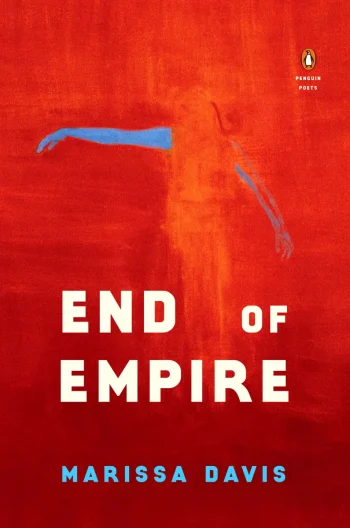
I am drawn to End of Empire because of its attention to craft. I am drawn because of its dedication to honoring place and the natural world. I’m also drawn by its unwavering eye, which does not turn away, does not sleep, it sees the end but also searches for rebirth. But what hooks me is Davis’s ability to marry those things to the personal, to give us a reason to internalize, to look ahead and know “every colossus we yearn to become—we become it.” When the world shakes, we need a poet to shake it back.
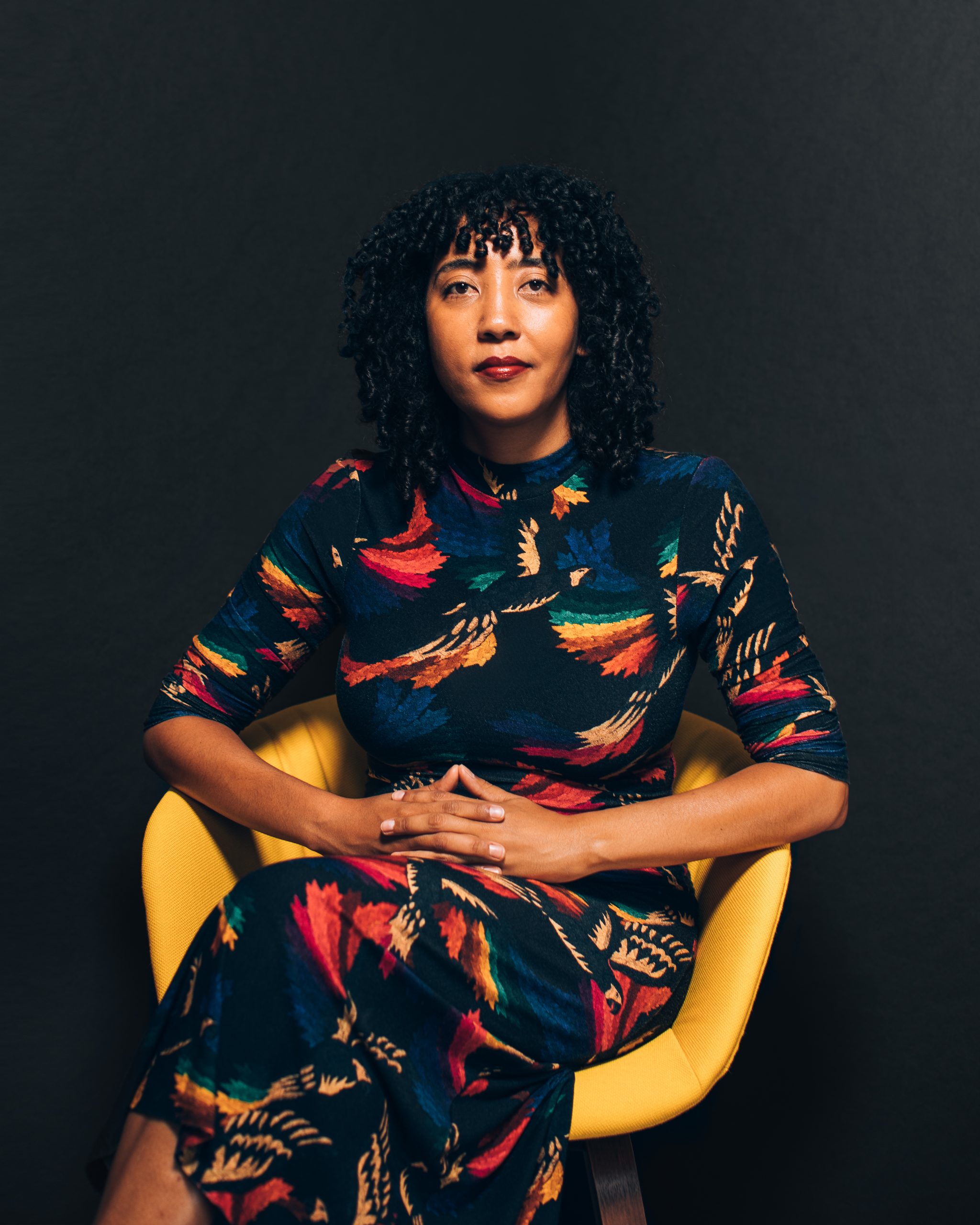
Marissa Davis is a writer, translator, and editor from Paducah, Kentucky. She received her MFA in poetry from New York University, where she was a Rona Jaffe fellow. Marissa is the author of My Name & Other Languages I Am Learning How to Speak (Jai-Alai Books, 2020), which received Cave Canem’s 2019 Toi Derricotte and Cornelius Eady Chapbook Prize, chosen by poet Danez Smith.
I was privileged to speak with her recently via email about dealing with breakage, reversing an established order, and how translation can influence the creation of poetry.
***
Rumpus: Given the themes in this collection, it might be a bit on the nose to ask about the genesis of this work. Instead I’ll ask what was the breadth of life that brought this manuscript forth, allowed it to grow?
Marissa: This is a great question, though a difficult one to answer in some ways. It’s a collection that began as separate strands that I realized down the line worked best threaded together; and it’s one whose shape changed as I negotiated my own relationship to poetry and its place in the world. I began writing the first of these poems while in my MFA at New York University. At that point, I had just come back to America after two years of living in Paris, France (and its environs), where I was teaching English at the time. I had moved from one massive, cosmopolitan city to another—skipping from concrete jungle to concrete jungle, in a sense—and the contrast of these spaces with the omnipresence of the land and environment, both physically and psychically, in the places and people that I came from propelled me to write more about the latter. I found myself writing first about my own relationship to my home in Kentucky, but then about the climate crisis and the way that it’s touched my home region throughout my life.
Those years were also (and continue to be) a particularly volatile period, and witnessing and struggling with that volatility became its own thread. I moved to New York and began my MFA in the fall of 2019. The next semester, Covid struck, and its shockwaves would continue for years. Then came the murders of George Floyd, Ahmaud Arbery, and Breonna Taylor. In 2021, Mayfield, Kentucky, which neighbors my hometown of Paducah, was devastated by an EF4 tornado. Israel’s genocide in Gaza began in 2023. It was a time of a lot of tragedy and grief on scales both large and small, and of a lot of learning about the world and its workings on my end. When you have to look straight at the nexus of all of these violences—see how, in our current world order, race and class so often determine who has the right to live safely and peacefully, or has the right to live at all—there’s something that breaks in you. There are several ways I’ve dealt with that breakage (I think art is very important, but I also don’t believe it’s the most tangible solution), but one way was writing about it.
Rumpus: There are obvious references to religion both thematically and in the way the collection is sectioned out (starting at Revelations and ending at Genesis), but there’s also a great deal of myth, magic, and tradition mixed here too. The poems themselves remind me of the strength that lies in the fractional, the heart-stutter, the broken breath. Did the form of this book present itself first or did the majority of poems find themselves leaning toward this type of container?
Marissa: A bit of both at once! I knew early on in the book’s development that the structure needed to reverse an established order. I felt that the narrative that these poems were arching and aching towards necessitated an inversion, a subversion, to pull them together. The original four section titles were the seasons, though, since nature is such a prominent theme in the book. I’d considered starting on spring and ending on winter (which of course doesn’t work quite the same, since the seasons are cyclical anyway—part of why I made the change!).
Since religious imagery features so heavily in the book, the Biblical section titles felt like the appropriate shift. It felt at once like the right thing to contain and the right thing to reverse, given the multitude of implications and connotations that Christianity can have: on the one hand, a faith whose central stories are meant to compel us towards a radical love of the desperate, mistreated, and forgotten; on the other hand, a political tool that served as a central weapon of European colonial conquest, and thus of the very Euro-American imperial world order that the collection critiques. I also felt there was an important connection between how we often consider the Old Testament God, as at once nourisher and punisher, and how I wanted to portray nature as a similarly both nourishing and punishing force—greater than us in every way, though we aim and claim to control it—as framed through the climate crisis and the disasters that these changes have provoked.
Rumpus: There are some really interesting things happening for the reader regarding how the collection progresses. As you mentioned there’s a shift/reversal in how the section titles are arranged, I don’t want to give too much away, but the poems themselves, as we get deeper, give a sense of subversion and an ending that feels cyclical, regenerative, maybe even a lean toward hope?
Marissa: Definitely towards hope! As a culture, we have a certain obsession with the idea of apocalypse; this idea that we’re rushing towards a catastrophic, violent end. I imagine it’s probably related both to the prominence of evangelical culture and the long tail of the Cold War—that terror of mutually-assured destruction that could any moment be brought down on us by the war-mongering powerful.
I feel, though, that paralysis is one danger, perhaps the greatest, of assuming that an end is impending. If everything is doomed to fall to pieces anyway, what’s the use of fighting back? I wanted to twist this idea some, which is part of why the book’s section titles reverse the usual structure. What if we imagine, instead, that the end is the place we begin—from that point, what do we understand, what do we construct, what do we decide has no place among us anymore, what do we decide is most necessary? I remember, too, reading some time ago someone describe Black Americans as being part of a post-apocalyptic culture. We’ve survived the worst: the belly of the slave ship; the tortures wrought upon generation after generation of our ancestors for centuries. I think that the spirit of that idea inhabits this book in a certain way. We have survived, we will survive, we will fight tooth and nail for our survival. We will do it together, we will do it out of our belief of the inherent worth of each other and ourselves. That conviction is where hope begins.
Rumpus: I’ve asserted in the past that art will always be influenced by what is happening around the artist, like if a painter is depicting something as benign as a tree, the tragedies or joys around them will somehow show up in the brushstrokes. Have you found that current events and the myriad of things we must change or survive (to borrow language from Audre Lorde) influence your work? I think “Living Soil” was one of the poems that prompted this question, which prods my mind toward the ecological, but also the Biblical “dust to dust” and, moreso, to events in Palestine.
Marissa: Most definitely. I sort of accidentally spoke to this point in my response to your first question, but the events of the past few years played a heavy part in what moved me to write many of these poems. Some pieces make their source more obvious—“Antigone in the Bluegrass,” “Thirteen Ways of Looking at a Dead Fish,” “For Columbia,” “The Living Soil,” for example—but I think our historical and political context runs through the work in ways less tied to the immediate, too. I feel that a fusing of time or playing with certain aspects of non-linearity—with how circles and cycles run perpendicular to causes and effects; with the spirals of progress and regression; with connectedness of struggles across time and space; with our dreams and anxieties for the future—is important to how I want this book to be read.
Speaking, for example, of “The Living Soil” and the genocide of Palestinians: I didn’t want this to be a poem that began with October 7th and all the brutality that Israel has wrought in its aftermath. Maybe that’s the current event, but it’s grounded in projects and purposes far older than that, which is a fact I wanted even the form itself (in its relation to the Balfour family) to shout. The role that the control of natural resources plays in that colonial violence is rewound and echoed in the opening lines of “Altar-Mondialism,” the poem that follows it. “Antigone in the Bluegrass” is a poem that moves in disastrous spirals. It was written about a murder committed by police at the site of a protest against other murders committed by police. All through the “Revelations” section, physical violence and psychological violence trade hands. I wanted this to be a collection in which current events, historical events, and personal events braid in a way that makes their points of contact all the more evident.
Rumpus: There’s a line in the first poem, “Lot’s Wife Triptych,” which is kind of an epilogue for the book, that grabbed me, “let me begin again / I was stripped by my country.” A little later, in the poem “Antigone in Bluegrass,” there’s another line which I’ll paraphrase; “I am tired of trying to shape beauty over violence or trust anything that claims this empire.” Again, floored. Can you talk about how or if these lines may be speaking to each other? I’m certain the latter quote is one of the places from which the title is derived, but I also believe the statement (or one of the statements) this book is making lies here.
Marissa: Reading your question, I’m left musing on whether these two lines perhaps form two-thirds of a sort of mini-triptych themselves. “Lot’s Wife Triptych” is a poem that lays the groundwork for the emotional tenor of the book’s opening (or ending, depending on the way that one looks at it)—the sorrow, the rage, the sense of what has been stolen (joy, safety, a trust in one’s worth, I could go on) in a society that views you as little more than a beast of burden. The line you’ve pointed out from “Antigone in the Bluegrass” is in some ways a sequel to it—where sorrow and rage blend with exhaustion; where hopelessness (and, perhaps, the limitations of art) has to be acknowledged and wrestled with. I have my own ideas about what lines could perhaps round out this trio, but I’ll refrain from saying—and let readers make their own guesses.
Rumpus: I read in another interview that you wanted to be a novelist when you were younger. There are so many good works of fiction coming out from poets these days (Phillip B. Williams, Julian Randall, and Elizabeth Acevedo come to mind most readily at the moment), seemingly enhanced by a honed poetic lean. Do you see yourself returning to fiction, or perhaps creative nonfiction, in the future?
Marissa: I do! I recently had the chance to write a creative essay for another literary magazine, which was new for me, but I enjoyed a ton. I’m toying right now with one potential fiction idea, but it’s a work that I want to be either historical fiction or heavily inspired by a specific period of history, so I know I’d need the time to do quite a bit of reading, research, and idea development before diving into it in earnest. I’ve always been drawn towards prose writers who write like poets—Cixous, Lispector, Morrison, to name a few—and I’d love to try my hand at melding those realms myself, applying a poetic logic and poetic attention to the elements of language to building an extended world and narrative.
Rumpus: In addition to being a poet, you are also a translator. How does the world of translation influence your poetry, and vice versa? Did it affect this collection?
Marissa: I got into translation initially as a combined poetry revision exercise and French vocabulary builder—I’d translate my own works into French then back into English, noting what new changes I made in the process and whether they served the poem better. That practice, plus the work I’ve done on other poets’ writing as the years went on, have taught me to think of intentionality in my writing in an entirely different way. When I used the word “tender” in a line, for example, what did I really want it to connote—something more similar to tendre, doux, or sensible? That was a choice I might not have had to make when writing my original, but I would have to make when translating it into French. Translation forced me to look beyond sound play or the immediate impression of a lovely image and analyze my own decisions, my own purpose in what I’d said.
Translating other poets, those wordsmithing choices matter just as much, if not more. There are often multiple words in a language that could express a similar idea to that of the English—so which one serves the rhythm better? Which harmonizes best with the other sounds around it? What other nuances or reference points can it conjure that might better emphasize the poem’s mood? These, too, are lessons that I feel continually filter back and forth between my translation and my creation of poetry.
Rumpus: What’s next for you, and, if you could will it to be so, what is one thing you are hopeful for?
Marissa: I’m currently both working a full-time job and in my final year of a pretty rigorous graduate program (12-14 different classes a week!) in technical translation, which means that my writing has taken a bit of a backseat lately. My dream is to have some downtime this upcoming year, likely once my program finishes, to dive back into reading and writing in a serious way. I have poetry translation projects I’d like to get back to, a few poems I’ve written but left unfinished or unrevised, plus a dream of trying to dive into the prose project mentioned above… the ideas have been plentiful, but the time to actually flesh them out, much less so! I’m hoping that the latter part of 2026—once I defend my thesis and my job enters its autumn low season—will bring me that opportunity.