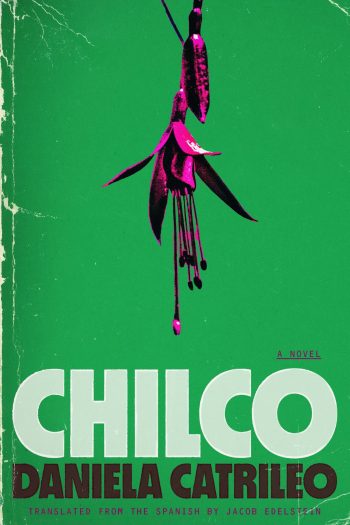
In Daniela Catrileo’s novel Chilco, a series of unexplainable sinkholes and tower collapses devastate a South American capital, bringing together a community of migrants, laborers, artists, activists, and refugees to struggle together and survive the ongoing crises. Despite the absurd greed of real estate corporations and fascist governments who enact the ongoing violence of coloniality, the novel’s central characters love, nurture, and defend memory at the end of the world while longing for their own impossible return home. At once a sensual, lyrical novel and an anti-colonial archive, Chilco is textured with languages and cosmologies indigenous to the Andes and beyond. It bursts with fragments of images, songs, and histories that flesh out the world of the imagined island of Chilco. Anchored by Jacob Edelstein’s vivid and nimble translation, this is a heartbreaking story that reminds us that love might be the most radical act for surviving the colonial wound.
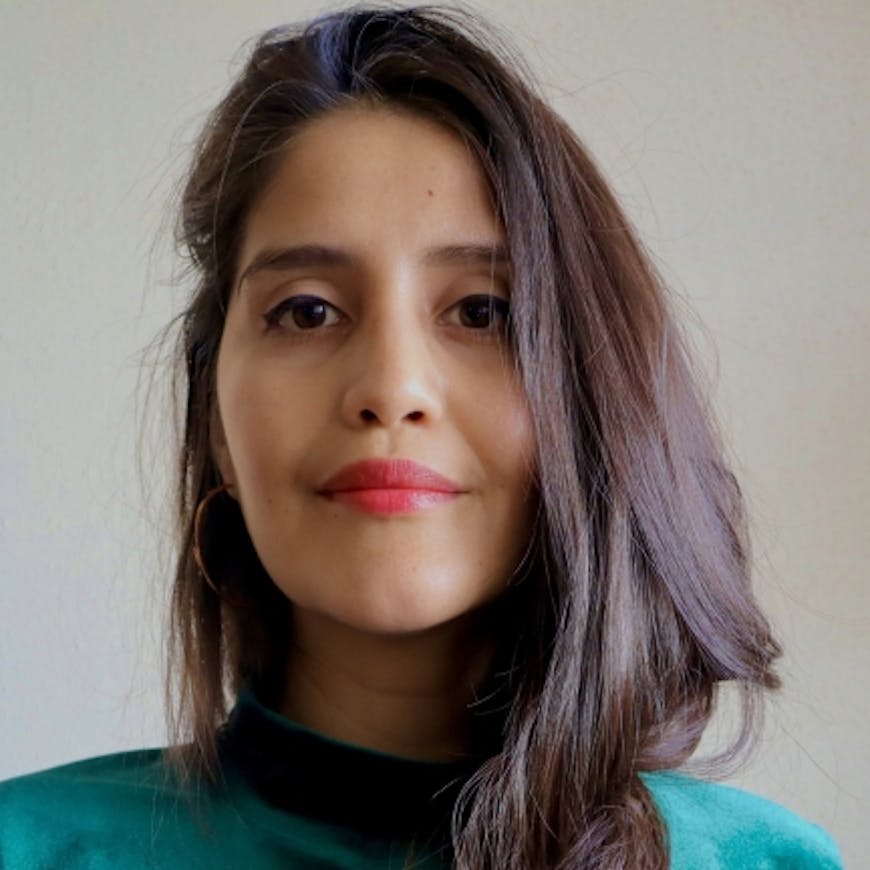
Daniela Catrileo is an award winning Mapuche poet, novelist, professor, and memory activist from Santiago de Chile. Her expansive and multidisciplinary body of work uplifts, celebrates, and defends Indigenous epistemologies, cultural productions, and self-determination.
During our Zoom conversation, we spoke about the interweaving braid of multilingualism, Mapuche cosmovisions, translation innovations, sensual perception as another way of knowing, and the rebelliousness of care.
The Rumpus: In Chilco, language embodies history, place, memory, and power. The Mapuche, Aymara, and Quechua appear within the intimate spaces of lovers, families, friends, neighborhoods, and almost always as a counterweight against capitalism and coloniality. Why was it important for you to tell this story through a braid of interconnected languages?
Daniela Catrileo: In my writing, I’m interested in a multilingual aesthetic because it captures the way territories encounter one another. Often our territories are woven together by multiple languages, but we rarely realize it because we imagine them as being so linguistically integrated. For example, in Latin America or elsewhere where Indigenous migrations are part of our history, Indigenous words are always being incorporated into local languages. This intersection—this weaving—makes language and its possibilities richer. Above all, in my writing I’m interested in collecting fragments of speech. As I began to write Chilco, the narrator Mari’s voice emerged almost as an extended poem. Then other supportive voices appeared. I wanted this novel to explicitly contain a plurality of voices so it could illustrate encounters and differences between the many cultures in the novel.
Rumpus: What was it like to write a novel as a poet?
Catrileo: It was very strange because when Chilco appeared in my life, I didn’t know it was going to be a novel. I told my friends I thought I was writing a poem that had just gone on too long, a poem in free prose that had musicality, a rhythm. Then a story appeared in the poem and I began incorporating more characters and voices. That’s when I realized that it could be a novel and that I was having fun with the writing. I got carried away by the joy of the fiction. The writing itself demanded how it would keep building and branching out.
I can never tear myself away from who I am, and at my core, I’m a poet. I learned language through poetry. Everything I have written since I was a girl is inspired by feeling and thinking through the poem. Through these experiences, I’ve developed an awareness for rhythm, for images, for how the poem can consume us. I won’t reject poetry if it appears in my writing be it in an essay or a story. I allow myself to be swept up by the poetic language.
Rumpus: In Chilco, language is bound up with the land and sea. These places are as dynamic as your characters, and they transform as the novel progresses. The land and sea seem to have their own subjectivity, but also act as extensions of characters like Mari, Pascale, and the communities surviving the catastrophes in the novel. What motivated you to develop land and sea as complex characters?
Catrileo: I belong to an Indigenous community that believes they are living entities. The Mapuche people do not believe that land and sea are simply passive objects, but that they are deeply intertwined with buen vivir, or a healthy and good life, with the ways we understand that everything is alive and related because they are interdependent entities. I didn’t want to shift away from that way of perceiving the world. There is an interesting myth among the Mapuche people about a battle between two giant snakes called Trentren and Caicai. One snake represents the waves of the sea and the other represents the hills of the land. In a way, these stories, which I’ve heard since childhood, were woven into Chilco, sometimes consciously, while other times they just appeared.
Through my writing, I was participating in these oral traditions and in this way of perceiving the world. Once it became clear in the novel that human beings are relating to nature as if it was another person or entity—as if our bodies could ever be separated from the flesh of the world—I wanted to establish that microhistories could also convey broader, historical events. In that sense, the land and the sea also write or have their own language and participate in producing a story mediated by plurality. These ideas appear organically in the text and when they emerged, I borrowed from them to continue transforming both the land and the sea into vital and urgent characters in the book.
Rumpus: During key moments, Mari relies on senses beyond the visual, particularly smell and hearing to understand her world. This sensual attention uplifts how your characters deliver care to one another be it through sex, friendship, or the literal act of feeding one another to survive the crises of the novel. Can you share how you approach writing the sensual, the embodied, and moments of rebellious care?
Catrileo: I’ve been thinking deeply about how to create with senses beyond sight for some time, primarily because our present moment is so governed by the eyes. I wanted to understand how a body attuned to the senses that learns through sensual perception could convey a tragedy, a catastrophe, or a love story. In fact, I gave Mari the ability to understand the world through senses beyond the gaze. I had a lot of fun understanding her this way because often our other senses are displaced during creativity, but also in everyday life. Everything is mediated by a single central sense when we’re faced with the whirlwind of the world we live in—its speed and constant acceleration. I’ve been studying aesthetics, and I’ve become interested in understanding sensual perception as a form of knowledge. Native people have taught us a lot about this way of knowing and the fact that not everything is mandated by reason. Mari helped me put this other way of knowing into practice, and just a few months ago I longed for how she understood the world. I thought, “How would she be perceiving this right now? How would she articulate this in her voice?”
The rest is part of the world of Chilco: her relationship with Pascale, with Laila, with family, with the community. I became fixated on how to tell a story about catastrophe. I wanted it to be a catastrophe where there was resistance and that resistance was based in love. There was already enough danger and crisis in the story that there needed to be a loving and tender environment despite the barrenness and the fury that ignites the interhuman conflicts in the novel. One of the key methods of resistance in the novel is the work that happens through the community that fights back until the very end and that continues to transform, taking on new shapes. That’s the way it is in the places where we’ve grown up: social fabrics are constantly being rebuilt in response to crises and catastrophes. It’s exhausting, but we know we must resist.
Rumpus: The archive is at the center of Chilco: the protagonists all work at an archive, an intertextual archive is woven throughout the book, and the novel itself enacts a simultaneous remembering into the past and speculating into the future to create another kind of record of extinction. How do you understand your novel’s relationship with the archive?
Catrileo: I was haunted by the archive because I was conducting academic research with colonial archives as I was writing. These things became interwoven and if you read the research, you’ll realize you can find plenty of the novel there and vice versa. It’s funny because I would escape from one project when it became difficult and I would go to the other, trying to maintain two different languages that were in fact dialoging with one another all the time.
I’m interested in how archives allow us to unsettle historical traces to rethink our present and the possibilities for the future. I’m also interested in how these archives have been read and interpreted over time by a hegemonic history that tells the story of our people through its own power and gaze. I invented these anti-colonial characters to subvert the idea of the hierarchical archive and to create archives that are ultimately counter archives of love, lexicons for lovers, ways of understanding each other through sensually perceptive gestures.
The archives were also a discursive strategy for the story’s narrative that could lend depth to the island of Chilco since it was an invention. I didn’t want Mari, as the narrator, to have to explain the history of the island, nor did I want the novel to be super dense. The archives then appeared to reconstitute the island. They gave it its history, provided breadth to the way it resisted and survived the colonizing invasion, showed how others understood the island across time, how certain objects important to the island survived such as the ülkantun, Indigenous songs that resemble prayers or poems. This process figured itself out as I went along and it helped me understand how to shape the history of the island while also enacting an anti-colonial strategy that was also an estrategia amorosa or a strategy for love.
Rumpus: At one point in the novel, Mari describes Leila as a militante de la memoria or a memory activist. In your work as an artist, activist, editor, and professor, would you consider yourself a militante de la memoria?
Catrileo: Absolutely—it’s the only way to keep alive the history of our people from our perspective. Our territories have been devastated by the hegemony of history, but also by the will of the state, which has seized and dispossessed many Indigenous territories. We survive through estrategias amorosas like community building. Community can’t be idealized or romanticized: there will be debates, struggles, and conflicts. But at the risk of sounding cheesy, despite everything, there is a common bond that is more important, and that is the love for our people and our will to survive. The way our ancestors fought for life is also a joyful way of understanding life. We can’t strip ourselves of this celebration because our grandparents resisted despite everything and that’s why we’re here. This is essential to the way I work to ethically understand the world, in the way I fall in love, in the way I understand and learn. I won’t get tired of persisting through building communities and collectives, through being a spokesperson for that living memory. Our voices are the only things that can keep it alive. Hopefully these voices multiply and spread like seeds into the future. So yes, I am fervently a militante de la memoria.
Rumpus: This is a complex novel that exists across forms and languages even as it appears in Jacob Edelstein’s remarkable translation. Can you tell us about the experience of working with a translator on a book that invites a meditation on language politics?
Catrileo: Chilco is situated in the interweaving between Andean and other Indigenous languages, so I never thought it could be translated. I’ve had a very beautiful relationship with Jacob in terms of how we’ve worked together to understand language. We met when he translated my short story collection, Piñen, so he was ideal to translate my novel because we already had a previous translation relationship. He had already read my work closely and we already understood how to talk about translation, how to translate ourselves to one another in addition to our understandings of the novel. It was a complex project, so in person and over email, we developed strategies for collaboration. We agreed on how to navigate around the use of a glossary, which I don’t like to use in my creative work. I feel like glossaries or footnotes are too didactic. I trust that readers will do the work to understand a word they’re unfamiliar with and at the very least, they’ll become immersed in the sound of the words. Maybe that’s the poet in me. I don’t think comprehension is everything—the sound of language is key. In the end, we decided to build an extra archive which appears as an additional section for the English translation of Chilco. The new archive is entitled “Lover’s Lexicon,” and we decided it was the most tender and careful way we could incorporate Indigenous words and their definitions into the novel. This was how we’d avoid forcing a glossary onto the reader while respecting both them and the language.
Rumpus: How do you understand the relationship of different languages in the space of a single novel or poem?
Catrileo: I think that relationship is characterized by a tension between encounter and collision. Sometimes languages come together and create meaning, but there are other times when distinct languages collide, and comprehension becomes more complex. It’s a dialectic, a permanent knot across languages. Even when we speak the same language, we can’t be too sure how much we understand one another. The poem helps us understand that it isn’t necessary to understand everything. Sometimes it’s simply enough to immerse ourselves in what the poem does to us rather than what the poem says. We must let ourselves be swept away by language. Writers often think we can own language, but it’s the opposite—language can be so frustrating in all its forms. We struggle with language; we fall in love with it. I can spend a whole day working on a line of poetry that isn’t clicking, and then, in a flash, an idea makes it all come together. Suddenly, the braid of the poem just seems more beautiful. This process most importantly depends on patience and a counter-acceleration.
Rumpus: Chilco might be read as a book about surviving capitalism, extinction, and exile through our relationships with land and one another—through care. What can this story tell its readers about the extinctions, displacement, and exile occurring throughout the world today?
Catrileo: We’re all built from stories of migration, except in this moment these stories are especially painful and dangerous considering the current state of borders and the way people, unfortunately, must leave lands they love to survive. Chilco understands these kinds of migrations, their diasporas, and the means through which they survive. During my writing process, I read a lot of frightening news about mothers migrating with their children, and I hope Chilco can offer some kind of shelter, a way to understand how maps displace people and how borders can also be spaces of survival. I’m interested in what happens during displacement, how people migrate with so little but still create homes along the journey or in the territory where they arrive.
My own family history is also one of migration, even if it is within the same country. Many Indigenous peoples were displaced because their land was taken from them, and we had to grow up in cities or other places that were not our family’s ancestral territories. Yet despite this dispossession, we still carry the living memory of our territories, we protect those lands by all means and the objects that we cling onto because they made it out of those places. In my family, the only object that survived the migration is a blanket that my father’s mother knitted. It’s become an element of this history that I’ve known since I was a child and that tells the story of forced migration through the colonial wound. I’m deeply connected with this relationship to migration, with how terrible it has been, and—of course—I’m committed to defending people’s right to migrate.
Rumpus: What are your hopes for this book in an English-speaking world?
Catrileo: I hope English-speaking readers can submerge themselves into this island, an island that resists extractivism and that’s in the present looking at what’s happening to our planet socially and ecologically. I think this is a book that can inspire dialogues that need to exist. I’m interested in the fact that the United States is also an Indigenous territory that has dispossessed its Native people. How might this book then connect with Indigenous populations or other people who belong to historically oppressed communities like migrants, people of African descent, or diasporic peoples living in the US? This book speaks lovingly to those who have resisted and who inherit histories of oppression. Beyond belonging to a specific community, there are many groups of people that we can connect and unite with through our shared pain. That common suffering is the colonial wound. There is a community that resists within the book and there is a community that resists outside of it. I hope Chilco will serve as a kind of balm, a shelter for care and dialogue.