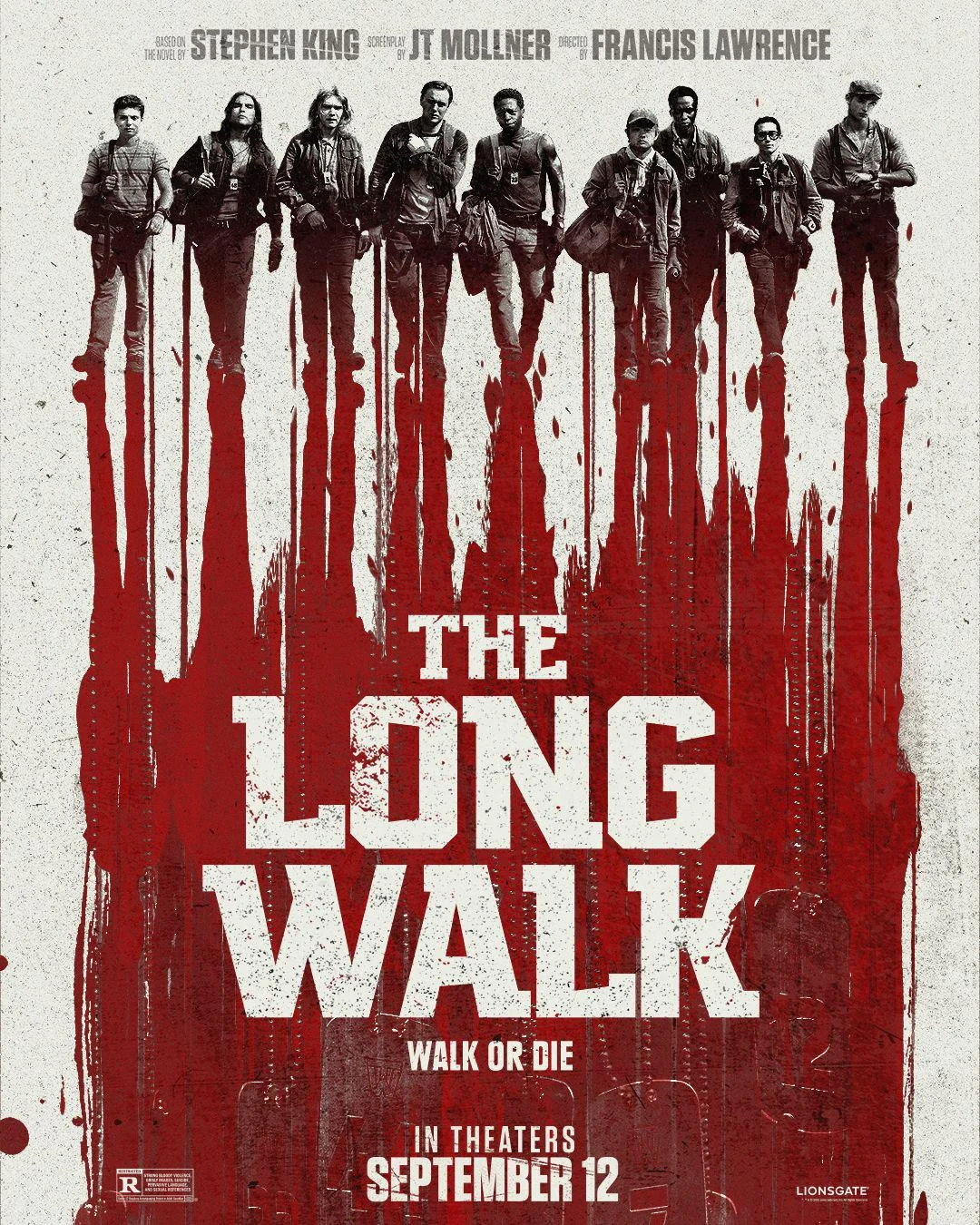
Francis Lawrence’s long-awaited screen adaptation of Stephen King’s early novel The Long Walk, published in 1979 under the pseudonym Richard Bachman, falls flat on its face. I went into the theater hoping for a film that might capture the power, vividness, dread, and suspense of the book, which I read as a teen and reread a couple of years ago. I left full of regret at having wasted nearly two hours on an overhyped B-picture whose makers did not know or care what King set out to capture in the novel. There are far more mediocre King adaptations than good ones, and The Long Walk, indeed, is the latest dud.
Where did things go wrong? Screen Rant, Den of Geeks, 1428 Elm, and other publications have published analyses of crucial differences between the novel and the movie. In the screen version, fifty boys have been selected to take part in a grueling contest where they must walk or get shot by soldiers riding on half-tracks until only one is left. In the book, there are a hundred boys. In the film, the minimum speed at which the boys must walk is three miles per hour, not four as in the novel. It is not pedantic to point out either of these differences. In the novel, the deaths of nearly one hundred walkers are spread out over nearly three hundred pages in a manner crucial to the pacing, themes, and narrative arc. Moreover, the higher minimum speed the boys must walk adds to the growing suspense and dread because it is harder for the boys to maintain hour after hour and day after day.
Over the course of the novel, King renders individual walkers with just enough detail that the reader begins to care about their fates. There’s Garraty, mentioned above, who can’t stop thinking about his mom or his girlfriend and hopes to get a glimpse – possibly his last – of the latter as the Walk passes through a town up ahead. Then we have McVries, who saves Garraty’s life more than once even though the continuing survival of one walker lessens the chances of McVries and all the others. Then there’s Harkness, who hopes to write a book about the Walk if he makes it to the end. And Baker, who has the decency to shoo away a pair of young boys who come up on bikes just as it grows clear that Harkness will not make it nearly to the end. Then, in the form of Parker, we have a doomed hero who attempts to mount a Treblinka-style uprising against the soldiers. And on and on. It is a testament to King’s skill that he made all these characters so vivid and relatable with bits of dialogue here and there. With half as many walkers to delineate, the filmmakers have a lower bar to clear yet fail to render anyone nearly as memorably.
Most jarringly, the film’s ending is different. Instead of the haunting denouement where Ray Garraty, having outlasted all the other boys, encounters a strange, menacing figure on a rural road, it’s his friend Peter McVries who makes it to the end. McVries then uses his wish—the winner of the Walk gets to wish for anything he wants, in addition to an unspecified amount of cash—to demand a carbine from a soldier standing nearby. Then, after a brief internal struggle, McVries shoots the Major, that authoritarian figure who wears reflective glasses and praises the boys who die for their valor without once showing empathy for them or remorse about the organized slaughter of the Walk. McVries kills the Major to avenge Ray, with whom he forged a deep, fraternal bond.
Critics have also noted that several of the characters in the film are composites of characters from the book. They have pointed out that the filmmakers conflate two memorable characters from King’s novel—Scramm and Stebbins. In the book, Scramm is a huge, musclebound guy who boasts of his might and intimidates some of the other walkers early on, making them wonder how they will ever outlast him, until he comes down with a cold and meets his demise. Stebbins is quite a different kettle of fish. He is a strange, faintly menacing boy who never seems to tire as the others grow exhausted and drop like flies around him. We learn that Stebbins is, or at least claims to be, the son of the Major, and wants to even the cosmic scales by getting vengeance on the father who never cared for him.
In conflating him with Scramm, the filmmakers have given us a character who is true neither to the Stebbins nor the Scramm of the book. Indeed, the movie Stebbins is nothing like the fictional one. He has none of the mystery, the understated menace. As Ruby Rivers acknowledges in her 1428 Elm piece, the Stebbins of the book is skinny, not physically imposing, and when Garraty first sees him at the outset, he guesses Stebbins will be one of the first boys to drop out. Rivers’s analysis could have gone a bit further in its consideration of the thing that keeps Stebbins going while nearly all the others die. It could have explored the moral and philosophical differences between Stebbins and the other walkers, which are essential to the book’s themes.
Most of King’s books have a message. The Stand explores the need to accept difficult and immature people, hard as it may be, in order to put their talents and abilities to use for the greater good of society. The Shining dares us to ask whether we can stay sane if we are isolated from the distractions of the world and we are left alone with who we are.
In The Long Walk, what we see play out is something akin to Gandhi’s principle of “firmness in the truth.” Most of the boys are after the things teenage boys yearn for: an island somewhere, a mansion full of women in bikinis, fleets of sports cars and yachts. They die, one by one, in the vain pursuit of those ends. But if you have a moral reason for doing something, as opposed to a crass material urge, there’s no telling how far you can go. The Walk comes down to Garraty and Stebbins. Garraty, you see, has unfinished business with his girlfriend. For Stebbins, it’s the need for a reckoning with the father who abandoned him. Stebbins has something on his mind that is so urgent, so right, so necessary, that he is able to keep walking even as stouter and more muscular boys collapse and die.
But in making Stebbins just another big shambling dude, the movie eliminates that dynamic—the non-correlation between physical strength and endurance—and almost completely bleeds the character’s defining feature from his psyche. His “I am the rabbit” speech late in the movie feels uninspired and falls flat. It lacks all resonance because the moral element that propels Stebbins doesn’t stand out in the same way. In director Francis Lawrence’s telling, he makes it almost to the end just because he’s physically tougher than most, not because of a spiritual fortitude that transcends brawn.
Moreover, without anything like Stebbins as King wrote the character, a larger theme of the book is all but impossible to appreciate. The movie, it must be said, is oddly paced. As aforementioned, we start with fifty boys. Most of them die off early on, including during a muddled nighttime scene where the deaths occur largely offscreen and lack all power. Before we know it, we are down to a handful of stragglers. We didn’t begin to get to know most of the walkers who have died up to this point so we cannot appreciate their loss. The sense of attrition that gave the book its suspense and power—of the inexorable taking of boys we have come to care about—has vanished.
King gave us a hundred walkers for a reason. He wanted us to get to know the boys just as they die off at the hands of the brutal soldiers. Not all are virtuous, but many have likable, relatable traits. As the book progresses, the reader comes to see that their camaraderie and friendship are a reward of infinitely greater value than the material things most of them pine for—and the tragedy is that they, and we, come to this realization only after they have submitted to the Walk and its horrific rules.
This nuance is pretty much impossible to grasp without Stebbins as King wrote him in the novel. Near the book’s end, it’s just Garraty and Stebbins on a remote road. Feeling that he can’t go any further, Garraty decides to go up to Stebbins and tell him. Just as he gets close to his last remaining rival, Stebbins cries out “Oh, Garraty!” and then drops dead.
It is the only point in the book where Stebbins expresses anything like alarm or regret—and, we sense, he does so because he, like the reader, has come to see the tragedy of nearly a hundred boys dying for something of lesser value than what they had before the Walk ever began.
If the film were not based on a King novel, it is hard to imagine who would ever be interested in it. Given its literary precedent, the film’s rotten writing and uninspired direction stand out all the more starkly, leaving us viewers with a fading hope that one of King’s many creations will successfully endure a long walk to the screen without the traducing of its author’s vision or the degradation of his themes.