
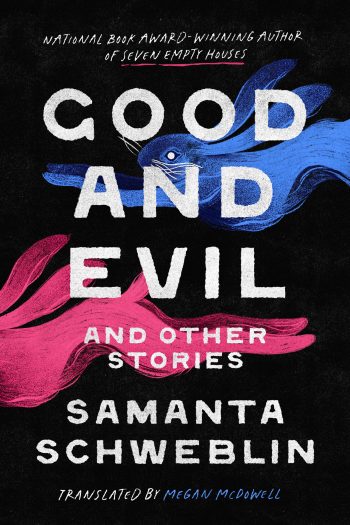
My godmother was the first person to teach me the cat’s cradle game, plucking at the string wrapped around her fingers, forming new shapes by twisting her hands outwards or inwards, even using her teeth to help make the shape of the Eiffel Tower. Samanta Schweblin’s short stories in her newest collection Good and Evil and Other Stories feel like a game of cat’s cradle. Her evocative, specific words (masterfully translated by Megan McDowell) weave around our minds amorphously before becoming something known, something true. And when we are led into that emotional state in such unexpected ways, as Schweblin does, through the characters in these six short stories, we stay there for days. We linger, thinking about the feeling she is able to conjure in each of us.
Schweblin is most alive in these emotional states that we don’t often think about. Or perhaps don’t want to think about. In “A Fabulous Animal,” two older women, Elena and Leila, talk on the phone after a period of estrangement. A tragedy took place many years before; Elena’s son fell to his death from a second story ledge, and the bereaved mother begs Leila for stories about him. It is this kind of darkness that brings us into Schweblin’s work and won’t allow us to leave it. It’s not only the accident that loiters in our minds, it is the way it has changed the mother, the way it has altered her personhood, her state of being. It is a reminder that death and dying is never something we truly come to terms with, but as something that we learn to survive.
Schweblin and I connected over email. We talked about how animals remind us of the language that exists outside of our language and how she is most interested in “reaching the extraordinary by walking down the most ordinary hallways of the most ordinary houses toward the most ordinary cat in the world.”
The Rumpus: You end this collection with an epilogue of sorts titled “Notes on the Stories,” where you describe the inspiration behind the pieces, who they’re dedicated to, and the real events they’re partially based on. For “William in the Window,” in particular, you write that it is “perhaps the most autobiographical story I’ve written, and perhaps also, for that reason, it’s better not to say any more.” Why did you decide to include this notes section?
Samanta Schweblin: I built those notes gradually over the three years I worked on this book, never quite sure if I should publish them. What surprises me now is not only that I decided to do it, but how wholeheartedly readers have received the gesture.
This is a special book for me because, even though it is fiction, I’ve been to all the places I describe, and I carry personal anecdotes from which some of these ideas were born. I feel this book comes closest to my personal world, and it is also my most realistic. Perhaps that’s why I wanted to include my notes.
Lately, I’ve also realized that, as a reader, I need to know who’s on the other side of the books I read. This has nothing to do with the culture of cancellation. I belong to the group of Lolita’s fans. Maybe it’s because of the enormous crisis we’re living through, a time when we can no longer be sure what’s real and what isn’t, and when the virtual has already become part of everyday reality. I want to know who that “other” is—as a way of reading them better. To lift the veil of fiction and see the person on the other side.
Rumpus: The first story, “Welcome to the Club,” begins in medias res—in the present tense, a woman is drowning herself in real time; her true fear is being unable to “move forward or backward, ever again, in any direction.” How did you choose this story to open the collection? And why first person and present tense here?
Schweblin: It’s a kind of false circle and it’s not truly cyclical, but it could be. Something has happened to this woman and now she’s anchored in the present, no matter how she tries to move toward anything. The tense marks that, verb by verb, and the first person makes me, as a reader, distrustful because how can I know whether this is happening or whether it’s only her perspective?
This was the first of the six stories I wrote, and originally it carried the collection’s title: El buen mal —The Good Evil. In a way, it set the themes and atmosphere for what followed. I even remember the order in which the others arrived (exactly as in the table of contents, except for “The Woman from Atlántida,” which I wrote last). Each new story I finished felt like it could also be called El buen mal. So in the end I moved the title to the book and found a new one for “Welcome to the Club.”
Rumpus: Many stories involve an outsider, a stranger, or a neighbor who sees the protagonist clearly—or who triggers a deep realization in them. In the closing story, “A Visit from the Chief,” a home invader pressures Lidia into admitting that she “hated her daughter as a baby,” something she may never have acknowledged to herself. How do you use these peripheral characters to clarify or blur the protagonist’s interiority and actions?
Schweblin: I think I’m mirroring the way it happens in real life. So often a piece of bad news or someone with bad intentions arrives and threatens what we thought was settled. The fear that provokes, how we do everything we can to contain it, to share it.
Sometimes “the bad” is simply bad, purely destructive. But often we label as “bad” what is merely unknown: strange, foreign, something we don’t yet know how to measure. It scares us, yes, but it also wakes us up and forces us to pay true attention. It changes our course, our energy, our thoughts, in directions that might even heal us, free us from fears or mistaken ideas.
Rumpus: Animals appear throughout these stories: a rabbit is skinned in “Welcome to the Club,” there is a fallen horse in “A Fabulous Animal,” a cat “in the Kilkenny window, upright and attentive, finally turning toward me, recognizing me, granting me the certainty of his gaze.” For you, what makes animals so resonant in narrative? Why use them?
Schweblin: There’s something in those presences that unsettles us and makes us enter into dialogue with ourselves, as if through a mirror. They confront us with other ways of perceiving reality. These animals don’t speak, but they communicate. They don’t reason as we do, but they make decisions.
That absence of language makes other species work as vessels: we pour into them ideas that are really our own. That’s why they often function as signs or nods from fate, as if they were there to teach or to point something out.
I’m deeply interested in language—this almost invented, extraordinary tool that constantly fails us, confuses us, alters us, makes us a little mad. I once heard or invented, I don’t know, the idea that mathematics, this other language of ours, is like a mantle we stretch over the world in order to measure it. Language works the same way: a mantle we lay over things so we can agree that this is a table. This is freedom. This is injustice. The more precise the language, the finer the agreement, but the mantle is not the world.
Nature, and the animal realm, that space we feel so distant from, beats every second without language, without our language. And there is so much outside language. I think these presences unsettle us because they come to remind us of that much larger world that contains us, which we insist on ignoring.
Rumpus: Did you grow up with animals? Do you have a favorite?
Schweblin: I always had pets in my childhood home, dogs at first, and later cats once I moved out on my own. I grew up in the suburbs, not in the city of Buenos Aires, so I often saw chickens, rabbits, and horses. All the animals in the book share that domestic quality; they aren’t extraordinary species but beings we are used to living alongside.
I’m fascinated by poetry that reaches complex, new ideas through the most ordinary words. It reminds us that fire, that hypnotic, powerful force, is nothing more than a spark born from two simple pieces of wood.
I suppose I long for something similar when I write. A unicorn is magical and extraordinary, but it’s also a pre-made, agreed-upon idea. I’m more interested in reaching the extraordinary by walking down the most ordinary hallways of the most ordinary house toward the most ordinary cat in the world.
Rumpus: One favorite short story of mine in the book is “An Eye in the Throat,” told from the perspective of a two-year-old who swallows a lithium battery while his father is watching him and eventually loses the ability to speak. It made me think about how children become people, and how we are shaped by others’ action and inaction. Why tell this story from a child’s perspective?
Schweblin: The accident doesn’t just break the child; it breaks the whole family. The adult perspective assumes the accident is what destroyed the boy, but no two-year-old can grasp the gravity of what’s happening. A toddler is not capable [of] understand[ing] the consequences of this accident in his future, and he doesn’t feel any physical pain, so why should he feel terrified? What breaks him is the sadness of seeing his father unable to relate to him as he did before—with openness, playfulness, and joy. What breaks the child is the father’s sadness.
That is why I knew from the start that the child’s perspective could be interesting. I did try other options—I usually jump among different narrators until I find what I’m looking for. Once I understood the kind of accident the boy would have, and the technical-literary permission a medical condition like a tracheotomy could give me, I followed that path without hesitation.
Rumpus: More broadly, what do you think a child’s perspective offers fiction?
Schweblin: It’s an absolute generalization—every narrator has their own reasons and specificity, but of course a child’s gaze is usually free of prejudice, fear, social mandates, pre-set labels. It’s more genuine. It lacks adult expertise, that is also what often traps us in very small worlds and in unnecessary pain.
Rumpus: I see a connection between the suicidal protagonists of “Welcome to the Club” and “The Woman from Atlántida,” especially in the line from the latter: “Maybe not fully learning your lessons is what ultimately keeps you alive.” Do you think about transference among characters—the way one might carry emotional residue into another story—or do these parallels emerge more subconsciously as you write?
Schweblin: In this collection, yes, the stories are closely connected. Maybe not in plot specifics, where we tend to look first, but in the ideas the book explores: their particular searches and pains, and also their discoveries—the different ways these characters, after their personal apocalypse, manage to stand up again.
Although I wrote each story independently, there was a moment when they were all on the table at once, and then, without my intending it, a kind of refraction began among them. They are independent, and at the same time they are deeply connected.
Rumpus: There are comedic moments throughout. I laughed in “A Visit from the Chief” when the narrator wonders whether she has to feed the strangers in her home. For you, what role does humor play in the collection?
Schweblin: I don’t remember ever planning humor while writing. But reading some of these stories aloud, I’ve often been surprised by the audience’s laughter. In “Welcome to the Club,” for example, probably the darkest story in the collection, I’ve heard bursts of laughter, to the point of tempting me to smile while reading, which feels inelegant, as if I were applauding myself, ha!
But it keeps surprising me—this humor that escapes from the texts without my planning it. I don’t fully control it. I suppose as readers we reach states of great tension, and then something opens a small escape, like a pressure-cooker valve—a reminder that we need to breathe. I hope here the humor works like that: a physical reminder that we’re so tense we need to breathe again.
Rumpus: The evil in these stories, as in much of your work, isn’t a monster but something more ineffable and nefarious—the ledge a child falls from, the rough sea, the lithium inside a battery, a partner’s diagnosis. How do you depict that ineffable darkness without letting it consume the narrative?
Schweblin: I love this question, because I think the energy of a new idea can mislead me if I focus only on plot—on the mechanism of actions and consequences. Only when I set that aside and focus on details do I understand why I feel the urge to tell the story. Plot is mostly information—actions, events—but at the end of the journey, what the reader wants to understand is why they’re being told this particular story, and that question is rarely answered by the weight of plot. I’ve studied this obsessively in the authors I admire most: plot is contingent, a bridge you cross to move from one state to another. What matters isn’t the bridge; it’s the new emotional state you reach.
Rumpus: Is there anything you are afraid of?
Schweblin: Ah, so many things. I’m fearful by nature, but also a curious kind of fearful: there are many things that frighten me, yet I’m also very curious to know how much they’ll hurt. Writing and reading help me understand that, and often, thanks to them, I shed my fears or at least learn what I’d need to do to survive them.