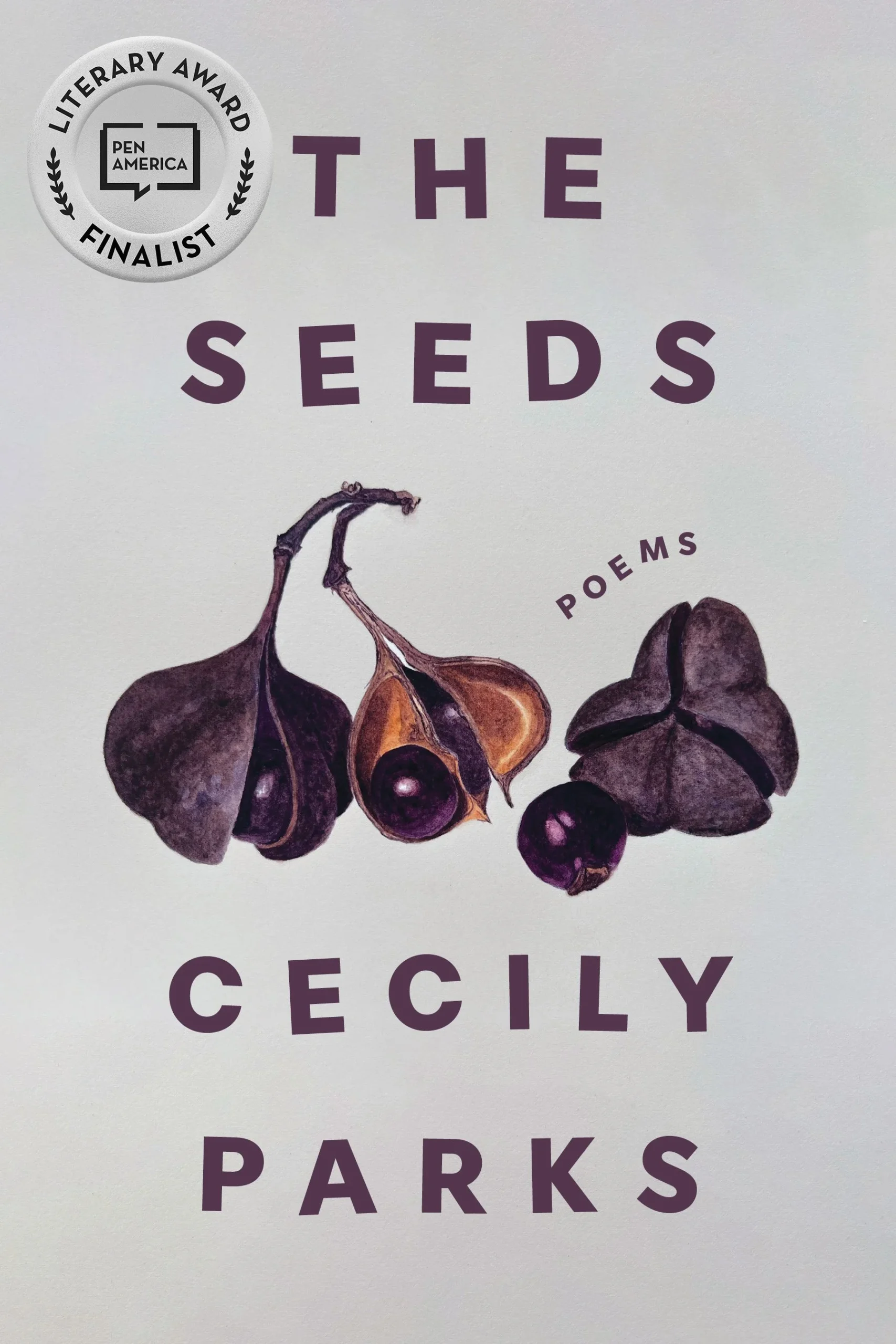
There is an elegant intentionality to the poetry and personhood of Cecily Parks, author of The Seeds, published by Alice James’ Books. The other graduate students and I used to joke that she doesn’t walk — she floats. Her ethereal qualities are also disarmingly grounded, tethered to the soil.
Though her voice is soft, Parks’ words drop like anchors. When she speaks or writes, the audience makes room; they quiet to welcome the stillness she inhabits and the revelations she unearths within it. Parks’ work is deliberate, earnest, luminous, and, at times, poignantly melancholic, tempered by a sense of play.
My vantage point is privileged and unavoidably biased, though I have mustered as much critical objectivity as I can. I came to know Parks as a professor and mentor during my time as an MFA candidate in poetry at Texas State University nearly a decade ago, when the poems that would form The Seeds were just starting to aggregate.
The Seeds is Parks’ third poetry collection, released in fall 2025 from Alice James Books, following her debut Field Folly Snow (2008) and O’Nights (2015). It is the culmination of ten years of work since her move from Cambridge, Massachusetts, to Austin, Texas, for a faculty position at the university in San Marcos to instruct us creative writing misfits. I was a twenty-six-year-old fledgling poet whom Parks cultivated with patience and care, despite my debilitating inability to master scansion.
In a season of transition, Parks had become a new wife, a mother to twin girls, and a homeowner who, for the first time, had access to her very own backyard. Learning to mother, along with tending a home and yard, brought her closer to her environment, an intimacy that inevitably draws one closer to self. What a place to coalesce, cataloging these new wildernesses to make sense of them. What came next were poems.
The incisive precision of The Seeds’s assemblage cannot be overstated: if the collection is an ecosystem, its sections and sequences are habitats, and each poem is a haunt. The poems are divided into five sections, bookended by a hackberry, and what unfolds in the pages between is exquisite and exacting. At just over 100 pages, this book undoubtedly requires time and attention, but persistence is rewarded over and over again as the text quickly gathers mass and meaning with each turn of the page. As it unfolds, the meticulous systems of intricate, interwoven images, themes, allusions, and phrases construct a root system, if you will.
“We Want to Be Known by the Woods”
Parks gets acquainted with her new home by way of its ecology, examining her own interior and exterior landscapes in the process. The Seeds is thus inextricably rooted in Texas. Though Parks was not a complete stranger to the Lone Star State — she received a BA from Rice University in Houston years prior — Austin’s comparatively parched, brambly ecosystem was distinct. She began to observe, explore, research, and investigate accordingly.
She studies place with relentless curiosity and an acute attention to the smallest flora and fauna, from a tiny fish in Goodenough Spring, discovered while it was going extinct in “Amistad Gambusia,” to a meditation on moss balls in “Epiphyte Interlude,” in which the speaker asks, “…does / the tree / let the / moss go / or does / the tree / ask us / to hold / the moss?” It wouldn’t be a book of poems about Texas without a few mentions of bats, trains, and bluebonnets, of course, but Parks expertly handles the tropes with a restraint that sidesteps the sentimental and overwrought.
Nature, in this context, doesn’t simply mean live oaks, oxeye daisies, datura, hedge parsley, or prickly pear cactus, though it does include those specimens. It also includes the unvarnished artifacts of the everyday: a mop resting on a neighbor’s fence in “Dispatches from the Alley,” for example. “I’m surprised to find stores of purple in the mop and the weeds: purple for the luxury we lace into the mundane, and purple for the grief.” Nature may also include a crushed Monster Energy can, a window that won’t open when the speaker just wants fresh air, or graffiti on a moving train against the backdrop of arboreal splendor.
Parks remains steadfast in the foundational lyric-ecopoetic mode as established in her first two books of poetry while interrogating the fraught Romantic and Transcendental legacies that shaped it. “Deciduous Interlude,” which falls precisely halfway through the book, functions as both the spatial center and figurative core:
We know
the moss,
forget-me-nots, and
blue-green spruce
but we
want to
be known
by the
woods…

We listen
to maples,
ash, and
oaks without
hearing, but
not hearing
doesn’t mean
that we
aren’t spoken
to…
The sentiment operates as ars poetica and refrain. Naming nature is, at best, a superficial way of knowing, but the gesture nonetheless illustrates a yearning for deeper recognition. Through these poems, Parks interrogates a writer’s relationship to the natural world, examining the misguided desire to possess or fully know. Rather than forcing clarity, she treats the act of seeing as a spiritual practice, a study in noticing what survives and how. Parks swims in the ambiguity and suggests that the reader join in; the water is just fine. In this way, she perhaps has more in common with Clarice Lispector cataloging flowers in Água Viva than with Thoreau or Emerson sometimes. If Romantic poets championed a return to nature, Parks insists we never left it in the first place.
Rather than lamenting the ineffable, Parks revels in negative capability and critiques those for whom simple answers are valuable. In the third poem of the “On Fire” series, the speaker draws on Anne Bradstreet’s “Verses upon the Burning of our House, July 10th, 1666” to explore the concept from another angle. Discussing Bradstreet’s poem with students, the speaker remarks on a familiar frustration: the inability to understand what a poem means as though answers are more important than wading through the muck of uncertainty, “The poem answers these questions, but searchers want the Internet’s answers instead.”
Similarly, in the first poem of the “Dispatches from the Alley” series, the speaker notes, “Then here comes a breeze, and someone’s wind chimes release a fragment of song that promises neither beginning nor crescendo nor resolution.” Parks makes room for meaning without insisting on neat closure.
“Uncomplicated Beauty Is Tough to Come By”
A poet wants beauty—beautiful names, beautiful plants, beautiful scenes—but an environmentally minded poet, who knows that the nandina’s roots displace other plants in the surrounding soil, knows that uncomplicated beauty is tough to come by.
While considering the complexities of these Texas terrains, including the pernicious human presences within them, Parks makes room for an extended examination of the pastoral tradition. In “The Past in Pastoral,” a series of eight prose block poems, she offers an incisive examination of the genre, especially as canonically practiced by men. “The pastoral stakes a claim on a place,” the speaker notes, “no matter who owns it, visits it, works in it, lives in it, or sleeps in it. The pastoral craves intimacy but discovers that environments are not promiscuous enough to let them all the way in.” Her critique is biting regarding Christopher Marlowe’s “The Passionate Shepherd to His Love,” which the speaker calls “an extractive sartorial fantasy” and notes, “The poem sidesteps the realities of not only ecosystems but also sheep herding: exposure, loneliness, sheep stench, sheep shit. All that baa-ing.” The commentary reveals a deep desire and respect for authenticity, honesty, and truth in poetry.
Likewise, she scrutinizes William Wordsworth’s “The Solitary Reaper” for imposing sentiment and poetic fancy onto an actual moment of a woman’s labor.
Predicated on distance and impression, the pastoral invited Wordsworth to overwrite the reaper’s words and hardship, the contours of the barley field she labored in but in all likelihood didn’t own. The poet will never know her field song. He goes home to write his poem by the fire. The only song, a tourist’s song, is his.
Parks also pushes back against the rigidity of ownership and the arbitrary, man-made boundaries imposed by modern capitalist ideas of land division. She rejects Gaston Bachelard’s advice to “make a map of your lost fields and meadows,” arguing that “the pastoral chases the impossible dream of describing a place after the experience of it has passed, yet in truth, both the place and the experience are gone.” Her interrogation with a lament for a lost field of one’s own.
“Some Days I’m the Animal, Some Days I Wound It”
At sunset the window can look like water
a wounded animal has walked through.
Some days I’m the animal, some days I wound it.
Texas isn’t a place known for its foliage. Its climate is dry but humid, and the summers aren’t just hot, they’re unrelenting. It’s inhospitable, a place that doesn’t make living easy. Though Parks renders aspects of this environment with a whimsy and beauty I found difficult to appreciate while living there, her vision never separates ecology from melancholy or violence.
Daughters, a husband, grackles, rats, and rolly pollies populate the landscape, contributing to its beauty even as they occasionally participate in its quiet brutalities. Parks reconciles beauty with the sublime: the wild is as much a site of shadows as it is of wonder, though cruelty is distinctly human. Throughout the collection, flowers may resemble fire or pools of blood, lightning splits the sky, and water carves land into new shapes. Harm is inevitable when dissecting, whether natural or inflicted.
To speak of nature, The Seeds suggests, is also to speak of what humans have done to it and of what remains regardless. “The Rio Grande” is a site of both natural beauty and human impact in the book and in reality, a place where parents and children are killed or taken, which defines the boundaries of the place. Its form mirrors the thing itself, moving like a river, carving through, and creating a boundary with force.
The Rio
Grande I
dipped my
hand in
after crossing
over into
motherhood is
also the
one sawing
through the
desert like
a sustained
howl…
The Rio
Grande holds
Texas in
the palm
of its
hand or
could it
be the
Rio Grande
is really
the fist
of the
United States
In the “On Fire” series, drought and the threat of flames are ever-present, as they so often are in Texas. Houses and ladybugs burn in the real world, while literary allusions, including Laura Ingalls Wilder, Sappho, Bruce Springsteen, and John Donne, contribute to the ruminations, collectively meditating on all that heat. The series culminates in the speaker observing that “the last time it rained, they found the body of a dead woman, naked, in the river.” Nature here serves as setting and witness, a world that contains us even as it remains unmoved by our suffering.
“Is Hope the Providence of Women?”
Motherhood acts as both subject and lens in The Seeds, and flipping through often feels like being gently parented. The sing-song quality of the rhyme poems (“Backyard Rhyme,” “Lightning Rhyme,” “Mother Cardinal Rhyme,” and “Front Yard Rhyme”) evokes a folkloric tone, as do a few storybook-inspired pieces. Yet motherhood here also collapses and dilates time. In “Motherhood,” the book’s magnum opus, she captures the grief of being a mother to a past self you wish you could have helped. It’s a poem expansive enough to hold Persephone, a married man, a field, and the ache of retrospective knowledge.
Parks is attentive to the lived experiences of girls and women and is in constant conversation with a feminine literary lineage, including Emily Dickinson, Gertrude Stein, Dorothy Wordsworth, and Ophelia, to name a few. In the title poem, “The Seeds,” the speaker melds personal and prophetic worlds together, asking, “Is hope the providence of women?” A masculine sense of entitlement is contrasted with a distinctly feminine solace via Odysseus and Penelope, among others.
     ...If I hadn’t hoped

to be a wild queen, I may not have hoped for a field,
     a small bounded valley
     for my dream daughters
     to drift into
     like two seeds.
“Alive Enough to Look at Light and See It”
I never used to write about flowers. Now I walk through my neighborhood in Los Angeles, stopping frequently to examine them. I’m looking: this one’s a bird of paradise, this one a lily of the Nile. Did you know that almost all succulents bloom? Cecily taught me this, not the names, but how to look at them. Reading Parks’ latest collection, The Seeds, reminds me again that beauty resides in the smallness and slowness of things — a backyard, an alley, a tiny fish — if only we can pay attention.
This extends into the importance of releasing ecology from our expectations of it. There can be resolve in not getting the answers one wants, in falling in love with the asking and the learning instead. There are such lush worlds in the liminalities if you’re willing to inhabit them.
The seeds, in this case, are daughters, the seeds are hope, and the seeds are a chance to see the world differently. The Seeds is a labor of love, a testament to what a decade of meticulous, thoughtful noticing can yield.