In his landmark 1975 essay Portrait of the Writer as a Fat Man, Russell Edson, one of the few undisputed masters of the prose poem, wrote: “Talent is… a dilettante measure… All is will and power, both growing from the other like a single club, with which I shall force a fiction––as though I scrubbed floors to send my son through college so that he might get a high-paying job and buy me a castle to live in.” What Edson refers to, in essence, is that the prose poem is a gluttonous, glimmering assertion of working-class mindfulness as much as it is answering to a stylistic curiosity. The form demands awareness, stamina, and sometimes sacrifice.
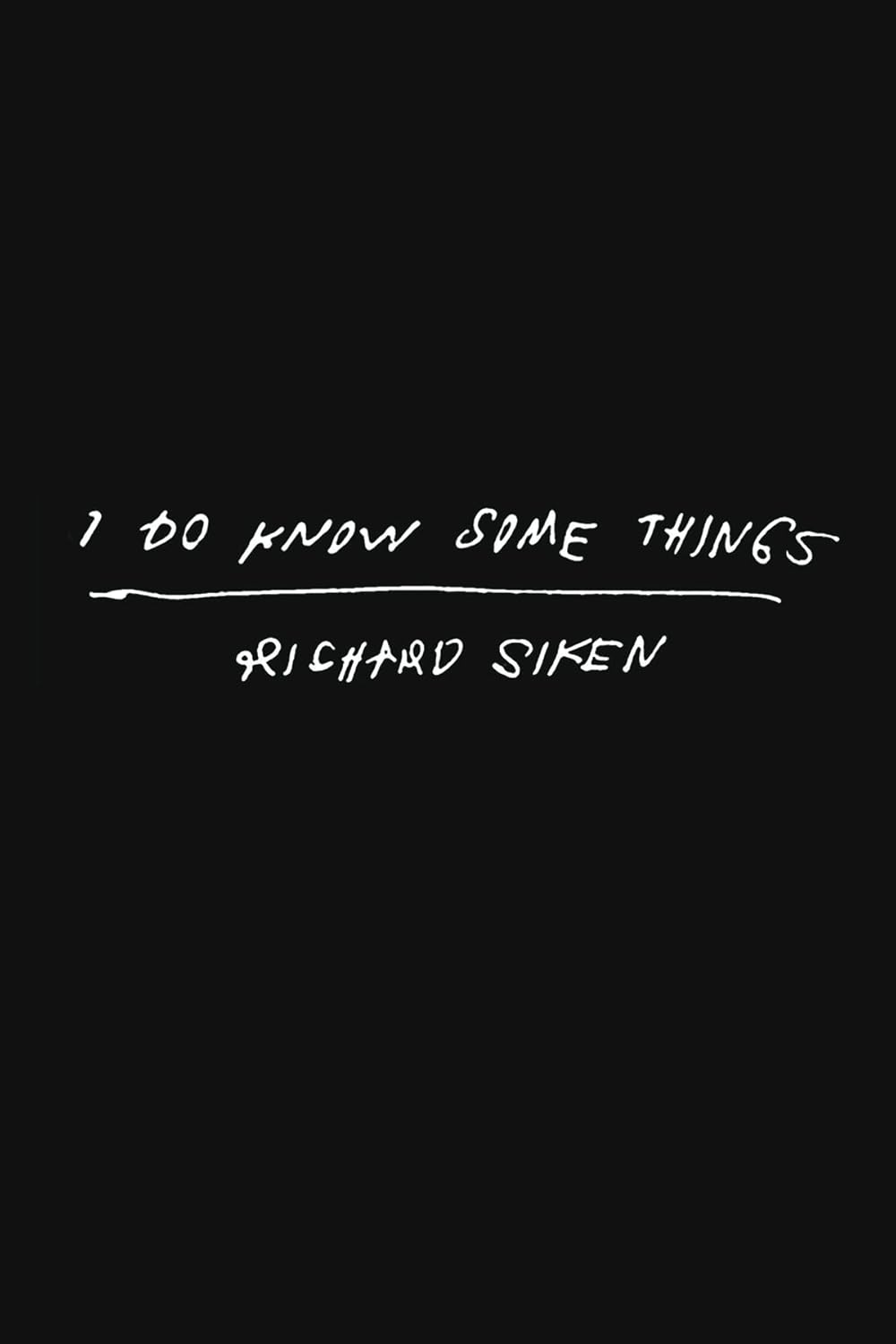
Richard Siken’s virtuoso third collection, I Do Know Some Things, Copper Canyon Press 2025, arrives as a righteous heir of Edson’s vision. The book, bloated with human truth and stripped of pretense, offers black comedy, lyrical excavation, and a persistent, forward-looking ache. Siken’s poems ask big questions and deliver their answers in fractured revelations, intimate collisions, and quiet refusals. They wield emotion and insight with fluency, even though the quotidian still demands that dinner be made at the end of the day.
The book is bound with rhetorical gravity, as in the poem “Hearsay,” where Siken writes, “That’s you, they say, pointing at a photograph… but they aren’t pointing at a photograph, they are pointing at a story, how this and that and something something. What does it take to own the myth? Why build a self from this? It makes me uncomfortable, my story––part insight, part anecdote––started by unreliable people at cross-purposes. And which photographs didn’t get saved? And which photographs didn’t get taken? I never figured out who named the cat but everyone took credit for it.”
Siken’s approach, like Edson’s, resists ease or complacency; his poems do not strive to please so much as to endure and expose the tensile strands of meaning stretched across memory, identity, and invention. Where Edson invoked the sheer will of his labor, Siken interrogates the architecture of the self with equal exertion, building and unbuilding the myths that underpin personal narrative. The power of I Do Know Some Things resists clarity in favor of authenticity. It rejects neat conclusions to honor the unresolved messes of human experience. Its poems confirm absolutism is a fool’s errand and mark another striking reinvention in Siken’s work.
Siken’s focus on effort underscores a poet in metamorphosis, with each of his books representing a different stage in his artistic evolution. As he advances from one collection, Siken pivots modes, reshapes concerns, and retunes his voice so thoroughly that each book feels like the product of a different mind. His debut, Crush—which won the Yale Series of Younger Poets Prize—offered raw, emotionally saturated confession, a book of desire and devastation. His second, War of the Foxes, shifted to a more cerebral register, where meditations on art and representation were treated with precision. Now, in I Do Know Some Things, Siken uses all that experience to examine illness, loss, survival, and memory. He has gone, as it were, from a principal figure skater to an adroit ice sculptor to a professional hockey goalie seemingly by will. Each turn coolly elevates the pursuit––so each book gets sharper, more nuanced. Siken achieves in three successive books what few great poets accomplish across a lifetime.
If the earlier collections circled love, longing, and artistic life, this third collection dwells in the aftermath—what remains when youth and certainty have collapsed. The death of parents, the decline of a body, the cultural and personal baggage we carry across time—these are mined not for closure, but for complexity.
I Do Know Some Things is relentlessly honest about failure. The failure to say exactly what you mean. The failure to understand love fully. The failure of personal knowledge and to be understood. And boldly, for a writer, the failure of language. Yet, through this vulnerability, Siken creates room for grace. As demonstrated in the poem “Strata,” he writes allowing for a poetics that embraces not knowing as a legitimate and even ethical stance, “We dig for artifacts and find a shard of pottery, a jawbone. We tell ourselves the story of a bright day in November. It isn’t accurate but we have to live as if some things are true. Landfill, I have a question for you, about the bones of things. Library, I have questions about the bones. Because everyone will die, die. Everyone will die. We rise into language for only so long before we fall back down into silence. It’s a small window, the span of time in which we get to say what we know.”
Siken suffered a stroke in 2019, an event that fundamentally changed his relationship to language and the self. The aftermath of this experience is deeply embedded in these poems, which simultaneously mourn the lost capacities of the body and celebrate the persistent, adaptive force of consciousness. In “Ventriloquist,” one of the book’s most affecting pieces, he writes of feeling like a dummy—voiceless, hollowed. Yet this supposed loss becomes fertile ground. The stroke robbed him of certain words and physical agility, but not of his poetic clarity or invention. Indeed, I Do Know Some Things teems with new metaphors, new phrases, new ways of saying what does not come easily.
“When you build on a graveyard everything is a graveyard, and everything is a graveyard because nothing is free from history,” Siken writes in “Redshift,” demonstrating the book’s quiet, brutal logic. Nothing is unscathed by the past—not the body, not the family, not the self. The speaker’s reckoning with a difficult father—professionally successful, cruel and unfaithful—is particularly harrowing. In the poem “Gun Case,” the father’s dying words are directed at his sons: “You don’t deserve to outlive me.” This is not merely trauma-as-content but trauma as form—the poems themselves carry the jittery, unpredictable rhythm of someone trying to both remember and forget at once.
Importantly, I Do Know Some Things is not self-pitying. Instead, it leans into absurdity and humor as a survival mechanism. Siken’s wit remains razor-sharp. The poems use surrealism to puncture reality’s veneer. Siken’s use of humor is a Trojan horse for delivering painful truths. These poems grin as they bleed. And unlike some of his contemporaries who retreat into the illustrious and performative, Siken always leaves the door open to genuine emotional risk.
Siken writes poems that embrace suffering like a Buddhist who drives a corvette. Live ascetically, fast, and free of the illusion of the self. “We are the stories we tell ourselves. I didn’t remember the story,” he writes in the poem “Doubt.” In forgetting, there is paradoxically a kind of freedom. If memory is unreliable, perhaps it can be rewritten. Or better yet, perhaps it doesn’t need to be. What matters is the capacity to question, to feel, to try again. These poems do not seek to recover the lost self—they seek to document the self as it reinvents itself in real time.
This refusal of closure is deeply modern. The poems resist definitive interpretations, leaning instead into an encompassing virtue about uncertainty, multiplicity, and contradiction. What matters is the motion forward, as “arrival is impossible,” Siken reminds us in the poem “Sentence.” Siken writes as someone who intimately understands that narrative, however fragmented, is our only way of navigating the chaos, as in the poem “Field,” which posits “So what are you doing? Ask yourself, seriously. Is this who you are? I didn’t like what I was remembering. You got some interesting clouds fucking up your sky tonight, amigo. There’s snow in my hair. My mouth is a dark line. This sweater has a zipper. The story becomes the field in which I become who I am. Who you are and who you think you are: They grind against each other.”
Siken does something rare in I Do Know Some Things––he restores significance to intimacy, to the personal, to the messy and mundane. These are not small concerns. They are the building blocks of a life. The prose poem, with its lack of line breaks and formal boundaries, mirrors this lived disarray. It is the perfect vessel for poems that sizably drift, veer, collide, and return— never quite in the same way.
I Do Know Some Things is Siken’s most mature, vulnerable, and daring work, although Crush dazzled with youthful urgency and War of the Foxes offered philosophical polish. This book could have easily been a salacious, discerning and best-selling memoir, but Siken does something more impressive and interesting by introducing a new way of being in language, using a collection that makes up its own constellations and is comfortable getting shipwrecked, admitting “I don’t know how to say it, so I’ll say something close.”
Siken, who once wrote with the velocity of desire, now writes with the depth of endurance. Rare is the book of poems where every entry finds the emotional core it seeks. I Do Know Some Things does just that, revealing what poetry can do when a poet is stripped of certainty. It is, without exaggeration, a book that will last and, more importantly, continue to mend, move, and astonish those who find it and, from the poem “Devonian Forest,” these words, “The beginning of a story—it isn’t the beginning, there’s always something that comes before. The first word in the Book of Genesis, in Hebrew, starts with B. It’s cautionary. It’s primordial. You have to be careful, things want to happen.”