Reading short stories sometimes feels like a niche hobby, like lepidopterology. It isn’t rare, exactly, to meet someone with your interests (winged insects, short fiction), but it’s not necessarily announced, not something that gets spoken in a first get-to-know-you conversation. As a person who cares about short stories—reading them, writing them—I feel a special kinship whenever I meet another writer who cares about short fiction, too. “Yes!” I think. “You get it! You understand how rich this form is—how experimental, delightful, weird, transforming.”
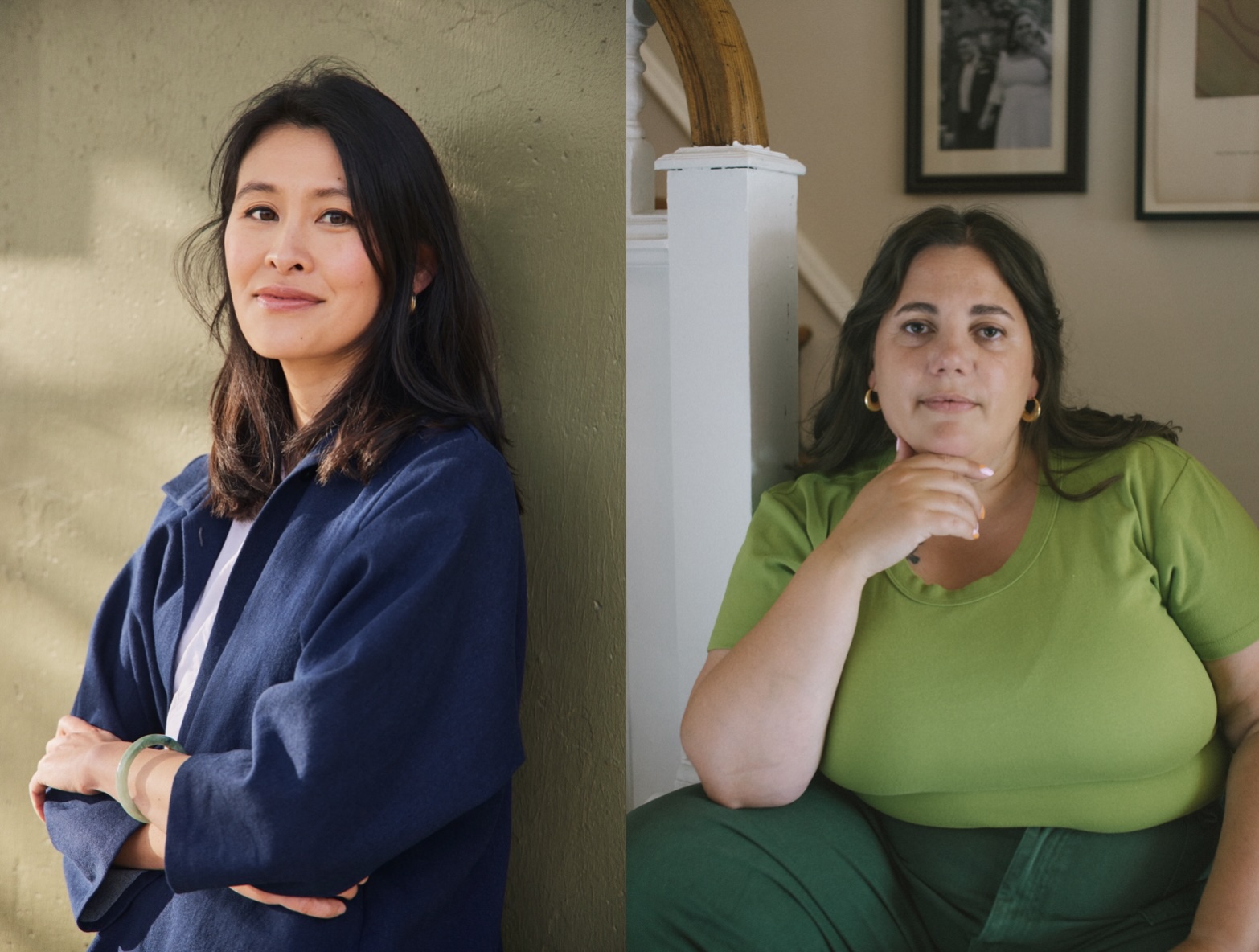
Emma Copley Eisenberg is a writer like this: immediate kin. I first met Emma because we both had novels published in 2024: Real Americans (Vintage) for me, Housemates (Hogarth) for Emma. We were part of an email group of writers navigating the strange, often absurd process of publication—comparing notes, celebrating, and commiserating. We live on opposite coasts (I’m in LA and Emma is in Philly), but we’ve thankfully managed some in-person time together: we’ve shared giant squid ink ravioli in New Orleans, and clinked drinks at a pink-upholstered gay bar in Pittsburgh.
If you haven’t read Emma’s essay, “Fatphobia is the literary world’s final frontier,” run to read it now. I’ll wait. In both her fiction and nonfiction, she writes with rare clarity, style, and conviction. Fat Swim is a collection bursting with some of the best writing on bodies I’ve read. Here’s what I wrote in my blurb for the book: “I love the way Emma Copley Eisenberg observes the world so precisely, attuned to unexpected—yet perfect—details. Fat Swim is lush with physical life and bodily sensation, vivid with textures and colors and temperature. Funny, mordant, and tender all at once—this is the rare book that exuberantly inhabits the human body, in all its grossness and glory.”
This April we, again, shared a publication season. My collection of stories, My Dear You, came out on April 7, and Emma’s excellent Fat Swim released on April 28. I loved this opportunity to talk stories with Emma. We did our “talking” via Google Doc.
***
Rachel Khong: Do you remember the first story you ever wrote?
Emma Copley Eisenberg: Oh yes. It was a retelling of The Twelve Dancing Princesses (I was a major fairy tale head and I think I was eight). I was reading a lot of Cricket at the time though too, and they were publishing some amazing short stories by kids. I never wanted to write novels or nonfiction as a kid or young adult or even in my MFA program: only stories.
Please tell me yours?
Khong: I was around the same age as you, I think. I wrote a story about a dead goldfish: Why the morbidity at such a young age? Who knows! I was also a major fairy tale head, and consumed them in many formats. One of my favorites was this Japanese anime series, retellings of fairy tales called Grimm’s Fairy Tale Classics; they played it on Nickelodeon. They did a version of The Twelve Dancing Princesses that feels essential to who I am as a writer, even now. I would still love to go dancing in my dreams. It hasn’t happened lately, alas. Mostly stress dreams.
Eisenberg: Truly. My neck, my back, et cetera.
Khong: What interests you about stories?
Eisenberg: I think they are life bombs, aka bombs of aliveness. They drop into your life and explode and then they’re gone. There is something about their quickness that makes their potency more shocking, I think, like a shock to the system. They wake you up. I’m obsessed with what they can do with time. Show me something more satisfying than a short story that covers twenty years in a person’s life or twenty minutes, both in six pages. But there was a time when I felt like I lost the story, when the idea of erecting a whole superstructure for fiction just felt so tedious and artificial. Fat Swim as a book is in some ways a document tracing my losing the story and then finding it again on my own terms—often sort of essayistic or meandering or monologuing.
What to you is a story?
Khong: I love “bombs of aliveness,” and couldn’t agree more. A story can change your day; it can give a different texture to it, like music can. I love precision and brevity in writing, and the best stories come in the smallest packages. I think of stories more like songs–more digestible, more manageable than novels. Yet they can also be totally life altering. I read a short story a day because it feels to me like a devotional practice: it orients me to the many different ways there are of being human.
Does writing stories feel different from writing novels—and why? What do stories allow for that novels do not?
Eisenberg: I started reading a story a day too because of you, so thank you for that. I love the idea of stories being like songs. The lyrics don’t quite make sense but they make you feel something. It reminds me of this conversation between Kevin Brockmeier and Kelly Link. “A narrative possesses daytime logic when at the end you can say, ‘This happened, and then this happened, and it makes sense, and I can explain why,’” Brockmeier says. “With nighttime logic, you say, ‘This happened, and then this happened, and it makes sense, and I can’t explain why.’” Plus reading a story is a different relationship to time than reading a novel. A short story can be read in the time it takes you to eat a buttered English muffin and an egg.
I had a teacher in grad school say that the goal of a story is to leave some cargo behind in a reader. I think that’s true and I think that short stories can do that in sneakier and stranger ways than novels sometimes, and in ways that feel more like life feels. I don’t think a story has to rise or fall in any particular way; I don’t even think it has to be a complete action or episode. I think a story is a complete emotional experience and at the end of it there is that cargo that is transferred from writer to reader, if all is working as it should.
Do you remember particular moments of reading stories where you feel like some cargo was transferred?
Khong: I’ve been experimenting a little with songwriting—getting back into playing piano and guitar—and have been finding that lyrics actually can’t make too much sense—they sort of fall apart when they’re too logical. I totally agree that the story as a form is so fascinatingly malleable—like the fact that a dog can be a Great Dane or a rat terrier. Stories can be so different, and that’s what makes them exciting to me.
In terms of transferring cargo, this is such an interesting question because what’s transferred feels less concrete than cargo—good stories feel like they become part of me, the way food does, or maybe they rewire me in some way. But I do feel like I understand your question, and the cargo transferring happened most aggressively when I was in my early twenties, still learning what kind of a writer I was, what kind of writing I was most interested in. Around then I discovered and loved Aimee Bender and Judy Budnitz—two writers who do not receive the flowers they deserve, in my opinion. Their work still carries through to mine today. I won’t name names, but I have a theory that men are rewarded—especially critically, in the establishment—for being sentimental, and women are rewarded for being cold. It’s still an impulse couched in misogyny.
Anyway! You have written across genres. How do you decide what form your writing takes? What does the deciding look like?
Eisenberg: I think it’s less of a conscious deciding and more of a following of the mood. Does this feel like something that is a place or an image or an argument or a question? A lot of my nonfiction comes from things I am angry about or things about which I feel I can see a little something that other people aren’t seeing or aren’t talking about. Fiction is totally different for me. With a novel, I have a conscious but inarticulable need to know more or understand more about something—a situation, a feeling, a complex problem. A story usually starts with an image or a phrase. The multi genre writer Grace Paley said, “In areas in which you are very smart you might try writing history or criticism” but “where you are kind of dumb, write a story or a novel, depending on the depth and breadth of your dumbness.” This has essentially tracked for me.
But you play with genre too—while mostly all living in the fiction area of the bookstore, your books have RANGE, moving between the satirical, the dystopic, and the family saga. How do you make decisions about scope, tone, and relationship to “realism?”
Khong: I will follow Grace Paley anywhere. I hadn’t heard that quote before, but I love it. I feel very dumb; I find it preferable to believing I’m smart. It’s a different orientation in life, one that is more curious and open. Whether I’m writing a story or a novel, I’m trying my best to stay open to what the work wants to be. I’m trying to listen to what the work and characters want to tell me. I know that sounds a little mystical, but I think it’s not necessarily all mystical, it’s also bodily. I know when what I’m writing feels right in my body, and I’m always trying to write toward that feeling of rightness.
Let’s talk about reading stories. What are some of your favorite story collections and authors?
Eisenberg: The first story collections I admired were Raymond Carver’s Where I’m Calling From and Lorrie Moore’s Self-Help. It took so long for me to stop writing very bad second person stories. Grace Paley’s The Collected Stories, George Saunders’ Tenth of December, and One! Hundred! Demons! by Lynda Barry are basically perfect books in my opinion. Miranda July’s No One Belongs Here More Than You. Elizabeth McCracken’s Thunderstruck. I used to re-read Mary Gaitskill’s story “The Other Place” once a week or so, which is maybe a bad thing to admit; ditto “A Sheltered Woman” by Yiyun Li. Black Tickets by Jayne Ann Phillips. A few more recent collections I’ve loved (besides yours) are Sarahland by Sam Cohen, Lot by Bryan Washington, and A Lucky Man by Jamel Brinkley.
What story collections that just came out or aren’t out yet are you most looking forward to?
Khong: Obviously, Fat Swim! And I’m curious about The Memory Museum by M. Lin and One Sun Only by Camille Bordas. I’m also excited to read That May Not Mean What You Think by Elizabeth Crane and Day Care by Nora Lange.
Can you describe an origin story for one of your stories in Fat Swim?
Eisenberg: One of the stories is called “Beauty” and it’s dedicated (pejorative) to Jonathan Franzen. The main character in Franzen’s novel Crossroads is named Marion, and she is introduced to the reader as “the overweight person who was Marion.” “Sexually,” Franzen writes, “there was no angle from which a man on the street might catch a glimpse of her and be curious to see her from a different angle, no point of relief from what she and time had done to her.” Writing out of spite can be a powerful motivator. I wanted to write a character named Marion who would be fat and sexual; I wanted to make the reader drip with excitement to see my Marion from every angle. At the same time, I found this YouTuber who made very odd and very slow videos where she just watched fish swim in a tank and then one where she combed her hair in the sun. She clearly lived in an extremely rural place and she talked in one about how hard it was for her to upload the videos because of a basically nonexistent internet connection. I got sort of obsessed with her and wanted more from her but there were no more videos. I got to thinking about that desire in myself and then that desire merged with my Marion fantasy and the story was born.
Khong: Your stories are so rich with detail… Can you talk about observing the world, observing people (and practically–how you keep track of it all)?
Eisenberg: I feel the same about yours, obviously, which is especially interesting in a speculative context maybe. But hmm, I think seeing is an essential part of the writing process for me. I have to see a thing to believe it is real or has the power to do something within a story. Writing “hairbrush” does nothing for me, but writing “purple plastic hairbrush” does. My memory is terrible for facts but I find I can root around in it for objects and images and those come back quite complete and vivid. I rarely write about a house or apartment I’ve never lived in, but I also love making up clothes I’ve never owned and foods I’ve never eaten. I like to shop and eat but I’m kind of cheap and kind of a homebody.
Can you tell me about something in your writing process or writing flow that gives you pleasure, that you can reliably tap to have fun?
Khong: In The Gift, Lewis Hyde writes, “The passage into mystery always refreshes. If, when we work, we can look once a day upon the face of mystery, then our labor satisfies. We are lightened when our gifts rise from pools we cannot fathom. Then we know they are not a solitary egotism and they are inexhaustible.” When I’m writing I crave that feeling of not-me-ness—that feeling that the writing is created in collaboration with some mystery. So I have a lot of tricks for trying to get myself into that space: music or sound that’s a little trance-like, journaling before I write in order to not feel as precious about the writing. I also really love The Phantom Thread soundtrack, and a lot of my writing has been created while listening to it on loop.
How do you know when a story is complete?Eisenberg: Darn. I think for a novel I usually know instinctually, it just is. But stories feel more cerebral to me somehow (does that contradict what I said earlier about them being more “nightime logic”? perhaps!) on a technical level and I can usually see the single thread of the story more clearly, so I can be more analytical about what is missing or what is extraneous. I usually end up re-writing the ending a bunch of times. I think one thing I tend to do is slightly overshoot my ending, i.e. write past an explosion of feeling or action into something mundane and then I need to cut and re-find that bang that is the true ending. I love stories that simply clobber you with the last line, where there is no room to breathe because the last words are so intense and you are racing, racing to keep up, and then you end right there, right up at the edge.