“Dear Editor: I wish to inquire for the women in me…I want to find my people.”
Lost Friends, Room Swept Home
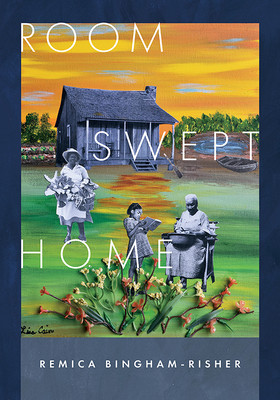
Remica Bingham-Risher’s award-winning, fourth poetry collection, Room Swept Home (Wesleyan University Press, 2024), starts with a letter to the editor, setting the tone for a paradigm-shifting journey into her ancestry. Spanning three centuries to present day, Room Swept Home escorts readers through the experiences of her foremothers in rural and urban Virginia. This collection’s five parts expound the documents of Black life in America’s history, touching on mental health, racism, family, and identity, and recalling loss, joy and triumph. Through her nearly decade-long archival research, which included documents, photographs, and interviews, we learn the questions that motivated Bingham-Risher’s quest to inquire about and find her people, to—as she puts it in the prologue—“make the dead become the living.” The poems stand in for her inquiries and also interrogate the systems that enabled harm against her ancestors. From her inquiries, we receive direct, unsentimentalized lyric—filled with spirit and judicious in its use of metaphor—that gives homage to her ancestry and the places they lived.
The collection uses the epistolary to encapsulate the time and space spanning symbolism of this work. As letters travel through these poems and in the archive, they record past and present, as well as the arriving futures already lived. “Lost Friends,” the collection’s first poem, takes the form of the classified ad used by formerly enslaved people and their families to find each other in the days and decades after emancipation. And as those ads symbolized hope and provided markers to help reunite families, Bingham-Risher, in “Lost Friends,” presents a somber forewarning:
“Note. – We receive many letters asking about lost friends. All such letters will be published in this column from the end of the Civil War until those in need stop looking and, if this isn’t the case, in perpetuity.” (emphasis mine)
The pressure to stop looking into America’s history has never been more present than it is today. But the poet’s job (albeit all artists) is indeed the insistence on the closer, critical look at our history, to create a space for those “in search of” and to do so in perpetuity.
Letters resurface in the poem “Night Class, Peabody High School, 1936,” a ghazal where the repetition reinforces the crucial role literacy played in social progress, recording memory, and the search for family and place. In fact, Part I’s epigraph comes from Bingham-Risher’s third great-grandmother, Minnie Lee Fowlkes’ 1937 interview with the Federal Writers’ Project:
“I just know I could if I knowed how to write, and had a little learning
I could put off a book on this here situation.”
The poem’s repetition also exposes a strength of this collection—Bingham-Risher’s ability to craft a poem within a poem. Taking the final clause of each line, we find a revelatory trove:
been counting for years but never had letters […][…] What will they make of corroded teeth and letters?
They understand letters […]we’re their unplanned letters […]tracing freehand letters […]their stone-clad letters […]
Each line urges its own set of questions. How to reconcile being an “unplanned letter” — is this future-telling, or regret, or hope? [T]heir stone-clad letters juxtaposed against familial flesh and blood bring to mind stone’s durability across time, a geological metaphor that reveals what is lasting, what is kept. One cannot read the poems in this collection without pausing at such lines to contemplate each one’s meaning for Black people in the US and across the diaspora.
The collection is fully realized at moments when inquiry drives the poems. In Room Swept Home, a subset of the Federal Writers’ Project (FWP)’s more than 300 questions asked of Virginia’s formerly enslaved, including the poet’s third great-grandmother, are presented as the list poem, “Questions That Still Need Answering.” Initially, the questions in the poem appear innocuous—age, number of children, etc. What is notably absent, however, is the most common first question of any questionnaire: Name. The collection is perhaps immediately, and silently, confronting our relationship with names. What questions can or can’t be answered without a name? Is this gnawing absence of name mirroring the Middle Passage? Or a nod to names lost in the Middle Passage? Ingenuity and necessity suggest we offer stories, birthmarks, mannerisms, hairlocks, and pieces of worn fabric. That we hold tight letters, keepsakes, any knowledge that might lead to answers (and people) we seek. At the end of the poem, the questions expose the sentiments of the predominantly white interviewers. For instance:
“189. Did slaves ever practice contraception?”
The questions also become more challenging to answer, yielding more questions:
“322. Did you or your people build a home after freedom?”
What is the period after freedom? Is freedom finite? What is meant by home?
The Federal Writers’ Project emerged only after a group of Florida-based Blacks began interviewing formerly enslaved peoples in the region. One of those interviewers was writer and memory-keeper Zora Neale Hurston, whose book “Baracoon” is based on her 1927 interview with Oluale Kossola, presumed to be the last to survive the Middle Passage. (Ninety-one years later, the work was published.) The time-lapse between question and answer, dead and living memory, record and manifestation gives new meaning to the word baracoon, from the Portuguese barraca, referring to holding cells where kidnapped Africans were processed for transatlantic slave trafficking. What memories or experiences of the lost still wait to be processed by the living? What questions that emerge in the wake of the slave trade remain unanswered?
Room Swept Home is as much about physical place as it is a metaphysical offering. The geography and topography of America— its tobacco fields and plantations, its asylums and homes, its churches and dance halls, places where Bingham-Risher’s people “dance for joy, dance for love,” intertwine with lines that time-travel liminal spaces of Black life, like in this line from the poem “Catching Babies”:
“I see through their bodies into another life. You free, I tell them, You free.”
Grandmother Minnie’s midwifery becomes the poet’s midwifery, shepherding us between past, present, and future, between the physical and spiritual. Sure, Grandmother Minnie knows that “another life” is the fetus within the womb. However, the collection also argues that “another life” refers to a counter-narrative life of possibility. “You free” becomes a declaration, a command, and a naming of this new life in a new realm. This temporal enmeshment is delightful, intriguing, and an important device that illustrates how Black existence (and our writing of it) can simultaneously teleport, serve as telepathic communication, and ground us in the present. This unencumbered movement through time and space in slavery’s afterlife situates us outside of Western thought’s strict linearity—we are in another life. We are free.
***
When we meet Mary Etta Knight, Bingham-Risher’s maternal grandmother, in Part II, there is no birth story. We start fifty-two years before her birth at the Central Lunatic Asylum for the Colored Insane, founded in Petersburg, VA. The seventeen-line, double-spaced poem, with its short lines, signals a shift in tone, style, and content in the collection. The first-person plural enters with a tender, ancestral declaration of what the Asylum is, its offerings, and its purpose. It was here that Mary spent two months and thirteen days with a diagnosis of “water on the brain” (postpartum psychosis). Throughout Part II, Mary’s voice is woven with the poet’s voice, a lyrical quilt. Even though Mary is alive well into Bingham-Risher’s 20s, one gets the impression that learning about her life was no easier than learning about her grandmother, Minnie. This is no fault of the work. For contemporary poets, working with archives, particularly living archives, opening our elders’ memory boxes presents its own set of challenges, requiring patience and compassion.
“Dear Doll” continues the epistolary scaffolding of this collection and exposes the emotional weight and restraint Black women exercise to survive, and its effects on mental health. Here, strikethroughs in the text symbolize a tongue-biting survival mechanism. (Bingham-Risher reads this poem beautifully in the audio version of the poetry collection.)
Married life is
nothing like I thoughta different life […]Gotladies of the night, urchins hustlingdancing […]Found a church withhalfwaydecent folks.
“Master Index: Case Record” draws from and reimagines the intake record from Mary’s commitment to the asylum. Bingham-Risher does not sentimentalize or trivialize her maternal grandmother’s mental illness. What she does instead is permit us to see Mary’s rich interior and exterior life through the duplex “Two Months and 13 Days,” the song-inspired “Tweedle Dee, Lavern Baker, 1955,” and her night out dancing the Charleston in “Mary perfects the Charleston, recalling it for the next eighty years.”
The most awe-inspiring poem of this collection, one that defies traditional notions of time, space, and memory as illustrated in Toni Morrison’s essay Site of Memory and Saidiya Hartman’s notion of “critical fabulation,” is the poem “Perhaps Minnie Sees Mary and Prays for Her Safekeeping.” Found at the end of Part I, “Perhaps” engages crosses temporalities and geographies in a way that is both familiar to the Black experience and necessary for its survival. “Perhaps” details the moment that Minnie and Mary’s orbits come closest to each other (until the arrival of Bingham-Risher 40 years later). The year is 1941 — the eve of the US’ involvement in World War II and four years before grandmother Minnie’s passing. From her porch, grandmother Minnie sees “a colored child, a girl” —Mary Etta Knight, barely 20 years old — cuffed in the back of a silent police car en route to the Asylum just three miles from her porch steps. Minnie blesses the passing with a prayer for Mary to return whole.
The poem begins with the adverb “perhaps.” Its etymological roots in Latin, French, and Old English suggest it was used to denote luck or chance’s role in life’s occurrences. Today, it’s often used to cast doubt or call into question. In this poem, however, it connotes possibility. Years ago, my theater teacher said during a scene study, “Entertain the possibility that something else could be occurring,” as a way for us to be present, curious, not prescriptive in our acting. “Perhaps” asks us not only to entertain the possibility that the dominant narrative is insufficient, but that the key to our free is in our curiosity, our interrogation of assumptions about who we are, where we are, how we are. In fact, in “Perhaps,” the impossible becomes possible and is.
With “Perhaps,” a new telling with its own “face and mind” emerges. This poem presents time as moments of crossing and circling back. All of Bingham-Risher’s foremothers’ experiences cross and issue from this point, making sense of the present. In the last four lines of the poem, the temporal and spatial realms collide in grandmother Minnie’s prayer:
maybe string and cord will ferry her
through reef and peril and vine
I’m hoping she’ll come back by me whole
in a stormless place, an abundant time.
1941, the past, her present, the future, and the distant future “she” — could it be the poet? — meet in grandmother Minnie’s moment of prayerful time-travel. Even the internal rhyme (“vine” and “time”) sears this prayer into stone. When and where is this stormless place and abundant time? Could it be that Mary returns whole in this collection? The poet? What does that say for how poetry and archive can resurrect the dead?
Part III, “What we had to pass through to get here,” signals another kind of middle passage, and is a sobering reminder of white supremacy’s persistent wake. In these seven poems, we are presented with what scholar Christina Sharpe calls “the past that is not yet past,” ultimately begging the final question of this section:
“O Master, O Maker, aren’t you/finished yet?”
This insidious, seemingly infinite wake is exemplified in the poem “25 days after I am born.” Set in the context of a young Black man’s murder in Mobile, Alabama, the poem reveals the gestures and memories that he and his family will no longer make. In the wake, Bingham-Risher centers humanity to the devastating shame of the systems and people that enable horrific acts. This is the task of the poet: to resurrect and not cause harm in the resurrection. This was Bingham-Risher’s task even as her excavations revealed the violence of America’s whitest citizens. She presents humanity, shows us the guardswomen who preserve the lineage, who insist on tenderness, and bodied futures: “In heaven, I’ll have my body.”
The sixteen sonnets that make up Part IV’s “Lose Your Mother Suite” —named after Saidiya Hartman’s work by the same name—are lyrically captivating. The contrapuntal, ghazals, and sonnets leave their mark through repetition (each final line becomes the first line in the subsequent sonnet), rhythm, and well-placed rhyme:
I am called/Black here and elsewhere, but mostly known as/strange. All of the women I am dragging to the surface/perhaps against their will, to kill and kill but name[…]” (italics mine)
Bingham-Risher’s thoughts on process (“Going back was like / a wound opening”), and her responsibilities in engaging the archive to create art (“If you lose your mother, tongue, /are you a new beginning?”), her fears in the work (“going back might kill you,” “I am scared my mind will turn on me”) emerge. She makes real the patterns that shape Black women’s experiences, their choices across time. We learn in the suite that the past has its own dirt, its own ruin; who’s mess is this, it questions. Who makes it clean? Inhabitable?
In Part IV, the poet is not just an archivist, historian, cartographer, alchemist, or domestic, but also a surgeon and infectious disease doctor, cleaning out and tending to internal, external, and transgenerational wounds. A monumental task that in the end only brings more questions:
What can we make clean?
Was I the world changing, daughter come apart?
God, where you been?
What will die with me? What will live again?
When are the women allowed to grieve?
What do we “make clean” as we move through our ancestry, through this nation’s past that is not past, from dust to dowry to tender and held? I return to what Christina Sharpe calls “wake work”—ways of attending to Black life in the wake of the slave trade. This creative engagement with the archive, what poet Tamara J. Madison coined as “lineage literature,” (poetry and non-genre abiding works steeped in family archive) is wake work. It makes room for what must become visible, what must be re-presented (made clean), swept out, and ushered in. Engagement with lineage moves us through this wake. Its power lies in our ability to do what Bingham-Risher has done here—make the dead come alive, whole.
By the end of the collection, her grandmothers’ voices return, and we are placed in the midst of a turning storm. But this storm is not destructive—it reveals. It heals.
“what little love/the world had/kept me alive”
All the artifacts, keepsakes, letters, and memories gathered into an honorable “spirit bundle” for our journey.
Bingham-Risher’s collection reminds us that the poet has many skills to employ. It follows work engaged in lineage and archive, like Lucille Clifton’s anthologized collection Blessing the Boats, Natasha Trethewey’s Native Guard, and Jericho Brown’s The Tradition. As official documents and studies pertaining to Black life in America are purged from government archives, libraries, and institutions, such work becomes more critical. The journey requires much. But, to answer the call (“Bring us back. Say we lived”) will yield fruit beyond our own space and time, or as grandmother Minnie voiced in Perhaps, will return us whole in “a stormless place, an abundant time.”
The collection comes with a bibliography, a notes section, and illustration credits and testifies to the rigor and integrity of the collection. It is a testament to Wesleyan University Press’ support of Bingham-Risher’s vision down to the touch, feel, and cover art of the collection.
If you have the opportunity, listen to the audiobook of Room Swept Home, dynamically narrated by Bingham-Risher. The aural and lyric choices she makes add another dimension to the work. Her offering is worthy of every syllable, every sound, every voice that comes through it.