
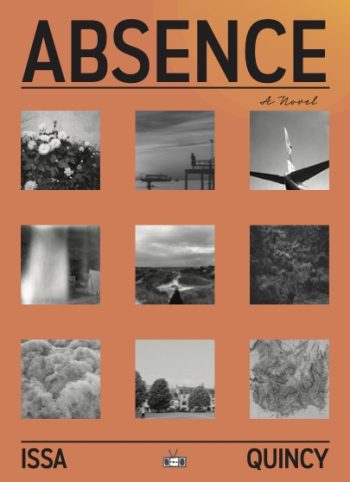
I looked everywhere for Absence. Days passed before I found the small orange book, written by Issa Quincy, nestled between a dictionary and the floor of my office. I picked it up and read it again. The book, released in July, is Quincy’s ambitious debut, in which an unnamed narrator serves as the vessel for a loose tapestry of outsider stories, rendered in prose simultaneously precise and insufficient.
Like the best works of literature, Absence exists just beyond where your feet can touch. Quincy and I connected over Zoom to discuss writing, intuition, echoes, and that which is not said. Naturally, the conversation includes many echoes itself. It has been edited for length and clarity, though tangents remain.
The Rumpus: My first question is about the book’s unnamed narrator and the decision to keep him so abstract. We don’t learn much about him besides the fact that his parents are dead and he feels like he has disappeared. I would love to hear more about that creative choice, as it feels so core to the novel.
Issa Quincy: It was one of the few decisions I made when writing that I began with and stuck to. Although I didn’t plan the novel and never really plan work in that way—I kind of just write with the feeling and I like the act of discovery—there was something I knew intuitively about the novel, which was that it had to do with listening. In order to foreground the characters and the interactions the narrator was having, the narrator almost had to be invisible. And there’s a line in the novel, in the first few pages, which is that “listening is where language both ends and begins.” That, for me, was quite central to the ethic of the narrator. It was this push and pull of allowing something to appear or emerge, while the narrator sinks back. A sort of vanishing and appearing almost at the same time. That, to me, was something to do with language and listening, but also witnessing. In order to sustain that kind of interest in others, the narrator had to be self-effacing.
Rumpus: I read in previous interviews that you said you were led by a kind of dim intuition while writing. I’m curious what else you did know about the novel going in. For instance, were you always planning to have the novel be an archive that took multiple forms, with letters and diaries? Does following intuition apply to form as well?
Quincy: I think so. The thing about dim intuition is that you feel as though you don’t know anything, but there is something that you do know. I think I always knew that I wanted it to be a novel about others and about rescuing something. Maybe that’s too moralistic, but I wanted to sort of grasp at something that was vanishing. That, for me, is not only the person in the stories and the way they sculpt themselves with their own language, but also the kind of ephemera of materials that make up that life. Something that’s always seemed miraculous to me is the passage of objects. [There’s] the silence of objects, but also the sort of noise they’re imbued with. When I was living in New York, I lived near this antique store, and they used to buy estates from deceased people. They’d buy all sorts of stuff: furniture and objects and paintings and things. But they also had boxes of letters, and I used to love collecting them. I have some here, somewhere in one of these drawers. You’d find the most incredible things and the most insane sort of letters from the twenties and the thirties and the forties and the fifties. Holding those objects always felt to me kind of miraculous and improbable. That tracedness and the weight of humanity that’s in the object was so profound and so moving and really central to the ideas of the novel.
Rumpus: I would love to hear about the selection of the poem that appears in the book, “The Ballad of Reading Gaol” by Oscar Wilde. I’m curious about two things: First, you’re a poet yourself, so I was curious if you considered creating a fictional poem for the sake of the story. But also, I’m curious about the decision to choose this poem then, like the narrator, never name it or show it fully.
Quincy: The poem initially existed in one or two of the stories, and during the editing process it became something more prominent than I had initially intended it to be. At first, it had been an echo of one of the stories, and then I realized, as I finished the whole thing, it actually echoed the themes of the entire novel. The context of the poem is that Oscar Wilde wrote it in exile in Paris after he’d gone to prison for gross indecency with a man. Oscar Wilde died in disrepute. He was this once high socialite in London’s theatrical circles and died basically a pauper in a bed, drinking, alone and rejected by everyone. But I don’t even think you need to necessarily know the context of the poem to feel the kind of echo that the poem has of the themes of otherness, exile, imprisonment, a desire for liberation and emancipation from those kinds of systemic forces. It seemed to fit with everything else and it kind of provided a throughline that threaded the stories together.
Rumpus: That’s so interesting because it’s hard for me to imagine the novel without the poem. It really does encapsulate it. When I was reading about the poem, I kept coming across this notion of a prisoner-poet. Do you feel like the narrator himself is a prisoner-poet, or is he listening to these prisoner-poets he’s encountered?
Quincy: It’s an interesting question. For me, a central question of the novel as well is language and the failure of language. I think many of these people are imprisoned by language and their inability to say what they want to say or remember what they want to remember. My grandmother used to say there’s no coincidence that a sentence is a sentence, but also a prison sentence. And we’re all, she used to say, sentenced to our sentences. In a way, the narrator is not really the prison warden, but the one who’s kind of revealing all of those things.
Rumpus: The revealing is done through such beautiful prose too. It’s so careful and rhythmic and strikes a delicate balance of giving so much while also withholding. But one of my favorite lines in the book is from a character’s notebook, Thinking of Patrick. It’s such a simple sentence but, in context, contains echoes, because multiple characters have that name, which itself echoes the schoolteacher at the beginning of the book who had formative encounters with two boys who also shared a name. How do you go about inserting or discovering those echoes in the text?
Quincy: You know, I didn’t even realize until I was doing a talk the other day, but someone brought up the fact that there were so many similar names, like Patrick and Patricia. I hate the term fate, and I hate the term coincidence as well. Fate is way too rigid and coincidence feels too loose. I was trying to find the in-between because there is something. I worked for a psychoanalyst in Boston for a bit and he taught me all about strange things. He would talk to me endlessly about quantum physics and taught me this thing called entanglement theory, which is the idea that there are often two things happening at the same time, and they eventually get drawn together or into collision with each other. You can also think about it like a tide pool. We’re all sort of whirling around in the same thing and perhaps these synchronicities, they are coincidences, and they are completely random, but there does seem to be some sort of symbolic meaning to them in life. I’m always so struck by those strange moments of intersection. It’s like the world collapses and becomes very small. I think the recurrence of those names gives the world a kind of phantasmic or spectral gloss. There is something haunted and repeating. Even if it’s kind of disparate, there is something connected and connecting all these things together.
Rumpus: Actually, a synchronicity that I encountered with your book was that right before I read it, I stumbled upon a free little library and picked up Artful by Ali Smith. I noticed that she was in the acknowledgments of Absence. I’m curious to hear more about her impact on the novel.
Quincy: Artful is my favorite book of hers. Ali was one of these strange synchronicities. I had a friend who knew her. She’s always been a mentor/friend to me. She’s in her eighties and she’s a very brilliant, eccentric, amazing woman. I began writing for theatre and she would come to my plays and always try to help me. Eventually, through her, the manuscript ended up in Ali’s hands—a very, very early draft. I didn’t really think much of it. It’d been like two or three months and one day I was in Italy, and I got this huge email from Ali. She’s so generous in her writing and she’s so generous as a person. I can’t believe she was because I re-read that early draft that she received, and I was so ashamed that it got read by Ali Smith. But she basically found one point in the middle of the book and said you need to rethink the focus of this. It blew open the whole novel somehow. It was the smallest bit of critique, really, and the whole thing was suddenly clear to me.
Rumpus: That’s fantastic. Another hyper-specific question: Why did you choose to use italics as opposed to quotation marks? It seems to me that the decision relates to the themes we’re talking about, but I would love to hear how you were thinking about it.
Quincy: You’re actually the first person to ask me that. And I thought, when the book came out, so many people were going to ask me. It’s actually something quite boring that I took from Tolstoy and The Death of Ivan Ilyich. There’s a point in the novel where the narrator is remembering what someone said to him, and it was in italics. Because [Absence] is all sort of refracted through the narrator, there seemed to be an improbability about the narrator remembering it all exactly. The italics were a way of opening up to its artifice. It’s a recollection of a recollection, to hint towards that layer of separation.
Rumpus: Has there been anything in doing readings and book talks that has surprised you about people’s response to the book?
Quincy: Hmm. I think the most surprising thing is people understand it better than I do. I’ve read reviews and spoken to people and I’ve been like, “Oh wow, you actually can articulate that better than I could.” That’s maybe what literature is about. The meaning making happens when someone reads it.
Rumpus: There’s a certain transience to the book as well. It made me think about how I sometimes have sparring notions of what it is to be a writer. Sometimes I think I must be a recluse who lives in the woods and never speaks to anyone. Other times, I think I must be in a new place and constantly traveling. I’m curious how your own travels or the day-to-day flow of your life affects your work and this novel, directly or indirectly?
Quincy: At the time of writing, I was drifting between a bunch of different places. Homes that weren’t really mine. That sort of wandering, drifting spirit bled into the work a lot. I’m kind of a wanderer and I like that. I like to be on the move. There’s something so calming for me about traveling. But I really always love novelists who have one place. I love Joyce’s Dublin and Hardy’s Wessex and I always wanted to have that in my writing. But that wasn’t honest to me. There has never really been one place. I mean Oxford, perhaps.
Rumpus: Does Oxford feel familiar and mundane to you? As an American, it seems so magical.
Quincy: Well, I never went to the university. Growing up there, it was full of closed, locked gates and tall walls. It’s a life within a life there. This sort of strange hidden world within a world. I knew the city around it, but actually, Oxford University was completely foreign to me. I knew nothing about it. It was this closed-off, gated community in the center of the city that you knew existed and you knew was there, but you had no participation in it. And to be honest, I’m not particularly interested in Oxford University. Everything you hear about Oxford has to do with the university, but there’s so much around Oxford that exists: immigrants who work in car factories, asylum seekers, aristocrats who live in the big farmhouses in the country, people living in tower blocks and rioting. I think that probably has impacted me a lot. Growing up with that in close proximality, you notice it more in other places. You notice the worlds within the worlds.
Rumpus: There’s another line from the novel that I love: “We don’t stop ritualizing until we forget it, and after that it is forgetting that becomes ritual.” I am curious to hear you talk about the relationship between writing and ritual for you.
Quincy: I don’t know that for me writing is ritual but it is something that I do to breathe. If I don’t do it, something’s not right. It’s not a compulsion, it’s sustenance or something. It’s how I work through the world perhaps. It’s thought in and of itself for me. And it’s exploration always. It’s exploration of the external world, but also my internal world, and oftentimes those things are shadowy and in darkness. And so, I can’t reach them unless I begin to write. But perhaps other people looking at me would say I’m quite ritualistic about it because I do write every day. And I have to be in a room like this, which, other than the painting there, there’s very little on the walls. I have to be in a room where I can close the door. But then I actually have all these strange images in front of me. It is sacred to me, but it’s also deeply boring.
Rumpus: Why do you think fiction is important right now?
Quincy: I think fiction is important because it’s fugitive. You can be on a train next to someone and they’re reading a book, and you have no idea what’s happening between them and that book, and that is incredible to me. It also, perhaps, uncovers something that’s hidden. The best books for me are [ones in which] I felt some kind of flash of light across something that I didn’t see within myself or didn’t notice in the world [until] someone else has put it into words for me.
Rumpus: I’d love to hear more about what you are working on now.
Quincy: I’m working on a novel that provisionally is a tale about domestic betrayal. It’s set again between the UK and America, primarily, and deals with familial deceit and secrets. But it’s really kind of exploring, again, the limits of what is knowable and the limits of what is sayable. But particularly knowable. It’s kind of an epistemic novel in that way: thinking about knowledge and the bounds of it and the limits of it and the dis-transmission, the mis-transmission of knowledge. What isn’t passed on. What is unsaid. [Also,] I think after Absence, I wanted to narrow the scope a bit.
Rumpus: It’s not hard to narrow the scope after Absence, especially for how short of a book it is. You probably couldn’t have covered any more ground than you did in that amount of space, both in terms of geographical breadth, but also historical.
Quincy: It’s not particularly difficult, you’re right. But I wanted more concentration on one thing as opposed to an exploration of all things.
Rumpus: What works informed Absence, and what books would you want Absence to be read alongside?Quincy: I write plays and love theatre and that was a big influence in terms of voice and monologue and things of course. Poetry as well is hugely important. I love film. I worked in film for a long time. But to answer your second question, I would love my book to be read alongside anything by Thomas Hardy. Thomas Hardy always foregrounds landscape in a way that I admire. Everything else kind of bleeds into the landscape, but the landscape is at the front, which is not that common actually. For a lot of writers, landscape is a character or just the vessel. But for him, it’s always here ahead of everything else. It reminds me of some paintings that I love as well, particularly a painting by Jack Yeats, who was W.B. Yeats’s brother. His [Jack’s] latest works often depict figures in the wild Irish landscapes, but it’s sort of abstract expressionist, and you almost really can’t make out the figures. You can vaguely if you’ve squinted at the work, but they’ve sort of melted into the land, into the earth. That is something I love and that I would love to think about in my own work in some way.