The Brits said they wanted to have all the quintessentially American experiences while they were here. They’d been in the country four months, if Nebraska counted as really being here. Joelle had a post-doc in the university’s research greenhouses, a two-year stint; it seemed like enough time. We asked what they meant by quintessential. We wanted to know what they thought of as American.
“Statue of Liberty shit?” I asked.
“Mass shooting,” my husband said, popping another giant cocktail ice cube from its silicon tray.
That the Brits were tickled by our irreverent humor made us feel deeply affirmed—some centuries’ old Anglophilic hangover, even as Adam and I believed ourselves the kind of earth salt that eschewed upper class aspirations for moral reasons. Still, I felt the desire to court the Brits, impress them, seduce them. It had something to do with the accent, but something also to do with their matching thinness and attractive faces, Joelle’s curt bob, Donovan’s front tooth, off kilter. They could have been siblings, which is something people have said about me and Adam, too.
We had Joelle and Donovan over on a Thursday—I had a Tuesday/Thursday teaching schedule in the university’s English department, Adam had a work week of four tens, and Donovan worked in some remote web-design capacity for The Guardian. Only Joelle had to report for work in the morning, and we had bullied her into attendance.
“I don’t know,” Joelle said, “New York, obviously. Los Angeles. Texas.”
“Texas, god,” I said.
“Cowboys!” Donovan said.
“Do your accent,” Joelle said.
“Howdy,” Donovan said.
I laughed so hard my eyes closed. “That’s all you got? Howdy?”
I had excellent accents, I told them, especially my British one, derived entirely from Audrey Hepburn’s cockney in My Fair Lady, which I’d had on VHS as a child for inexplicable reasons. The thing about Americans doing British accents, I told them, was that we tended to go up an octave, an attempt to approximate some chirpiness, some pattern of intonation we could perceive but not quite pin down. They urged me to perform the accent. I blushed and told them I would have to spring it on them later, when they were unsuspecting. I couldn’t just now, for stage fright.
Because we had, during previous hang-outs in bars, gotten thoroughly obliterated drinking beer after beer, and because we had drunkenly parsed the emo-pop/punk divide and the boys had gotten into a good natured emo-pop/punk fight that soured, and because they’d had to make up the next day, drinking together again, and because Joelle wore a black leather jacket for all occasions, I imagined the Brits deeply familiar and comfortable with dark, variously seedy and cosmopolitan bars—pubs, they might have said, rather exotically—with bodies pressed hard against a hundred other gangly, chain-smoking young people and all their smoldering, drunken stupidity. This is to say that I felt very close to the Brits, but also thought they were mysterious. This is to say I had a crush on them.
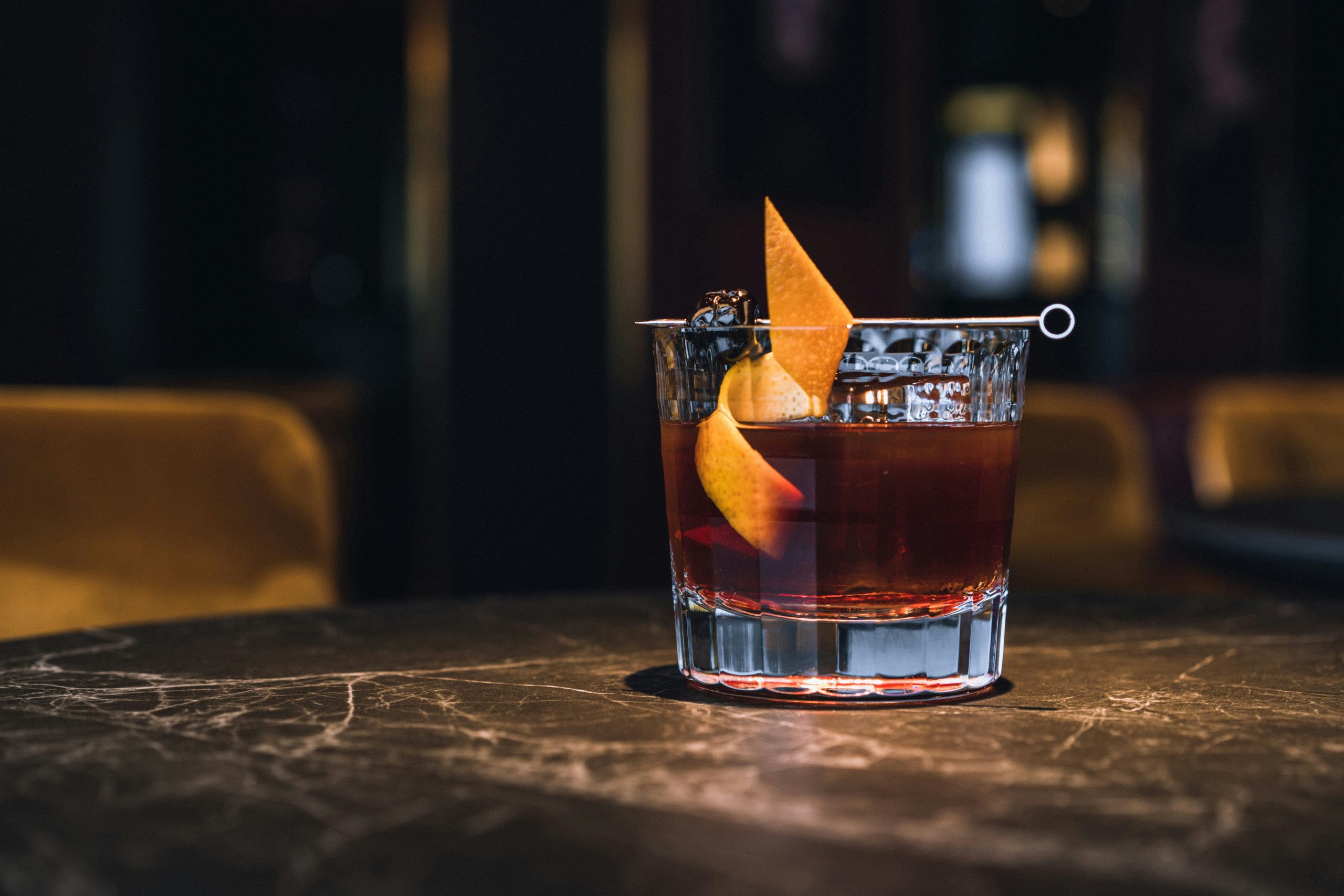
Adam served the third round of old fashions. Irish whiskey, an Italian vermouth, and some faux-Prohibition bitters I’d seen on an endcap at the hardware store—this was the epitomal trifecta of American goods, I told the Brits: nostalgia for a time that was never very good, packaging design that signaled not sophistication, exactly, but wealth, at least to the tasteless middle class, and a real shit formula of the cheapest ingredients. Cheers.
“Now Jamie will be telling you what’s quintessentially American for the rest of the night,” Adam said. It was the house drink, and had been for almost two weeks, since we’d come across that bottle of bitters at the right-wing hardware store where we bought cat litter. We’d only recently discovered it was a right-wing hardware store. The cat litter was of unmatched quality and price.
“I was going to say that you’ve picked the worst place in America to really see America,” Adam said, holding a pliant cat in his lap and gesturing with its arms like a puppet, “But it’s actually not a bad home-base to travel from. Centrally located.”
“Cheap,” Donovan agreed.
“Plus, we have a Trader Joe’s,” I said.
“What’s a Trader Joe’s?” Joelle said.
Trader Joe’s had been an epiphany to me and Adam, when we’d moved to a city big enough to have one. We’d thought it exclusive to the East Coast, a place we arguably hadn’t yet reached (we were in western Pennsylvania at the time), and we’d marveled at the lemon pepper pappardelle, which seemed to us hand-folded into its little bags. My husband and I were both one generation out of rural poverty, the first college attendees, the first in our lines to pronounce “creek” with the long E. We had been bridged into the white middle class by our industrious, thrifty, clock-punching parents, who’d moved from well-water farmhouses to our state’s modest metropolises.
“It’s just a bougie chain grocery store owned by the same Germans that own Aldi,” Adam said, with the cat. In our thirties, we were worldly now.
“And isn’t that the most American thing?” I said.
“Oh, god,” Adam said.
“I used to think the most American thing was Mad Men,” Donovan said, tinkling his drink, “and you guys are not dissuading me.” I had already finished mine.
“Yeah, what was the fixation with Mad Men?” Joelle asked.
“Costuming, mostly,” Adam said, “Also, the drinking and sex.” And then he said—or, rather, the cat said—“A pseudo-intellectual facade for mid-century gender role nostalgia.” I couldn’t tell whether he was simply parroting my critique so that he didn’t have to hear it again later or had adopted it as his own. He’d watched the entire series; I’d stopped a few episodes in, utterly bored by the slow burn of discovering what was abundantly uninteresting about Don Draper from the beginning, excellent set-dressing notwithstanding.
I said, “White America loves an excruciatingly self-aware piece of shit. Especially if he’s hot. Daddy trauma? Yes, please. It’s maybe the only narrative we have left to aspire to. It makes us feel tragic and smart, for knowing ourselves.”
The Brits weren’t sure whether this was supposed to be funny. They smiled politely. I held eye contact with Adam, daring him to challenge me. The cat, sensing our animosity, fled. The cat loved me the most.
“You know what you guys really need to experience,” Adam said, rescuing us from ourselves, “Is Garth Brooks. You guys know who Garth Brooks is?”
“Oh, Garth Brooks is emblematic!” I shouted, parodying myself so that Adam would laugh.
“You guys need to get Garth Drunk!” Adam shouted. The Brits, as ever, seemed pleased by our abrasive fervor.
I began to sing. When you sing a Garth Brooks song, you really have to get into it, the long slide of the I into the refrain I got friends in low places, think I’ll slip on down to the Oh-oh-asis… I had an excellent Southern accent—which Garth Brooks himself did not have—and I had a terrible singing voice—which Garth Brooks definitely did not have—and the Brits laughed, which I took to mean they were impressed. I told the Brits that country music was formally called Country and Western, which was a politically correct term for a genre once called Hillbilly music, when Hillbilly differentiated poor whites from poor Blacks, when Hillbilly was a kind of slur, when white people could be affected by slurs, some historical moment before white ethnicities converged, or maybe—
Adam waved this digression away. More importantly, he told the Brits, Garth Brooks had had one of the most phenomenally successful music careers of all time—he named several hits, we sang them, the Brits recognized nothing—but having reached unfathomable heights in his career, Garth Brooks really questioned his own talent. How could he trust anyone? Everybody in his life was a yes-man. Everything he touched turned to gold. His name was too big. Not to mention, he was hamstrung by his own fickle market: twanging country til the day he died, no room for him to make art.
“So he goes full midlife crisis,” I said, stealing the climax of the story, “And he releases an alternative rock album under a pseudonym, calls himself Chris Gaines. Chris Fucking Gaines.”
“He wanted to be totally unrecognizable,” Adam said, “He wore a prosthetic nose on the cover and everything. He had a flavor saver.” Adam pinched below his bottom lip to indicate where the little triangle of facial hair called a flavor saver would be. Everything about it was disgusting.
“And?” Donovan asked.
“Fucking bombed!” I shouted. Adam pulled up a song on his phone. Nothing, perhaps, could have sounded like art under our scrutiny. We reveled in his failure.
“But the old Garth is really where it’s at,” Adam said.
“I thought you guys hated country music,” Donovan said.
“Not Garth,” I said. There was something pure about our love for Garth, something of childhood, before we had articulated our own self-loathing. I fiddled with the record player’s aux cable, trying and failing to play “The Thunder Rolls” on my phone through the speakers.
“What’s the difference between how drunk we are now, and Garth drunk?” Joelle said, burping.
“For one thing,” Adam said, “We have to be driving.”
**
We lived on the southern edge of the state’s capitol, a city of just over a hundred thousand. Hardly a city. We lived in one of the older houses, a humble farmhouse surrounded by more recent development, bought cheaply because of its single bathroom and its knob-and-tube wiring and its flaking wallpaper. We perceived ourselves unlike our neighbors, suburban conformists in horrendous neo-eclectic houses with identical midsize SUVs and sticky, spoiled children with fascist haircuts, whom we enjoyed despising. I tended to fixate on their spending habits, the way they bought everything on payments. My confusion was a result, perhaps, of once having associated money with intelligence, or wisdom, of having come from a family of believers in bootstrapping. Our neighbors were just like the poor people they hated so much, except they had more money, I often complained. But that is the middle class, my husband sometimes said to me, That’s all it is.
Further out, just a dozen miles south of us, were the gravel roads of our youths, the necessary landscape for blasting Garth Brooks’ greatest hits on the stereo of a rusty pickup—which we still drove, we were the kind of people that drove a vehicle to its death—windows down, night screaming by.
Well, not the exact gravel roads. Neither of us had grown up here, but along other suburban edges, adjacent to other rural, empty parts of the state.
“This feels like high school,” I said, touching Joelle’s knee as my husband returned from the gas station with a paper bag. We were crammed into the cab of the pickup, Joelle and I in the narrow backseat, if it could be called that, sitting sideways in the jump seats with our knees knocking. It was the gender segregation, too, that felt like high school, but Joelle and I were the smaller of our group, if only barely, so it was practical. I might have outweighed Donovan by a dozen pounds, but his legs were longer, and I had surrendered the front seat. I could have taken him in a fight. He was scrawny.
We pulled out of the gas station lot, and gradually, out of town, toward darkness. A few miles of pavement remained.
“So now we just what, we just listen to Garth Brooks?” Donovan asked. It required some effort for Donovan to pronounce the dental fricative th at the end of Garth. He would have said Gart, had we not given him so much shit for it—taken the piss out of him, in his words. Adam reached between Donovan’s legs. He maneuvered deftly, his elbow rooting against the seat for leverage, and freed two beers from the plastic rings of their six-pack.
“We need road sodas.”
“God, this is high school,” I said gleefully, reaching forward for mine, popping the tab and dripping foam across all of us as I brought it into the back seat, brought it to my mouth.
“Party on,” Donovan said, amicably.
“I’m okay,” Joelle said.
“You have to,” I said, clamping one of her thighs between mine. “We’ll share.” The Brits were easily peer-pressured into more drinking, which was also true of me and my husband. It was simply the way of fun people. When she put the ice-cold can to her lips, and the ice-cold liquid wetted them, I drank it in.
“Drink up, love!” I said, in my best South London, “That’s the ticket.”
Joelle sputtered the beer. “That’s your accent? When does Eliza Doolittle say that’s the ticket?”
Donovan laughed heartily, repeated that’s the ticket stupidly, while I said howdy in return.
“He can do New York, too,” Joelle giggled.
“I’m walkin’ here!” Donovan shouted.
“Do your Italian, Jamie,” Adam said.
“It’sa me, Mario!”
The Brits were tickled, and slightly mortified, which alerted me to the fact that when they said Italian, they meant Real Italian, while Adam and I meant Italian American.
“It’sa okay to do the bad Italian accent because-a they’re white-a!” I yelled, and the Brits absolutely died. I thought to myself, that was perhaps my crowning comic achievement of the evening, and, I can’t believe we are drunk enough to think that was funny, and, if this is any indication of things to come, I will really hate myself in the morning.
Adam and I had plenty of international friends and acquaintances, the many doctoral programs at a land-grant university serving as international pipelines for the acquisition of serf labor for research programs, but even before I’d begun my PhD, we’d had a knack for socializing with immigrants and expats. The trick was to make fun of yourself as a white American caricature in slightly unsettling ways, to toe the line of not-joking. It became a hard trick to pull off, the drunker you were. It depended on your sense of your audience. I looked at Joelle. I thought, Joelle is beautiful. I thought, I would like to be dead. I thought, I wonder if they do open relationships in England. I thought, I might be far drunker than everybody else.
We reached the end of the pavement. Pavement Ends, the sign said. Adam accelerated onto loose gravel. The vehicle fish-tailed faintly and then caught traction, grinding against the swimming surface of the road. It was more like boating.
“Just don’t kill us,” Joelle said, placing her hand on my knee.
“We won’t!” I said, catching her hand before she’d retracted it, threading my fingers through hers.
“Jesus!” Donovan shouted, grabbing the plastic handle mounted above the passenger-side window for just this purpose.
It nearly occurred to me to reassure them. I might have told the Brits that all of our roads were straight and flat, that this part of our massive country had been sectioned off in mile-by-mile squares, ripped out from under the massacred and displaced Indigenous peoples and gifted to European settlers willing to go insane from starvation and wind, willing to eat each other every winter in sod houses for the righteousness of nationhood. I might even have remembered the point of that story, and reiterated that the roads were very wide, very straight, and very flat. We wouldn’t meet another soul out here. Our biggest concern was hitting a deer. I might have told the Brits that, endearingly, our previous university football coach, household name, had been promptly arrested for drunk driving when he took a job out East, because he was so accustomed to auto-piloting the dead-straight roads back here, three sheets to the wind.
What occurred to me, instead, was to yell, “Drunk driving is a quintessentially American experience!”
Adam had rolled the windows down, so I was screaming. The vehicle floated on the road, gaining speed. Joelle’s hair whipped her face.
“It’s so dark out here!” she screamed back.
“Yeah!” I cheered.
It was late October, another dry and hot year of disappointing harvest: to the east, a combine crawled a perfectly straight line across a cornfield in the dark, plotted into existence by satellites, floodlights blaring a small industrial halo around it. The rig went by our windows like a lunar landing. I simultaneously hated corn for everything that it represented—death of the prairie, atrazine in our water, federal subsidies paid out to absentee landlords and corporate trusts—and breathed the combine dust deeply into my lungs, knowing it was bad for me, the smell and taste of home.
I was about to tell the Brits that more than high school this felt like riding around with my uncles, spotlighting raccoons, combine dust on my tongue. I used to sit bitch between them on the bench seat, one uncle throwing the floor shifter around between my legs as the old pickup bumped over the gentle hills, slowing to a crawl beside windbreaks and gullies, the younger uncle combing the scrub trees with the spotlight like a blade. You’d see their eyes, is how it worked, two white coins flashing back at you, and then my uncles would slip out either side of the pickup and sprint, dragging the rifle across my lap as they left, and I’d scoot over to take the wheel, stretch my toes out to the brake and the clutch. The adrenaline, the swiftness, the sound of the shot if they held him blinded in the light long enough to catch him.
I was about to tell the Brits that until just this moment, it had never occurred to me to wonder about the activity, why we did it, what joy there was in it. Furs was all the answer I’d ever needed.
But before I could formulate a sentence, the first acoustic chords of “The Thunder Rolls” trickled through the cab, followed by Garth Brooks’ gentle vocals. I forgot everything.
“Oh! He has a lovely voice!” Joelle chirped, which made all of us laugh.
“This guy’s really got something special,” Adam yelled.
“I think this guy’s gonna be a star,” I yelled.
Then the fiddle wept and thunder rumbled through the speakers, and Adam turned it way the fuck up.
As the pickup sped through a crossroads, intersecting with a gravel road banked slightly higher than the one we were on, we caught a little air. Those were the kinds of intersections you would know well, if they were your own: you’d really speed into them, give your passengers a good stomach drop. It was fun.
The song “The Thunder Rolls” tells the story of a husband returning home late during a storm, of a wife waiting for her husband. She wants to fear for his safety but suspects infidelity; he’s late because he’s been with another woman. When the husband finally comes through the door, and the smell of strange perfume follows him inside, Garth Brooks embellishes the otherwise simple melody with all the angst of revelation and tears through the words lightning flashes in her eyes, and he knows that she knows.
The Brits had never heard the song before, but they felt it, and I knew they felt it. The notes of that line were inscribed in my spine. Adam and I sang at the tops of our lungs. We really meant it. The guitar breakdown came through, and Garth growled the chorus.
“This is the part! This is the part where you sing at the top of your lungs!” I screamed. Donovan made a good effort. He was game. That was something we liked about him. Joelle simply laughed, pinned to her seat.
We listened to “Two Piña Coladas,” swaying as we sang, the pickup swooping lazily from side to side across the wide road. That was the kind of song you could actually sing along with after the first chorus, designed expressly for the purpose of drunken belonging. Again, Donovan did great. We caught air over rough railroad tracks. We listened to “Two of a Kind, Workin’ on a Full House,” a song idealizing the nuclear family, an idealization we politically despised but an idealization so nostalgically conveyed by a poker metaphor that we couldn’t help but love it, fall into its groove.
We listened to “Ain’t Goin’ Down (‘Til the Sun Comes Up),” another song about drinking through the night, and “Long Neck Bottle,” another song about drinking through the night, and “Friends in Low Places,” another song about drinking through the night.
We listened to “Callin’ Baton Rouge,” a long-distance love song built on fast-paced fiddle that made Donovan yell, “This is Irish!”, a song that describes the object of Garth Brooks’ love as a strange combination of a woman and a child, words that poured themselves out of my mouth before I even remembered what I was saying. We listened to “Papa Loved Mama,” an upbeat, feel-good ditty about a jealous husband murdering his wife.
When “Rodeo” came on, Adam took a turn too fast, sliding around it like a racing corner. “Rodeo” is an undeniable banger, perhaps Garth’s most moving vocal performance. It’s only a few minutes long, but feels longer, warping time around an urgent tempo, and yearning, and the self-destructive impulse. We practically yodeled. You know the woman wants her cowboy like he wants his rodeo. My husband took another fast turn, drifted around it.
“Adam!” I yelled happily.
He restarted the song as soon as it ended. We drove laps around the same section, the same mile-by-mile square of barren cornfield. He restarted it again.
“This is it, you guys,” I said to the Brits, “This is Garth Drunk. We’re here.”
“Yeah, I think we got it,” Donovan said, sort of laughing.
“Yeah, I think we really got it.”
“Check Garth Drunk off the list!”
“I’ve still got to be to work in the morning.”
Work in the morning? She was thinking about work in the morning? Maybe they really did not get it. Of course, it occurred to me, Joelle and Donovan could not really sing at the tops of their lungs, because they did not really know the words. The notes were not inscribed in them. I didn’t know why, but it made me angry. It must have made Adam angry, too.
“So they want to feel American, huh?” my husband cackled, both hands tight around the wheel, gunning it.
“They want their taxes to fund genocide!” I yelled. My husband laughed. He was my perfect audience.
“They want to destabilize nascent governments!” Adam yelled. I loved him so much. He was so clever.
“They want to hamstring development efforts in the so-called Third World with military intervention and corporate takeover! And then extort legal fees!”
“Hey, we have Brexit!” Donovan hollered, trying to play along, maybe trying to reel us back in, “We had Boris!”
I shouted over Donovan, “They want to be oblivious to other countries’ political situations!” I had practically crawled into the front seat, my torso between the boys’ torsos. My husband and I were especially funny because we knew we were acting like ass-hats. Obnoxiousness was the whole bit.
“America First!” Adam yelled.
“Fuck nuance!” I yelled, spit flying. The truck hovered over the road; gravel swam beneath us, streaming like foam on river water.
“This is undeniably a quintessential American experience,” I would have said over my shoulder to Joelle, had the joke not already worn off, had the air screaming through the windows not been so loud, had my body not been abruptly catapulted forward, into the glass.
***
It was not a deer we swerved to avoid, which might have killed us, but a raccoon, barreling across the road and then rising on her little haunches, turning her head in slow motion, trapped in the high beams. The pickup braked hard, and I flew into the windshield, and then we swerved. Had there been a single obstruction—a curb, a tree, a pothole, a divot—we would have rolled. As it was, we simply swung one-eighty and slammed sideways down into the steep ditch.
After, I sat a few yards away with a t-shirt bunched up on the hot pain in my face. Joelle had tried to ask if I was okay, and I had growled that I was fine, and shrugged off the hand that reached for my shoulder. I was afraid to try to open my eye; I did not want to discover what was under the sticky t-shirt, what part of my face had spider-webbed the windshield from the inside. Adam had looked at it with the flashlight on his phone, and I’d seen the blood on the t-shirt, and I’d watched his face for a sign. He tried not to give anything away. His nostrils flared almost imperceptibly. I took that to mean he was both a little impressed by whatever cut I had incurred on my brow—stitches, probably, and some explaining to do—but that I had not visibly shattered part of my skull.
“It’ll be fine,” he said.
“Adam?” I said, as he stalked back to the truck.
“What,” he said, but kept walking. There were times that he could not handle my talking, the way I might articulate with my cosmic pessimism the inherent ugliness of a situation, and how we had made it, and how that said something inherently ugly about us, the black-hole truth, the real shit. Turning his back to me was shorthand for a perpetual not now.
But I wasn’t even trying to say anything. I was trying to be careful with my neck. I had heard of several people surviving drunk driving accidents—I had not been driving, so that’s not what this was, but I was drunk—because their bodies had been so loose. The tension caused the injury, the resistance. If you could allow yourself to simply be flung, you had a better chance. A person that drunk wouldn’t be thinking this, I thought, and That’s not even what happened.
In other circumstances, I would have been helping Adam inspect the pickup, push it out of the ditch. In other circumstances—which is to say, if they were different people—so would Donovan and Joelle. But the Brits stood with one another a few yards away, his arms around her. Joelle and Donovan and Adam were all perfectly fine. Rattled, but not injured. I had been the only idiot free-roaming the cab, no seatbelt.
“Are we calling emergency, then?” Donovan asked. I scoffed, which hurt ferociously.
Adam stood up from behind the pickup. “No,” he said. “It looks fine. If we need to get towed out, I’ll call somebody I know.” I might have vomited with relief, as I released the images of a snapped tie rod and a folded-in back tire, of police red-and-blue, of a trooper’s flashlight in my face, but I had to hold very still. We both had people out here, or close enough that they’d drive a truck with a winch on it thirty-, forty-some miles to keep us out of trouble.
My husband started the pickup and began shifting into drive and reverse, drive and reverse, rocking it out of the trench it’d dug itself into. It was rear-wheel drive; we needed to put something down for traction in front of the back wheels, a board, some shovelfuls of gravel. These were things I knew, somewhere in my head, and things I knew he knew, and things the Brits did not know, whoever they were, wherever they were from.
Eventually, he got the pickup back onto the road. Climbing into the confined space of the cab was oppressive. Joelle kept her eyes averted from me. Donovan squinted into my face before he took the jump seat in the back, across from Joelle; their legs had to be fully intertwined in the tight space. I fumbled my way into the front seat, groping with my free hand, pressing the shirt to my face with the other. In the jostling of the shirt, I smelled the dust and pennies of fresh blood. I hunched into a defensive fetal curl. Adam helped me put on my seatbelt in the way of an angry parent performing a basic task for an incompetent child. Or maybe he did it with a kind of resigned care. I couldn’t tell the difference. The cracked windshield glared.
He eased the pickup toward the next intersection, getting his bearings to navigate us home.
A few moments into the drive, the Bluetooth connection picked back up. It was so stupid that I almost laughed. The playlist had downshifted into Garth’s ballads.
An acoustic trickle and a mournful fiddle poured through the cab like running water, like life. Garth sang this ole highway’s gettin’ longer, and then I did laugh, and even though it hurt, I couldn’t stop. It seems there ain’t no end in sight.
“Turn it off,” Donovan said, and my husband tried, but I batted away his hand. I forgot about the pain in my face.
“Jamie, c’mon,” Adam said, “It’s over.”
But it was perfect. What was he not getting? This was the stuff of humorless laughter, the black-hole kind, the real shit.
To sleep would be best, Garth sang, But I just can’t afford the rest.
Adam reached for the dial again. “Jamie, we have to go home now.”
“But this is the part.” I turned it back up.
“Jamie, stop,” my husband said.
“This is the part of the night where we decide we have to change everything,”
“Jamie, please.”
“And then we just get home, and we get into our beds, and our alarms go off again,”
“Jamie, shut up.”
“And then we just keep going along, because it’s too much work to stop.”