
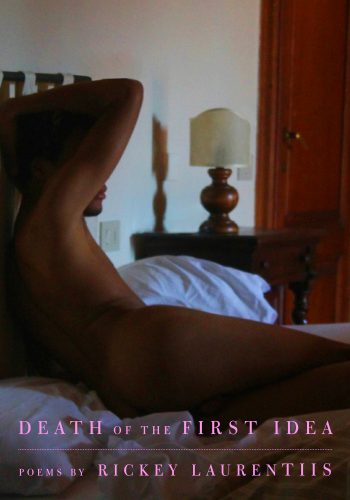
In an industry that, like any creative one nowadays, can fall prey to overconsumption and saturation, it can be brave to take your time. Rickey Laurentiis’ powerful return to poetry proves that that act of bravery is not without reward. Already longlisted for the National Book Award, Death of the First Idea stakes its claim on a space in the literary canon with a fierce forward motion.
Ten years after her book Boy With Thorn (University of Pittsburgh Press, 2015), a debut heralded and praised with accolades such as the Cave Canem Poetry Prize and a finalist for the Kate Tufts Discovery Award, First Idea comes less as a sequel than a revelation. Death of the First Idea incorporates wide ranges of mythological and theoretical influences, and is unafraid to sit within its own organized chaos. It is not often a book is worth such a wait; this one is.
I had the utmost pleasure of speaking with Rickey Laurentiis about her second collection. In this conversation we covered Orphic hymns, Walt Whitman, New Orleans, transition, transformation, and what it takes not just to write a beautiful poem, but a “useful” one.
The Rumpus: My first question is a bit of an elephant-in-the-room. Your debut collection Boy With Thorn came out ten years ago, in 2015, to major accolades and praise from a variety of press junkets. For other writers, in many ways due to the nature of the publishing industry as one that can prioritize more frequent output, a second book would’ve come about 2, 3 years after, but for you it’s been a decade. A lot has happened in your life personally, professionally, and outside politically to the world at large. What does it feel like to return after so long?
Rickey Laurentiis: That’s a good question. It wasn’t a deliberate decision per se. There’s a pressure in academia, so I’ve been able to surmise, to push out a second or even a third book, pretty quickly after your first deal,which is all a part of the professionalization, I guess, of poetry. But in the same ten year period, I’ve been outside academia, almost kind of to the side of it. And that has been deliberate.
The 10 year period feels poignant, and feels resonant. It feels weighty. And the right amount of time. My only analogy is music. I was in band as a high schooler and I would play xylophone, so there always would be these long rests that, eventually, I learned to sense as opposed to having to count beat by beat. And somehow the 10 years feels like that long rest for me. It felt useful, not just personally, since I went through my own transformation and journeys, but also useful for the poetry that I arrived at.
But also, not for nothing, I remember reading when I was blossoming, coming up, Jorie Graham and Lucie Brock-Broido, and poets like that. And it seemed not uncommon for some poets to wait maybe seven to 10 years between books—Lucie Brock-Broido, Frank Bidart. The only poet that sits outside that rhythm that I followed was Carl Phillips, who is just a phenom and pushes out books every two years like Mariah Carey with albums.
I’m thinking through social media where everything is content, and is constantly being revised and being replaced in front of your eyes. And it doesn’t allow the audience time to miss or seek out the content creator, the artist. And I think that that is something that I miss. Let’s get to Beyoncé. It’s exciting that she takes a wall between her projects. This latest installation, there’s a line that she’s shining through her trilogy, but at the same time, we had to build up this kind of enthusiasm. I think that’s a nice relationship to have with any medium. So, that being said, I don’t know if this was on the top of my mind or at the front of it, but I was working against a kind of pop machine because the poems and my life required patience.
I sort of traveled a spiral during these 10 years, and that can be both debilitating or narrowing—a spiral can go upwards or downwards,so it is also propagating,if you’re patient enough.
Rumpus: I think the book reflects that as well in that the poems are very long. Most of them take up an entire page, very long lines, multiple pages. Each poem is its own universe. Each poem is almost like a gospel in the Bible. It’s forcing me to sit with each poem. And I was really grateful for that.
Laurentiis: Yeah. Exactly. As you begin to write a book and once you realize you are inside of a book, you can begin to start making decisions. I was very much on Instagram during the writing of this book. So I was balancing both kinds of realities. And I noticed what you just mentioned that so many, maybe not in book form, but so many poems of others were becoming truncated and becoming the size of the screen. I thought some of the poems, they’re just too short. They’re just too quick. They’re done before they’re done, as far as I saw online. And so one of the things I wanted to do once I realized I was writing up a thick book, was to press back against the reader and to have them stop reading. I always thought of that as a sign of a really good book. I remember reading Frank Bidart’s very latest book Against Silence, and it made me throw the book across the room and I didn’t go back until a day later. It was so good. When something’s so good, I want to relish it and cherish it and just take my time. So, thank you. That’s good to know. I’m glad that effect was successful.
Rumpus: This collection is deeply, arguably indebted to a vast, multidisciplinary universe: the notes you include in the back provide ample and welcome contextualization to these poems, through historical contemplations; Greek, Egyptian, and Christian mythologies; the work of queer and trans theorists; and more. It’s too simple to say the book is referential—it feels more correct to say the book is an addition to a canon of its own making. Obviously, there are so many things to discuss here, so forgive how broad this question is: what motivated you to include all of these layers to the collection?
Laurentiis: My main and usual motivation for interpolating my obsessions is requirement. I don’t know if I would be a poet if I didn’t follow my obsessive tendencies and my compulsions and my neuroses. A part of this book was written during my Saturn return, so there was a lot of time I had to think, and a lot on my mind, about coming back to some sort of notion of a native place, not only personally, but also historically. And so I feel as if the poems are more alive, more human, if I allow my own very personal, very idiosyncratic obsessions to seep in. But not just seep in, but also take the effect of the obsession.
I think one of the differences between Boy With Thorn and Death of the First Idea is how I manage those obsessions. In the first book, they’re there. They arrive, but they’re orderly. They’re measured. They come three times; they’re organized or arranged gradually. It was very important to create a very exquisite book with Boy With Thorn. And in Death of the First Idea, I haven’t foregone beauty, per se, but I remember thinking that I know how to write a beautiful poem, so what’s next? Can I write a useful poem? Can I write a provocative poem? Can I write, simply, a happy poem? And so a part of those questions, the answer to those questions relate to the obsessions, because naturally, I was already reading across mythologies, which I do all the time. Naturally, I was already reading through theory and through things of that nature. And then also, I have this habit of mythologizing my own personal experience.
Hopefully it either collides or it collapses into a messy bridge. And with that point, I recognize, at least from my point of view, the book’s not perfect. It’s just arrived. And it seemed a good idea in the end to allow some of its mess to stay on the page. Because the process of transforming, the process of transition is methodical, is measured, is a math. It’s also a slow and sleepy second puberty. As much as it’s a coming into yourself and it’s a triumphant, positive experience, it’s also not. It’s also fucked up. It feels dizzy in a sort of sense.
Rumpus: There are two series of poems within this collection that are numbered: “Sometimes Tropic of New Orleans,” and “Tiresiad: Auspices.” Is this coincidence, and if not, what is the purpose of their alignment?
Laurentiis: You could say in a sense that it arrived coincidentally, but at a certain point, during the revision and certainly during the structuring of the book, I had to come to realize that I was creating a serial poem. The first decision I had to make was whether or not the series would arrive in the book as one consolidated gasp, or if I wanted to string them across the whole arc of the book.
I don’t have a deep philosophical explanation for that, except to say, mechanically, I knew I wanted to have certain engines and certain batteries, and would arrive at different points in the book. Because even though I wanted people to read it to feel at rest, I also wanted people to finish it.
A lot of this book wants to approximate how it feels, how it goes, to transition, but without necessarily directly repeating autobiographical details. As I said before, I mythologized myself. I come in and out of the speaker, and that’s just fun. But those two poem series, they don’t have any relationship necessarily together that I thought of, but it would be interesting to have them spiral in some stranger’s mind. There’s a lot of spirals in this book.
At the time of writing this, I was knee-deep in antiquity. I was reading primary texts. So I was reading Orphic hymns, and Egyptian hymns, and the process of reading those fragmentary archives was wading through this murky past, looking for antecedents for myself that I knew existed. I knew they were there. I knew I’ve always existed. I knew I’ve been this, since the beginning and I’ll be here at the end. And the question was, where are these antecedents hidden? Where are they tucked? Where have they been revised? Where have they been scratched out of the record? And so in some ways, this book attempts a rescue of those ghostly demarcations.
Rumpus: Hearing you say that you were reading fragments from the archives is really poignant because that is exactly how the collection reads. It reads like you are jumping through fragments of an archive; the notes at the end feel very like an historian explaining to the layperson the context of what you’re reading.
Laurentiis: The notes were really fun to write because there I was like, “Okay, here, I’ll show them that I know how to write prose!” There’s a kind of tone that I can strike in the notes that’s a little bit cheeky. There were so many times that I was put face-to-face with a notion of conceit and structure as opposed to form, and, you know, so many different conceits arrive in this book. Hopefully it works. It culminates with the strange, sloppy prose. I knew from the start that I didn’t want it to be polished. The form became, how do I write an essay or a story that finishes but also fails? So when I got to the notes, I said, “Well, what if I make this an essay, but also not?” It became a fun project.
In so many ways, this book saved my life. So to say that it was fun, it’s kind of shocking. You know, there were times this book and the path that I went along tried me, really did test me to the extreme. So I’m just glad to be here and I’m glad to arrive at this place.
Rumpus: The speaker often “breaks the fourth wall” to us, confessing her position in a poem or as a poet. The poem itself—the fact that the speaker is choosing to communicate through poetry—is an active participant in all of the other goings-on of the collection. Emily Dickinson, in particular, is invoked, seemingly as a foil to the speaker’s own poetics. In particular the line “Just to be writing again any one poem” from “Coming Back to Poetry (Or, Trans—?)” indicates the distance from and subsequent return to poetry that mirrors the same journey the speaker takes through her gender, body, and transition. Can you speak more more about the collection’s tongue-in-cheek approach to itself as poetry?
Laurentiis: It seems sometimes the only way to get through the poem is to rupture it and to expose its mechanisms as a means of getting to the next beat. And at the same time, one realizes that that can become a crutch, right? If you’re always falling back on this move, especially within a book, it can become maddening or even it can fail. For me it was an opportunity to bring the contemporary into the books. So it seemed important to me to always yoke the poems back into the contemporary, the present moment, by which I mean not necessarily the contemporary moment as like, iPhones…, but the present moment as the moment that the reader is literally reading the poem. That’s what’s exciting about meta-moves to me, or meta-technique, is that whenever the reader is reading the poem, it presses or forces them to have an engagement with the poem in sync with their own time. And that feels mystical.
It feels very much like Whitman at the end of Leaves of Grass. He, after all of his brilliant text, ends with extending a hand to you. It makes me crazy because… you have to imagine this at the moment that he’s writing. And he’s torn the poem apart. Not without risking its music, but he tears the lines apart, and he, in so doing, he opens up the body of the American lyric poem in an effort to, and not always, perfectly, to include anyone. To include a slave, to include the Civil War heroes, to include the slain, the dead. And to have, at the very end, him offering his hand to the reader, in the 19th century. It feels like what poems are uniquely built to offer because they can be a bridge, like a glue between us. Or waters between the islands of an archipelago. It becomes that kind of constitution that has propelled this art form for thousands of years.
I think that it was really useful and amazing to have reminded myself of that after ten years. While I am a loner and I like to be introverted, it was also lonely, and it was hard and it felt, I don’t know if this was unfair of me to imagine this, or press this upon the world, but so many reactions to trans people, so many reactions to myself have been less than positive, that it began to skew my mind to such a place where I would automatically assume disaster. And I remember there was a moment, where I would write a poem, and I would put it immediately on Instagram. And it was just that gesture of extending a hand, and it wasn’t about the poem, it wasn’t for people to say it was beautiful or, “Oh, my God, you’re amazing; you’re a genius.” It’s simply that hand that says, “Hey, I’m here, and you can grab my hand if you want, and we can do this together.” And that feels important.
Over the last 10 years, America has changed. America has been through significant shifts. We went through a pandemic that I don’t think anybody takes seriously enough. There’s so many millions of people who just died as a result, it’s like… it’s like a version of a world war. Let me just say that seems significant, not just with my poems, not just with my book, but it seems significant that we have poems, that we have art, that can serve as contemporary artifacts, and contemporary reminders that we exist in community with each other.
I won’t remember who said it, but in my first poetry workshop at Sarah Lawrence, the textbook opened with a quote that says something to the nature of poetry is not necessarily the mode of communication, but of communion. Basically landing on the same points where we’re making, that exchange of language between two persons is so critical and so spiritual.
Rumpus: New Orleans doesn’t just act as the setting of many of these poems, but as a breathing entity. The history and culture of the city acts as a mirror to the speaker’s own journey through womanhood, Blackness, transness, and the interconnected experiences of those with each other. You were born in this city, and returned to it later in life—what is it about New Orleans that draws you to it in life and in poetry?
Laurentiis: Well, this is a way I can say it: I was surely not aware of this at the making of my first book any more than I was aware 10 years, 15 years ago, that I was trans, right? Although, if one returned back to Boy with Thorn, there are some spooky foreshadowings in a deliberate, almost overly frank image of a cutoff penis that happens like two or three times. It does and does not relate to the specter of a trans woman, right? Whether or not that is the actual procedure, that is the sort of notion of what a trans woman undergoes. And so, I was fascinated with the fact that Boy With Thorn sort of anticipated who I would become later in Death of the First Idea.
And it occurred to me while I was finishing the book that, while I’m not done, it feels like I need to carve out this arc, if you will,and end it in the same sort of gesture that happens in Dante’s The Divine Comedy. I was writing towards, well, what does my paradiso look like? What is that? Where have I arrived? What am I doing? New Orleans, to me, feels related. I’m not only from New Orleans, but I have returned back to the city as an adult. So it seems now appropriate, and the right moment to have her announced and seen visibly. It was exciting to do because I had to ask, “How do I play back and play into the sort of mythos of this city?” And there are so many competing mythos—the New Orleans that I grew up with, not just because of the hurricanes, but because of time and space, has changed. And the New Orleans that I know is necessarily going to be different from the New Orleans that you know, right? It’s one of those cities. It’s one of those cities that people have an idea about, have a notion of to the extent that when they come, they expect something. And usually that’s some kind of bias or pleasure of this and that, what the city is known for, but it’s also known for its mysteries, its voodoo, its mysticism, its darker moments. And so that felt like a nice backdrop, and a nice parallel to strike with my archival work through antiquity.
Despite the fact that America tries its best to act like poetry doesn’t exist, poetry insists on existing. It will be here 3,000 years later. Along with painting and dance, we’re like the oldest art form. We’ve been here since the beginning, and we’ll be here at the end. Right? You know, film and rap and learn something from us. You know, like, you know, they’ve been new girls on the block. It feels no longer overwhelming, but it feels like I’m riding away to join that canon, to join that tradition, and to really make use of it.
One of the things that became apparent. As I said, the Orphic and the Egyptian hymns—they’re kind of like proto-poems. They’re the ancestors of what would become the American English lyric, which is tight, which is very tight and—but before that—millennia before that, poems were all over the place, because they were direct utterances, and sometimes specific formulas for the gods or for the natural world and so they served a purpose. They served their use. They used all the tools that we use today, but they also were utilitarian. And so these proto-poems became the loose structure that I wanted to repeat in this book as well.
I had a mind to try to make some sonnets, you know, because every poet in America writes sonnets. I wrote Boy with Thorn and I wrote all these short poems and everyone started calling them sonnets. So I was like, I guess I write sonnets. And I was trying so hard. I was like, “Oh, can I do it? Can I do it?” And then at some point I just realized, they just won’t be sonnets. And that’s okay. They can be these exploded proto-pieces. They can be worlds of themselves.