
Procrastistitching: Verb, the act of procrastinating on work you need to do by engaging in some sort of fiber or sewing craft that involves stitches.
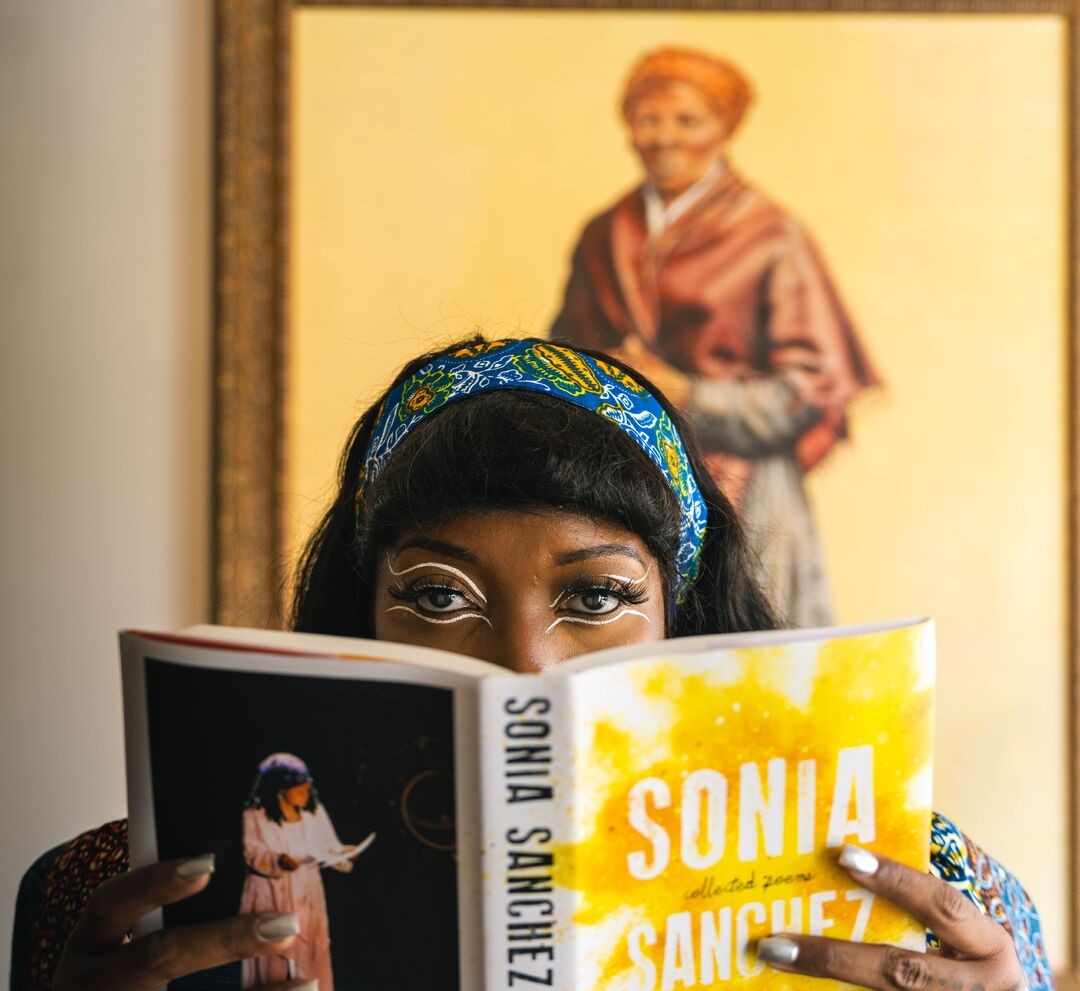
It has been four days since I read Patchwork: A Sewists’ Diary By Maddie Ballard, and I haven’t written this review yet because in that time I’ve been doing a lot of “procrastistitching.” Ballard knows what many crafters know: crafting is about more than the finished project. It’s about connecting with our foremothers, our own history, and ourselves. It’s about slowing down, choosing with intention instead of impulse, and for many of us it also involves an environmental awareness component. Ballard covers so many themes in this simple collection of essays on sewing, while she walks the reader through her experiences surviving a global pandemic, a breakup, and finding herself again while sitting at her sewing table. This little collection of essays made me want to sew. And knit. And do a bit of embroidery. It made me want to slow down, and create the world I want to live in. And it made me want to pick up my own diary, and learn more about who I am.
Although I am surrounded by crafters, I’m sure there are people out there who don’t craft… Don’t sew… I’m not sure what you do with your free time, but I’m sure you exist. Patchwork: A Sewist’s Diary, varies between feeling like a diary, or a crafter’s journal, and feeling like a series of letters. The reader is offered the opportunity to see inside the sewist’s mind, and for that reason, I feel that this book isn’t just for crafters. Ballard isn’t talking over the heads of the non-sewists, she’s bridging a gap between your world and ours. Between the mundane world, so to speak, and the creative one we inhabit.
Each essay in the collection begins with a description and accompanying sketch of something Ballard has sewn. It is through that item of clothing that she then explores a moment in time, a moment in her life. In the opening essay, “First Love,” Ballard uses the creation of a Demeter Dress, which is a basic over-the-head style dress with a relaxed fit. In this essay, which begins in second person, (presumably aimed at a lover/partner), she explores the way the COVID-19 Pandemic forced us all to slow down. It was the inception of the pandemic lockdowns that inspired Ballard (and so many others) to either return to a long-abandoned craft project, or start crafting for the first time. Ballard writes, “It is a privilege not to have to—not to be able to—rush.” That sentence so perfectly encapsulates not just this collection, but also my own feelings during the pandemic. Being forced to spend so much time at home enabled me to take on and complete mending projects that had been waiting for, in some cases, literal years. Watching so many loved ones return to work as essential workers during the pandemic, risking their lives while I stayed cozy at home, was an odd privilege. Being able to take the time out of my day to sew, to create, was a privilege. Through “Patchwork,” I revisited and explored those feelings of privilege.
Perhaps most notable about this little book is that although it doesn’t take much time to read, it can take extra time to digest, and thus it (like a handmade wardrobe) forces us to slow down. Ballard notes in her essay “Work,” in which she both makes an apron and inherits her grandmother’s sewing supplies, the experience of slowing down. She writes, “The process of sewing a garment–printing the pattern, tracing and cutting, sewing the first and the second and the fifteenth seam–is a lesson in taking your time.” I first approached this book thinking it would be a quick read, and then as I completed each essay I found myself wanting to take my time, the way sewing my own clothing makes me take my time. Each essay has so many layers, so much depth. I found myself wanting to take a break and contemplate the essay, read a few portions over and over. Savor it.
In the essay “Moral Fiber,” Ballard takes on the environmental impact of our fast fashion industry while she sews a zero-waste dress. Ballard asks questions I have been asking myself, the same questions many crafters ask ourselves: Does the ability to buy cheap materials mean we should? When I buy fabric am I giving any thought to the impact its creation had on our planet? Or on the people tasked with working in the factory it was created in? Were those people treated humanely? Given a living wage? Did the dyes used on this fabric destroy a natural water source? Ballard is asking these questions. She is also offering the reader the space and time to contemplate ways to make their own crafting more sustainable.
In her essay, “Silver Lining,” where Ballard makes “The Fabric Store Poppy Coat,” she finds herself facing life as a single person, which can catch the reader slightly off guard. I flipped back a few pages, thinking I had maybe missed something, because Ballard so casually moves past the plot point of this breakup (from the unnamed lover she seemed to be writing to in the first essay) that it’s a bit jarring. But as I kept reading it began to make perfect sense. After all, this isn’t a collection about this partner. It’s a collection about Ballard herself. At this point we’ve seen her take on casual workplace racism, the pandemic, and moths. Ballard seems to take on each challenge, whether it’s welt pockets or lockdowns, with the same contemplation and thoughtfulness that she shows as she moves on from her prior relationship. She claims in this essay that she likes to sew fast, but each essay belies that; making it feel as if she is always moving with such precision and careful attention to detail in her life. As a reader, and a crafter, it encourages me to do the same.
Ballard then moves into a series of essays where she is not just learning who she is through her art, through her crafting, but she is creating who she is as she goes. Since she is now single, she gains flatmates, who want her to go clubbing with them, so she makes clothing for that experience. She explores her own heritage and makes a cheongsam, a traditional Chinese dress. It is in this project that she explores her race, whether she is or isn’t “half of anything,” and why this dress feels less like clothing and more like costume. This essay feels like such an important reclaiming of herself, in light of the many challenges she has faced and moved past up until this point. She writes, “I want to wear this garment. I choose this self.” Ballard isn’t just making clothing. She’s making her sense of self. She’s making her personhood. She’s building herself while she builds a wardrobe.
I first learned to sew when I was a very young child, turning an old sheet into a stuffed doll, and a pair of jeans into a skirt. I can’t imagine my life without crafting, and Ballard explores so many of the reasons for that in this book. It isn’t just about making an item of clothing, finishing a hat. It’s about creating a world and a sense of self we can live with. Ballard made me want to research where my yarn is from, who made the thread I just bought for my serger, and she made me want to look at my local thrift stores for fabric I may one day want to use. It is through her expert use of language, similar to the simplicity of a single seam, that she ties this collection up with a perfect silk ribbon and inspires me to create.
“Between sewing, writing and cooking, my life is full of making. And I savour it.” With Patchwork: a Sewist’s Diary, Ballard reminds us to create, and to savor the creation. Perhaps, in an uncertain world, it’s less about “procrastistitching” and more about reclaiming our time to do the things that feed our souls. Sew, write in a diary, cook.