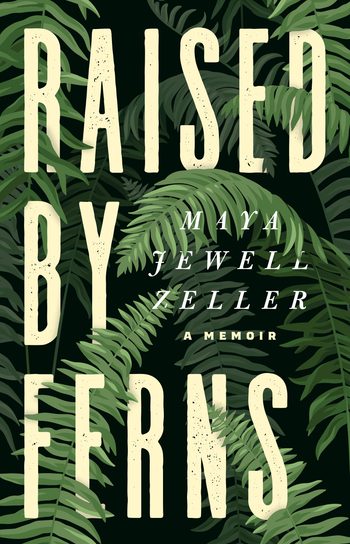
As the great-granddaughter of immigrants, a first-gen university student, and a native Detroiter, Maya Jewell Zeller’s account of uneasy class navigation in her debut memoir, Raised by Ferns, felt familiar to me—as did the exhaustion of code switching with middle-class and wealthy friends and colleagues. I come from a Rust Belt city whose urban blight is “featured” and “liked” on Instagram. A photographer’s “ruin porn” is my first home. Yet, like Jewell Zeller, I find wholeness, identity, and discovery in landscapes that others overlook or misperceive.
“This is how nature does it,” she notes of the co-location of healing sword ferns and stinging nettle. “You can almost always find a cure for what harms you growing right next door.” For Jewell Zeller, it’s not a binary—manicured gardens versus perilous woods—but a fertile ecotone that refuses to be defined.
Jewell Zeller’s life story begins at a family-owned gas station in Oregon where she was born. Her memoir probes the myth of a class-free American meritocracy, a stubbornly popular misconception that fuels biases against poverty, rural life, and wildness, particularly of women and girls. These subjects anchor her body of poetry, but in this memoir-in-essays, the veil between speaker and writer sweeps aside; there is no mystique about the “I” we meet.
Observed with a poet’s care and wit, Raised by Ferns describes how harm and flourishing, abundance and want, risk and resourcefulness are inextricably intertwined in Jewell Zeller’s upbringing. Her formally inventive essays plumb crumbling national illusions—sexual equality in a patriarchal society, the pursuit of happiness in late capitalism—to reveal how the labor, value, and agency of women and girls unfurl in the dark.
This exchange took place via a shared document over several weeks in March and April 2026.
The Rumpus: In a craft talk on spells, you asked the audience, “Who casts spells?” Our list included midwives, witches, women, children, and writers—people whose agency and expertise have been historically undervalued and repressed by patriarchy. How has your thinking about self-reliance, the liberty of girls, and wildness—and its link with poverty—evolved by writing Raised By Ferns?
Maya Jewell Zeller: Thanks for attending and remembering that talk, Gabriela. I’ve been returning lately to Inger Christensen and So Mayer. In “The Naive Reader,” Christensen says: “When I write poems, I sometimes pretend it’s not me but language that’s writing… I pretend language and the world have their own connection. Pretend the individual words, without me, are directly related to the phenomena they refer to.” And, “My expressing myself here is no different in principle from a tree growing leaves.” So Mayer, in Spells: 21st Century Occult Poetry, writes, “What a spell creates, as you speak it, is you: a sense of your power to create. A spell spells you.”
My relationship to language, to wildness and poverty and gender, is a continuously changing set of unfamiliars. Before beginning, I knew I had a special relationship to the natural world—though we each have this capacity—and that relationship is always interrupted by power structures, one of which is capitalism. Poverty exists because of capitalism, not because of the natural world, which is abundant and indifferent, if not generous.
I don’t know if writing these essays is an independent interlocutor, but I know when writing “The Privilege Button,” I felt a kind of shame I no longer feel. I now feel only a hunger to return to the world around me, whatever it gives. About a decade ago, the world looked different—possible. Now, I know we are irreversibly barreling into the unknown and that safety is an illusion. My fidelity is to the earth and the earth’s creatures—human, plant, animal—and to my children and children everywhere. My fidelity is to language and the ongoing attempt to articulate what trees, ferns, rivers, and sky have always said better.
Rumpus: What language have you developed to talk about privilege and class with your children or your university students? Is there anything that you struggle to find words for?
Jewell Zeller: There are plenty of folks with better systems of language around privilege and class, which we must discuss in concert with gender, race, nationalism, sexuality, marriage, and oppressive systems that fail us by forcing categories and identity barriers. I think about June Jordan’s poem, “Calling All Silent Minorities.” I think a lot about that tree [in the poem] “AIN’ EVEN BEEN / PLANTED / YET.” Ooh! that sings! June Jordan gives me hope. If we write, if we teach, if we organize, if we plant, and if we parent, we are working against systemic flaws.
It’s been interesting to realize from my own life arc that, regardless of social class, none of these systems are designed to help a person with a uterus. Caring for children while working full-time outside the home in a financial and sociocultural system that doesn’t value motherhood, or an academic woman with children, a marriage and divorce that did not value my body or my gender, a country that does not value a woman’s body and brain… I wish I had more time to develop a language around these things.
I’ve been in survival mode long enough that I barely understand anymore where I fit into the violent stratifications. When I wrote the majority of Raised by Ferns, I lived in a two-income household; even if my husband’s income was inconsistent, it was something. Now, my children and I are a one-income household, so I feel extreme pressure to provide beyond what one person really can or should have to. So many women carry the domestic, emotional, and financial labor of their entire households—often multigenerational—and their larger communities.
In 2026, these labors demand more than 100 percent of my faculties and what’s left is spent revisiting ideas that I had during spells of productive insomnia or early tenure. That’s why I’m grateful to have women poets and writers like June Jordan whose language precedes mine, so that I don’t have to invent it. I’m grateful for the natural world’s models, too: the ways that ants work together, the resilience of fungi.
Rumpus: How does the book’s architecture—a memoir in essays—relate to the evolution of the pieces individually, then collectively?
Jewell Zeller: I came to understand that the book was a fractal or spiral, a kind of rhizome about wildness and home and survival. I didn’t understand that my life would destabilize in ways beyond my control but within my household after writing the majority of the book.
The current form of Raised by Ferns begins in a narrative present of 2015, which is not where it began when I first conceived of it as a collection of essays in 2018; I submitted a very different version to the Graywolf nonfiction prize. It was mostly short lyric essays and opened with “‘A Wrong Turning in American [blank]:’ An Essay in Parts,” a multiple-choice hybrid essay riffing on and departing from Robert Bly’s “A Wrong Turning In American Poetry.” That manuscript was a little over 100 pages of little weirds like “Questions for the Immigrant’s Daughter” and other lyric experiments that bordered on poetry, most of which didn’t end up in the memoir.
The gravity was around questioning the (in)stability of my life, which I recognized as “relative privilege.” But I knew something was off. I could not have predicted how the next few years would involve such extreme betrayals inside my marriage and my country. Those systems, which include legal systems and marriage itself, would come to be my greatest oppressors as I finished the revisions six years later. They nearly terrified me out of publishing it.
The central themes of poverty and power, wildness and neighborhood living, gender and parenting, education and one’s inner resources came to bear differently after my divorce. The events of my life precipitated an epilogue and denouement that ended not in realizing ferns and self can expand into galaxies—the conclusion of the second major draft in 2020—but in floating down a river filled with deer corpses in 2021. I revisited that scene over and over in my body in fall of 2022 and the winters of 2023 and 2024. As I revised that last essay, the terrible arc and arrival of climate change and ecological ruin conjoined with the ruining of marriage vows and a nuclear family who is not safe—not from without or within, and possibly not at all.
Rumpus: How do you know when essays like “Complete the Sentence,” which borrows its architecture from standardized tests (and found its first home at The Rumpus), want to diverge from traditional narrative?
Jewell Zeller: I got pretty lucky with “Complete the Sentence.” I’d already been playing with (fumbling with?) invented and discursive structures when I started writing it, so the first 10 pages or so came out pretty clear. As soon as I started writing about my son’s worksheet, the SAT connection provided a narrative roadmap. The original draft also had Walt Whitman in it, and departed into Surrealist painter Maruja Mallo, who Salvador Dalí called “half angel, half shellfish.” It ended with the narrator “going out into the everything,” into solitude. But that didn’t really make sense: When I wrote that essay, I was married. It was one of those moments that our writing knows before we do. That ending seemed disjunctive to the narrative reality, so I revised away from it, into an opening of any possibility, not tied to love. I’m glad for how it ends now, but I do miss Mallo, and I hope I’ll bring her into another project, especially now that I’ve gotten free of having “to imagine America.”
Rumpus: What does your practice as a poet make possible in memoir?
Jewell Zeller: In her hybrid memoir Bright, Kiki Petrosino says “to write a poem is to assert one’s attachment to the materiality of language, but it also requires the poet to assume the openhanded posture of a questioner,” and later, “In others’ gazes, I lose my privacy, just as the moon does, reflecting.”
Since I also began as a poet, I didn’t feel genre-handcuffed. There are ways of questioning that include stating, exploring, making arcs, and making messes. Even though poetry is often known for its constricting—what we call received forms—I, like many poets, see those rules as a fun puzzle or escape room. They exist to allow creative thinking. I’m not a formalist poet, but I do love that I could play, like in “Sestina for Foragers,” in which I allowed language and repetition to lead me into lyric narrative.
Rumpus: I wanted to ask about that! Did “Sestina for Foragers,” start out as a sestina? When and how did you decide to break form?
Jewell Zeller: “Sestina for Foragers” was always going to be an essay, but it is a sestina, too—it has six repeated “end words.” I wrote it in quick succession after “Scavenger Panorama,” which ends on the hinge image: “a form of foraging, of grazing what was offered by ruin and violence, not so different from the blooming of fruit and flower.” I started there, with six words, and let myself write sections instead of stanzas. I didn’t worry about lines so much as getting all six end words into each section.
Those three essays: “Scavenger Panorama,” “Sestina for Foragers,” and “Poverty Fires,” form a triptych that loops; they were the fastest and clearest and easiest to write. They knew they wanted to be in the book before they existed. I think that was partly poetic training, making that set of linked chapters, like fulfilling a larger received form.
Rumpus: Why not poetry for these ideas?
Jewell Zeller: I had written several books of poems already, from Rust Fish (Lost Horse Press, 2011), which explores rural poverty and static violence and flooding, to Yesterday, the Bees (Open Books, 2015), a chapbook weaving postpartum depression and birth complications, and Alchemy for Cells & Other Beasts (Entre Rios Books, 2017) [a book of poems in collaboration with a visual artist] and out takes/glove box (New American Press, 2023), which both involve climate and work and parenting anxiety. The books got weirder and more experimental as I explored the dissonance and impossibilities inherent in being both a domestic and financial provider in a body that never receives rest nor care.
I had written hybrid fiction, too—all of this was autobiographically inspired. But the essay form allowed me to communicate very clearly and in different containers. Readers liked the memoir-ish aspects of my earlier works across genres and wanted more. When “The Privilege Button” came out, I received a lot of fan mail asking about a potential memoir. So, part of this project was answering that desire and part was about assembling my already in-progress essays. Some arrived easily, like poems, forming themselves. Others I had to really wrestle.
Rumpus: How does an essay like “Ruin Porn,” in which you weave together the beauty and precarity of growing up in rural America, evolve?
Jewell Zeller: This is another great question about form and how an essay shapes itself. My works are almost always organic, in that they start Ruefle-esque, with the scrap of sound, image, or scene. I don’t know where they are going. With a poem, I’m totally in the dark, following the green glow into the middle of the stanzas. In essays, I usually have more ideas than music. I have to wrangle and chop a bit to find music and shape.
Essays lead me into tangles. I make segments. I write paragraphs and see where they want to go. Then I fill in. Sometimes, I start an essay as a poem that feels so narrative and wide-ranging that I realize it wants to be an essay. Sometimes, I take older narrative poems and write into the background story.
“Ruin Porn” took shape in Port Townsend. My friend Eric and I saw that awful scene of snails on poison hemlock. I’d been working on an essay on ruin and rural male gaze, and the snails were an obvious gift. I had already written the part about the pornography magazines, and of course, the spiral of dead snails felt adjacent. In poetry, the associations we make when we put two unlike things next to each other are fairly organic. In essays, the same can be true—we just have to be willing to make lyric leaps.
Rumpus: As a poet, how do you adapt, resist, or employ the way you work on the level of the line to working in prose?
Jewell Zeller: In both poetry and prose, I’m interested in music. I like the sonic hum of repeated sounds across lines, sentences, and paragraphs. I compose by ear, and I read my prose aloud. I think a lot about what Mary Oliver explains in Rules for the Dance about patterns and how we set them up and disrupt them.
I am also a student of Hass and Hopkins and Dickinson: I love repetition, surprise/sunrise, interrupture, and rhythm—and, well, the joy of language. I think in terms of the driving forces of prose, accretion and momentum of music needs to pair with narrative as much as it does with image. An essay leans more into story than moment, but I don’t think the genres have to be magnetic opposites. There’s a lot of alignment between poetry and essay.
Rumpus: Though our backgrounds are different, Raised By Ferns stirred deep-seated feelings of precarity in me that co-exist with newfound self-confidence that’s strengthened in middle age. Is it similar for you?
Jewell Zeller: I know we share a penchant for the surreal and absurd, and I can’t help but think that’s because of our constant cognitive dissonance: the state of living a life that isn’t exactly who we are, or is only one layer of self that makes the other layers feel invisible.
The writer Dawn Pichón Barron and I have an ongoing conversation about bringing our past selves with us into the present and how we never overcome them, especially the poverty selves. We just put them under the layer of what’s visible on the surface. Middle age has made me both raw and callous about it. I think I’m exactly who I am, who I have been. If I want to figure something out, say, how to handle my frustrating and impossible finances as a solo parent, I don’t go to a financial planner; I climb a tree or wade into the river until I remember what matters.
Rumpus: Do you feel a difference between poetry and essays when writing about people you know?
Jewell Zeller: This is something with which I’m currently wrestling. My neighbors are reading this book (Thanks, L! Thanks, A!) but I didn’t run it by them before it was published. I asked my sister to read each essay and give her approval, and my close friends had the chance to request naming by letter or first name or to have dialogue deleted.
I’ve written friends and family into my poems, but with poems, there is the veil of persona and invention. In memoir, it’s more complicated because the genre announces that it’s nonfiction. That tyranny of perception is right there. I tried really hard to be careful with portrayal, gentle with loved ones, and a little vague with reference to neighbors, because I do want to protect their privacy. But I also believe in the importance of women telling their stories. And that demands a form and genre that declares itself true.