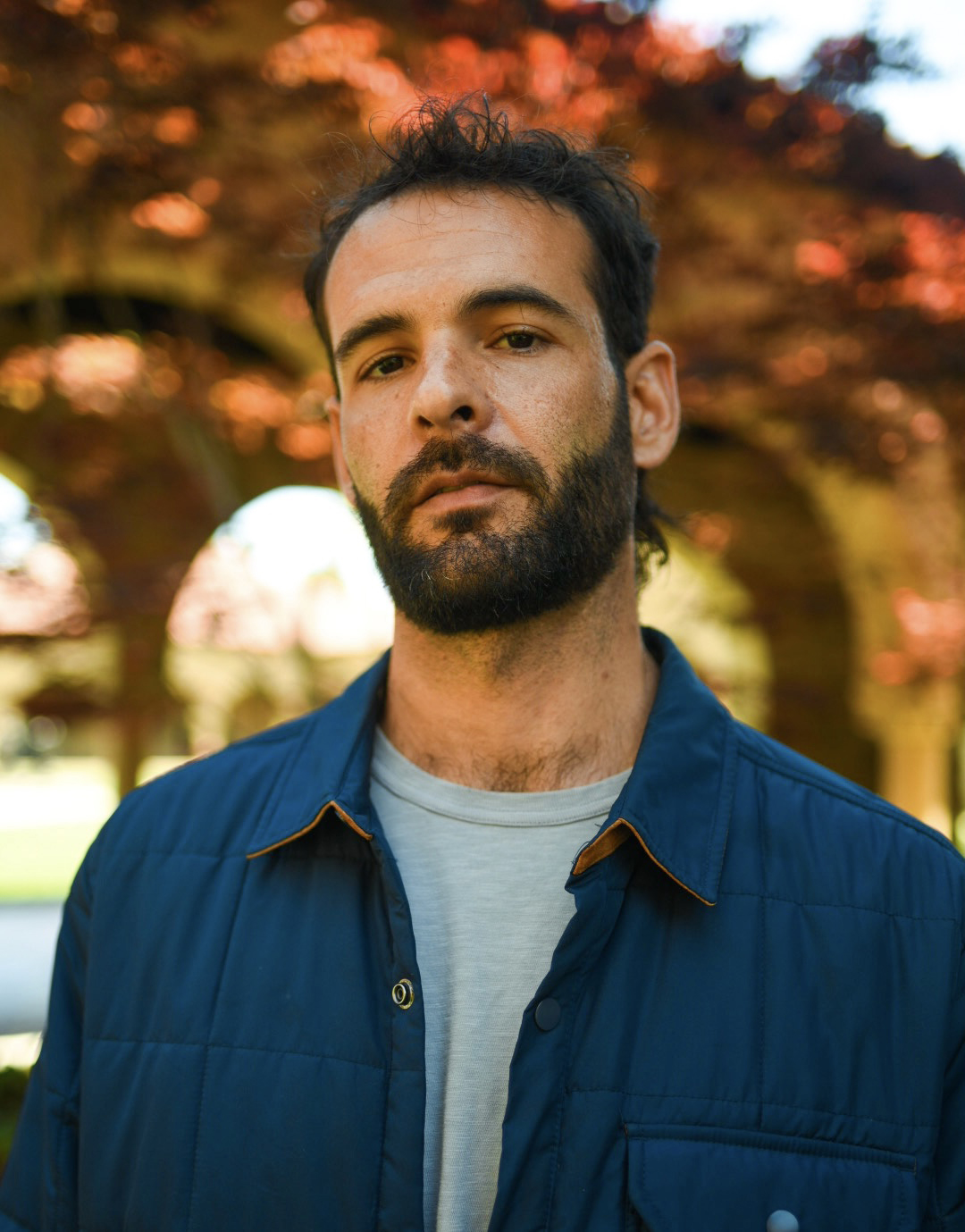
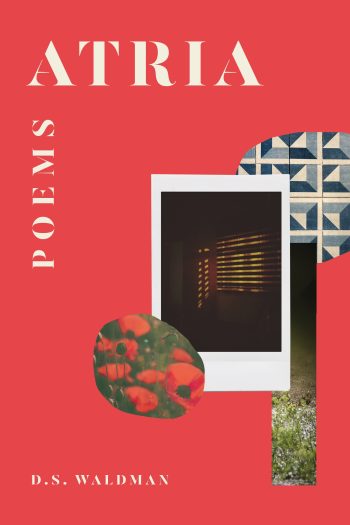
A few years ago, while promoting one of my new releases, I met D. S. (Dan) Waldman in his role as Poetry Editor at Adroit Journal. At the time, I served in the same role at the acclaimed publication FENCE. I was immediately struck by Dan’s impressive CV—Wallace Stegner Fellow at Stanford; work in many, many top-tier magazines. But I was even more compelled by his unique sensitivities and stunning craft choices as a poet, especially as Dan’s debut collection ATRIA is forthcoming from Liveright/WW Norton in February 2026.
I’ve long been curious about Dan’s writing process, his thoughts about the poetry “industry” at large, and so on—he has been an enigmatic figure in my poetic imagination. I’m delighted to have had the opportunity to “switch seats”—interviewee to interviewer—for the first time, to hear from someone who will undoubtedly shape our poetic landscape well into the future.
Part of this conversation took place over email while I was traveling abroad (and Dan was in Brooklyn); the rest occurred upon my return—the whole thing coalesced over a period of several weeks.
The Rumpus: Tell us about your background in terms of where you grew up, what you studied at school, and the like.
D.S. Waldman: I grew up in rural Kentucky, on the outskirts of Fayette County. I went to a small liberal arts college in New England, where I studied art history and architecture.
Rumpus: Is living in Brooklyn as cliché as it sounds?
Waldman: Ha. I should offer the disclaimer that I’ve only lived in Brooklyn for ~15 months, so I am by no means an expert. I will also say that Brooklyn is very big and vast in its neighborhoods and cultures and vibes. So I have definitely encountered certain clichés—I’ve been run off the sidewalk by Park Slope moms and their strollers, and I do get treated, at particular coffee shops, like a gentrifier by baristas who are, themselves, gentrifiers.
Rumpus:Did you always want to be a writer, or did you sort of stumble into it?
Waldman: I didn’t write my first poem until I was 27. But I came up writing a lot of criticism—I also went through a weird phase in my twenties that had me reading and writing into dream theory and other Jungian/post-Jungian stuff.
Rumpus: What was your first poem “about?”
Waldman:I remember the whole poem. It was a very short prose poem titled “Matty,” my late brother’s name:
I miss you in ways only the abalone diver knows, shooting to the surface after a deep plunge into November water.
It’s dramatic, but I still like the image.
Rumpus: Okay, let’s pierce the veil a little bit. What was Stanford / the Stegner Fellowship like?
Waldman: Two of my favorite years thus far. A lot of free time! A lot of time to play in writing—I basically wrote this entire book there, as well as a first draft of a novel. I enjoyed being around such talented poets—peers, instructors, visiting writers—and besides the close friendships, that’s probably what I miss most, the creative osmosis I felt in that environment.
Rumpus:: In the work of Stegner Fellows, I always see the fingerprints of the late, great Eavan Boland. Can you describe some of your influences? Are those people the same ones you like to read? I make this distinction because I think reading for enjoyment and reading “for influence” are discrete things.
Waldman:ATRIA is pretty deferential—I nod to a few of my major influences and would maybe divide my influences into: (a) the folks I read and reread but do not personally know; and (b) the folks I’ve been taught by, whose work I probably also read and reread. Beyond poetry: Keith Jarrett and Georges Braque.
Rumpus: Expound on your influences—who are the top 4 / 5 people on your Mount Rushmore?
Waldman: Anne Carson: I’ve never met her, but I feel very close to her through her work. In particular, I feel a kinship to her imperviousness to genre, or at the very least her genre-fluidity. Carson’s voice is just her voice—I think her expert understanding of form and structure allows her to channel that voice into whatever form it calls for, be it an essay or a fiction or a poem or a book length criticism.
John Ashbery: I love his strange, expansive imagination. I love the surprise and little firework-y turns of phrase in his poems. I love his rejection of the facile.
Bashō: Such magic and tension in those tiny poems, especially the Hass translations. I turn to them whenever I sense my verse lacks energy, or when the images feel flat.
Etheridge Knight: He grew up not too far from me, in Paducah, Kentucky. The first poem I remember reading was “Feeling Fucked Up.”
Eavan Boland: I think the two hardest types of poems to write are the political poem and the love poem, and those were Boland’s bread and butter. “Quarantine” is the finest love (and political) poem I’m aware of. “Lines Written for a Thirtieth Wedding Anniversary” is also outstanding.
Rumpus: Who are your “guilty pleasure” poets, meaning poets that I wouldn’t necessarily connect to you, or poets that are your unsung heroes?
Waldman:Mary Ruefle! She’s one of my favorite poets to read, and I think one of our great living poets. And I would so like to write with her humor and whimsy and wonder—but it’s just not me. Reading her, though, gives me life.
Rumpus: For you, what makes a poem sing?
Waldman: I don’t know. Part of the magic of poems, to me, is the unnameable, unidentifiable current that charges the most affecting work. I think we feel it when writing something particularly strong—the decisions seem to be making themselves, guided by that lyric spirit that’s overtaken us.
The more rigorous and critical part of me does like to try to unpack certain successful poems, and break things down on a line- or word-level. There seems an orchestration of language and form and content necessary for poems to really work—that might be an obvious thing to say. But really, the more I know, it seems, the less I know.
There’s this analogy I like: the whole idea of astrology is that we were each born at a specific moment in time, under a specific and singular arrangement of planets and stars and the sun. That arrangement, in theory, is responsible for who we are, our interior lives and behavioral tendencies, our ways of relating to other people, et cetera. I think there’s something very similar about each poem we write. We are working with all this interior material, and channeling that material through worldly things and poetic forms, but also that material has to be married to the moment of the poems’ writing, to the political moment, to the arrangement of stars and suns. I think the very best poems feel, at once, of the moment and also of all moments. Timely and timeless. The very best poems, I think, are able to nail all the technical stuff, in a singular voice, with content that speaks to the present moment, but also pins itself to the stars. Maybe that’s what singing is.
Rumpus: You’re obviously very studied in poetry, but you sometimes write things that seem very UNstudied (in the best way)—how do you do that?
Waldman: I take that as a compliment, the unstudiedness. I’m definitely of the thought that I have to study poetry, form, craft, the canon, in order to then step back from it all and decide: (a) who I am as a poet/what my voice is; and (b) what I want to take from the canon and what I want to discard.
Terrance Hayes comes to mind, here. He’s so, so studied, so knowledgeable when it comes to received forms, canonical American poetry, et cetera, and he incorporates a lot of that into his work, but he channels it through his voice, what his poems need and want and are asking for.
Rumpus: Are you a straight white man? If so, what is it like to be a straight white man / white man in poetry today?
Waldman: I am a straight white man. Though, regarding straightness—and I bring this up only because it’s in the book, alluded to in my poem “On Photography”—my first romantic experience was with a boy. And I’ve kissed a few boys. But at this juncture, I do consider myself pretty straight. More to the meat of your question, though, my experience as someone who presents to empire—to police, the federal government, to potentially violent and bigoted civilians who own guns—as straight and white and male is an experience of grotesque safety. Especially as this country enters maybe its most complete and transparent iteration of fascism, as we watch our neighbors kidnapped and disappeared based on skin tone, the languages they’re capable of speaking, et cetera, that safety I live with has really felt sickening. Not sure what else to say about it.
And being a white man in poetry? I think part of how privilege plays out in poetry, literature, the arts—I was speaking about this recently with a friend—is that I, and other straight white men, aren’t pressured by the establishment to bare our whiteness and straightness on the page the same way writers of color, queer and trans writers, women, have been asked to bring their identities—or the most legible form of their identities—to the page. We get to just be “artists” and to “make art for art’s sake.” This is, of course unfair, and I am trying, as a writer, to press myself toward political identification in my work. Who am I within the body politic? If all art is political, and I think it is, then what is the political work of my art?
Rumpus: Tell me something you think would surprise me about your writing process.
Waldman: I wrote a lot of this book while writing a novel. It felt like too much to always be sitting at a desk, so a lot of the poems began as voicenotes I had to go back, later, and transcribe. The big block prose poems were only lightly revised from their original voice memos. A lot of the museum poems also started that way, since museums really don’t like you using pens in the galleries, but those poems went through a more rigorous revision process.
Rumpus: Art-inspired poetry is well-trodden territory. What makes yours different?
Waldman: Part of what thrills me about art and art-writing is the seemingly boundless possibility of experience a single piece of art can offer. There is the object—the painting, the sculpture, et cetera—which arguably does not change, or changes very little and very slowly over time. Then there is the “I” addressing the piece of art, an “I” who brings their own little private storm of feelings and memories and experiences to the piece of art they are observing and engaging with. And that private storm looks different depending on the day.
I wrote the poem “Calder,” for instance, in the days or weeks immediately after ending an engagement to my then-fiancé. I remember standing in the gallery full of these amazing, peculiar mobiles, and simply feeling so much. About distance and desire, touch and absence. And so much grief, of course. I’ve been back to that room a handful of times since and have felt very little of that. I love the mobiles, still. I love walking around and feeling the child-like impulse to reach out and touch them, to make them move. But that intensity of feeling I experienced the first day was particular to that exact moment in my life, at which my life intersected with those mobiles. I think all art writing and art experience can be like that, totally unoriginal in its setup—human looks at art and feels things—and totally irreplicable in its outcome.
Rumpus: Specifically as it relates to art-inspired poetry, how are you pushing the envelope with this book?
Waldman: I think generally with poetry I’m less interested, explicitly, in pushing the envelope, and more interested probably in writing something that feels as close to genuine and authentic as I can manage. This book does feel that way to me, and I think that’s sort of how I knew when it was “done,” or ready to leave my hands. It felt like I’d made something that was distinctly my own.
Rumpus: How do you distinguish your poetry and stop it from being one-note / one-dimensional?
Waldman: The poems in this book lay themselves out across a pretty wide range of forms and modes and styles. I have the big block prose poems, which skew more narrative. There are the more slender art/museum-y prose poems, which feel a little more elliptical. I have a lyric essay in there. The crown of sonnets is all fracture and fragment and non-linear expression. So I think working in a variety of form and style has felt pretty important as a way to avoid monotony, if not in outcome then at least in process.
Rumpus: Much of this book appears to be written—or at least “set”—somewhere else. Tell us how “place” has affected your work, both in terms of poetic content and the physical act of writing the poems.
Waldman: There is so much language tied up in place. Every place I’ve lived has its particular ways of saying, its accents and idioms. I think landscape also has an impact on the writing—the New York School poets, for example, have the voice-y discursive style that feels so tied to New York urbanism. Ginsburg and Ferlinghetti had the kind of wild, untamed flourish that feels so of that era in the Bay. Then there’s someone like Wendell Berry, from my home state, whose work has that sort of languid rurality knit into it. Growing up in rural Kentucky—I had an accent, the whole thing—but I also went to sort of fancy schools. All of that is me, and I try to knit all my voices and registers into one speaker.
Rumpus: There seems to be a prevailing sense of hybridity in the book. A lot of multitudinous stuff. You handle it so expertly. Could you let us know how you think of “hybridity,” and why that seems to matter to you?
Waldman: I think my poetry education was a little backwards. I didn’t write my first poem until I was 27; I entered the MFA at 29. In school, I studied art and art history and architecture, so I spent a lot of time considering design and writing about it critically. There’s a lot of poetry in other media, across other disciplines—my first architecture studio instructor, John McLeod, encouraged us to think about architecture as “a poetics of space.” I think even though I wouldn’t have had the language at the time, I was always, across these various modes of expression, chasing or trying to harness this underlying current of poetry—that thing in paintings or buildings or concertos or in (some) really good prose that makes me, even if temporarily, wholeheartedly invested in being alive. It pulses through poems, sure—good poems are maybe the lightning caught in a bottle—but there’s so much poetry beyond the poem, the page, and I think I’m interested, as an artist, in pursuing that lightning across as many forms and shapes and disciplines as I’m able.
Rumpus: Did you set out to write a book of art poems (broadly defined), or did you kind of realize you had a critical mass of art poems that cohered nicely into a collection?
Waldman: I did set out to write a book of art poems, yes, but once I wrote a book of art poems, I realized the scope was too narrow. The project needed to coalesce around something else, with the art element being just that, an element, a thread. But I had also been writing, for many years, a book-length brother elegy. So I went back and started revising some of those brother poems and sliding them into this manuscript, and it evolved into this project, more broadly, about loss—about different types of losses and griefs. That’s really the book I wanted to write. I didn’t know that, though, until I’d finished it.
Rumpus: Can you touch upon the prevalence of sorrow in the book, and how you process grief / loss through a sort of centrifuge that has led us to these poems?
Waldman: At its essence, I think ATRIA is a book of losses. My brother, who died in 2014. My right hand, which I lost use of when I was 11 or 12. I began the book engaged to my then-fiancé, and in the course of writing it, we split. My parents, who appear in the book, are getting older, so that’s a loss I sense on the horizon. Grief is rich soil for poems, but it’s also easy, when writing into grief, to slip too far into one’s own despair and come off as glib or sappy or sentimental. I wrote a lot of those poems, none of which made it into the book, of course.
With the poems in ATRIA, I think I was more interested in looking out at the world, or looking back into memory, and imbuing those worldly things—visual art, music, landscape, memory images—with the interior shades and tints grief gifts us. To go back to the stars, Louise Glück used an analogy I love and think about often—I actually include it in the book, in my poem “Leaving the Party.” Basically, there exist certain stars we can’t see by looking at them directly. We have to look at the surrounding stars, and can only see that other star in our periphery. I think there’s a lot to learn from that.
Rumpus: I’ve gone through ATRIA a few times and picked out a number of my favorite lines. Shed some light on them: the inspirations, insights, and so forth behind them:
“It is the act of entering that creates loneliness” (from “Calder”)
Waldman: It’s funny, I love this line—it’s the first in the book—and I have no recollection of writing it.
Rumpus: “[For three years] after my brother died I was a painter” (from “For three years”)
Waldman: There was a stretch of years after my brother died that I painted almost every day. Before or after work, as told in that poem, I’d just fling acrylic paint across these canvases I used and re-used until basically the paint caked too thick onto the canvas or board or whatever I was painting on. I still have a lot of those paintings, these sort of talismans from a very difficult, but also very generative time.
Rumpus: “Epiphany: no one lets anyone else scroll their photo library” (from “Notebook Fragments”)
Waldman: Right?
Rumpus: “As a rule, I do not enter museums on an empty stomach” (from “Calder in Motion”)
Waldman: I’ve never had a positive experience hungry in a museum. It’s almost like framing the experience—I eat, usually caffeinate, then go inside.
Rumpus: Share with us some observations about the state of U.S. poetry in 2025. Tell me where / how you think things are going.
Waldman: So many talented poets, and not enough resources or opportunities for them. I really hate how, for every opportunity I apply for, I’m competing against all my best friends. We are constantly competing for resources. It doesn’t have to be like that. I don’t blame the writers, of course; we live in a country of money and competition. But I do long for a literary/academic environment that caters to collaboration and mutual support, as opposed to this Hunger Games vibe we seem all to be forced into.
Rumpus: I want to press you a little on PoBiz trends. What do you think is going on in PoBiz today? Are you optimistic? What are some things to fix, and how?
Waldman: I’ll offer a rose and a thorn. The last three winners of the National Book Award were published by University of Akron Press, Omnidawn, and The Song Cave—small presses I love, and I think it’s great for these presses to thrive and receive this sort of continued recognition. And for the NBCC, New Directions and Four Way Books have won the last three. Great presses, great books. I think especially as the literary world—like basically every other industry in this country—is being consolidated and collapsed into these few conglomerate publishers, it’s meaningful for small presses to be thriving and winning the big awards.
But that consolidation into conglomerate publishing is infiltrating writing and publishing in ways I find less desirable. For instance, I think these big commercial presses, in all genres, are looking for the brilliant young writer into whom they can invest big money. I think a lot of young writers feel pressured to rush out their first book—to establish themselves, to be able to apply for tenure track jobs, et cetera. And the publishing industry encourages this because, again, they’re looking for the next “thing.”
Rumpus: Do you have any advice for young poets, anything besides “read more?”
Waldman: Something Louise Glück spoke to me about pretty regularly was this idea of patience, about poems taking years, decades sometimes, to find their finished form. So even though I’m not big on advice, something I do try to remind myself is that poetry is a lifelong pursuit—a single poem can be a lifelong pursuit.
Rumpus: What is something new that you’re going to attempt with your next volume? Why, and what else?
Waldman: The next volume, if there is one, is a total mystery to me. In truth, I haven’t written a poem in probably 18 months. Since I brought up Louise, something she was totally allergic to was the idea of self-replication. She always warned about writing the same poem more than once, and she really felt sad about poets writing the same book of poems more than once. I think I share that wariness for myself, so I’m going to take my time.