
In a contemporary moment that has become increasingly filled with horror and unreality, Kim Samek’s debut short story collection, I Am the Ghost Here, arrives right on time. It reads both like a fever dream of the life to come and a reflection of modern alienation. These surreal, tightly plotted stories depict an absurdist world where technology and social media has blurred the truth in our relationships to each other and climate change has warped our relationship to the planet. The stories are both high concept and deeply human. They are also very, very funny.
The narrators in Samek’s collection experience bodily dismemberment and existential alienation. A chair transports them involuntarily to ecological disaster sites. A mysterious disease relegates their organs to jars outside of their bodies. Early motherhood disorients them and algorithms manipulate their love lives. And still they reach out towards one another and towards community.
I had the pleasure of speaking to Samek over the phone in January. We discussed climate change, the isolation of the pandemic years, and what the form of a short story can offer a writer—and a reader—that the novel cannot. The interview has been condensed for length and clarity.
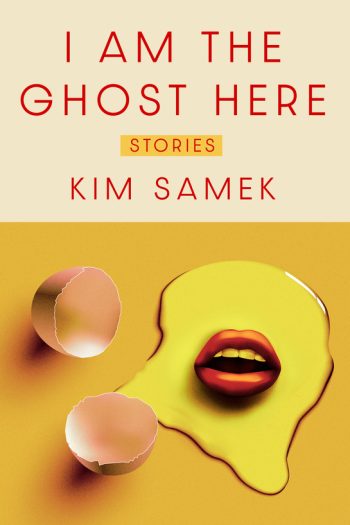
Rumpus: Story collections are such a rare breed these days. What does the form of the short story offer that a novel doesn’t? Why write short?
Samek: I always loved short fiction, but the idea of spending a lot of time world building and creating characters for a short piece was confusing to me. And one day, everything changed. It was during the pandemic. I needed to write to survive—to find joy and make myself laugh. So I wrote a bunch of stories all at once, and I started sending them out to lit journals. Thank goodness they exist, because I wasn’t even seeing friends. I was completely in this bubble, sending stories out into a void, and they would get plucked out from the slush pile, which was incredible.
I ended up putting the story collection together. I like stories because you can take a big swing, you can do anything you can;, you can be experimental. If it doesn’t work out, it really doesn’t matter. When you work in the long form, if you take a wrong turn, you could lose a year or two. I think the pressure is off with a short story. It’s the purest expression of my ideas, my sense of humor. There’s no filler. It can be something that’s personal, that’s for me. It’s just very pure to me. And I like being able to finish something quickly.
Rumpus: How did you curate the collection?
Samek: The trickiest part was finding a balance. I wanted to kind of get a portrait of the times. I had to find a balance and make sure that there was the right amount of overlap between themes so that it felt linked yet didn’t retread the same ground.
I wanted to end on the climate and the note of hope—looking toward the future. And there were a couple stories that were sister stories—“Everything Disappears” and “Trash Heap Hero.” I put them back-to-back because “Everything Disappears” is about what happens to products that are poorly made because they don’t ever go away. And in this case, the chair sends people to ecological disasters briefly, and then they return to their regular lives. “Trash Heap Hero” explores a trash heap firefighter who’s dealing with the trash sent to Thailand.
I put the title story up front because it explores identity in an open-ended way, which I think is a good introduction to the themes.
Rumpus: Are there any writers you feel that your work is in conversation with, or writers that you were thinking about while you were writing this book?
Samek: Yes, these are writers that I would recommend for readers who like the collection: Kate Folk, Ed Park, Charles Yu, Vauhini Vara, Ling Ma, Sayaka Murata, Aimee Bender, Kenan Orhan, Debbie Urbanski, and so many more.
Rumpus: What’s so unsettling about these stories is their proximity to modern life. They’re engaged with contemporary issues, but they feel prescient not reactive. How did you come to these stories? When did you write them?
Samek: I wrote them all in a very short span. Even though some of the stories are set in the near future or an off-kilter reality, they’re emotionally set in the last five years—in the time of the pandemic and the isolation that I experienced.
I wanted to capture the modern anxieties that many people felt during these times. It felt like the best way was to use surrealism. I had set some in the near future, and some were kind of hyper-real versions of the present. And it was kind of odd, because only a couple years had passed before I was doing line editing with my editor, and the urban fires happened in LA, and it started to feel like some of the stories were becoming real scenarios.
Rumpus: Did you edit any of the stories after the fires? Did you change anything developmentally?
Samek: I didn’t want to. With this collection, it was really important to me to try and stay close to the spirit of a first draft. What was important to me was to capture and stick with the original spark of every story.
Rumpus: The stories seem to suggest that with each technological development, we’re paying a deeply human, deeply embodied cost. How is technology changing not only the way we live now but the way we tell stories?
Samek: Technology is a good tool, [it] can help people connect, can save lives. I’m focused mainly on either fictional technologies or specific ones like social media, those owned by some of the biggest companies that have the power to reorganize the world around their needs, to increase profits without necessarily always thinking about human or environmental impacts. Our data is already owned; it was taken before we could even know what we were signing up for. [The book] is more focused on the erosion of truth that has come about with social media. Our tolerance for things that might not be real is a little bit higher now.
During isolation [in the pandemic] I was mostly online. There’s the experience of being online and there are the real-life experiences happening at the same time. The world that way just felt incredibly surreal to me.
I also wrote one of the stories about a tech product that is meant to foster real connection, but it fails because it can’t make enough money to compete. And I think that’s pretty interesting. Can we create spaces for technology that does connect and center the human experience?
Rumpus: In “Egg Mother,” “The Cloud,” and “The Sharpest Knife,” you use the physical body to represent changes [in technology]. Can you talk about that choice?
Samek: I was really ill when I wrote the book. It made me feel like I had lost agency. It was an interesting parallel because I felt the same way thinking about politics, climate change, all of the anxieties. There was a sense around the time of the pandemic that life had spun out of control, that it was something that we could not recognize—the world moving in a way that we can’t really understand.
Rumpus: The past haunts these stories. Characters are often longing for what they’ve lost, or they’re sad about what they won’t be able to pass along to their children. Is this something you think about a lot? What do you feel like we’ve lost that you’re exploring in your fiction?
Samek: That’s a shared theme throughout the stories, sort of a subconscious thread, maybe. Part of why I chose the title, I Am the Ghost Here, is because it represents a nostalgia for a simpler time and what is lost. It’s emotionally very grounded in the pandemic because communities were lost, like everything that we took for granted felt like it was gone. And it was just very disorienting.
I think there’s also a nostalgia for a simpler time in technology, back when it was easier to actually connect with people through tech instead of feeling alienated by it.
Rumpus: The narrator of “Everything Disappears” says towards the end of the story, “I’m one catastrophe away from losing everything.” Where did that line come from?
Samek: I was thinking a lot about freelance work in the gig economy. I have a lot of stories with gig workers or freelance workers, people who are living paycheck to paycheck. I like to think about the hustle and how everything could be gone in an instant. There’s an illusion that you have achieved some amount of success, but actually it could all evaporate. You can’t take for granted something as basic as health insurance. In the hustle culture, people can work every hour of the day. But after ten years of that, if they want to take some vacations, that could be a problem. There’s no security. I wanted to capture that because I think that workers are increasingly more disposable to companies.
Rumpus: In “I am the Ghost Here,” “The MILF Hotel,” and “Sven,” you play with this idea that there are two selves—the person we are and the person we perform or “produce” for others. How has producing and writing for television influenced your fiction?
Samek: I think somewhat minimally, but I think it has focused my attention on a couple of topics, like to use a show as a device to explore narrative and identity. It’s useful because you can have people outside of the show exerting an influence on the characters. I find that interesting.
But I’m more interested in the way that social media causes us to create these selves. It’s commodified our lives. It’s professionalized our thoughts. It’s very much shaped by capitalism.
Rumpus: Do you use social media?
Samek: Yeah, I do. It’s funny because I know how to produce a story, but I don’t like to share things about my life. I actually really love following other people’s work. But I think the problem is more macro. There’s no limits. Everything is porous.
Rumpus: The issues grappled with in these stories are pretty bleak, but the deadpan humor prevents the reader from falling into despair. How did you find your voice in these stories? How do you see yourself using humor?
Samek: When I wrote these stories, it was such a dark time. I wasn’t trying to write a book to publish, I was sitting down to make myself laugh and entertain myself and just keep busy. And the voice just came naturally. I needed an escape. There are a lot of anxieties that I wanted to write about, but in a funny way. The voice arrived with the stories and the characters and the scenarios. It’s more effective sometimes to use humor if you’re writing about difficult subjects. It’s also a way to relate to other people when they read it, to share that experience of being in on the humor of it. Humor is sort of a social experience even though writing is solitary.
Rumpus: Your stories have this texture of both surprise and inevitability. How did you achieve this? How much did you know ahead of time?
Samek: I get a chunk all at once, usually, like the scenario, the character, the voice. Hopefully, I’ll have the obstacle somewhere in there. I write it all right away, at least half the story. Once all of those elements are in place, it just kind of writes itself. The ending can take some work to nail, definitely. But, you know, once you start the ball moving forward, I think it keeps going.
Rumpus: That’s so interesting process-wise. It’s kind of remarkable, honestly.
Samek: Yeah, yeah. If you have a character that wants something and you have conflict, that’s enough to tell a story.
Rumpus: Your Thai heritage permeates the collection. Notably in the title story, a white woman puppeteers the narrator’s Thai brother. I won’t ruin the ending, but the story concludes with a different puppet and another puppeteer. What is the puppet symbolizing here? When you sat down to write, how were you thinking about immigration stories?
Samek: I know that a lot of readers have interpreted that story in a different way, a lot of different ways, actually. I don’t want to limit the scope of that. I think it’s part of the symbolism of just, you know, not being able to be yourself for some reason. It plays into the lack of control a lot of the characters experience. And I was thinking about intergenerational trauma, identity, and immigration in that story.
Rumpus: “Trash Heap Hero” and “The Garbage Patch” both dance around the cost countries in the developing world pay for the overconsumption and pollution in the developed world, but instead of bemoaning this, the narrators in both stories relish in it. One makes a career out of it. The other craves it. Can you talk about that choice and the agency that lends to your characters?
Samek: It is intentional to some extent. I did want to give the characters agency, and also I wanted to write something different. Nonfiction exists [on this topic], and it was more interesting for me to see what a character could do if she had maybe the opposite feelings towards trash.
Rumpus: Despite the bleakness in these stories, the characters still seem to be reaching for each other, for human connection. The endings of your stories deliberately resist despair. Why end on hope or optimism?
Samek: I feel like the settings were kind of bleak and so it wouldn’t make sense to have bleak endings. I’m usually juxtaposing an idea, a bigger theme, with a personal story—like a story about family or people trying to connect. The juxtaposition is kind of intriguing to me. The easiest example would be climate change, which is like a slow motion disaster.
I wanted to capture looming catastrophes and human moments at the same time. I think that’s an accurate portrait of where we are right now. You still find meaning and connection with others.