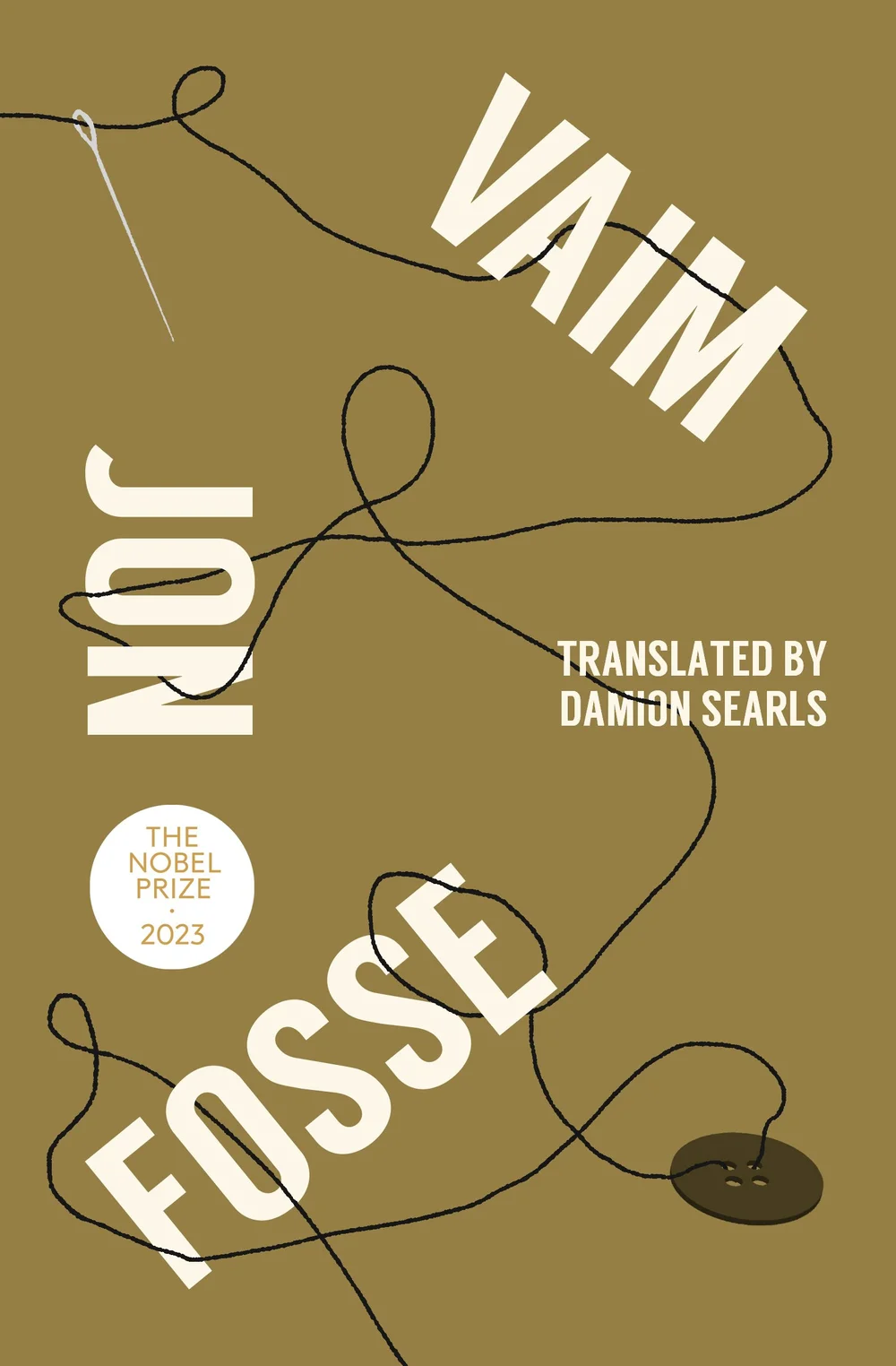
If it ever seems like all the men in your life who can’t express their feelings are interchangeable, Jon Fosse’s Vaim is the novel for you. Eline, the central character, takes that impression to heart as, over the course of her adult life, she jumps from man to man and back again without ever explaining why.
Here is her story. One night, when she is a young woman, Eline approaches a fisherman in a bar. She informs him she will call him Frank (though his name is Olaf), and that they should be a couple. “Frank” is too conflict averse to say no, and so takes her home to his coastal house. She lives with him for years until one night Jatgeir, a fisherman from her home village of Vaim, ties up his boat at the local general store for the night. Then, as if she’d been coerced into living with “Frank” all this time, she sneaks to Jatgeir’s boat in the dark and insists he take her home without delay. She keeps him from seeing his friend, Elias, and lives with Jatgeir until he dies. Not long into her widowhood, she goes to fetch “Frank” again, instructing him to leave his home and come live with her in what had been Jatgeir’s house. She is the type to present such commands without explanation; he is the type to obey without complaint or question. He goes to fill Jatgeir’s shoes until her death, at which point he moves back to his own neglected house. Got all that?
If this sequence of events seems far-fetched, the men whose lives she disrupts would agree with you. They can’t make heads or tails of what happened. “Even though I’ve thought about Eline and me all these years,” “Frank” reflects in his old age at the end of the novel, “I’ve never come up with any explanation other than that everything was strange.” No kidding.
The strangeness of the story is not limited to the way Eline hopscotches through the lives of men incapable of telling her no. Though she is the most interesting character and the one who drives the action, the book does not belong to her. Instead, she is filtered through the perspectives of three men whose lives she throws into upheaval with her leaps. They narrate the book in three discrete sections: the first belongs to Jatgeir; the second to his only friend, Elias; and the third to “Frank.”
For most authors, writing from three points of view would represent an opportunity to show off their range and versatility, while using distinct narrative styles to develop character. Each man would “speak” with his own diction, cadence, and points of reference that, taken together, would convey his class, his emotional baseline, his personality. We would come to know these men through the power of “voice,” and so the superficial perception that they are more or less the same would reveal itself to be an illusion. As the reader learned to see each man as a distinct individual with his own wants and proclivities, she would form expectations of them that would allow for suspense and surprise.
Fosse does not take this opportunity. He does not distinguish his characters in this way. In fact, he has each man speak in exactly the same voice, a voice that accentuates the rhythms of private rumination. The book’s opening lines are characteristic. They are in Jatgeir’s point of view but would not be out of place in any of the three sections:
So, I said, well here we are, I said and I ran my fingers through my beard, my graying beard, I wasn’t young anymore, no, but I wasn’t an old man either, it would probably be fair to say aging, yes, an aging man, neither more nor less, and it was about time I stopped taking these little sprees to Bjørgvin, what was the point anymore, tying up at the quay of The Wharf in Bjørgvin and not using my time there to do anything but sit in a bar or restaurant or café…
All three men speak in this shy, discursive way. Not one of them can tell you even something as simple as his age without some throat-clearing and carefully chosen qualifiers to make sure that he isn’t making an indefensibly immodest claim. Solitude is each man’s natural state, crowds are primarily a source of threat, and even an interaction with a friend or loved one is a trial that requires careful preparation. They’re kindly men, they pay close attention to life, but all the same, these are among the least charismatic people who’ve ever graced the page.
One of the great achievements of Vaim, then, is that Fosse manages to keep the reader engaged despite focusing attention squarely on such passive, diffident narrators. Surprise, in this story, comes not from the revelation of character through the narrators’ individual choices, since those choices seem predestined for all three. Instead, surprises emerge from the rules governing Fosse’s fictional world, which are markedly unsettled.
The first section, from Jatgeir’s perspective, is so grounded in realism that, at the start, it borders on the prosaic. We start by following him on an errand to buy a spool of thread and a needle, a simple errand taking him more than twenty pages. Along the way, his self-doubting thoughts rise no higher than pining for Eline, though he has not seen her for decades. It adds up to a persuasive portrait of a man whose fear has so circumscribed his life that he has found a hundred reasons to let each chance for human connection pass him by, and who last fell in love with a woman during his adolescence. At the end of the section, when Eline barges into his boat, it is a surprising event, but one consistent with the atmosphere of realism that precedes it. After her arrival, the reader expects the rest of the book to trace how the pair’s lives are transformed by this sudden reconnection.
But in the next section Fosse dispenses with these expectations. We find ourselves in Elias’s mind on a cold lonely night at home. When Jatgeir comes to the door, the two exchange a few words before Jatgeir leaves as suddenly as he arrived. Later, when Elias goes to town, the men loitering down by the quay tell him that Jatgeir is dead—and had been dead hours before he showed up at Elias’s door.
Nothing anticipates the ghost. Its entrance in Vaim is as surprising as it would be in the back half of Pride and Prejudice. There is no “realist” explanation offered for the visitation; the reader is forced to accept the ghost at face value. Elias is a little unsettled by the experience; the reader is a little bewildered; the supernatural plays no role whatsoever in the book’s third and final part.
There are real pleasures in reading a book that allows itself sudden lurches of this kind. For one, there is no question of getting bored: Nothing the reader learns early in the book will help her predict what happens next. It is a glorious amount of twisting and turning for just 125 pages.
Another pleasure is the sense that Fosse has given his characters room to experience the randomness of life. People really do spend all day on simple errands; surprises really do arrive in the afternoon that could not have been anticipated in the morning. This cumulative effect of an unplanned story is not an accident. “I never intend anything,” Fosse said in a recent interview. “I am sure that when I am writing with intention the writing will suffer…I am writing exactly what is out there. What it means I don’t know.”
This ethos sounds like a good way of keeping the reader’s attention squarely on the characters and the story, but it doesn’t work out that way. Consider the two character entrances mentioned above: first Eline shows up in Jatgeir’s life, then Jatgeir’s ghost shows up in Elias’s. Both of these events are well-rendered and fit smoothly within the context of their respective scenes. However, each moment comes off as an inciting incident, the sort of implausibility that readers accept at the beginning of a novel but reject at the end for being a contrivance. Readers want to feel that the big events of a plot arise organically from the terrain of the story, and they resent a reminder that the author could just as easily have chosen something else. If the events of a story feel arbitrary and interchangeable, we naturally give more thought to the author who is doing the choosing of those events.
Beyond diverting our attention to the author, this arbitrariness also creates a real problem for Fosse’s diffident men. We learn so little about them, and so little of what we learn differentiates them from one another, that the reader never forms anything more than the most basic expectations of them: more shyness, more passivity, more deference. We don’t know enough to be invested in who lives with Eline, nor can we see how Eline’s life is different with each man. There’s genuine humor in the notion that it doesn’t really matter who she ends up with, but, since Fosse does not undercut the impression that they’re essentially the same, it feels like an easy joke at the men’s expense. Because real people are not like that, the cartoonishness of the portraiture, like the lunging of the plot, emphasizes the artificiality of the storytelling.
In rereading Fosse’s Vaim, the mysteries do not deepen; instead the text reveals itself to be no more than the sum of its interesting parts. His “impartial stance” is partially to blame. There is a faux-humility in simply writing “exactly what is out there.” Not even journalists make this claim. They sculpt their stories, omitting this and emphasizing that. The problem here isn’t with that ambition: The most satisfying novels are indeed the ones creating the sense in the reader that she is observing, through a clear window, “exactly what is out there.”
But that effect, intended or not, is achieved through carefully controlled artifice, not from an effort to “objectively” render the randomness of life. An author refusing to impose a deliberate structure on his story is not actually empowering his reader. He is, instead, insisting she do the work he declined to do, for one cannot read a story without trying to find meaning in it. When the events of a story are meaningless, this experience does not feel like freedom, but rather abandonment.
Not that this is such an unpleasant experience in Vaim. The prose is sharp, the plot is original, and the reader feels no pressure to come to any conclusion or judgment about the characters. When so much literary fiction seems intent on making an airtight case for a moral view, Vaim’s light touch arrives as a breath of fresh air.
Unfortunately, by the end of the novel, the price Fosse pays for writing without intention may be too steep for many readers. It isn’t merely the case that the novel resists one clear meaning—it resists all possible meanings. And the text’s deepest mysteries do not point towards the world in its strangeness, but back at Fosse himself, alone at his desk, making strange choices.
Vaim by Jon Fosse, translated by Damion Searls (Transit Books)