
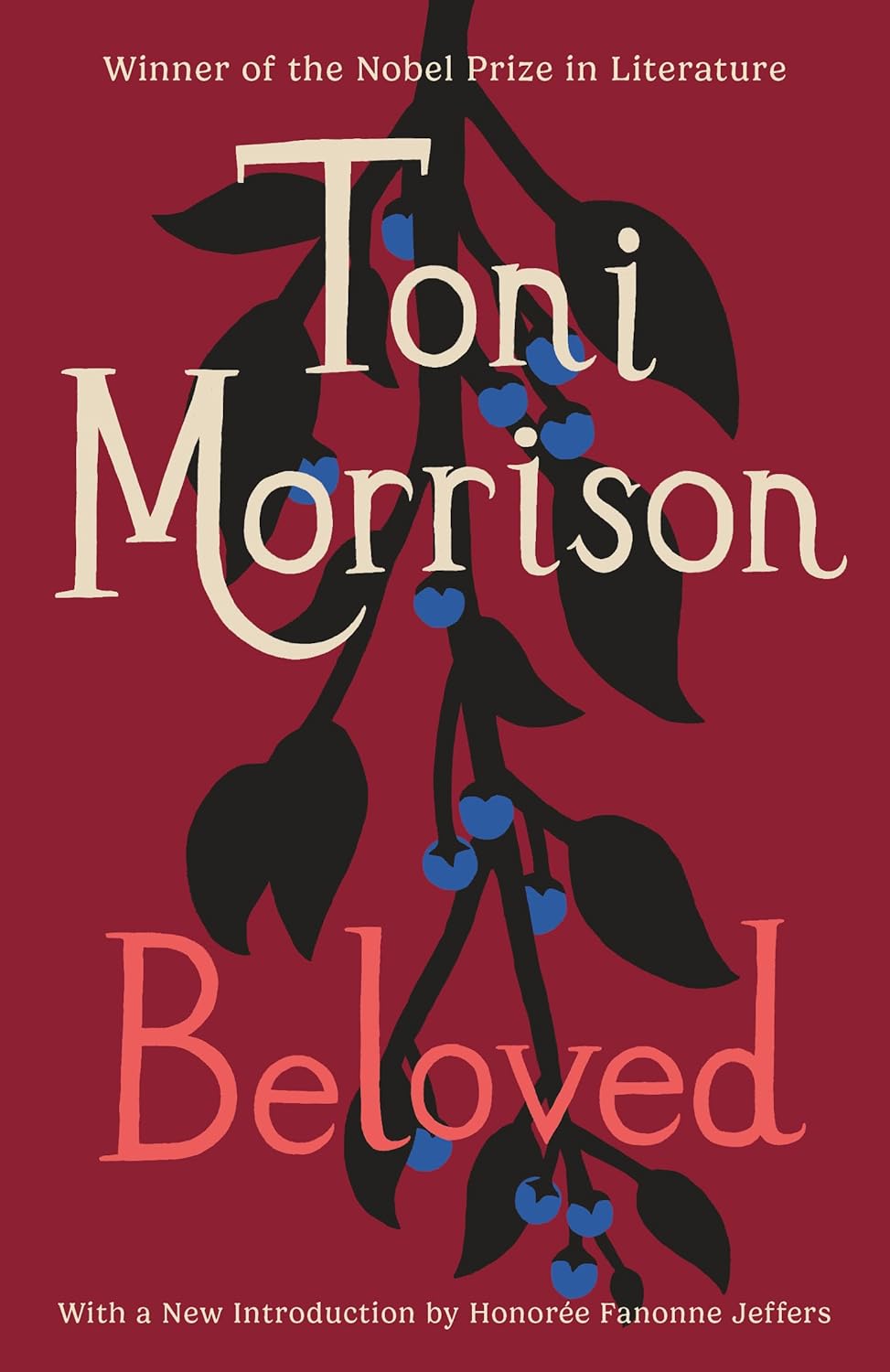
In a moment when public memory is contested, across classrooms, monuments, and national narratives, Toni Morrison’s Beloved returns as an ethical provocation. The novel refuses the comfortable assumption that history is a closed chapter; instead it insists that the past lodges in bodies, language, and domestic spaces until it is acknowledged and reckoned with. I am returning to Beloved now because our politics of remembrance demand a form of attention that is not merely archival but imaginative and communal: Morrison teaches how stories can be the instruments of both witness and repair.
Toni Morrison’s Beloved arrives at its reader with the economy of a hush and the force of a storm. It is an argument written in the grammar of ghosts: sentences that are at once precise and porous, voices braided together until subject and object blur, time folding back upon itself like a map soaked in memory. To read Beloved is to enter a country where language does more than name experience; it conjures, excavates, accuses, and sometimes refuses to be the last word. The novel resists summary rightly, because its subject is not a plot that can be cleanly recounted but an ache that keeps resurfacing. Still, the burden of criticism is to make sense of art’s insistence; what follows is an attempt to understand how Beloved stages the relationship between historical violence and the interior life, and what that staging reveals about our culture’s capacities and failures around remembering.
At the center of the novel is Sethe, a woman whose personal history is a ledger of dispossession. Her past remains a living topology: Sweet Home, the Kentucky plantation; the escape; the baby girl baptized and then reclaimed in body and name by an act that will forever complicate the meaning of “freedom.” Morrison does not reduce Sethe to a singular moral archetype; instead, she shows how the logic of slavery shapes a set of choices that become indistinguishable from the terrain itself. The most famous of those choices is Sethe’s decision to kill her child rather than submit her to the owner’s world has been read and misread as an act of monstrous self-dissolution or glorious maternal defense. Morrison refuses both caricatures. The killing is not spectacle; it is the inevitable, unthinkable product of a regime insisting one’s bodily sovereignty can be bartered, broken, and owned. In the world of the novel, an act like Sethe’s is neither solely evil nor purely sacrificial; it is the final, terrible grammar available to someone who has been denied every other language for self-possession.
Morrison’s genius lies in the novel’s formal choices: fragmentation, multiple focalizers, and an insistence that the past be experienced in the present tense. The recurring apparition of Beloved, the child who may or may not be the reincarnation of Sethe’s murdered infant, functions as an ethical test and a narrative technique. Beloved is simultaneously a character, a symptom, and a device dramatizing the psychic cost of unprocessed history. Morrison’s spectralization of trauma performs a simple but radical claim: unresolved violence will not be contained in the neat, historical sense; it returns, it insists, and it demands recognition. The book thereby refuses the comforting myth that history is linear and that horrors can be neatly allocated to “then.” Instead, the past intrudes, domestic spaces become sites of trial, community bonds are frayed by unspoken horrors, and the act of remembering is represented as both a civic duty and a private torment.
Language is not merely the medium of memory in Beloved; it is the object of contestation. Morrison’s sentences oscillate between lyric compression and forensic specificity. She refuses the novelistic convention of an omniscient, authoritative voice surveying events from a safe distance. Instead, she disperses authority across a chorus: Sethe, Paul D, Denver, Baby Suggs, and even the land itself speak in fragments. The effect is disorienting in the best way; readers feel the instabilities of identity and the porousness of memory. Morrison’s choice to rely on interiority rather than exposition asks readers to inhabit rather than simply observe. This is criticism’s difficulty and its joy: interpretation must match the work’s ethical posture. One cannot simply map the novel’s moral equations; one must practice a kind of sympathetic attention, recognizing that Morrison’s fragmentation is precisely the form suited to the fragmentation of a people whose histories were written by others.
A recurring motif in the novel is the idea of ownership; who owns bodies, stories, and the land? Sweet Home, despite its ironic name, functions as a locus of contradictory claims: white masters claim ownership over labor and flesh; Black characters assert their own claims of belonging in ways that are often intimate, sometimes violent, and always vulnerable. Morrison probes the intimate economy produced under slavery: sexual relations coded as commerce, maternal bonds fractured by law and profit, memory traded for survival. But she also makes space for what survival demands in its tenderest form: the crafting of family and community meaning outside of the law. Baby Suggs, in her sermons in the Clearing, attempts a different politics, one that exhorts Black people to “love” their flesh, to reclaim the tender interiority that slavery had stripped away. Morrison’s account of communal healing, however, is not sentimental; it recognizes that spiritual exhortation is insufficient without material change. Love is a reclamation practice, but it does not erase the structural violence producing trauma in the first place.
The novel’s critique extends beyond the historical moment of slavery to the afterlives of that institution: the ways in which freedom can be formal without being actual. Sethe’s post emancipation life is numbered not by legal status but by social power, economic precarity, and the stigma of her own actions. Morrison shows that emancipation alone cannot dismantle the psychic architecture erected by slavery. The community’s treatment of Sethe oscillating between empathy and ostracism raises ethical questions about forgiveness and accountability outside of the juridical frame. How should a community integrate a member whose survival strategies transgress communal norms? Morrison refuses a facile resolution here. The act of reintegration requires narrative labor remembering and telling and communal readiness to hear what it means to have been treated as less than human.
This is where Beloved remains urgently modern. In our present, the politics of memory are omnipresent: debates over monuments, curricula, reparations, and whose histories are taught in schools. Morrison’s novel offers a model for the ethical work of remembering a model rooted in narrative complexity and collective witness. The book insists that the act of remembering is not a neutral archival duty but a moral responsibility that reshapes social life. If we choose to forget, the specters return in degradation and repetition; if we choose to remember without humility or listening, remembrance becomes a new instrument of domination. Morrison’s politics is not about grand gestures but about the quotidian ethics of how a community tells its stories and who is permitted a voice.
Yet the novel is not without its tensions. Critics have sometimes argued that Morrison’s compression of history into psychic phenomena risks aestheticizing suffering; the ghost metaphor can be interpreted as an abstraction that distances the reader from the material conditions of slavery. There is a risk that poetic language could make the violence more palatable rather than forcing an accountability that insists on structural redress. But such criticism often misses Morrison’s careful choreography: haunting in the text is less a metaphorical flourish than a narrative strategy insisting the reader experience history as a living presence. The ghost in Beloved is not an aestheticized ornament; it is a byproduct of histories that have no adequate legal or institutional memorial. Morrison’s formal choices thus become political, they demand an embodied response rather than an academic assent.
Another point of debate centers on the novel’s portrayal of motherhood. Some readers, uncomfortable with Sethe’s act, are tempted to reduce the novel to a parable of maternal pathology. Yet to read Sethe as a purely aberrant mother is to ignore the systems that made her act conceivable. Morrison’s work complicates the category of the maternal by showing how motherhood under slavery is a form of labor under surveillance and market rule. Sethe’s act is both a maternal assertion and a desperate act against the commodification of Black life. The novel refuses to sentimentalize motherhood; it insists that maternal love, when constrained by violence, may produce acts a culture finds unthinkable. The challenge for readers is to recognize the ethical space Morrison creates: one where love and violence cohabit within a moral soil tilled by historical brutality.
Finally, there is the novel’s relevance to contemporary discussions about trauma, memory, and possibility. In a culture so often privileging quick reconciliation over sustained reckoning, Beloved serves as a corrective: there is no shortcut. Morrison’s novel demands patience and the willingness to be unsettled. She teaches that historical malfeasance requires attention that is narrative, communal, and painstaking. The path to repair, if such a path exists, moves through confession, restitution, and the reestablishment of narrative sovereignty. Literature here is not merely a mirror but a tool; it reshapes what we can imagine as right and reparative.
Beloved does not offer tidy solutions. Its reward is not consolation but obligation. Morrison gives us a form of moral education through fiction: a lesson in listening, in the necessity of collective narration, and in the ethical complexities of survival. The novel’s power endures because it refuses to let the past be settled. It insists that memory be active, painful, and remaking. That insistence makes Beloved not merely a masterpiece of American letters but a persistent moral interlocutor for anyone interested in how stories shape what we are willing to hold, forgive, or change.
To return to the opening metaphor: the book is a storm. It cleanses in ways storms sometimes do, by stripping leaves and exposing roots, but it also leaves an altered landscape. The responsibility that falls upon readers is not to admire Morrison’s mastery from a distance, but to let the book reconfigure our capacities for witness. If literature’s civic function is to enlarge our empathy and sharpen our moral imagination, then Beloved performs that function with an uncompromising rigor. It asks us whether we will let the ghosts of history teach us, and whether, in listening, we might begin to answer for the world that made those ghosts possible.




Click here to subscribe today and leave your comment, or log in if you’re already a paid subscriber.