The First Book: Mariah Rigg
The Author: Mariah Rigg
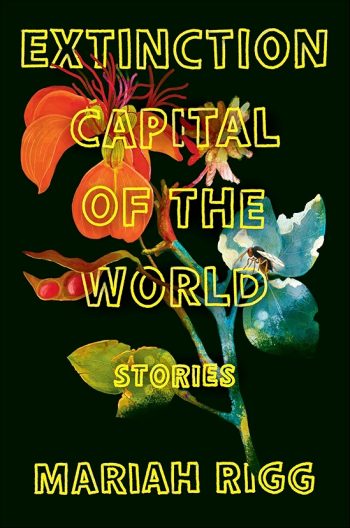
The Book: Extinction Capital of the World (ECCO, 2025)The Elevator Pitch: In 25 words or less, what is your book about?
The characters of these ten stories range from flower poachers to Olympic kayakers and museum curators, culminating in a love letter to Hawaiʻi.
The Rumpus: Where did the idea of your book come from?
Mariah Rigg: There wasn’t a single idea for this book. They borrow and build on the stories I was told as a child, the experiences I had growing up as a mixed-race settler on Oʻahu. When I first started my MFA at the University of Oregon, I knew what I wanted to write but I wasn’t sure what. It’s hard to think of the stories you come from as being capital L, “Literature,” when they’re not the stories that you’re taught in class. My first term at Oregon I wrote a lot of stories that had nothing to do with the life I’d lived, but over time, through the feedback of my peers and especially the guidance of my professor, Mat Johnson, I found a way back to these stories, of the land and people that I love.
Rumpus: How long did it take to write the book?
Rigg: The first story I wrote for the collection, “After Ivan,” a love story between two Olympic kayakers, was drafted in spring of 2020. It came together surprisingly quickly, and was in its final form—the one that’s now in the book—less than a year later. “Target Island,” the last story I wrote for this book, tracks a single man’s relationship to the island of Kahoʻolawe across his life—from boy to geologist to ordnance cleanup volunteer. It was written in the spring of 2023, and revised by fall of 2023, which was when I signed with my agent, Amy Bishop-Wycisk at Trellis. The collection was then sold to Ecco in the spring of 2024, and stayed largely the same, minus one story that was swapped out and a lot of clarifying of time, relationships, and character, thanks to my stellar editor Rachel Sargent.
Rumpus: Is this the first book you’ve written? If not, what made it the first to be published?
Rigg: It is the first book I’ve written! However, the collection as it reads now is a lot different than the first draft—it even has a different title. When I first sent it to agents, the collection was “I Miss You in My Sleep,” a line borrowed from Sandra Cisneros’, “Eyes of Zapata”(a short story in Woman Hollering Creek). At least half of the stories have been changed from that draft to now, largely because, as I continued to write stories, I kept returning to characters I’d featured in stories before. It made sense to revamp the collection to make it linked, to showcase the many ways that life in Hawaiʻi is entangled.
Rumpus: In submitting the book, how many nos did you get before your yes?
Rigg: Oh, so many. After a certain point, I lost count. Before I was a writer, I was an athlete, and had a pile of sports psychology books. Throughout my childhood and young adulthood, I’d copy quotes from these books (and also poetry books) into a composition notebook, cut out the lines I liked best, and pin them to my walls. They were all pretty cliché. One in particular was: “Rejection is a necessary part of learning.” It sucks, but it’s true. This collection is so much better because of the people who said no.
Rumpus: Which authors / writers buoyed you along the way? How?
Rigg: My mentors at the University of Oregon, University Tennessee, and elsewhere—Mary Gaitskill, Nora Keller, Casey Plett, Marjorie Celona, Mat Johnson, Karen Thompson Walker, Margaret Lazarus Dean, Michael Knight, Chris Hebert—provided me with many of the tools that made writing this book possible. The writing friends I made there, and elsewhere—Nic Anstett, Olufunke Grace Bankole, Ariel Machell, Josie Tolin, Tanisha Khan, Sam Herschel Wein, Steve Kiernan, Sara Mae, Saúl Hernández, Natalie Staples, and so many more—helped me to see writing this book as an act of joy, instead of struggle. There are so many writers who are guiding lights to me, more than I can count: Megan Kamalei Kakimoto, Kristiana Kahakauwila, Kali Fajardo-Anstine, Bryan Washington, Megan Milks, Kimberly King Parsons.
Rumpus: How did your book change over the course of working on it?
Rigg: The book wasn’t linked in its first draft. There was a messy triptych at the center of the book where characters overlapped, but the real heart of the book came to the surface when I drafted the titular novellette, “Extinction Capital of the World.” I realized then that the collection had to be linked throughout.
Rumpus: Before your first book, where has your work been published?
Rigg: Before my book, I had stories and essays published in a handful of places—Oxford American, The Cincinnati Review, Catapult, Scalawag Magazine, et cetera. I also had a creative nonfiction chapbook, All Hat, No Cattle, come out with Bull City Press in 2023.
Rumpus: What is the best advice someone gave you about publishing?
Rigg: Don’t look at your phone before bed. It’s good advice for publishing, but also life. If you’re stressed about your book being on submission and see someone you know get a book deal—if you’re waiting to hear back about an award and see someone post about winning, you’re not going to be able to sleep. You’re just going to beat yourself up. While, like I said before, rejection can sometimes open doors to new ways of telling stories, comparison will only stagnate your writing. It will turn you away from the work that you need to create, the work that is entirely yours, and have you trying to fit your stories into some framework that you think will sell, or win awards, or be reviewed well, which most often results in the opposite.
Rumpus: Who’s the reader you’re writing to—or tell us about your target audience and how you cultivated or found it?
Rigg: The person I’m writing to is my younger self, but also, I think, my mom. Everything I am and everything I’ve accomplished was made possible by her.
Rumpus: What is one completely unexpected thing that surprised you about the process of getting your book published?
Rigg: So much of it! There’s a lot of mystery in publishing, and I felt like I was always coming up on something new. I feel lucky that I had my agent, Amy Bishop-Wycisk, to steer me through. I’m also grateful to my publicist, Nina Leopold, and the team at Ecco for always answering my many, many questions. Their patience and generosity made this process a joyful one!