
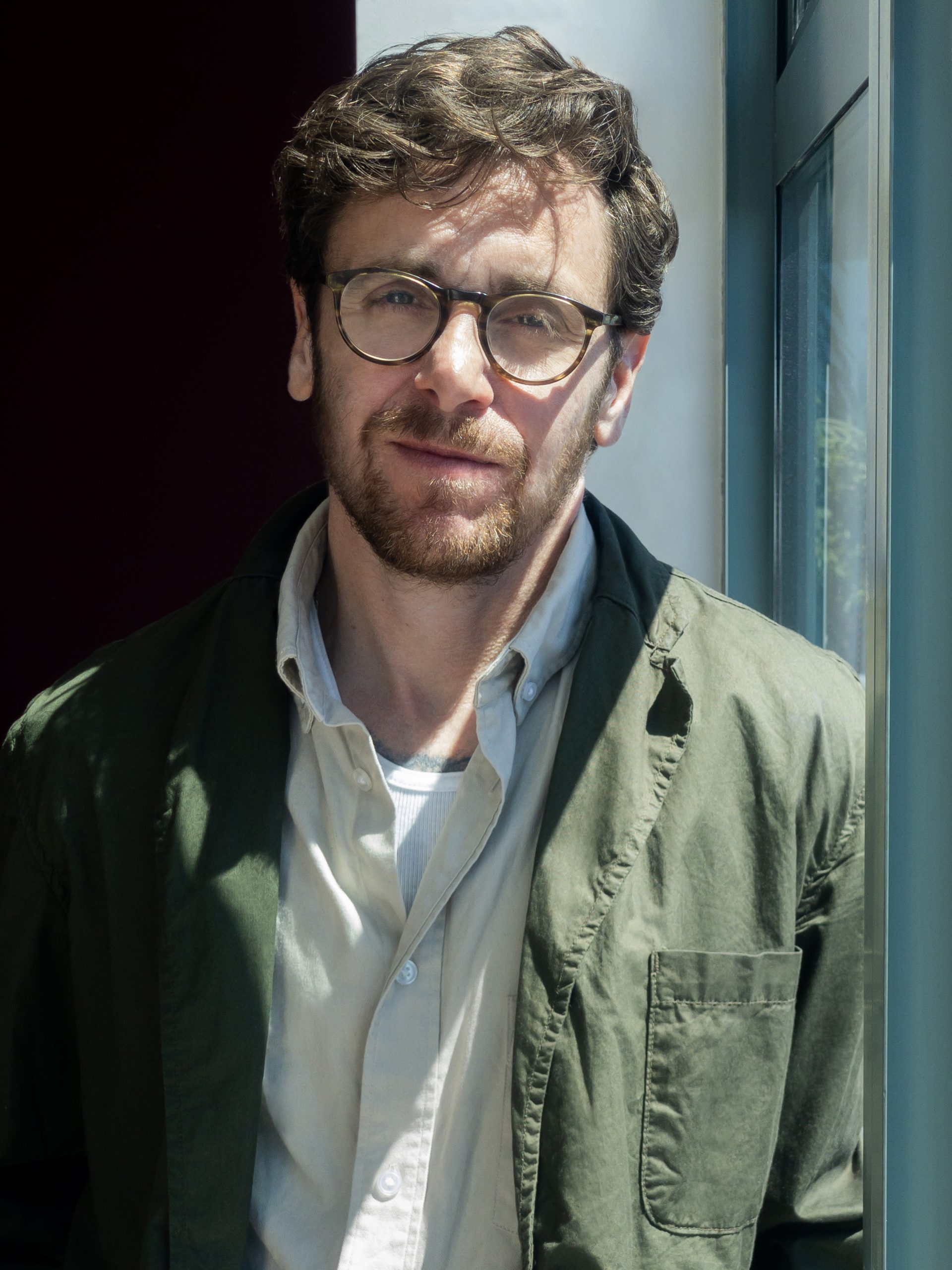
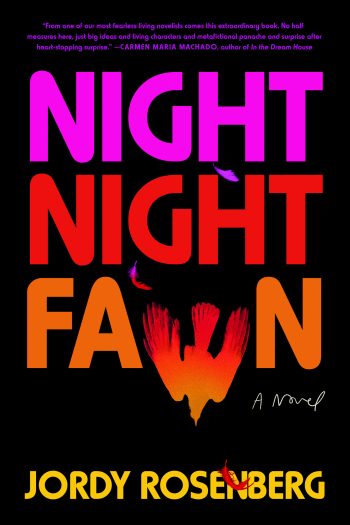
If you’d told me that one of my most enjoyable reading experiences of 2025 would involve inhabiting the mind of a homophobic, transphobic character with Zionist aspirations, I absolutely wouldn’t have believed you. And yet, from page one of Jordy Rosenberg’s ambitious second novel Night Night Fawn, I was hooked. I didn’t want to stop listening as the protagonist, Barbara Rosenberg, narrated the story of her life.
It’s no surprise that Rosenberg has written an extraordinary novel. Rosenberg is a writer who takes creative, intellectual risks, and his work is a thrill to read. His debut novel, Confessions of the Fox (One World, 2018), which I loved, was an ambitious speculative historical reimagining of the 18th century thief Jack Sheppard as a trans man. Now, with Night Night Fawn, Rosenberg traverses into a different century and country, and with a radically different style and voice.
Set in the second half of the twentieth century in New York City, Night Night Fawn stars Barbara Rosenberg—old-world yenta, receptionist for an Upper East Side plastic surgeon, and mother to a trans son who returns home to care for her. From her deathbed, delirious on Oxy, Barbara rants, reminisces, and complains about her life’s disappointments: her failed aspirations to become a film noir actress; her marriage and her husband’s family; the betrayal of her best friend; and most bitterly, her inability to make her child conform to her repressive fantasies of respectability and success.
Satirical with elements of gothic horror, Night Night Fawn is a hilarious and audacious novel that interrogates the troubled fantasies and ideologies of heterosexuality, capitalism, and Zionism, through the voice of a narrator whose contradictions are as revealing as they are grotesque.
I spoke to Jordy Rosenberg over Zoom and by email in December about channeling his deceased mother’s voice, the erotics and politics of film, and writing queer sex from a homophobe’s perspective. We spoke on Zoom for over an hour, and the interview has been edited for clarity and length.
The Rumpus: In 2014, I read your remarkable essay in the Los Angeles Review of Books, about taking care of your dying mother, who you’d been estranged from, and I couldn’t stop thinking about it. I was happy to learn that you were writing a memoir that would cover some of the same subjects. Now, a decade later, I have in my hands this brilliant novel from the point of view of Barbara Rosenberg, who I assume is based on your mother. Can you walk me through the process of making the shift from memoir to novel?
Jordy Rosenberg: Is it really a decade later? First of all, thanks for reading that essay. During a period of time in which I was taking care of my estranged mother as she was dying, I wrote, in a fugue state, a couple of memoirish pieces. Taking care of her opened some floodgates. Suddenly, I was writing these essays and putting them out there. People responded to them, and so I thought I’d write a memoir-length version. But I ended up taking a pretty drastic turn-around with this project when I was doing a public reading from it. At one point, I was ventriloquizing my mother’s voice—something she had actually said when I came out to her in 1990—and there was this breakthrough moment of really long laughter from the audience. It took me aback, the effect of doing this voice and [the effect] this joke had on people, and afterwards I couldn’t really stop thinking about the intensity of that. What was I doing, channeling my mother’s voice—a person whose politics I reject and abhor, and from whom I had been estranged for most of my adult life? What was this melancholic voice doing inside me?
The book became more of a hybrid form of my first person memoir sections and my mother’s voice, but then I really just came to feel, for a variety of reasons, that the project needed to be narrated by her. When I got rid of the memoir parts, I felt so relieved.
That situation of, like, being possessed by the voice of an other—especially someone you’re in total conflict with—became, to me, a fictional situation, and I started to regard the whole project from the point of view of this mother-character who is trapped, dying, and being taken care of by an estranged trans son who she believes is trying to murder her. I wanted to really dramatize the aggression, paranoia, and obsessiveness of the transphobe.
Rumpus: Yes, as I was reading your novel, I remembered this wonderful writing prompt by Grace Paley to write from the point of view of a person with whom you’re in conflict—how it can be both challenging and liberating for a writer. Barbara is an absolute homophobe and transphobe, and yet her voice is so compelling. How did you even step into her troubling perspective? What did it feel like to write from the first person point of view?
Rosenberg: There are a couple of answers to that question. This character is a bigoted yenta. She is homophobic. She’s transphobic. And she’s a Zionist. One of the things I was interested in showing was the ubiquity and ordinariness with which certain far-right positions have been normalized within American households. I wanted to be very honest about that through a character who identifies with supremacist and colonialist projects. And for something like that, it had to be written from that character’s perspective—someone who was not going to hedge or varnish over her enjoyment of cruelty.
Constantly being in Barbara’s worldview was very difficult. I mean, I like a utopian horizon, and this character really, deeply lacks a utopian horizon. She embodies what Sophie Lewis has called a “restrictive pessimism about what it means to be female.” So in some ways the satirical mode was a way to deal with that character’s restrictive pessimism—to make it ludicrous.
And also, there were aspects of embodying that voice that were very familiar to me, of course, because it’s what I was raised with. I remember, during that reading of the memoir version, saying something about how since taking testosterone, it had become easier to mimic a gravely yenta voice—how there are two ways you can get this particular voice: either from smoking and blaming people for decades, or by taking T. And it was kind of like, “Okay, I don’t really know what is driving this, but people are responding to it.” I was just like, “What’s going on here?”
Rumpus: Okay, I’m very interested (and laughing). Can you say more about what you mean, this connection between yenta voice and starting testosterone?
Rosenberg: This goes back to the thing about possession. There’s a recurrent issue that comes up in the novel around the trans teenager’s desire to masculinize, and Barbara is doing everything in her power to put an end to this. She’s reacting to her child’s desire for gender, right? All that stuff Andrea Long Chu addressed so iconically in “On Liking Women.” Against all the medicalizing and pathologizing prohibitions, and all of the respectability politics, trans people actually have complex affects and desires. But also, we share these complex desires with cis people (this is something Kay Gabriel has elaborated so crucially). And Barbara has an absolutely enormous desire for gender—to be a woman, to be part of a gendered binary with her husband, all of it. In the course of that quest, Barbara becomes phobically obsessed with her child’s own gendered desires as a sign of sexuality gone awry, but this transphobic obsession is in so many ways just a projection about the desire-ridden nature of all gendered identity.
Rumpus: Yes, she’s incredibly obsessed with what it means for her to be a woman, a mother, a wife. I’m curious about your approach to writing Barbara’s character. Did you know early on that you wanted to write this as satire?
Rosenberg: I knew pretty quickly. First of all, it was a pretty cathartic way to satirize transphobes.
The way that the far-right has seized on humor and meme culture is not a secret; they have exploited this very unhinged libidinal energy, right? So with this book, it felt appropriate to use a certain version of unhinged humor of our own—to lampoon, to parody. Part of creating a culture of resistance has to do with satire. Think about writers like Orwell, Emile Habibi, Bolano, Randa Abdel-Fattah.
Rumpus: Some of your portrayals of the child—the Jordy character—are also very funny. For example, Barbara is annoyed that he’s always, in her view, lecturing her about Marxist theory.
Rosenberg: Well, this is a teenager coming of age at the end of the Cold War who believes they’re the first person in their family to have ever heard of communism. And meanwhile this kid is talking to his mother who grew up before McCarthyism set in, when communism was part of an open public discourse, especially in working class Jewish communities. I liked to imagine: How would this kid’s inflated sense of historical newness come across? How would it feel to Barbara to be lectured to by her own child on Marxism and class? I tried to have some fun with it.
Rumpus: While I read this, I was thinking about trans narratives—the expectations around them, the desire for them. This is a trans narrative that feels very fresh and unexpected; you’re writing about the trans-masc character from the mother’s narrow-minded, reactionary perspective. I was also thinking about how difficult this may have been to maneuver for you, the writer. For example, Barbara constantly refers to the child as “my daughter” and uses she/her pronouns. How did you navigate this?
Rosenberg: On some level, I was inspired by the recent wave of trans horror writing—Gretchen Felker Martin, Grace Byron, Zefyr Lisowski, Alison Rumfit, and others. I remember when Manhunt came out, thinking, “Okay, we can just do this? Wow, okay.” That was one of the books where I was jealous that someone had taken the guard rails off and just gone there. There are so many trans horror writers experimenting with creative ways around the demands you’re speaking about. Horror and satire are incredibly proximate genres. They both nourish the over-excitement of the reader—either through terror or laughter, or both—which I was hoping to do. Sometimes these are the only genres that are allowed to tell the truth about what is going on in our world. What are the forces at play? Exactly how vile are they?
Rumpus: I’m also interested in how film shows up in the novel. Barbara dreamed of being an actress, but ends up working in a plastic surgeon’s office. She often turns to film as a way to describe some idealized version of herself or her desires, or to reflect her worldview. There’s a particularly hilarious, surprising scene where she and her future husband go to see Exodus at the movie theater. What drew you to writing about film and how did the film also give you a way to examine the politics of Zionism?
Rosenberg: Barbara’s relationship to film is an erotic attachment. There is a certain kind of mid-century noir, with the elegant femme fatale—the ‘40s noir villain/ heroine actress—that sits in a direct line to the big-shouldered fashions of the 1980s, and I was thinking about how those women are playing out this cycle of attachment to film tropes, to history.
I was also interested in the way in which the colonization of Palestine was wrapped up with the movie industry in the middle of the twentieth century, and the way that affected a lot of people who were coming of age at that time. There’s a really great book by Amy Kaplan called Our American Israel, and she talks about the role that Exodus played as propaganda in developing a narrative for diasporic audiences about the Israeli state project. How did you get American teenagers, who otherwise were just into James Dean and bobby socks—how did they become obsessed with colonies and statecraft? There’s a certain amount of it that is rooted libidinally through Paul Newman and Exodus.
Rumpus: Can we talk about all the queer sex in this novel? I’d love to hear you say more about writing queer sex scenes from Barbara’s perspective.
Rosenberg: With the exclusion of one scene, all of the queer and trans sex scenes are narrated from the paranoid, hysterical point of view of Barbara as she imagines or eavesdrops on her trans son’s sex life. I found it quite fun and healing, really, to parody Barbara’s absurd visions of what trans people or lesbians are doing in bed. It brought me back to coming out in the early ‘90s, when being queer was treated like you were doing an unspeakably monstrous thing. In this novel, the worst thing that Barbara can think of is gay sex. I wanted to push that farther—what exactly does that terrifying sex look like to her? I wanted to see it.
Rumpus: Yes, even as she’s dying, Barbara can’t stop obsessing that her child, who is taking care of her, is now engaging in queer sex in her apartment.
Rosenberg: I really wanted to excavate Barbara’s obsessive worry that her child is glorying in the power reversal. He’s really shoving his transness, his sex life in his mother’s face as she’s dying… I think he’s sort of like, “Well, this person can’t do anything to me anymore.” He does have a lot of power over someone who mistreated him really badly. I was interested in the bit of sadism that can come out both sides of a parent-child relationship. You’re taking care of this parent who was abusive to you and you are doing a lot of caretaking and you even in some ways may want to do it or feel like it’s an important thing to do—this still is your parent—but there also are elements of maybe twisting the knife. I wanted to dramatize all that.
Rumpus: We’ve talked about the humor, but you’re also exploring heavy subjects and serious themes, including the difficulty of caretaking, and illness and mortality. You don’t shy away from dying or the horrors of the body. There are scenes with shit and diapers that are graphic and absurd. You capture Barbara’s pain and humiliation, her resentment and vulnerability.
Rosenberg: I think for anyone who has taken care of an estranged dying parent, there’s a lot involved. Queer kids often end up being the ones doing it. Often, they don’t see our lives as real, right? So it’s kind of like, “What’s your excuse? Where are you?” I wanted to capture the weirdness of taking care of someone who was abusive to you. But I approached that dynamic from its inverse—from Barbara’s perspective, who is being cared for by someone she thinks of as monstrous, but who she’s now totally dependent on.
Recently, when I was rereading The Prettiest Star, I couldn’t help but think of certain similarities between things we’re touching on in our books, especially that incredible scene where Brian loses control of his bowels—there is something so obviously, needless to say, really primal about that scene.
Rumpus: Thanks for rereading my novel. I agree this is an overlooked but such a common story—the rejected queer child now taking care of their aging parents, and it’s something I’m also writing about.
Jordy, we’re living through this very intense moment in history—every day we’re witnessing a terrifying rise in fascism and violent repression, and we’re also seeing people coming together and resisting. How does it feel to have a book come out right now that is touching on so many of the more horrifying elements of our history and our present?
Rosenberg: Writing fiction and organizing are not the same thing. A novel is not a collectively-generated tactic; it’s a novel. But I like to think that satire can hopefully give readers a small measure of release of anxiety, a momentary release. This is something that my partner, Jasbir, helped articulate while I was writing. And there’s a very real focalizing of righteous anger, too, that happens through satire. I do take this question of the cultures of the left very seriously. We can’t abandon the public sphere, especially when the right is trying to excise trans people from it, when they’ve been trying to shut down platforms for Palestinians and Palestinian solidarity, and disappearing people. Actually, we need to double down on being in the world. Happily, I’m not alone in saying this. We’re talking about insisting on a version of the social world that is ours, that is appealing, that has teeth and is funny, courageous and collective.


Click here to subscribe today and leave your comment, or log in if you’re already a paid subscriber.