
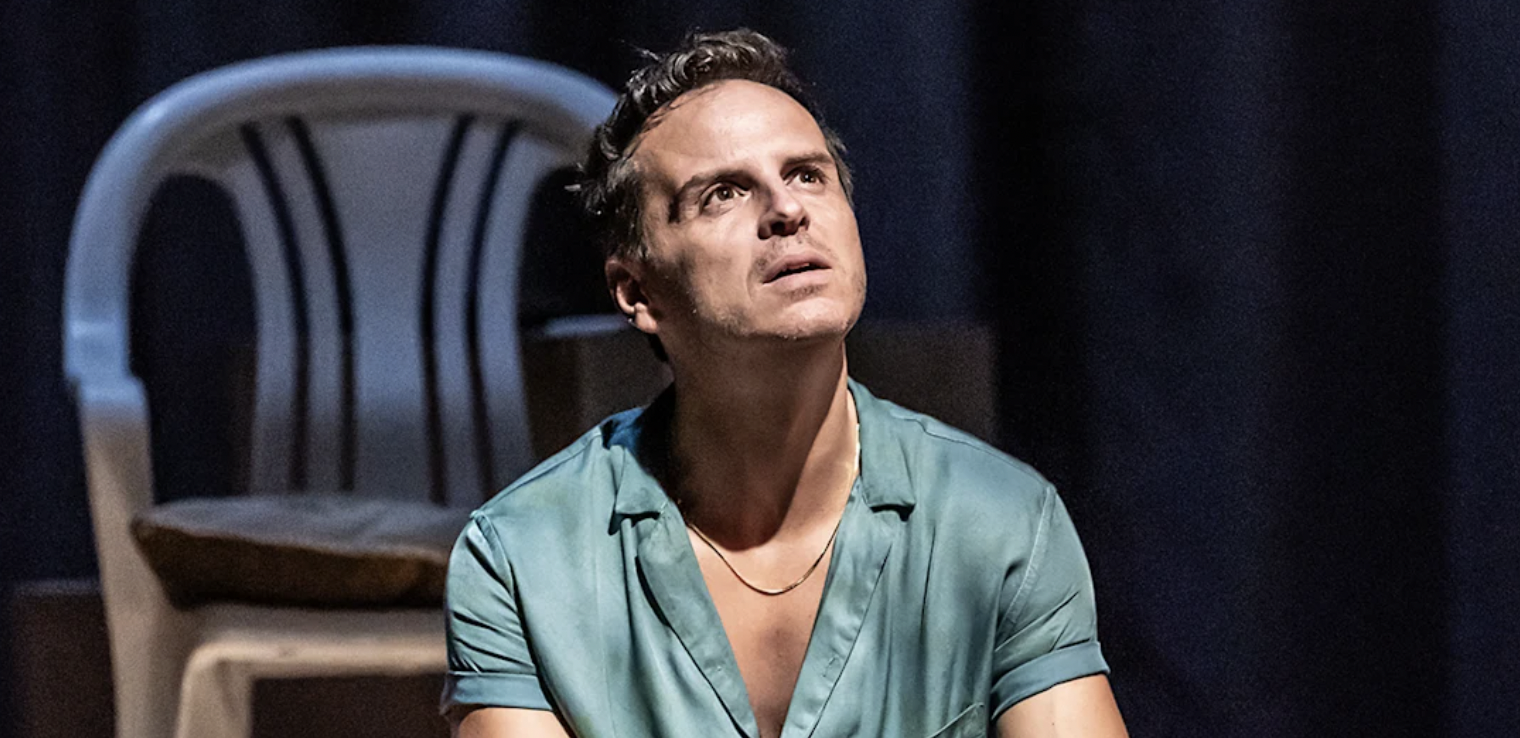
The space in the Lucille Lortel Theatre is tight, simple, conveying a sort of austere self-respect befitting of the historical avant-garde.
The grading of the orchestra floor is rather flat, such that one has to perpetually try and look between the large-looming heads of the preceding row. It’s the sort of space you would readily call intimate. For the next one hour and forty minutes, the stage is set for an intensely personal conversation between Andrew Scott, the only actor in Vanya, and the small audience.
On the left of the stage is a contemporary, commonplace kitchenette; in the middle is a door in a detached bit of wall, floating and surreal (an important scene- and character- transition device); on the right is a noticeably more sentimental ensemble of a giant, translucent, plastic spherical light, an upright piano, and a long swing. In the background, there is a narrow span of space lit by a different light source, where we can see the exit door and a little staircase. This space will indicate at times backstage and at times the outdoors. Rosanna Vize’s set is a pared-down collage of ordinary and occasionally hyperbolic objects, delicately specific and rigorously controlled.
At about ten past seven, Andrew Scott jauntily enters the stage in an easy outfit—comfortable and loose. He sports a teal short-sleeve shirt, loose-fitting pants with the cuffs rolled up, and a springy pair of sneakers. A sensible hush comes over the audience. He moves, swiftly but without hurry, to pull back the curtains at the back of the stage, revealing a rehearsal-room style mirror. He goes to the kitchenette and flips on the light switch. He looks at us, acknowledging our existence. Then for a few minutes, as he puts on the kettle and waits for the water to boil, doing nothing in particular — as if recollecting lines and preparing to start, or as if the character, yet unidentified, is brooding on something — the audience waits in the hush heightened by the familiar, soothing sound of a kettle, anticipation intensifying.
These opening moments set the tone for the show — ambiguous, informal, ordinary, and perfectly close to us and our lives. Instead of a venerable, canonical work of nineteenth-century Russian literature, here Uncle Vanya is treated more like a personal, contemplative exercise, enabled as much by what happens on stage as by what the audience brings.
Before coming to New York, Vanya, the one-man production of Anton Chekhov’s Uncle Vanya adapted by Simon Stephens and directed by Sam Yates, ran for five weeks in 2023 at the Duke of York’s Theatre in London. The storyline follows closely Chekhov’s original, with modernising tweaks here and there: anglicized names, 21st-century occupations, and contemporary details
The quiet, hard-working life of Ivan — Uncle Vanya — and his niece Sonia, managing Ivan’s late sister’s country estate, is disrupted by the arrival of the urban-dwelling, once-successful filmmaker Alexander — Ivan’s former brother-in-law and Sonia’s father — and his young, beautiful second wife Helena. Alexander’s doctor Michael, who is in love with Helena, visits increasingly often. Sonia, in love with Michael, tries to work out his feelings. Ivan, bitter about Alexander, complains and throws tantrums. In the end, Michael and Helena almost have an affair; Ivan tries to shoot Alexander and misses; Alexander and Helena return to the city; and life on the potato farm shall go on as before.
Except that Andrew Scott plays all eight characters. A page in the playbill explains that the one-man-show idea occurred accidentally during readings of Stephens’ straight version. ‘It turns out when one person [does it], when there was one voice,’ Scott explains, ‘it just sounded like an insane person talking to themselves.’ The characters in Uncle Vanya, the co-creators realised, may be much more alike than we are used to thinking. The one-person, slightly-insane adaptation was then developed to highlight a commonality, beneath the surface, of human desires, defects, and disappointments.
The challenge, of course, is to execute the concept in a way that doesn’t lose the plot. Scott’s nimble, full-body impersonations and the production’s precise, clever choreography met the challenge with excellence. While demanding of the audience, Vanya gives just enough signals, using brilliantly simple tactics, for us to keep up with the story. The set is fully exploited to facilitate quick character transitions, and in earlier or more populated scenes, lines of dialogue often end with naming the addressee. Beyond Scott’s fine-tuned pitch of voice, accent, gravity of demeanour, gait, and direction of attention, each character is associated with an object they fiddle with. This last tactic — a sort of object-character Pavlovian training of the audience — is in a sense crude. But precisely such a quality of crudity rounds off the essential, unique merits of Vanya: its subversion of representational realism, sense of informality and humour, and hence real intimacy with the audience.
The one-man-show concept inherently defies representational realism. Instead of seeking to immerse the audience in the believability of variable faces, costumes, and interactions, as theatre traditionally does, it aims at an altogether different kind of engagement. At any point, the audience is free to decide whether to take the action on stage literally or figuratively. Taken literally, Scott is a man talking to himself in delirium. Only when taken figuratively does he become eight separate characters. The latter view requires a touch of imagination willingly invested by the audience. It is part of the structure of the production that we must put in the work to decipher the cues and see the same actor differently, playing along in the high-concept game.
Because he could, at any point, be any of the characters, he could also be none of them. This instability of meaning and activation of imagination, opening a wider than usual space for interpretive possibilities, (mis-)identifications, and double-entendres, gives Scott the perfect opportunity to capitalize on his gifts for subtle humour and knowing looks. There are moments when, looking at us directly and intently, he seems to be delivering the lines half in character (seriously) and half as the actor himself (ironically). The fourth-wall-breaking trick is as old as theatre itself, but he manages to pack layers in simultaneously: he is Ivan complaining about life, he is the actor making fun of Ivan, he is also the actor making fun of himself for the Ivan he finds in himself.
Ambiguity of this kind, ubiquitous in the production, has the effect of inducing a generally humorous, reflexive mood. We have the impression that he is often talking to us off-record about the play, as if we are let in behind the scenes — as if we are taking part in a rehearsal, albeit a perfectly polished one. From the set design, to the character transition devices, to Scott’s style, the production follows the surrealism of the one-man-show to its logical conclusion, disavowing the authority that comes naturally with an elevated stage. We feel included, understood, and relaxed. This atmosphere, more than the space itself, is what makes Vanya intimate.
What, then, does Vanya make of the truly serious, dark, heavy moments in Chekhov?
In the fluid flow of the storyline, every once in a while we hit a moment of deep sadness or heavy sincerity — a moment of stillness, where the interior world of a certain character expands to engulf us all. It usually comes in the form of a character’s unflinching examination, at length, of their own flaws: Ivan’s lament on never having amounted to anything, Alexander’s struggle with old age, Sonia calling herself plain. — After all, Chekhov’s central themes involve untenable passion, irrevocable failure, and the meaning of life nonetheless.
It is in these moments,that the intimacy with the audience truly pays off. The audience, hitherto disarmed by Scott’s friendly, conversational tone and reflexive humour, feeling wonderfully complicit and smart in the actor’s exposé of his characters, is now forced to admit and confront deep weaknesses exposed in us. If just moments earlier we felt Scott was speaking to us, now we feel he is speaking of us, our unstable realities finally blended with the characters’ on stage. The monologues then have the effect of an almost excruciating, almost offensively personal interrogation of each of our own lives. (See how you are wasting your life — see how easily life is wasted…) Having shed all traces of irony, they are sometimes almost didactic, almost pastoral, in any case coming straight at the darkest part of your soul. (At times the audience lets out a little, funny, understanding ‘hmm’, just like how it let out a good-natured laugh ten minutes ago.)
These are moments of truth in a play against realism. Like a building that makes a point in being structurally honest — in displaying the trusses and beams — Vanya is a production that makes a point in displaying the constructive parts and techniques of a play. Instead of presenting a closed world of finished fiction, here the inner workings — how the fiction works on us — are visible. If in thus disclosing irreality the play forgoes a measure of sensory persuasion, what is gained is the truths we each discover as we are lured into the making of the story.
If Vanya exposes uncomfortable truths in our lives, does it offer any consolation? Does it, like a responsible therapist, seek closure? After all, untenable passion, irrevocable failure, and the meaning of life are dreadful things to talk about, things most of us are unable, in everyday life, to confront and discuss without euphemism. They are also particularly difficult in our times of exalted ambitions, ambitions unfulfilled, and technologically complicated existential angst, and perhaps more so for the theatre-going types in London or New York.
The final word from Sonia, locating redemption in hard work and the afterlife, asking Ivan to just wait and be faithful, perhaps no longer provides much consolation for many of us. If Chekhov’s spiritual resolution is unavailable, the darkness is simply left hanging in the air — long after the enthusiastic applause, on the subway home, and on the next day’s commute to work.
Ultimately, Vanya is no therapy. If we went in with the hope for some therapeutic effect, as we often seek and sometimes get from the arts, we would find that hope thwarted. The play, staying truthful about its subjects, has no resolution to deliver . For a hundred minutes , we watched ourselves mirrored on the stage, reminded of our own desires, defects, and disappointments. The artistic excellence of the production offered temporary exaltation: the pure aesthetic delight of form and method. Chekhov, Scott, and the production team can do no more for us. Once the existential questions are laid bare, the responsibility for resolution falls to the audience. We exit the play and return to our lives with a little more imagination.
Vanya is available on National Theatre Live.

Click here to subscribe today and leave your comment, or log in if you’re already a paid subscriber.