
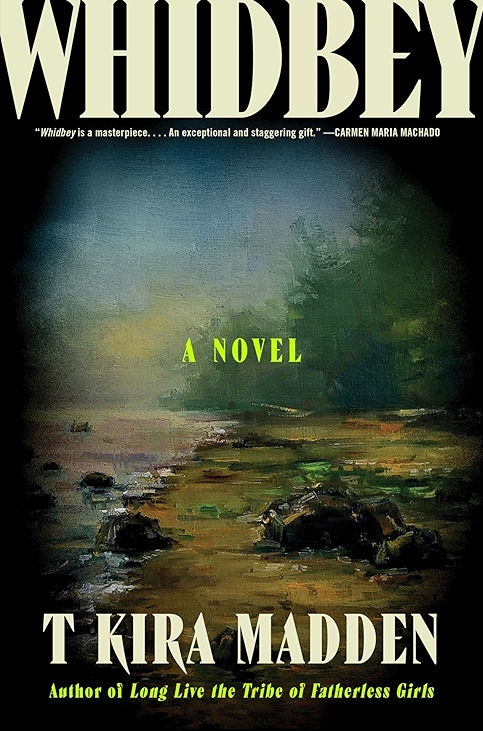
What does surviving mean: beyond stalking incident logs, renewed protective orders, victim impact statements, and incarceration; beyond fear; beyond safety. This is where Whidbey lives. T Kira Māhealani Madden’s debut novel chronicles three women—Birdie, Linzie, and Mary-Beth —and the murder of Calvin, a child sex offender to Birdie and Linzie and son to Mary-Beth. To add to the messiness of this trio, Linzie writes a memoir about Calvin’s sexual assault where she narrativizes Birdie’s trauma.
Madden’s memoir, Long Live the Tribe of Fatherless Girls (Bloomsbury Publishing, 2019), focuses on her coming-of-age and the impact of sexual assault while Whidbey zooms out on a community impacted and connected by violence. In Whidbey, Madden asks the reader to reconsider the performance of humanity.
Here are the women who were abused as children. Be with them and their anger, their unspoken desires for reinvention. Watch how their pain radiates to loved ones. Who has the right to suffer? Here is a child sex offender without mental health support, once relegated to live under a bridge, and a mother ready for his return home. Who is deserving of humanity?
These questions are never far from me. I worked in sexual assault services where clients hid burner phones and go-bags from abusers and readied their children for escape. After safety comes the surviving. My mother reminds me to have my own money, just in case. In the mirror, I cannot deny how my biological father’s eyebrows are mine. Or, mine are his. Do they remind my mother of his violence? I love Whidbey for how it is true to the messiness of trauma.
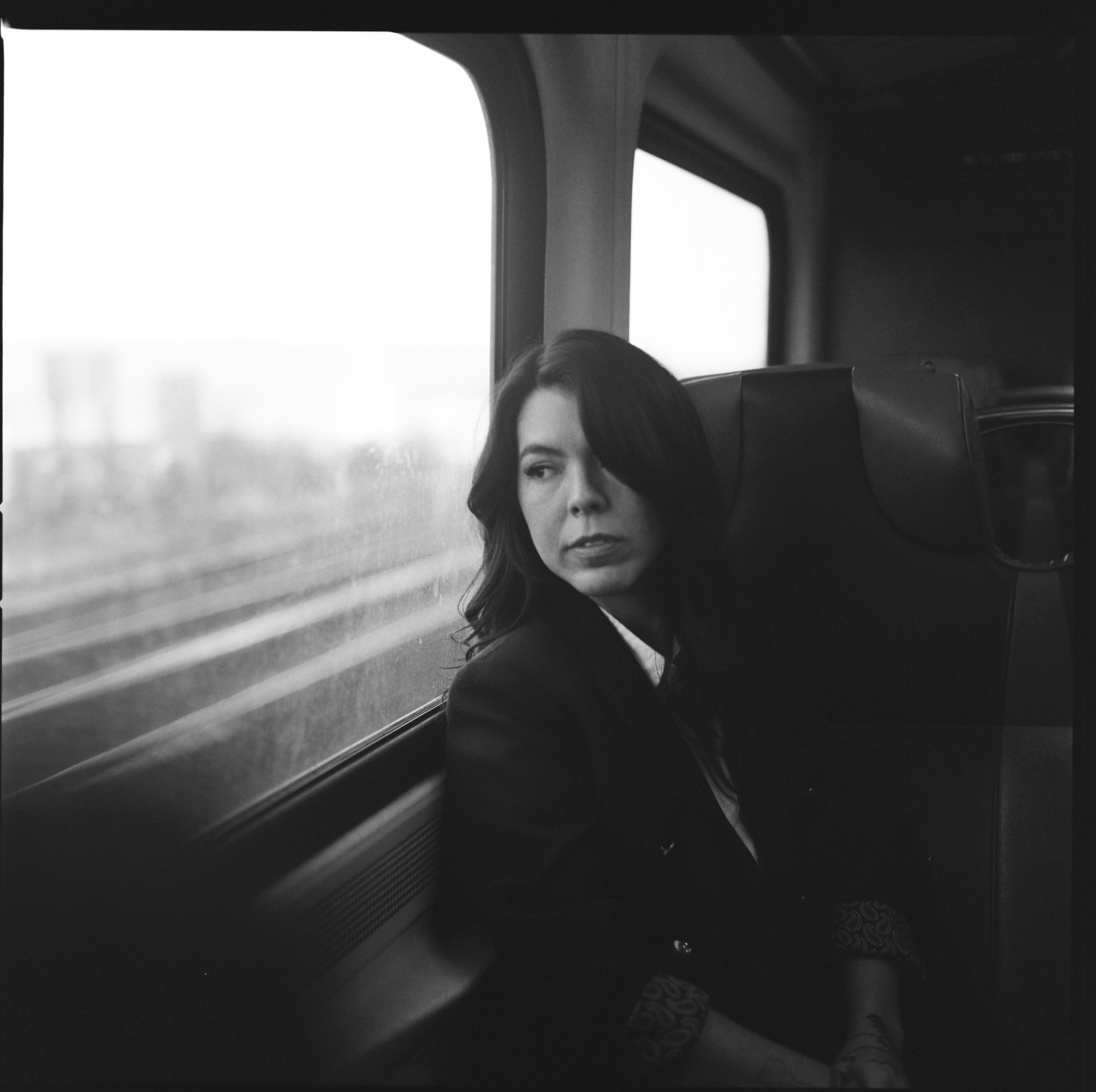
Madden is a kind-hearted teacher and writer. Years ago, time in her classroom renewed my love for writing. I feel that again from speaking with her. On the phone from her Albany home, Madden discussed her commitment to the music of writing and her relationship between trauma and writing. This interview has been edited for length and clarity.
The Rumpus: The women are the focus of Whidbey. Their lives are bifurcated by the before and after of child sexual assault. They want their pain to be visible and invisible. They desire, dissociate, lie, and anger. They have sex, pull out their hair, and fantasize about justice. What was it like to get to know these women?
T Kira Māhealani Madden: Getting to know my characters is the greatest ambition, and the most fun, in a project. My other great priority is finding the music of a project, the sonics, and what that arrangement of music looks like. The characters provide the major and minor notes.
In terms of the characters in Whidbey, I needed to know everything. Hundreds, if not thousands, of pages were written which don’t appear in the final manuscript. I hope what remains of their stories contains the fullness of my knowing them. I had to know the history of their lives: their greatest fears, what’s in their fridge, how they eat, if they’re a top or bottom, their most shameful moments. I need to know their families, their star charts. Even if those particular organizing principles of personality don’t apply to me, I’m always interested in how other people choose to organize their lives, with what principles or containers.
When I’m lucky enough to have a full writing day, I ask questions to prompt myself into knowing the people, animals, and landscapes of the page. That’s a lot of overwriting. That’s a lot of writing until I can hear their voices, understand their diction, understand what’s behind their cravings, their health, their healthcare, and the negative space of the unsaid.
Rumpus: Definitely. Flipping the pages from Birdie to Mary-Beth to Linzie felt like entering different psyches.
Madden: I’m so glad. Even the way their commas would be placed in a sentence… it’s different for each character. They all had different grammatical rules that I worked through with the copy editors of the book. The way the characters use conjunctions, the way an ‘okina in Hawai’i would or would not be used—those syntactic details needed to feel true to each character and section.
Also, the way they each situate themselves in time. Mary-Beth, for example… this is not someone who can afford to think about the past, and she certainly doesn’t think about the future. She’s someone in survival mode, existing moment to moment. Birdie’s psyche, alone on an island, exists almost entirely in the past. I wanted the three characters to embody different ways of moving through time.
Rumpus: That is so impressive. I imagine novellas could exist for each character.
Madden: I wish. (laughter) Mary-Beth had a whole love story.
Rumpus: Mary-Beth does have a yearning quality.
Madden: There are so many lives Mary-Beth doesn’t get to live because of the conditions of her life. Rather than the fullness, maybe you’re picking up on the vacancy.
Rumpus: The absence felt like a magic trick. For each of the women, in different ways, and their longings. Can you talk more about their desires?
Madden: There is a line of Birdie’s: “Someone had finally seen not what I feared, but what I wanted.” That was a loose thesis statement, or question, held throughout the writing process. Survivors are so easily reduced to their fear, or what (or whom) they’ve survived. My life has been led by fear; I wish that were not the case, but it’s true. So I wanted to push these characters, and I suppose myself, beyond that numbness or trauma point—what do they want beyond what they’ve lost? And beyond that?
Rumpus: Their wants are messy which feels realistic. Birdie gets off on Linzie’s memoir, hidden in the cabin, while having sex with Trace.
Madden: Our wants sometimes feel like nonsense. Our desires are often unpredictable, elaborately selfish, and they resist sense-making. I’m always interested in moments where people step out of their so-called character or self-proclaimed role.
The one scene that’s very true to my life is the scene that opens the book. We, Birdie and I, are very different people; we make very different decisions, but the opening scene feels true to us both in its lack of narrative sense. I’m a very private person; I struggled to disclose the sexual abuse that happened until I published an essay about it fifteen years later because I still saw it from a child-like perspective—which is to say, it was all shame. So it was very out of character for me to tell a stranger on a ferry to Whidbey Island what happened to me. Why did I do that? That became a moment of obsession. I suppose it was tethered to the basic desire to be seen, to have one’s suffering known, one’s wants known.
Rumpus: To be seen and understood in how abuse can shape someone, rather than to be perceived and judged because of that abuse. It’s so tricky to navigate. You show this and more for Birdie, Mary-Beth, and Linzie. How did you enter their points of view?
Madden: They certainly have different musical playlists. They all have celebrity north stars. My secret holy trinity is Monica Lewinsky, Linda Tripp, and Paula Jones.
A few summers ago, teaching at the Disquiet program in Lisbon, I visited a grocery store with my students. The objective was for us to walk aisle by aisle and make grocery lists for our characters. I did that for the characters in Whidbey and it helped in understanding what they would be able to afford, what they would pick out. What does it mean for the character of Mary-Beth, who has untreated tooth decay because she doesn’t have dental care? What would she eat, or wish she could eat? I push myself into sensory, world-building prompts when I don’t have the time to write.
Rumpus: I love this and want to try it. Let’s say you have a curiosity about a character because of a generative prompt. How do you decide if you’ll pursue that curiosity?
Madden: I always chase curiosity. I have to write my way through it. Only then can I unearth information about the character, whether or not it appears in the book.
It’s hard for me to have an editorial eye for knowing what needs to be there, what stays. That’s where I most often need help. Jessica Williams is my visionary editor at Mariner, Jin Auh my longtime agent and reader, and Hannah, my wife and greatest collaborator—I’m lucky enough to have three central figures to help shape and find my work, plus very patient friends and a writing group who’ve read many drafts over the years, seeing the shape, arcs, and jewels within the noise. All integral. I wish more people spoke about writing as a collaborative process. Editors! What a gift.
Rumpus: What a beautiful team! And it shows—I could study every sentence in your book. When in your writing process did you polish your sentences?
Madden: I try to be deliberate about sentences as I write the first draft on the typewriter. If I don’t find a line, it’s no big deal, but I’ll rewrite the same line in different ways a couple of times as a signal to myself–make this better. When I transcribe the page to the computer, I’ll choose the best version or write a new version.
That said, line work happens more in the revision process. I’ll slowly, over the years and the drafts I read aloud, change the way it looks on the page. I look at the paragraph as its own little work of music. I need to make sure the repetition, any sort of rhyme scheme, meter, consecution – everything needs to be clicking within the paragraph form. Sometimes that alters the individual line, so I can’t secure it until I have the paragraph. I learn from the poets in my life. And I was a drummer when I was younger… I hope to be a drummer again as an adult. I’d like to think the paragraphs for which I feel most pride are a product of my love of percussion, jazz especially—Max Roach, Buddy Rich. I’m proud of my ear, though it can always be sharper, more refined. That’s lifelong listening work.
Rumpus: Your writing technique sounds similar to how you wrote Long Live, in bursts of curiosities to see what comes together.
Madden: Absolutely. I think people think these [Long Live and Whidbey] are very different books, with good reason—even the covers (laughter), a sunset and then the bleakest, grimmest dark. They’re very different—memoir, novel,coming-of-age to murder mystery. But to me, they’re very similar.
Rumpus: I think so, too. Whidbey reminded me of the preface of Long Live—the TV commercial that featured beautiful, smiling women and the man they smile for. It feels like Whidbey focuses on the performance of the women. In Long Live, the focus is on you, the child narrator, watching the television. For me, Whidbey is about the TV.
Madden: It might not be obvious, and of course many people won’t have read both books, but they feel like sister texts. I’m so glad you picked up on the whispers between them. It’s astute of you to mention the TV because, to me, Whidbey’s great menace is a television or radio or some other form of media present in every scene, something always strobing in the background.
Rumpus: Yes! The media is a menace—tension between what happened and the story that is told, who has power and control, and who profits. Did you know this tension would be central to the novel?
Madden: That story concern came from writing and publishing a memoir. Writing memoir, for me, was about making a story legible. It was my first book and my first work of nonfiction; everything felt so vulnerable… Am I a likable narrator? Will people believe me? Will they hate me, hate my family? I was snagged by this question of likeability and what it takes to establish trust on the page.
Later that year, going to [federal] trial, I felt the same anxieties writing and delivering my victim impact statement. Is this story legible? Is my pain still believable if I don’t remember every detail accurately? What if I’m not wearing the right thing or expressing the proper emotions? We’re so easily discredited if peripheral memory blurs, fades, though there’s significant scientific support for why peripheral memories fall away while central traumatic memories remain.
With the character of Linzie, I considered reality TV practices, the importance of the edit, the making of the hero or a villain. On The Bachelor, I thought about the confessional dinner date. A contestant often waits until dinner to reveal the worst thing that ever happened to them, and then the “Object of Affection” makes a decision: “Do I reward this? Do I connect with this tragedy?”
I used to work on film sets, never reality television, but the more I learned about ITM (in-the-moment) confessions and how they’re played, the more it felt similar to interrogation rooms. It all depends on who is listening or watching, who stands to profit.
Rumpus: I couldn’t believe when Linzie confessed her sexual assault to her love interest on The Dating Show and a crew member replaces the love interest in the scene.
Madden: We really did that. The talent goes home, their hours up, and an extra stands in for the inserts. You shoot them dirty from behind with the same outfit on.
Rumpus: That is terrifying and hilarious. I’d ask myself, am I supposed to be laughing? Of course. Mary-Beth bullies Odette, the podcaster, at a sushi restaurant. Havi calls Birdie a bitch because Birdie is being a bitch.
Madden: Thank you so much for laughing. I love the razor’s edge between tragedy and comedy. For many survivors, or people carrying trauma, it’s often a trait we share–I’ve found it in many friends and artists. When we tell a story that’s really dark, sometimes we’re the only one laughing and everyone is like, “Whoa there, that’s a really tough story.” It’s because we’ve had to use humor as a survival tactic.
I hope that sensibility comes through in the work. I believe all my work is dramatic or tragic satire. I mean, there’s a podcast advertisement in the middle of it (laughter). I hope people can feel that this is a serious story about serious stuff, but it doesn’t have to always take itself that seriously.
I love absurdity, hyperbole. I love Gogol. Gogol’s Dead Souls changed everything for me, as did many of the Russians, the humor I found in Dostoevsky, Nabokov, Lermontov as a young student of words. Really, we’re allowed to laugh? That permission felt ecstatic. I love bridging the darkest dark with the absurdity of human existence, so yes, Whidbey had to feature some unwieldy monologues and conversations. Like the scene about suing the hibachi chef–
Rumpus: I loved that scene! Someone had to ask Havi about her forehead. (laughter)
Madden: I fought for the scene! As you know from working with me, I believe in the misfit. Sometimes scenes or monologues or images remain mysterious even to us as the writers, we just know they must stay. Those are often the most memorable, for readers. At least for me as a reader, I remember the oddball word, the thing that vibrates with strangeness.
It’s the subversion of expectation, too, right? The first draft idea or plan is usually the most logical A to B to C. No misfits unless you’re very lucky.
Rumpus: I believe in misfits, thanks to you! They add layers of depth without added weight, if that makes sense. In Whidbey, it never felt like a monologue or repeating image was a narrative detour. Each misfit felt purposeful to understanding the unfolding story.
Madden: I try to tether scenes to the same central questions. I hope the repetition of those questions, whether implicit or explicit, does some work in containing the scenes, quietly building resonance, rhyming action. In Whidbey, everyone is trying to express their suffering. I asked central questions like “What’s the value of my suffering?” and “Who would I be without it?” within each characters’ sections. People are clumsily trying to express their pain, but always missing.
I also wanted to explore how selfish suffering can be. How potent denial can be.
Rumpus: It feels true to the messiness of trauma. I loved your book so much that I read it twice.
Madden: That’s wild. It’s a long book.
Rumpus: On my reread, I noticed the last sentence of the book is on the first page!
(laughter)
Madden: It was originally the very first sentence of the book and then I had to change it. I tried to make it work a thousand times as both the first and last line, but couldn’t. Thank you for noticing!
Rumpus: You dedicated so much time, heart, and research on Whidbey. What are you most proud of?
Madden: Both finishing it and letting it go. It’s tough to finish a novel, anyone who finishes a book or full-length project of any kind—hats off, you know what it’s like. It’s hard to stay dedicated, obsessed, to push through the bad days where it feels like a worthless pursuit or when the writing is just… awful.
I’m really proud of this book that I wrote for eight years. Of course I have a strong psychic pull to this project because so many of its questions live in me. There’s a way in which intellectualizing something or making art with pain blunts that pain a little bit. Just enough to keep going. I like wearing many hats… my writer hat, my research hat, teacher hat, and not just laid bare to the experience. There’s a reason Birdie wears a helmet.
My therapist is always saying, “This book is your sail dragging in the water. Eventually you have to hack it off and you’ll feel the wind again.” I’m proud of being able to finally say, “It’s done.” I could edit forever, but I won’t. It’s yours now.



Click here to subscribe today and leave your comment, or log in if you’re already a paid subscriber.