
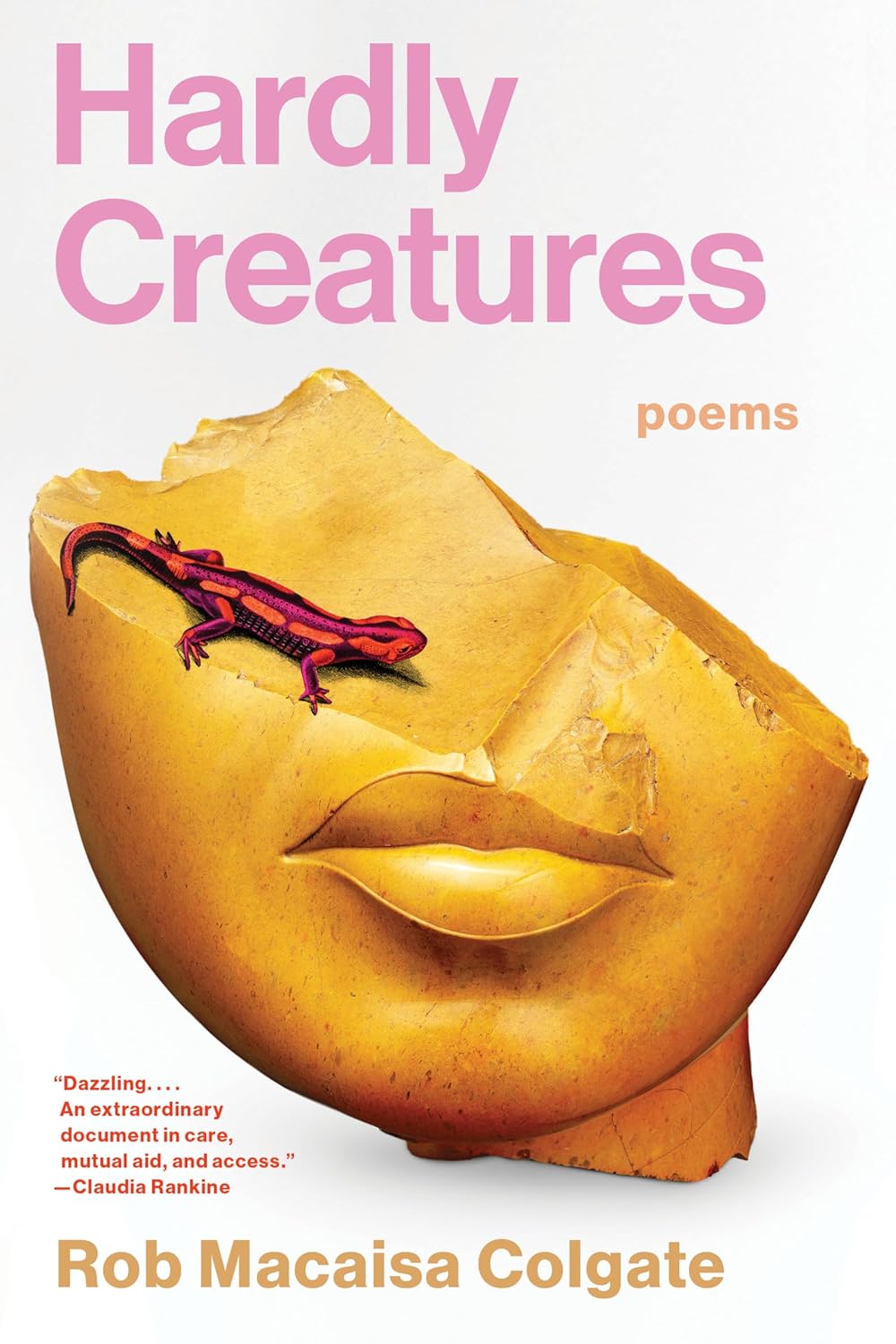
I remember taking Hardly Creatures with me to a community reading event at a bar, unable to dive into it beyond the first page. A month later, I decided to give it another chance, this time in the quiet of my Midwest apartment. And to say this book was an immersive experience, would be a huge understatement.
When I think about the poems in this collection, I am compelled to ponder on the possibilities of language, what it can and cannot do. It is 2025, and humankind has made considerable progress; yet language keeps being used in harmful and dehumanizing ways to diminish so many human experiences. What, then, is the responsibility of language beyond the page? How can we acknowledge the danger of carelessness in our use of language? How do we combat the violence and apathy created by certain rhetoric? These are all questions that this collection spawns for me.
I entered this book as one would enter an art gallery– clueless, curious, and slightly apprehensive. Very quickly though, the book held my hand and taught me how to read it. As in an art gallery, the book guides the reader through the signs and symbols they will encounter later, arrows pointing in different directions to help the reader navigate which exhibit they want to walk into. Unlike an art gallery though, this collection does not have strict visiting hours or a closing time. It keeps its doors open, not rushing the reader while they experience the poems, letting them take as much time as they need. This is fitting, as the author writes within a lineage of queer and disability poetics. In its very foundational pillars, this book demonstrates how crip time and queer time move, not in direct opposition to linear time, but also not in competition with it.
In an article on the entanglement between crip time and queer time, Élaina Gauthier-Mamaril talks about how Alison Kafer identifies three aspects of queer time that can be useful to an analysis of crip time: “strange temporalities,” “imaginative life strategies,” and “eccentric economic practices,” all of which work together to reimagine a future for disabled bodies. “Strange temporalities” refers to the ways in which time is experienced and organized differently by marginalized groups, often folding the past, present, and future cyclically rather than moving through them chronologically. Combined with “imaginative life strategies”—a way to live life with joy as the central purpose, thus resisting capitalist expectations— and consequentially, the rise of “eccentric economic practices” rather than normative ones, crip and queer time is a lens of understanding individual needs rather than conforming to a standard. Gauthier-Mamaril states, “In short, crip time is both a theory and a practice, a way of existing according to an alternate durational logic for many disabled people.” Colgate’s collection is not only based on these theories of disability studies, but also embodies the everyday practices that queer disabled people perform to protect themselves and one another. Through poems of caregiving and friendship, of spending quiet evenings watching the sunset, Colgate stretches time, allowing it to slow down and claim its own pace, a rebellion against the robotic pressures of capitalism.
In “Self-Portrait Without Sense of Self,” he writes:
Later, at the lake, I sit in my sweat, alone on the big rocks, wondering whether I have chosen wrong, trying to have a moment, but I get distracted by my phone, and then it gets dark, and then it’s all over.
Even though the speaker is aware of crip time and their life made better by it, they are also constantly trying to move forward in the world rowing against linear time. This dissonance creates fear and doubt about exploiting the luxury of time. What if their self-worth is directly tied to how much they can contribute to the economy? What if a person is not enough when they’re simply existing?
The poems in this collection are communal and collaborative. The reader’s experience activates the poems, rendering each encounter unique and alive. Unlike in a museum where touching any art is prohibited, this gallery is rich with sensory engagement. There are instructions to touch the art, hold someone’s hand, sit on a bench if needed. These poems are considerate of the reader just as much as they are of its subjects.
The poem “I Need a Minute” reads: Slow down. No poem on this page.
This is the shortest poem in the book, by which I mean it occupies the least space on the page. However, this poem is an entryway, an invitation for the reader to experience the poem rather than merely consume it. It is both an instruction and a permission to take a pause, and just be still for a moment. In this process, the reader not only is looking at the poem from the outside, but becomes a participant by inhabiting the world of the poem in that particular time and space. The poem’s nature is transient, moving and changing with different readers, different approaches toward it, and different emotions the reader leaves the page with.
Going back to my previous thoughts on language and rhetoric, one poem that stood out to me in particular was “History of Display,” where the poet draws a timeline to highlight disability related events of historical significance. In one section, he writes:
Mad people exist in public
	(guys this one doesn’t go well)
Mad people existing in public deemed a failure of the state
	mad people not considered part of the public
	mad people considered the part of the public that is scary
	mad people denied private housing
(Not sure where to put this in timeline; kind of an “always” thing?)
Throughout this poem, and especially in this section, Colgate talks about oppression through language– once an individual is labeled mad, the focus shifts away from care or support and toward questions of social legitimacy and belonging. He also questions the authorities that assign and reinstate these labels—often the state, the media, financial institutions, the justice system, to name a few. The history of mental illness is as old as the history of human civilization. However, the vocabulary surrounding it is relatively quite new and prejudiced. People with mental illnesses, often understood as having invisible disabilities, get outcasted to the margins. Even though they are called dangerous, the dangers are often inflicted on them. Unlike physical disabilities that might prompt some governmental or institutional support, mental disabilities are dismissed, with the individual expected to maintain optimal levels of productivity. What is saddest is the last line in the excerpt; as time and technology have evolved over the decades, so has treatment for mental illness. However, in most places and communities, age-old discriminations still persist.
When I left the museum of poems, I left with the knowledge and reassurance that it is us who protect our kin. We take care of one other when the world closes in on us; we help each other stay alive. While this collection critiques the existing systemic structures and their failures in providing for the people, it also acknowledges the relentless labor and heartbreak inherent in loving and caring for someone living with a disability. In these poems, Colgate explores romance in friendships, intimacy of peeing in front of friends, shame in asking for help, and communities that sometimes create themselves.
In what is envisioned as a “Gender-Neutral Bathroom,” the poet writes an “Ode to Pissing,” which in actuality, is a wonderful ode to friendship:
The song of piss on porcelain. Lorraine and I talk dreams of bathhouse raves,
disabled teachers, careers in porn. I ask how she became so comfortabl
with friends wiping her and she shrugs, lifts her shoulders, checks if she’s done.
I love these lines because they highlight the importance of our unspoken responsibilities toward one another. I do not believe that human beings owe each other nothing. We do owe each other kindness, empathy, generosity—and, for those who matter most, unconditional love, especially when the conditions relate to human anatomy.
I also admire this collection’s ability to place acts of love next to what we perceive as the most unlovable parts of ourselves. This peeks through the entirety of the collection, especially in the poems addressed to Eli, the speaker’s lover, romantic interest, and best friend. Eli is the person we think we do not deserve, yet, they teach us to embrace our insecurities by showing how to love them.
In “Eli Interprets,” the speaker recounts a difficult day, one where they can “feel the familiar click/ of my tongue down my throat.” Later, they get on FaceTime with Eli, and—
He asks how I am. I attempt:
It’s always dark and start and go and go and there’s no Rob
that is awake it’s always dark and sleep and goodbye and please.
He nods. Yes, dark, you. Personally, I’d be happy if you stayed alive.
This moment not only throws light on the tenderness extended by one human to another, but also the shared vocabulary we create with our special people. It reminds me of the broken English and bad syntax that my friends and I communicate in, when too tired to form cohesive thoughts. Isn’t that what love is– a little respite from the gnawing world?
Eli’s care extends beyond words; it manifests in acts of service offered without request. In “Eli’s App History, February 4-5, Messages Accidentally Erased,” an entry reads:
1:31 PM ET —Instacart
	REXALL, 250 University Ave Unit #120, Toronto, ON M5H 3EH
		Liquid IVTM Hydration Multiplier (12 sachets)
		TylenolTM —Extra Strength 500mg Caplets (24 ct)
		3.25” Mini Love Ya So Much Love Card
	MINISO, 219 Queen St W, Toronto, ON M5V IZ4
		Soft White Compressed Mask Sheet Hydration (20 pcs)
		Salmon Sushi Cat Plush Toy 13.7” Cute Stuffed Animal Soft
.
Not only is this an inventory of care, it is also an excellent masterclass in playing with poetic forms. Through lists, erasure, emails, flipping the abecedarian, Colgate reinvents and personalizes these forms to expand what they can contain. His deep and dedicated relationship with language is simultaneously filled with playfulness and humor, characteristics that keep us alive in our darkest hours.
Even as these poems reach outward and achieve so much, the collection is aware of its shortcomings, and that makes it even more poignant. In a section titled Information (followed by the question mark inside a black circle), a stanza titled Apologies addresses the reader directly:
We are sorry the fonts are not larger.
We are sorry that the page has no texture or sound.
We wish the benches were benches instead of poems.
Hardly Creatures taught me a lot, mostly to recognize that to be inclusive is to acknowledge that, despite our best efforts, we will inevitably fall short. There will always be room for improvement. Even in our attempt to build a non-exhaustive vocabulary, we might still end up leaving someone out. Our museums are works-in-progress, and our work, therefore, will never be completely done.




Click here to subscribe today and leave your comment, or log in if you’re already a paid subscriber.