
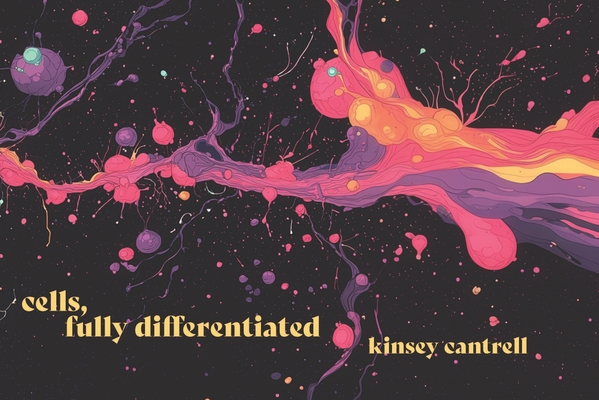
Kinsey Cantrell’s debut poetry collection, cells, fully differentiated, is a cacophony of crowns, an encircling of repeated words and phrases, a mirror for sputtering language trapped inside the mind and body of a narrator reckoning with internal misfires too convoluted for an outsider to diagnosis or label seen. Cells, fully differentiated is divided into four parts like a nod to the cell cycle with an authorial side note to buckle up, reader: (1) Start, (2) Interphase, (3) Cycle Arrest, (4) Apoptosis.
Before venturing into Cantrell’s poetic narrative, the 9×7-inch poetic design of the collection presents symmetrical squared concrete poems encouraging disarray to the reading experience. Where one’s reading experience may take place traditionally across the page from left to right, the squared unnumbered sections build the narrative up, left to right, up and down, no matter the course the eye chooses to follow. Additionally, Cantrell’s white space is just as loud as the scattered or poignantly spaced words on the page. With little to no punctuation for cued breath, Cantrell’s white space paces the reading, and depending on one’s preference to urgency, the fluidity between control and uncontrollability is up for the reader to decide. The experience of observing these poems is just as fascinating as the reading experience, if not more telling on the experience of living with a chronic illness. The negative space on the page tells its own story, too, should one care to look deliberately and delicately. Cantrell’s intentional white space says don’t fill in the gaps but listen to them. Cantrell takes us poetically to the cellular level of embodiment—that is, what is being said within a body on revolt, what is not being said, and how it’s being said.
In the narrative experience, readers are introduced at the beginning of each section to an italicized phrase that is explored further in individual poems respectively titled from the main phrase: “circling the encircling the circling isn’t working doesn’t work isn’t working.” It’s as if the narrator, or the cells, themselves, recognize ERROR but can’t quite determine the cause or place of injury. We venture into each cellular section of the collection to uncover what isn’t working, never quite certain what will be discovered, if anything at all. For instance, in the opening poem “re/up/take,” the narrator discloses:
i / still can’t say it outright / go on without the compulsion / to a magnified blankness / never intended illumination. / nothing makes sense to me / after the senses vague and dull / and in those days no notice. / the room blue with the lighting / like that only in the minute / to kill the idea of the self- / mutilation fuming under force / or slow and building threat in / detail the railing against / the memory tightly sealed / for protection, or unperceived / strength. pass time. time past. // these mangled afterthoughts, afterimages.
Readers are revealed more explicitly to this body of work as a body at work with something amiss inside (these “afterthoughts, afterimages”), later understanding this has been ongoing for quite some time as an “indefensible self-duplicity.” We venture further into the “Start” with words sporadically spaced as if the narrator has become breathless and exhausted in search of the source of the first wound: “the self-regulating mistake of my body / off / off / off / off so long…”
Upon reaching “Interphase,” or the second section within the collection, Cantrell’s poetic play with white space, repetition, consonance, assonance, and anastrophe becomes rhythmic, challenging the central image or thought. Cells, fully differentiated is a body of work in which controlled disorder (via language assembly) reveals an embodied catastrophic experience with chronic illness. It is this challenge of disorder that brings Cantrell’s innovative use of poetic devices to a deliverance of acceptance with such internalized, of the body pain, “then there i was, at uncertain altitude, / characterizing myself adjective, blood vessel / constrictions lighting my hands.”
We find ourselves journeying chaotically through a “circling” not “working.” Taking in the final three poems of “Interphase,” with each respectively titled “working,” “circling,” and “how to interpret season as range,” Cantrell’s direct imagery grounds us in the ambiguity of rebellious cycles of entropy. Such as in the poem “working,” “when everything starts and ends that same… // Stomach hurts, earth shatters… / breath comes red and / everything breaks differently.” Or with “circling,” in which “afterthoughts” are mangled and nothing quite makes sense, and that is the only rationale to chaos occurring within misarranged bodily systems: “fallen face earth can’t. want image, text, it lives / traffic to bearing, discern. curdled and comes someone blurred / of transmitters, parasites, relentless / you knew the sunset took.” We go further into jumbled thoughts with “how to interpret season as range,” revealing the wages (or rages) of a body with increasing demands from capitalistic expectations while enduring “a cytokine storm, as / rage through the body / wave of inflammation / nods to inflation, itemized.”
Upon arrival at “cycle arrest,” the poems in this third section attempt to “map” or reckon with what has led the body astray: “enforced wherewithal. withdrawal. a culmination. / i was a pulse and a misdirection.” Short lines, full end-stopped punctuation, and intricate spacing between stanzas furthers the ERROR message of despair and disrepair of invisible wounds. The narrator in this section affirms,
i cling but flicker.
sing but sicken.

we speak of cost. trade language with careful minds to the physical
exertion, the energy expenditure. spreading coffee grounds thin with water.
a skeptical disillusionment, anticipating ambivalent response, repose.
The “memory maps” within this section declare “everything that never happened” and the voraciousness to the urgency for information, to question memory, and the quality of material bodies in the physical world, “who was i to find myself / underground cracked to longing / rupturing the artery / meek and splitting / both my aching hands.”
We arrive at “apoptosis” in the closing section. Apoptosis in its scientific form is a programmed sequence towards a cell’s death in the cell cycle. Apoptosis in its poetic form specifically within Cantrell’s poetry collection, is a sequence of events leading to the inquisitive acceptance of the declination of the ecotone between body and mind, “what about illness / feels unnatural? the cold sweat of your dying / like water from a damned reservoir.” We experience apoptosis in a countdown of poems beginning at 10. Each of these ten apoptosis poems reveal the breakdown of survival. We encounter the mysteries of a prognosis, the eclipses of the sicken waiting to be found, collective trauma, making new again, and fragmented bodily flames reaching a breaking point with one final question, what is keeping me here?
To reach the end of Cantrell’s cells, fully differentiated is to go back to the beginning, read it again but slower. Cantrell invites readers to sit in the space between asterisk and block stanzas. Pull the language—the body—apart word by word, line by line. Start on right page then the left. Start on the left page then the right. Linger longer in the white space. As a chronically ill reader, I welcome the big bay window and the sunlight in excess as described in Cantrell’s final poem “sickness behavior.” To want more, to feel deeper, to imagine greater, especially in a body, sick and compromised in an unknown state, Cantrell leaves us with one poetic truth, everything is short-lchallenge of disorderived.

Click here to subscribe today and leave your comment, or log in if you’re already a paid subscriber.