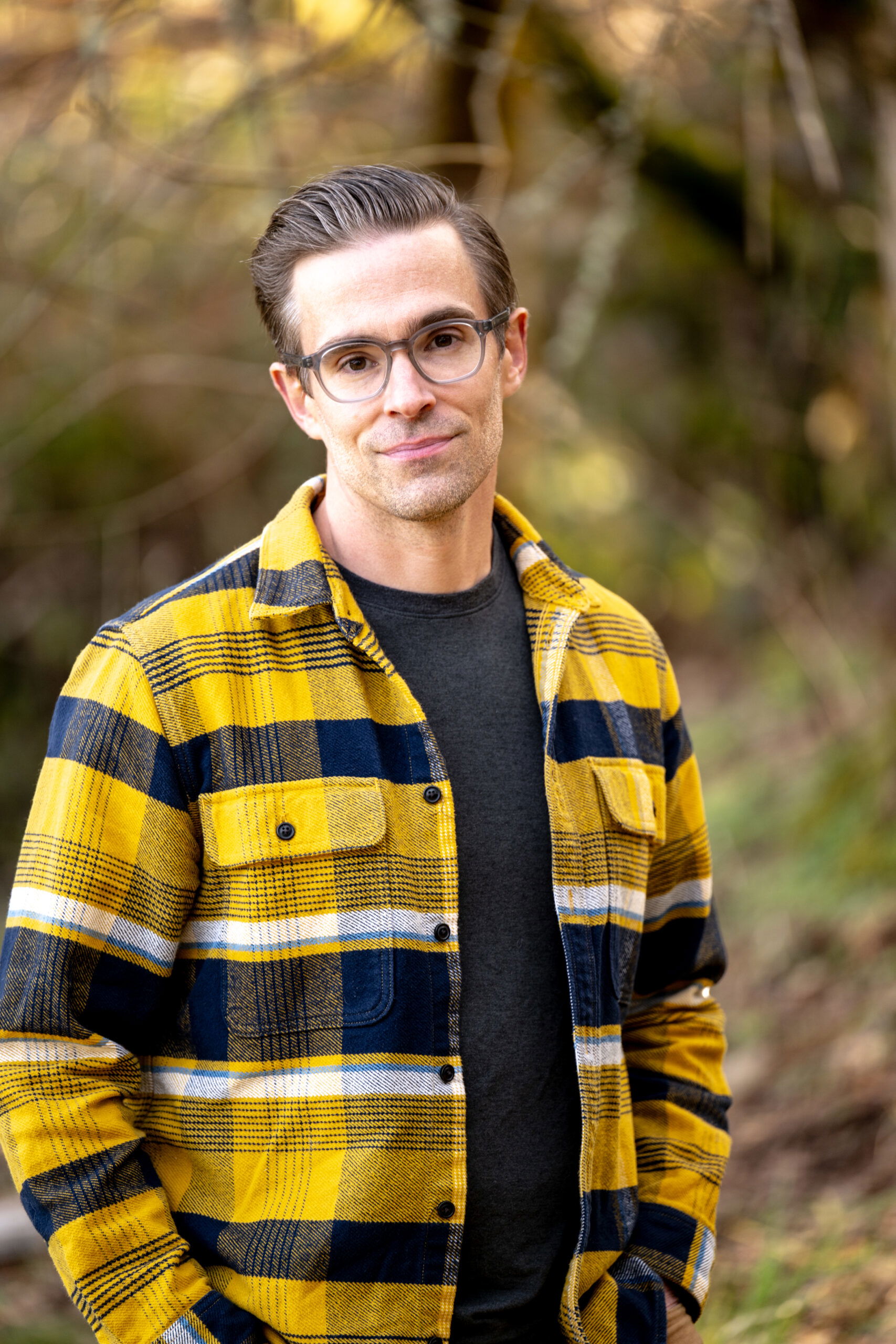
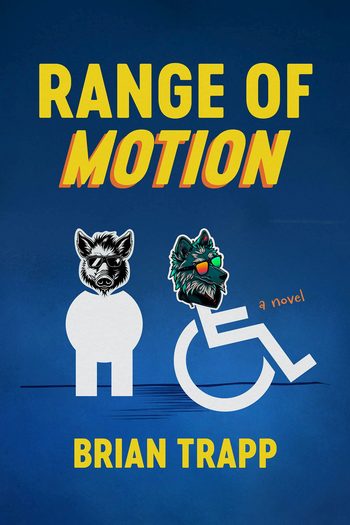
Above all, Brian Trapp wanted his debut novel—inspired by his experiences growing up alongside a twin brother with cerebral palsy—to be funny.
Twins Michael and Sal are born moments apart, but Sal has a brain bleed that leaves him with severe cerebral palsy and intellectual disabilities. Told from the perspectives of the boys’ father, their mother, and Michael, Range of Motion follows the family as they navigate raising a disabled child in the face of an unforgiving healthcare system. The novel spans nearly two decades (which, incidentally, is about how long it took Trapp to write it), and touches on everything from body image issues to lab research politics to the horrors of summer camp sing-alongs.
Sal can say only eight words because of his speech and mobility disabilities, but as a small child, Michael feels that he alone can understand what Sal is saying. The twins’ intense bond leads to such mischief as wheelchair bobsledding and performing exploratory surgery on their cousin’s Baby Feels So Real doll. Yet as the boys grow up, Michael’s ability to “hear” his twin grows hazier and hazier, and he fears losing their semi-telepathic connection forever.
It’s this desire to know what Sal is thinking and feeling that forms the crux of the novel. Each family member projects their own meanings onto Sal as they interpret his eight words based on tone, body language, context, et cetera. This process of interdependent communication is complex and imprecise, but Range of Motion leans into those limits and embraces the impossibility of ever truly knowing the mystery of another person’s mind.
Trapp is director of disability studies at the University of Oregon, where he also teaches creative writing. I met with him over Zoom to discuss his favorite comic writers, and the challenges of representing disabled interiority. This interview has been edited for length and clarity.
The Rumpus: How has the book tour been? Has talking about Range of Motion all the time affected your relationship with the book?
Brian Trapp: People are going to read it with their own agendas, so it’s been interesting to hear people process it. Some people are going to read it like a tragedy or focus on more of the sad aspects, and other people are going to get the humor more. It just depends on who’s reading it, and I think that’s the thing that makes me the most terrified. It’s not mine anymore. It belongs to the reader.
I’ve heard positive feedback from the disability community. Some of my favorite disabled writers, Greg Marshall and Zach Anner, both of whom have cerebral palsy like my brother, gave me really sweet blurbs. So that has been nice. It’s relieving that people I really admire are getting behind it, because then if other people don’t like it, that’s okay. It’s not for everybody, but at least I’m getting positive reactions from the communities I care about.
Rumpus: In past interviews, you’ve talked about the challenge of figuring out ways to represent disabled interiority and dramatizing it effectively. Was there a particularly difficult scene to dramatize with limited dialogue?
Trapp: My character Sal—who is based on my twin brother and on one of my former campers—very rarely do you have someone like that in literature. Part of that is because novels are about what people do and what people say, characters with agency acting on the world. A character like my brother has what we might call “low-agency” (the term some disability scholars use when a person has limited communication and limited ability to act upon the world). So how do you make that person into a dynamic character? Part of that was figuring out how to dramatize the creative ways someone like my brother showed agency, how he communicated with few words but also body expression, body language, silence or not responding, and tone (how he said something and the context in which he would say it).
What I came to realize is that my brother already spoke a dynamic language. He communicated interdependently, meaning he needed other people to interpret what he was saying and co-construct his meaning. And that was a language that I wanted to dramatize fully, and not try to solve the problem of what a character like my brother was thinking by imagining his point-of-view. I wanted to put the problem on the page, if that makes sense.
The fun of the novel was discovering all the ways in which someone like my brother was already communicating, and the interesting ways in which I could put that under pressure. Like Michael being totally convinced he knows what his brother is thinking, so much so that he hears it. That was cool because it was fantastic, but it was also very emotionally true for me as a sibling. I had this very intimate and intense relationship with my brother and thought I knew him best. So I could dramatize that by having it in dialogue, and then thinking about ways in which, if that’s the one true thing, how could I chip away at it in the course of the novel? So, first it’s in italics, and then the italics don’t come as often. And then metaphor, where there’s even more distance, and then, in the most ungenerous response to disabled interiority, Michael doesn’t even bother to imagine. So dramatizing that whole spectrum. And then how do the brothers, as adults, re-establish their connection and come to a new understanding of each other?
Rumpus: Has it affected your approach to writing dialogue for other projects?
Trapp: I’m working on a memoir now, more about the latter part of our lives, but it does draw on some of the same themes, featuring my twin brother and how he talked. So, I am definitely borrowing some of the techniques to show my real brother in-scene. And because I’ve done the deep work of imagining how he communicates, I can establish that too with my nonfiction character, who is a version of my brother. I’m still focused on the life-writing part, so I’m looking forward to seeing what I can do when I’m not just writing about my family, but it’s going to be several years until I figure that out.
My press, Acre Books, is a small but mighty press. I’m so glad that my novel can find its way to readers. But I will admit that I want the most people possible to know about my brother, the kind of exposure you can only get with a Big 5 publishing house. When I was trying to sell the book, I came very close to selling the novel to a New York City house but they ultimately passed. They said, “We like this, but we would prefer a memoir about the same subject.” When it comes to stories about disability, the industry has a bias against fiction. They want the “real story,” the “raw experience” without too much invention. It’s as if they want anthropology, not art. But memoir can be artful too. And if they want the real story, then fine, I’m going to give it to them.
Rumpus: Is that why you decided on nonfiction versus another novel?
Trapp: I just think I owe my brother another book. The story isn’t done yet, and it’s definitely about the latter part of our relationship. I’m also still interested in what actually happened and showing people the dignity and the vibrancy of his life and the effect he had on other people.
Rumpus: I wanted to talk about when Michael starts going to Catholic school. Between his point system and cheat codes, and his paranoia about himself dying or Sal going to hell because he can’t attend confession, it was such an accurate depiction of what a particularly anxious child can go through while being raised Catholic. Could you talk more about getting into Michael’s mindset for that period?
Trapp: I never tried to smuggle my brother a confession, but it was really fun to imagine that desire as an emotional response. A lot of it is based off of my own anxious thoughts as a child. Catholicism was actually a big part of my life growing up. I went to Catholic school for six years, and the shock of going from Catholic school to not-Catholic school was dramatic for me. But there’s a lot of comfort in Catholicism. It’s very rules-based, so it answers a lot of questions. And depending on what church you attend, it can be very welcoming for people with disabilities. The Catholic church worked hard to make a home for my brother. They had special masses for people with disabilities at our church, and he felt really welcome there. At the same time, it can have some damaging ideas about disability, but when you look up at the cross, there’s Jesus hanging on the cross. He’s a wounded God. He’s almost like a disabled God in certain ways.
When I was seven, I did think my eyes and ears were going to bleed, and I did think: “Why was I normal, and my brother disabled? Well, God must have a plan for me in some way.” Learning about Revelation was like, “Wow, maybe I’ll be part of Jesus’s battle with Satan.” So it was easy to tap back into that child logic. I think this is a novel about able-bodied anxiety. You’re adjacent to disability, adjacent to a very vulnerable body who often has health problems, and that makes you question your own vulnerability and the borders of your own body and your own mind.
Rumpus: You mentioned a heightened awareness of bodies and fragility. You had an interest in medicine at one point, right? What specific field did you want to study?
Trapp: I was pretty good at biology, like Michael is. You imagine this vast system underlying evolution as an explanatory theory—I try to represent that in the book where there’s Catholicism and there’s science, and they’re both pretty beautiful, but also problematic.
I always thought of my life as a response to my brother’s, and I wanted to either become a doctor or a writer. I was pursuing both in college up until a point. This chemistry class ruined everything. But yeah, I was thinking about becoming a physiatrist. They are doctors who improve function, reduce pain, and often work in rehab. I wanted to care for people like my brother because I knew how important it was for him to have good doctors and good caregivers.
But ultimately, I didn’t really like the laboratory. Like the father character, Gabe, in my book, my dad is a neuroscientist, so he kind of had that science part covered. Instead, I felt compelled to write about my sibling experience, to see a character like my brother in both fiction and nonfiction. So that is the path I chose. But I still wonder if I could have been a good doctor. There’s a ghost of me that is a doctor right now, and I wonder if he would be happy or frustrated. When I was younger, I think I fell in love with the medical model, and I still am a little bit in love with it. I mean, it did extend my brother’s life, but a medical mistake also killed him. We don’t know what happened, but a medical professional’s act caused the final downfall of his systems. So the medical model is a complicated thing in our life.
When I was really in love with medicine, I would think of my brother as an evolutionary mistake and think about all the pathologies he had. It was very depressing to put that lens on him, even though it’s a helping lens that might improve his life in certain ways. I felt a certain despair as I fell in love with medicine that I think disability studies has helped me balance out.
Rumpus: When did you first get introduced to the field of disability studies?
Trapp: I first heard about it when I was a junior or senior in college. There was this book called the Handbook of Disability Studies, but the articles were kind of dense and I wasn’t really ready to engage with it. Then when I was in my PhD, I started reading more disability criticism and ended up choosing to pursue that as part of my specialty. But really there was no faculty in my program that did disability studies, so I was kind of doing it on my own. Disability Studies asked questions that I was already writing about, but articulated them in a critical way. So it was pretty great to find.
Rumpus: Who were your favorite comedians and comic writers when you were first starting out?
Trapp: I was really interested in comedy and thought maybe I could do standup. I did standup for a while, but I did not love performing. I suffer from social anxiety and it takes a lot out of me to perform. I preferred the writing part of it. But I was really into Mark Twain for a while, and then George Saunders.
I went to the University of Cincinnati where my teachers were these great comic writers: Michael Griffith, Leah Stewart, Chris Bachelder, and Brock Clarke. All those people write in the comic mode in some way, and so that was a revelation—where you could be funny on the page in a short story or a novel and really scratch that itch of entertaining people. But also, as Donald Barthelme says, the wacky mode must break your heart. So balancing comedy with pathos, that’s the big difference between writing jokes and telling a story.
My mentor Michael Griffith once described my writing as walking a “tonal tightrope.” That’s where you’re being funny and moving at the same time, or using humor to write about something that’s emotionally difficult. My favorite writers are Tom Drury, especially The Black Brook. Miriam Toews’s All My Puny Sorrows is really great. Stanley Elkin’s The Magic Kingdom. These writers walked that tonal tightrope. I used them as inspiration as I tried to write about my medically fragile family member who nevertheless is vibrant and also very funny.
Rumpus: The epigraph is taken from a Djuna Barnes novel, Nightwood: “I would carry that boy’s mind like a bowl picked up in the dark; you don’t know what’s in it. He feeds on odd remnants that we have not priced; he eats a sleep that is not our sleep. There is more in sickness than the name of that sickness. In the average person is the peculiar that has been scuttled, and in the peculiar the ordinary that has been sunk; people always fear what requires watching.” I was curious why you wanted to reference that novel specifically.
Trapp: Well, it’s a late modernist novel, and a lot of subjectivity is mixed into the reality of the book. Characters are becoming animals and there’s those great bombastic speeches by Dr. O’Connor. I haven’t read it in a long time, but it was mostly that quote which stuck out to me. It’s actually kind of a throwaway line early in the book, but there’s these great poetic, lyrical, strange observations in that book. And that’s one of those little mini-poems that sums up the challenge of representing someone like my brother, and also these false dichotomies we make between normal and abnormal.
George Estreich wrote about representing intellectual disability in The Writer’s Chronicle, talking about how true belonging for people with intellectual disabilities “hinges on respect for unknowability, on the understanding that we are at least partly mysterious to one another.” In other words, respecting what you don’t know about someone is also part of treating them as a full human. I feel like the quote kind of epitomizes the central tension in my novel. My book explores the challenge of wanting to know what my brother was thinking and the complicated process of trying to figure that out, but also coming to the limits of empathy or that knowing.