
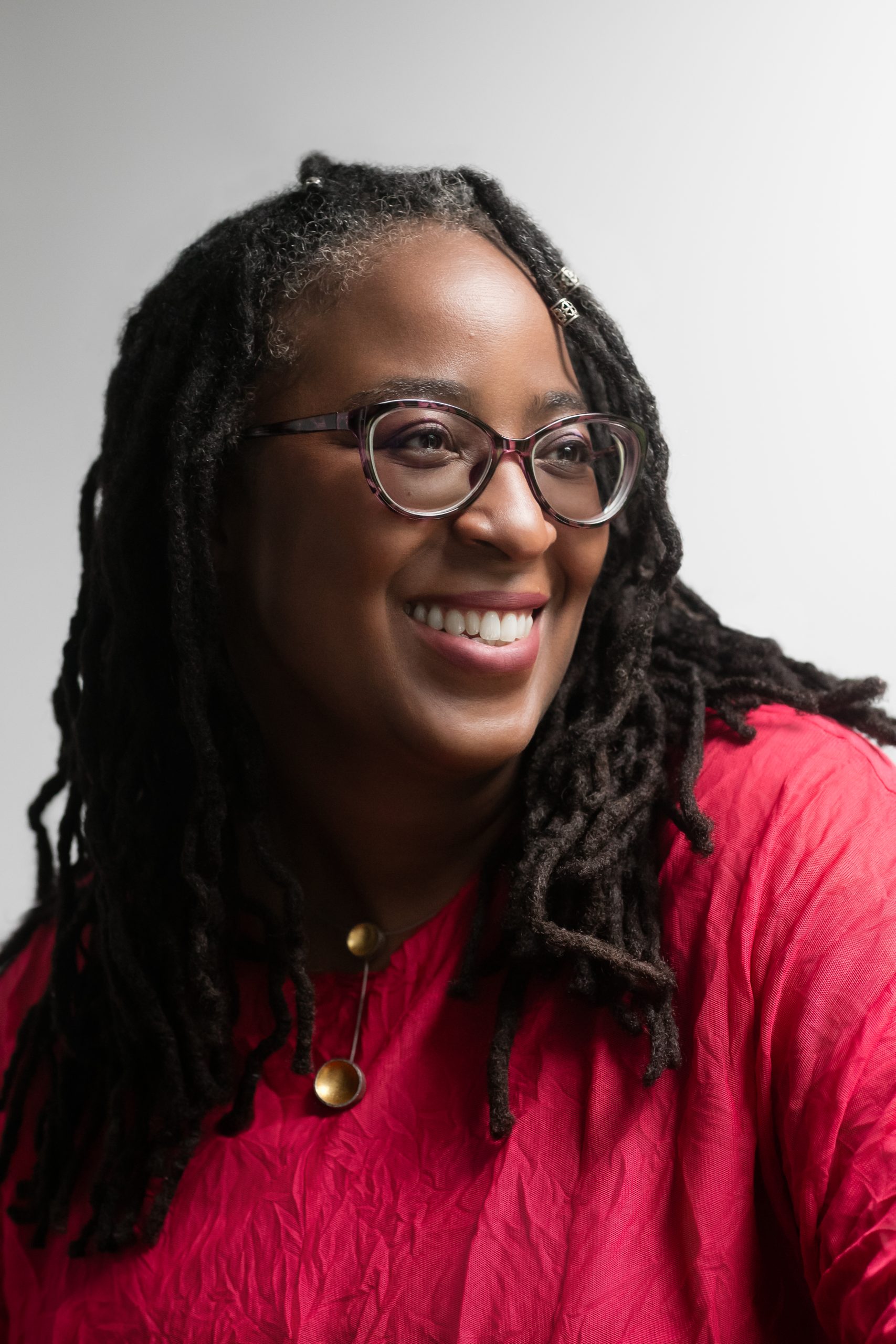
It took Camille T. Dungy over a decade to write the poems in America, A Love Story and this collection aptly captures what fleeting time can hold, and the weight of its history. With precision and candor, Dungy examines Black womanhood and motherhood in America and turns a questioning gaze at love, survival, and beauty. On these pages, there is no looking away from despair and the terror that plagues one’s life. “No story I write could ignore the perils that endanger my loves, threaten to kill them,” she writes. Dungy’s language is unrestrained and unapologetic, and the poems surprise, unsettle, and awaken you.
Dungy and I connected over email. We talked about motherhood, writing in the face of fear, putting the emotion of anger to good use, and insisting on beauty and love.

The Rumpus: I would like to start at the very beginning. Can you think of particular moments in your childhood that have led you to the subjects you explore in your writing?
Camille T. Dungy: Last year, my daughter enrolled in an ethnic studies class in her high school. She was excited for the course, but it immediately became disappointing. The curriculum was geared to a population who hadn’t had to think about the implications of race in America. One of the first discussion questions asked students to name the first time they understood that people came from different racial and ethnic backgrounds. Because of where we have lived, my daughter and I have frequently been the only Black girls in the classroom. Let me tell you, white people are very skilled at making it clear that we are different from them. Almost daily, my daughter and I navigate the implications of those differences. The subjects I explore in this book have always been apparent and expansive to me.
Rumpus: One can trace the subject of Black American history and motherhood in so much of your work–from your 2017 essay collection, Guidebook to Relative Strangers: Journeys into Race, Motherhood, and History (W.W. Norton, 2018) to these news poems in America, A Love Story. I am curious about the questions that underpin your writing of these important subjects and things you may have discovered in the process.
Dungy: You’d need to go back further than Guidebook for that answer. From my first collection of poems, What to Eat, What to Drink, What to Leave for Poison (Red Hen Press, 2006), I have explored questions of what it takes for Black people and women to survive and thrive in this country. I’ve explored the histories, landscapes, climates, and communities that nourish me, and I’ve tried to look squarely and fairly at forces that I work to resist. My daughter shows up embryonically in my third collection, Smith Blue (Southern Illinois University Press, 2011). In every book since, I’ve added questions that parenting excites to the list of concerns my poems circle around.
Rumpus: Can you share about what you’ve learned and discovered from years of asking questions and exploring these subjects?
Dungy: One of the most interesting things that I’ve learned over these years, or perhaps it would be more precise to say that this is something I’ve verified, are the ways that form can guide these questions and discoveries. That first book was a collection of sonnets. Fifty-two poems that were either fourteen lines or some multiple of fourteen lines. These were poems about Black people and women in mid-20th century America, people who lived ordinary and extraordinary lives despite the restrictions placed upon them. I thought a lot at that time about the ways that I could use that form as a container for the people and subjects at the center of my poems to push against. The ways that the poems did and did not conform to the restrictions and expectations of the sonnet offered opportunities to reveal a lot more than my words alone might be able to convey.
With each new book, I explore form and structure differently. Very long lines, short lines, jagged lines that are arrayed all across a page. Received forms like the sonnet and the prose poem. In Smith Blue, I created an acrostic form that borrowed lines from a translation of a poem by C.P. Cavafy. This was before Terrance Hayes invented the Golden Shovel and Patricia Smith popularized that form, and before I wrote the Golden Shovel of my own that’s in my fourth poetry collection, Trophic Cascade (Wesleyan University Press, 2018). My own acrostic is a poem called “Prayer for P—” and the form was instrumental in helping me write that elegy, just as the form I created for an essay in Guidebook to Relative Strangers called “Inherent Risk” provided me with a way to talk about how dangerous and lucky it felt for me to become a mother. Soil: The Story of a Black Mother’s Garden (Simon & Schuster, 2023) is a book length narrative containing hundreds of pages of interconnected prose, which was a whole new form for me to experiment with.
In America, A Love Story I play with form again. This time, though, I created a form that is practically invisible. I was curious what it might mean to spend the time and care and energy it takes to create and adhere to a formal convention that hardly anyone would notice. The seven-hundred character poems that weave throughout this book taught me a new way of thinking about how I could use form as a container for the people and subjects at the center of my poems to push against.
Rumpus: You’ve noted it took you a decade to write this book with many of the poems capturing the early days of motherhood—its exhaustion, its sacrifices, its hope. What can you share about the process of writing this collection?
Dungy: I published the book-length narrative Soil: The Story of a Black Mother’s Garden in 2023, so it’s not exactly that I haven’t been writing for that decade. Writing and then publishing the memoir kept me busy. And there was a global pandemic in the middle of that decade. I was the parent in charge of overseeing my daughter’s remote learning, so that kept me busy as well. I was writing poems all the while but writing poems and making a book are different matters altogether. The real question is what it took for me to organize these poems into a collection that held the energy I desired. That required time and space and some specific inspiration. Maybe I needed a larger arc for the story? You note that there are poems of early motherhood here, but also there are poems about the beginnings of my life as an open nester. That’s a whole life cycle completed, as hard as it still is for me to admit. The baby I introduce, within hours of her birth, moved out of our house at fourteen to follow her own artistic journey. Maybe I needed to see that stage of motherhood all the way through before I could see my way to shaping this collection.
Rumpus: I am interested in the subject of time and space for writers, how one continues to remain faithful to their craft in the changing seasons of their lives, how difficult and demanding it can be to create while attending to so much more. Lucille Clifton said she wrote shorter poems when she was raising her six children. What did inspiration look like? What did it take you?
Dungy: Such a good question! I’m interested in this as well. For many years of my life, I was a night writer. I preferred to write between about midnight and 3 a.m. But now, I shut down around 10 p.m. Except for rare moments of intense inspiration, it would be unlikely that I could write anything valuable in those late late night hours. I also had a long period in my daughter’s earliest years when I woke up very early and wrote before anyone else in the house was awake. But, eventually, the kid started to find me about 20 minutes after I sat down at my desk, no matter how early I started. So that routine became useless. I started a habit of stopping for 20-minute intervals throughout the day to record whatever seemed urgent. I drafted much of Guidebook to Relative Strangers that way, so it was useful, but luckily I’ve been able to leave that method behind as well. I guess what I’m getting at here is simply the fact that life is often difficult and demanding, and that the changing seasons of my life have presented many new demands and challenges. For me, the key is to be able to pivot in ways that accommodate the realities of life and also my urge to keep writing. I don’t have any secret sauce recipe to share other than to assure you that where there is a will there is usually a way. I think of Anna Akhmatova’s great poem “Requiem.” For seventeen months, she visited a loved one at the prison in Leningrad. One day, another woman in the line asked if Akhmatova could “describe this.” After replying, “Yes, I can,” Akhmatova continued to stand in line, writing the long poem in her head. Once a favored Russian poet, during the era of Stalinist purges Akhmatova endured persistent threats to her life and safety. She continued to compose poems but burned any drafts she wrote down after committing her lines to memory. Sure, sometimes my writing days are complicated by department meetings, carpool duties, elder care, and writing letters of recommendation, but those are laughable obstacles compared to the things women before me have faced who have still found time and ways to write what needed to be written.
Rumpus: In the poem “To enter our own empty house,” we witness a speaker who thinks of bashing someone’s head with a rock and wrestles her daughter to teach her how it feels to break free. I kept returning to the line, “Vulnerability is the root of much fury.” These poems are nothing if not vulnerable, raw, an open wound of sorts. Was there ever a time when you feared the risk of being vulnerable on the page? Or have you always leaned in this direction in your writing and perhaps, life?
Dungy: There’s never not a time when I am afraid. Writing honestly and openly is always terrifying. The key is to face the fear and still write.
Rumpus: Facing one’s fear always feels like such an impossible endeavor. You look at the thing that terrifies you and then you walk straight into it. Does understanding the urgency of one’s work, the need for one to turn to the page, help with these steps towards overcoming?
Dungy: I want to be careful here when I talk about “urgency.” I’m not directly recording the stories of women standing in line to visit loved ones in a Stalinist-era prison. I’m not writing poems that would immediately free anyone from a detention center in 2026. The poems I write won’t even keep my own family safe from immediate harm. My dear Aunt Mary won’t be any less dead because I wrote an elegy for her in this new book. I’m not naive enough to believe that poetry makes any enormous difference in this world. And yet. And yet.
And yet, I believe poetry and art matter more than any other thing a human being can do. What I am doing when I am writing a poem is akin to casting a spell. I sit down, wherever and whenever I sit down, and I carve out a moment to create a moment of beauty and intention and care in an otherwise essentially indifferent world. That seems radically important. F* my fear.
Almost every act of beauty and splendor I have been lucky to enjoy in this world must have been terrifying for someone. If the high board diver who throws herself from the 10-meter board at the Olympics isn’t somewhat afraid, I would wager that the people who love her are terrified in some way every time she climbs that ladder. And yet. And yet. We keep finding ways to insist on creating more beauty. Bless our insanely hungry human hearts.
Rumpus: In your author’s note, you write: “Perhaps one day I will write a simple love story. But this is the United States of America, and I am who I am. No story I write could ignore the perils that endanger my loves, threaten to kill them. And still, I hand over my heart.” Two things came to mind after reading this. I wondered about why anyone would want a simpler story and who that story would serve. And of course, I couldn’t help but sense the hope in those final words.
Dungy: I really prefer simpler love stories, though. Let me explain it like this: Before I met my husband, I lived for several years in Virginia. The town was not my place. I was perpetually an outsider. Even though, for many reasons, I should have been able to claim a birthright in Virginia, I had to work hard to understand that landscape, climate, and culture. I had to work hard to fit in while still being myself. I dated when I lived there, but nothing stuck. When I was offered a job back in California, where I had lived most of my life, I moved. I was grateful to be back in a place where so much of my psychic energy didn’t have to be expended trying to fit in without contorting myself. Within three months of returning to California, I met my husband. It was nice to be in a place where I could be more fully myself, and where I could be appreciated, loved, just as I am. That’s the kind of simple love story I want.
This title, America, A Love Story, opens itself to many possible interpretations. This is by design. But one of the things I am most interested in exploring is what it means to insist on loving and on being loved. I’m asking for what I want from the world: simple, sustaining, splendid, unwavering love.
Rumpus: Every time I came across a statistic about childbirth and the cost of childcare in the collection, I was startled by its gravity even though I am familiar with the facts. Was there a lot of research that went into making this collection? Any surprising data you came across?
Dungy: I was as startled by these statistics as you were. I wrote the poems to try to make some sense out of realities that seem fundamentally senseless.
Rumpus: In the poem “On Brevity,” you write that “revision is a struggle toward truth.” Looking back on the writing and revising process, can you talk about the challenges you encountered and things you learned along the way?
Dungy: This is such a big question. Remember, this book took over a decade to complete, so it would be nearly impossible for me to discuss all the challenges and lessons. Maybe one big thing I learned, or re-learned, in this process is that the idea of endings is a myth. I had to think differently about how I approached each poem and the book as a whole. If I accept the fact that nothing ever really ends, that history continually repeats and that the past is constantly reborn inside the present, how do I close a poem? How do I complete a book? I found many different answers to such questions in America, A Love Story.
Rumpus: There are several moments when we are confronted with the narrator’s anger, and rightfully so. They are grieving a legacy of loss and the terror of living in a country that offers no safety, no love. I kept thinking of Audre Lorde’s “Uses of Anger” as I read, and I wondered about your own relationship to this powerful emotion as a writer.
Dungy: Yes, there is anger throughout this collection. But also, there is love. There is love. And in love, there is safety. Along with pointing toward the uses of anger, Audre Lorde made sure to point to the power of sensual connection in the “The Uses of the Erotic.” Elsewhere she reminds readers that poetry can be a space for active resistance as well as celebration. In my own life and time, I’ve learned that anger can be as useful an emotion as any if anger is put to good use, but anger alone will never be sufficient.
Rumpus: As much as there is heavy spilling and sacrificing in these pages, there’s also birthing and blooming. I absolutely enjoyed the imagery in all the gardening poems. Is there any relationship between your practice of gardening and writing?
Dungy: Absolutely. I spend nearly 300 pages of Soil: The Story of a Black Mother’s Garden exploring this relationship. That book is an exploration of a years-long effort to diversify the landscape around us, starting in our own yard. I consider what it means to be one of the few Black families in town and how my efforts to create a garden that honors the native flora, fauna, and climate around our home provides ways of thinking about social justice, community building, and sustaining self-care. As you’ve pointed to in many of the questions you’ve asked me here, these are ongoing lines of inquiry in my writing, and so composing Soil helped me to more directly articulate some of the key questions that drive my writing and my life.
Rumpus: Speaking of personal practices, do you have any rituals as a writer?
Dungy: The only ritual that matters is the act of writing itself. Everything else is just decoration.


Click here to subscribe today and leave your comment, or log in if you’re already a paid subscriber.