My father called them “episodes.” He said I would tighten my whole body, ball up my fists, and stomp, refusing to speak. I picture myself in my childhood bedroom, with the pastel pink curtains and Beauty and the Beast bedspread. My fine brown hair clings to my face and neck, gnarled and stringy with sweat, every micro-muscle tensed with desperation. What look like suds from a washing machine drain from the corner of my mouth, combining with my tears to form a not-insubstantial pool on the pastel pink rug. My mother looks on with stunned concern. She called them “tantrums.”
I have no memory of any of it. My childhood is a black box. What little I know is from a photo or something someone told me. My mother said I would sometimes “foam at the mouth,” calling to mind a rabid animal. What could turn a girl into such a wretched creature? When I looked for an explanation, all I could find was my own deficiency, the shameful fact that I could not contain myself, that my feelings were always spilling out. My parents sent me to therapy in the third grade.
~~~
What I’m about to tell you might have stayed buried if I hadn’t listened to the August 30, 2022 episode of The Daily podcast, “Inside the Adolescent Mental Health Crisis.” Iconic host Michael Barbaro interviewed journalist Matt Richtel about the striking spike in anxiety, depression, attention deficit, self-harm, and suicide among adolescents.
The topic was relatable. I stopped therapy in the sixth grade, but the feelings remained: staggering fear and insecurity, deeply unconscious repressed rage, and an impenetrable, crystalline loneliness swirled around inside me. I learned to hide it, but emotional pain was the set of wet clothes I walked around in for as long as I can remember. I returned to therapy in my thirties, and stayed.
I expected the Daily episode to be a mirror, but could not have anticipated what the mirror would divulge.
Richtel discussed early puberty as a contributing factor to the crisis. Girls used to have their first menstruation around the age of 14 in 1900. Now, it’s two years earlier, around the age of 12.
To illustrate why that matters, Richtel told the story of “C”, a non-binary adolescent who started puberty in the third grade. Early puberty launched them into “really intense physical symptoms of depression”—vomiting, sweats, shaking, and awful chest and neck pain. They described it as, “suddenly my brain is working 20 times faster on the dark crap.”
While we think of puberty as sex or reproduction, Richtel explained that, “really, a lot of it’s happening in the brain.” The brain is making the child crave social information “as a way of figuring out how to fit into a much more complex world.” Hierarchy and competition become apparent. Information that a child was either blind to or didn’t care about becomes vivid.
The problem with early puberty is that the rest of the brain—the parts that help you cope with that information—has not caught up. As Richtel put it, puberty’s “cascade of social, hierarchical and competitive information” can be debilitating when “your regulatory functions aren’t there to help you make sense of how seriously to take what information.”
I thought about my constant panic in social situations, how the information I instinctively took in about others seemed to fill up the space where a sense of self should have been.
Barbaro summed it up: “There’s a mismatch here.”
~~~
I always knew I started puberty early, something like C’s experience. Listening to the Daily episode, for the first time, I began to wonder what role my early puberty played in my mental health struggles. I began to question whether my episodes or tantrums—like C’s vomiting, sweats, and shaking—might have been, in part, boiling points of that mental mismatch of my early puberty.
The idea shot to the surface, but was submerged again shortly thereafter. There was no room for it. A naked, psychotic man had found his way into my apartment late one night, and that trauma had rendered me a cliché: I moved in and tried to rekindle things with my ex-girlfriend. At the same time, I was navigating a best-friend breakup and the initial stages of what would become chronic Long Covid.
~~~
In November of 2022, I went home for Thanksgiving. Life wasn’t much calmer. My ex and I had broken up again (duh), and she had wasted no time in partnering with another writer I knew. It was also dawning on me that the friend group I brought her into was choosing her, my ex-best friend included. But at least I was physically settled in a new apartment and would be getting the hell out of St. Louis for the holiday. The chosen family I sought because of estrangement from my biological family was falling apart. And so, in the midst of that relational plight, I gravitated back toward my bio family. Insofar as everything is relative, they weren’t looking half bad.
My parents still lived in the Northern Virginia suburbs of Washington, D.C., in my childhood home. I stayed in the study that used to be my bedroom, the coldest room in the house. No longer coated in pink, the room was now filled with international art, old economics textbooks, and bottles of wine. On the wall hung an award decorated in dollar bills recognizing my mother’s twenty-three years of service to the Board of Governors of the Federal Reserve.
It took me too long to take my own suffering seriously. I understood myself to be privileged and felt I had no reason to complain. I was part of a largely white suburban nuclear family (my father is Jewish, of Eastern European descent). My parents had risen from modest means to the upper-middle class. They both had PhDs and pensions. There was no addiction, no violence, no abuse. This reinforced my belief that I was the problem.
Through therapy, a deeper narrative began to emerge. But it was vague and unsatisfying—that my mother and I were not a good “fit,” that my parents had “limitations,” that I did not get what I needed in the way of “attachment.” Without memories of those early formative years, I was left to speculate and extrapolate. I longed for certainty, for a story that would validate the magnitude of my pain.
One day, I went for a walk with my parents. I had finally become curious about my history and that gave us something to talk about. Somehow, I recorded everything from my trip but that walk. I’m pretty sure we were at the intersection of Waterway and Dearborn Drives, near the house with the weeping willow and the Spanish-tiled roof, when the topic of puberty came up. I can’t recall the context. I immediately thought of the Daily episode, which sparked a question that would prove extraordinarily revelatory.
“When did I go into puberty?”
“Well, you were diagnosed with precocious puberty when you were one year old and you started treatment when you were two,” one of them replied.
Apparently, my pediatrician noticed that I was developing breasts and referred me to a precocious puberty specialist, Dr. A. Later, I asked my mom if she or my dad had told me this before—how old I had been, or rather, how young. No, they hadn’t. I didn’t ask and they didn’t want to bring it up. They didn’t want me to feel different.
Precocious puberty in infants and toddlers is extremely rare. Dr. A, fairly advanced in age when I saw him, had only seen half a dozen cases in his entire career.
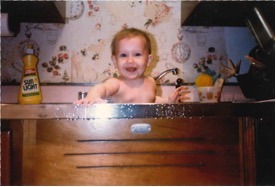
(A photo of me at eight months old showing my breast development)
One year old. An infant. Starting puberty. Growing breasts.
Most people don’t know such a thing is even possible. I didn’t know. Until I found out that it had happened to me. The notion produces an intense cognitive dissonance, the two realities seemingly irreconcilable—the social, sexual, and reproductive maturity of puberty and the radiant innocence of infancy. A baby whose tiny body knows far too much, far too soon.
It was freakish, really, if you took away the pejorative connotation. My mother remembered waiting in line at the grocery store, seeing the National Enquirer boast PREGNANT SIX-YEAR-OLD IN SOUTH AMERICA, and thinking that’s the untreated version of what my daughter has.
I discovered that my tantrums, my episodes, began as early as four. I would have been barely out of diapers.
The universe took on a neat symmetry. I had always felt like a freak and, come to find out, I was one.
~~~
I skipped over frustration that my parents hadn’t mentioned this earlier and went straight into shocked freneticism.
My mind hurtled with implications. No one had ever talked to my parents about brain development. Dr. A had been concerned with two things: secondary sex characteristics and bone age (he didn’t want me to be incredibly short). But, as I had learned, puberty is about much more than that. My parents reported no indication that the drugs I had taken, buseralin and Lupron, suppressed the brain development component of puberty.
I began to develop a theory. If starting puberty just a few years early could wreak havoc on a child’s mental health, what would going into puberty as an infant do? Imagine beginning to develop that teenage radar for social information, for whether you’re in or out, for competition and hierarchy, when the rest of your brain is in its literal infancy. Such a gross mismatch would surely have profound consequences. Little is known in this area. A 2019 article in the Expert Review of Endocrinology and Metabolism observes “[a] particular shortage of information exists … regarding the psychological implications of [precocious puberty] in girls, and more research is needed.”
I saw my suffering in a new light. Maybe it wasn’t just the product of a lack of nurturing, attunement, or connection with my parents, not just my sensitivity or precocity in a colloquial sense. Maybe it was due to something much rarer: a true medical precocity, a stunningly premature social intelligence that the rest of my little-girl brain could not remotely handle.
Here was an Answer! One that had shape to it, objectivity, and a heavy dose of intrigue. It took the heat off of not just me, but my parents too. This was an explanation that absolved us all, one that gave me a new permission to internalize that maybe it really wasn’t my fault.
And, it made me special. It made my suffering special. I liked that. I began to wonder whether I might be one of only a handful of people in the world with a brain like mine.
~~~
During the next two years, the mental sprint of discovery reduced to a simmering percolation. I continued to process the constellation of breakups I came to call my “attachment rock bottom.” Then, right as I was beginning to see the light, my Long Covid took a turn for the worse and, with that, center stage. It wasn’t until the fall of 2024 that I returned in earnest to the project of understanding my precocious puberty. By then, my health had stabilized to the point that I was occasionally able to direct my limited energy toward other things.
The medical records my mother had immaculately preserved were sitting in the top drawer of my dresser, virtually untouched since she gave them to me. I pulled them out. They were full of her notes, her clean handwriting wandering across Federal Reserve memo forms and lined sheets of legal pad paper. There were bills, consent forms, and information about treatment protocols. But the most illuminating contents were regular letters from Dr. A to my pediatrician. It was chilling to read one letter after another updating him on the size of my breasts and whether I had armpit or pubic hair.
I was supposed to fly to D.C. for a meditation retreat in mid-September, but it was canceled. I saw an opportunity; I kept the tickets. I would try to track down and interview Dr. A.
~~~
When I googled Dr. A, there was no obituary, so I figured he was still alive. He would be well into his 80s by now. I had no idea what kind of shape he was in or how to get in touch.
But I had one small lead. My mom mentioned she knew a lawyer who had worked at Children’s Hospital in D.C. earlier in her career. I asked her to reach out.
The lawyer didn’t have any information but she pointed me to Dr. C, the only doctor still at Children’s who had been there when Dr. A was chair of the Endocrinology Department.
All I had was Dr. C’s name, but I went to work. I left a futile voicemail with the Endocrinology Department (I was a non-patient with a weird inquiry; there was no way I was getting a call back). Then I found a bare-bones George Washington University professor page with a hyperlinked email form. I explained who I was and that I was trying to get in touch with Dr. A, expecting very little.
Mere hours later, I got a response. I couldn’t believe it. It turned out that Dr. C didn’t have any information either, but she offered to put me in touch with another colleague who specialized in precocious puberty. I enthusiastically accepted.
The next morning, I got an email from Dr. K, essentially the new and improved Dr. A.
Dr. K retired from Children’s in 2018, but he still had access to their records. He reviewed what records remained for me and agreed to meet. I was thrilled and incredulous that he was making himself so available—it seemed I had landed on someone even better equipped to give me answers than Dr. A—but his last email unsettled me. He wrote, “The picture I got is more complicated than what you may have been expecting, so I agree it would be a good idea to discuss it in person.” Why did I suddenly feel like I was about to be broken up with? What could be more “complicated” than starting puberty as an infant?
~~~
I meet Dr. K outside his apartment complex in Alexandria, just a ten-minute drive from my parents’ home. My mother drops me off.
“Maggie!” I turn toward his voice. Dr. K is not much taller than me, wearing a T-shirt, khakis, and hot pink tennis shoes. He has a quaint paunch and looks like a much older Jay Duplass. He’s energetic, a man on a mission, and slightly awkward in the way of Very Smart People.
We greet each other and walk to a small park across the street, settling at a metal café table. When I set down my folder of medical records and notes, the table tilts toward me with an echoey screech. I make a mental note to not disturb it any further.
“Why did you become interested in your history now?” Dr. K asks by way of icebreaker.
“I actually didn’t know about my history until recently.”
“But you were seeing Dr. A and getting treated until you were ten…”
“I don’t have a lot of childhood memories. I knew I had gone into puberty early, but I didn’t realize how early.” I relay how my parents told me I started puberty as an infant for the first time two years ago. “My memories start around third grade, which is when I started seeing a therapist for some emotional and mental health issues.” I go on to explain how my interest arose after listening to the Daily episode. He peppers my speech with little attentive okays and yeas, but I get the feeling of a good little boy waiting his turn.
“Before we get to what I concluded, I wanted to tell you a little bit about myself because—”
His cell phone goes off. He tells the car repair company to contact his wife.
“Anyway, the reason I wanted to tell you a little about myself is so you feel some confidence that I am not just a pediatric endocrinologist, but a pediatric endocrinologist who has specialized in the area of precocious puberty.” He reviews his professional interest in early and precocious puberty, highlighting articles he’s published about the overtreatment of girls aged six to eight. I’m startled by the role reversal. I was ready to defer to him, grateful that he had even agreed to meet, and now he is ostensibly pitching himself to me.
He continues, “More recently, I’ve become interested in what happens when you have a girl who’s under three years old who develops breasts. Is it true precocious puberty or is it a condition—does the term ‘premature thelarche’ mean anything to you?”
The past two years, maybe the past decade, have been building toward this moment. I am finally across the table from someone with the expertise to give me real insight into the significance of my peculiar medical history. But this is not the conversation I envisioned. The word “true” evokes its opposite.
“Thelarche is breast development?”
“Yes, premature thelarche, which I’ve seen probably a thousand cases of, because it’s very common, is when a girl under three years of age, often under two, develops breasts, and it doesn’t progress to full-blown puberty.
The question is how do you tell the difference between true precocious puberty, the kind that needs the treatment you had, and premature thelarche, which quite honestly we consider a normal variation.”
He goes on to not just describe, but physically hand me, an article of his setting forth how the standard GnRH test for precocious puberty is much harder to interpret in one- and two-year-olds, leading to misdiagnosis. I’m beginning to understand what he meant by “complicated.”
“Your first visit with Dr. A was when you were 13 ½ months old. He measured those hormones and apparently at that time, your parents said that the breasts were—”
His cell phone goes off again, cooing a name I presume is his wife’s. He tells her, “I’m with Maggie.” It’s an odd feeling: being a pseudo-celebrity within this tiny medical microcosm.
Hanging up, he turns back to me. “Huhuh, I told her,” he confesses in a juvenile high pitch before returning to his doctor voice. He reviews my initial testing and what Dr. A did, how he probably misinterpreted my GnRH test.
“I’ve been in this situation many times. My position has been that I really, really, really have to see some striking evidence in favor of precocious puberty to go ahead and treat.
Once you’re on treatment and you stay on treatment, there’s no way to know whether you needed it. All of the tests Dr. A did—and he did an awful lot of testing—basically said you’re not showing pubertal hormones. Is that because you were getting treated successfully, or because you weren’t really in puberty in the first place?
Dr. A was very proud of himself that he had stopped your puberty, without seriously considering that you might have done fine if he had just said, this looks like premature thelarche, let’s keep an eye on it.”
I can see that Dr. K doesn’t relish criticizing his colleague, but he does relish being right.
“It’s a mistake I’ve seen before,” he reassures me.
~~~
“I’m sure your parents would find this very painful because they invested a lot of time in all those visits and they trusted Dr. A.”
This turn in the conversation catches me off guard. I’m absorbing this news in real time. I’ve barely had time to form my own reaction, much less consider my parents’. And I’m struck by Dr. K’s conviction that they will necessarily be devastated. Clearly, he does not know my parents. Even if they felt that way, they wouldn’t show it.
I ask about the incidence of true precocious puberty in a case like mine where MRIs didn’t show any brain abnormality, like a tumor or cyst.
Dr. K won’t say it doesn’t exist, but he puts it at “rarer than rare.”
There are things he can’t explain, most notably the advancement in my bone age to six years and ten months when I was chronologically four years old and being treated with buseralin. (He calls it “weird” and a “curious thing” and agrees that it’s a “puzzle.”)
Finally, I ask for the bottom line, his percentage of certainty that I was misdiagnosed.
“90 to 95 percent.”
And there it is. I wrapped my mind around the discovery of this impossible condition only to find out that it is, in fact, impossible. Or nearly so in my case. If I wasn’t so focused on making the most of my conversation with Dr. K, the whiplash would bowl me over.
Circling back, he opines, “I would say the likelihood is that your mental health issues had nothing to do with this. Premature thelarche doesn’t really involve the brain. It’s a peripheral breast development without the brain really triggering it.”
I watch the last legs of my brilliant brain development theory float away like loose balloons.
~~~
The good news: Dr. K assures me that my treatment was safe. Most people are not treated for as long, or from as young an age as me, but he doesn’t know of anything to suggest my treatment presented unique harms. I went through puberty at a “normal” age and got my periods regularly. It’s unlikely I will have issues with bone density or fertility.
~~~
“I’ll talk to her,” Dr. K declares, as we—both of us—wait for my mother to pick me up. When she pulls up, she spots me and comes to a stop across the street. Dr. K and I march over.
I’m not exactly sure what my parents’ reaction will be. Something was lost. For all of us. I will have to find a way to trust myself and validate my own suffering, come to terms with what I can know and what I can’t. They will have to swallow years of evidently unnecessary treatment. We will all have to revise our understanding of what happened to me.
“Mom, this is Dr. K,” I offer. “He wanted to meet you.”
“Hello, it’s nice to meet you,” she says, half-opening her door, surprised, like I am, that he’s still with me.
After a brief introduction, Dr. K dives straight in, “Maggie and I had a long conversation, at least some of which she will share with you. As I explained to her, it’s unlikely that she had true precocious puberty and far more likely that she simply had premature thelarche.”
I realize Dr. K is acting out a scene he’s played a thousand times. The expert-doctor speaking to the child-patient’s parents. Only, I’m nearly 40 and we’re in the middle of the street in front of his apartment building.
“She likely did not need the treatment she got,” he concludes.
“Oh!” my mother submits, understanding that some response is required.
I try to smooth over his indelicacy, put it into laymen’s terms. “Dr. K thinks that Dr. A was too quick to treat me, and that I probably didn’t have precocious puberty.”
“I see,” she says, measured, beginning to take it in.
“Well, it was very nice to meet you,” Dr. K interjects jauntily, signaling that this doctor’s visit is over. He shakes my mother’s hand, and then mine, all three of us still standing in the street.
He turns to me, “Please feel free to email me if you have any follow-up questions. I’m happy to respond.”
And then he’s walking back to his building and I’m getting in the car.
~~~
My mother asks if I want to talk. I fill her in as best I can and then ask if she has any reaction. The well-greased wheels of her intellect turn quietly as she steers us back toward my childhood home. Ever the skeptic, she initially responds that of course Dr. K would see my case through the lens of his “non-intervention agenda.” (Our pre-meeting internet-stalking revealed that reducing unnecessary and costly medical intervention was his big professional soapbox.)
She defends what she and my father did: “It wasn’t like we went to some nobody. We went to the expert at Children’s Hospital. We took the best course of action we could.”
Then she thinks about me: “If it really wasn’t necessary, I just feel bad that we put you through all that.”
When we get home and tell my father, he wonders, in pseudo-conspiracist fashion, whether Dr. A was influenced by the drug companies. “I think it’s fairly standard to refer patients to drug trials,” my mother says.
While my parents’ responses are predictably muted and analytical, I can’t help but think about how terrifying it must have been—to hear that their daughter was a medical anomaly, an infant going into puberty.
~~~
I had built this red-string murder board in my mind and it turned out there was no murder. After decades of trying to connect dots that might explain me, I had found and lost a superhero-worthy origin story over the small span of two years. Well, maybe lost. That part was unclear. A five to ten percent chance is not nothing.
But when the dust settled, I found quite surprisingly that this was an outcome I could live with. I still had a story to tell. It just wasn’t the one I thought I would be telling.