
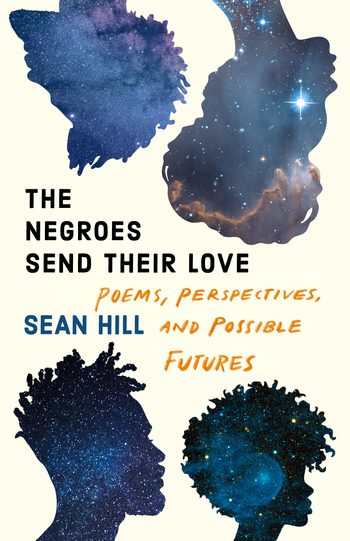
Time, from the Old English tīma; akin to Norse tīmi, and back to Old English tīd, as in tide, is a variable Sean Hill folds and expands in his flitting, multi-genre collection The Negroes Send Their Love.
The book spans from the “antebellum” period to the 25th century of Black people in space and “whitey on the moon.” The speakers and narrators of the poems, essays, short stories take on various forms, conventions, registers that feel less linearly disparate, more lyrically connected.
Over the span of two weeks, we corresponded over email. I wanted to better understand the psychogeography of the self-proclaimed “extremophile”—a stranger to my lexicon until the proximal now; to get into what I thought of as etymological commercial breaks constellating the text; to, as a fellow birder, talk about the many avian species that populate the text and what they might represent. Some of it felt too selfish of me to include. Some of it just didn’t fit the interview. The remainder of it goes like this.
The Rumpus: Though I’m unaware of how much time has elapsed since your mother’s passing, condolences to you and yours. As someone who’s also lost a parent, I feel I more profoundly understand grief and honoring, and the ways that absence can linger long after. In the essay, “What You Studyin’ On: An Environmental Statement,” you write about switching your attention from your father to the women in your family. How do you feel that decision you made in 1998, to redirect your focus towards your mother, grandmothers, and aunts transformed your perspective and ultimately you writing The Negroes Send Their Love (TNSTL)?
Sean Hill: I appreciate your condolences and perspective. To answer your question, that refocusing and the interview I mention in the essay were important. That interview and the writing that followed coincided with my first experiments with received forms. From the interview, I wrote a series of sonnets titled “B. Nov. 14, 1926: Grandmother Poems.” I was interested in seeing what I could do with the sonnet and a voice much like my grandmother’s. Being urged to write about the women in my family moved me to write about the people and place I came from in a deeper way than I was when writing about my relationship with my father. It not only moved me to reconsider what I frame in my viewfinder, it also gave me a wide-angle lens sooner than I would have likely found on my own. I feel my writing underwent a sea change. But it didn’t stop me from writing about my father. He’s in The Negroes Send Their Love as are my mother, my brother, aunts, uncle, some of all my cousins, and, of course, my grandmothers. And I feel that refocusing was the first step in that direction.
Rumpus: Amazing what the women in our families can call out of us. Say more about being moved “to write about people and place.” What was it about the women in your family that granted you your “wide-angle lens?”
Hill: Well, as I mention in the essay, I interviewed my grandmother as a result of a classmate’s comment. And since my grandmother understood this was for school, she was willing to help me out. In 1999, I submitted the poems that were drawn from that interview to Callaloo, and Charles Rowell, the founding editor, accepted them and gave them a great home. That was my first real publication, and when the issue came out, I took it to my grandmother to show her the poems. Her reaction wasn’t excitement for the publication; instead, she said she felt exposed. And I realized I needed to respect her desire for privacy. I also wanted to continue working with her and her generation’s lived history while honoring that desire for privacy. That’s when I invented the character Silas Wright and his family and community, who is a generation older than my grandmother. He allowed us to carry on our conversation and to write about lives that weren’t hers but lives she might recognize parts of and that she would recognize the truth in. That move away from the biographic allowed me to draw from different sources and write a wider history, and that’s what I meant when I said it granted me a wide-angle lens. And I guess not the refocusing comment exactly, but the interaction with my grandmother it led to, precipitated that shift.
Rumpus: When I read “the homeplace” in “Where I Live [Redux]” my mind immediately traveled to J. Drew Lanham’s The Home Place: Memoirs of a Colored Man’s Love Affair with Nature. Nod? As an amateur birder, I found myself thrilling in the various avian species soaring across the book (the green heron just made my top three). Tell me about the inclusion of the birds and other nonhuman beings that inhabit the book and what you’ve learned from attending to their existence.
Hill: That’s cool that you’re into birding. I’m glad you brought up The Home Place: Memoirs of a Colored Man’s Love Affair with Nature. It’s a beautiful and important book. I heard about Drew and the manuscript for The Home Place a couple years before its 2016 publication. And we didn’t meet in person until 2019. Drew is a good friend. But in that instance, I think I was thinking about how we talk, as well as nodding to Marilyn Nelson’s book The Homeplace. That was a very important book for me.
And as for the inclusion of birds and other nonhuman beings in TNSTL, they’re there because I grew up in a small town in middle Georgia—the Piedmont, a verdant place. And in our backyard, I came into contact with so many nonhuman beings—frogs, toads, turtles, tons of bugs, the occasional snake, and the birds that visited. And every now and again there were mammals like moles and opossums. Occasionally, I would help to catch birds and bats that flew inside the house. All this gave me the sense that the natural world was always with us and us with it—that the walls and doors and windows were these barriers erected to try to keep it at bay, but it was just outside the walls, and sometimes inside the walls, and on the rare occasion in the walls. I don’t feel I need to “go out into nature” to experience the other than human. I understand that action, that access, as getting away from the human world, away from humans, and that is sometimes desirable. For me it’s more important to work on being aware of and receptive to the wider than human world and tuning out the noise of what we’ve built,or maybe include just experiencing the greater than human world wherever it is and perhaps especially when it exists in the cracks of our built one.
Rumpus: Was TNSTL always intended to be such a sprawling, eclectic collection or was there a moment when the book and its arc began to take shape? Also, what were your strategies in ordering the manuscript?
Hill: Yes, since around 2017 I envisioned it as a multi-genre collection and in 2018 I gathered an incomplete rough version that was 45 pages. Ten years earlier, in 2007, I became more aware of and interested in the enslaved African Americans who worked and lived at the Governor’s Mansion just before and during the Civil War, and in 2013, I started imagining Negroes in space in the 25th century. So, I had the span from the antebellum to the twenty-fifth century already in mind, but the places the book goes in between those poles took shape as my life led from Alaska to Georgia to Montana around the time the multi-genre vision came into focus. In that moment, the project engaging various genres seemed right and necessary. For instance, “Necessarily a Negro,” the prose piece at the beginning of the Mansion Suite section and a few other pieces in the book started out as discursive explanatory footnotes for “Governor’s Mansion Hands.” They felt necessary to the drafting of the poem. And when working on the manuscript those footnotes floated away from the poem and found their places in the book.
In 2021, I had a 65 page manuscript that was still incomplete. That grew to 149 pages over the next year and in the following year, it reached 204 pages. I knew I had written and brought together more than the manuscript would hold. And I knew the whole manuscript still needed a lot of work. So, in late summer 2023, I set about paring it down and winnowing it to what I felt was necessary. I was in a similar place with the Dangerous Goods (Milkweed Editions, 2014) manuscript a little over a decade earlier, and my friend Jericho Brown suggested several poems that could easily be removed without them being missed. And he said after that I should cut until I felt like I was losing something.
With TNSTL there were a few previously published poems that referenced my time in Texas and California and Minnesota that I thought would find a home also in the book, but they didn’t fit. Some pieces that felt integral needed developing. Of course, some pieces needed revising—for instance, there was a 10-minute play that needed to be recast in a different genre. I had to get a handle on what the sections would hold and how to order the whole manuscript. To do this, I printed it and spread it out on the floor and walked up and down the rows of pages and moved things around. I did this several times, ordering generally along the lines of spans of time, so from the eve of the Civil War and through it to the late 19th into the 20th century and the 21st century—now—into imagined futures. At some point I decided each section should begin with prose. I got the manuscript down to 175 pages or so when I delivered it to Milkweed on Election Day 2024. And I still worked on it and completed the last piece on Inauguration Day 2025.
Rumpus: I keep returning to the poem “Where I Live,” a shoutout to “the speaker’s” lineage to Langston Hughes through explicit recognition and also the anaphoric form in Hughes’s “The Negro Speaks of Rivers.” I feel your poem wants to and is succeeding at removing the mask of what we as poets call the “lyric I,” and is also pluralistic, like Hughes’s definitive article but instead through your use of POV. You also include several persona poems throughout the collection, many in the section “In The House of the Sun” that utilize a vernacular. What brought about the shift in the speakers’ registers? Also, what is your relationship to persona and the biographic? In “Where I Live” you write “And you know, here there’s an ‘I’ that is a putting on of the mask that engages the persona…” Is the “mask” a nod to Paul Lawrence Dunbar?
Hill: Yes, the mask is a nod to Paul Lawrence Dunbar and also the origins of the word “persona”—that mask used in theatre. And my sense of that relationship with persona and the biographic has shifted across my books. Like I said, those grandmother poems in Blood Ties & Brown Liquor were drawn from an interview, so they’re a blend of persona poems / dramatic monologues and biographic poems. And navigating my relationship with my grandmother and that series of poems helped me to understand what I could do with those modes. That also helped me to think about how to make ethical choices when doing so.
“In the House of the Sun” section, I’m imagining how those future folks who live on space stations and call themselves Negroes might speak. Language is how we think; it’s how we understand, communicate, and construct our reality. Twenty-odd years ago, when I was living in Houston, I was telling a new friend about my “little brother,” and this friend asked me to describe him. I told her he was an inch or so taller than me, and his shoulders were a little broader than mine, and he was seven years younger but a grown man. And she shifted my thinking by suggesting I might try calling him my “younger brother.” This friend was a little older than me but the youngest of her siblings. With that imagined vernacular “In the House of the Sun” section, I’m trying to imagine what future might be possible over the next four hundred-odd years.
Rumpus: Continuing with POV, I’m interested in the way “A Father and Son Speak About the Painting A Desperate Stand by Charles M. Russell” functions in its departure from first to third person. Is this a story distant from you/the narrator? If the former, what do you feel the change of POV allowed in your writing it?
Hill: That’s a good question. There are five “Father and Son” pieces in the book. Some are poetry; some are prose, and two in the first person and three are in the third person. I think the piece you’re referring to started out in the first person, and in revisions, I tried it in the third person. I sometimes switch POV when drafting and revising to test how the distance feels. I think, though the story isn’t distant from me, the POV allowed me to embrace “father” and “son” as characters as I revised the story, building the scene.
Rumpus: You use various forms and conventions throughout TNSTL, from sestinas and elongated villanelles to recipes and a photo essay. Were there any poems that were first written in a different container? In either case, what did the fixed forms allow you to access?
Hill: Yes, a poem sometimes starts off in a different container as part of the drafting process. “The State: An Orderly’s Remembrance” is only the second sestina I’ve written. I wrote my first nearly thirty years ago, and it was horrible. Fifteen years ago, I thought I would ease into a sestina by writing a couple tritinas, but they ended up becoming this sestina instead. The elongated villanelle became an elongated villanelle because it needed to be. I think I learned that from Rita Dove’s Sonata Mulattica. I find the villanelle and other repetitive forms generative.
Once I find my refrains I have the skeleton of the poem—a kind of road map—and then I get to work between those points of return. All the play, travel, and surprise happen between the refrains, and the path is shaped by the possibilities introduced by the need for rhymes and echoes and the variations of those as I help the poem find the rest of its body.
Rumpus: Dialects, registers, etymologies—so much of this collection focuses on speech and the speakers’ relationship to words and phrases. What is your current relationship to the spoken word and how did it change from the start of this collection to now?
Hill: I’m just trying to keep the voices of those folks who raised me, especially those who have passed on, in my head and heart. And if we consider being drawn in 2007 to ruminate on those negroes who worked and lived at the Governor’s Mansion as the start of this collection, I’ve lost a few loved ones. But I still hear their voices, and I’m grateful for that.
Rumpus: As a self-proclaimed “wandering Southerner” you also take on the term “extremophile,” to describe growing up in Georgia to live in several “hyper-white spaces” such as Alaska, Montana, Minnesota, et cetera. How has your writing varied in each place, if any, and how do you define the word home today?
Hill: The lens we use to view the world is shaped by our lives. My lens was cast and molded in Milledgeville. The grinding process started there in that place at a specific “then” in the history of that place and my people there. As far as I’ve been able to trace back, my great great grandfather was born as another man’s property in 1812, likely in or near Milledgeville, about eight years after it was founded as the capital of Georgia. His son, my great grandfather—also claimed as someone’s property—was born in or near Milledgeville closer to the then coming Civil War. And my family has been there ever since. My father was born in his grandmother’s shack close to eighty years ago, and, as his mother did (the first person in the family to do so), he went off to college, and he graduated and came back and built a home for his family right next door. That’s where I was raised. So that place is home—home home, the homeplace.
And each place I go, for whatever amount of time, continues to shape my lens with its human and nonhuman beings, its landscape and climate, its history, its engagement with social constructs like race, gender, and class. All of it shapes the lens—those conversations had, the sunsets seen, the pages read in that place and that “then.” I’ve settled in some places for a time, and I consider them heart homes. Home is a place when I’ve felt grounded. Home has been the viridescent aroma of Georgia, my father’s hug in his driveway, the crunch of snow under my boot, the settling feeling driving back into the sprawl of Houston and all its possibilities, soothing embrace of Minnesota’s northwoods, the view of a valley or ocean from some hill or mountain that feeds me that taste of sublimity I might not have known I needed, walking with my wife to get our son from school.