
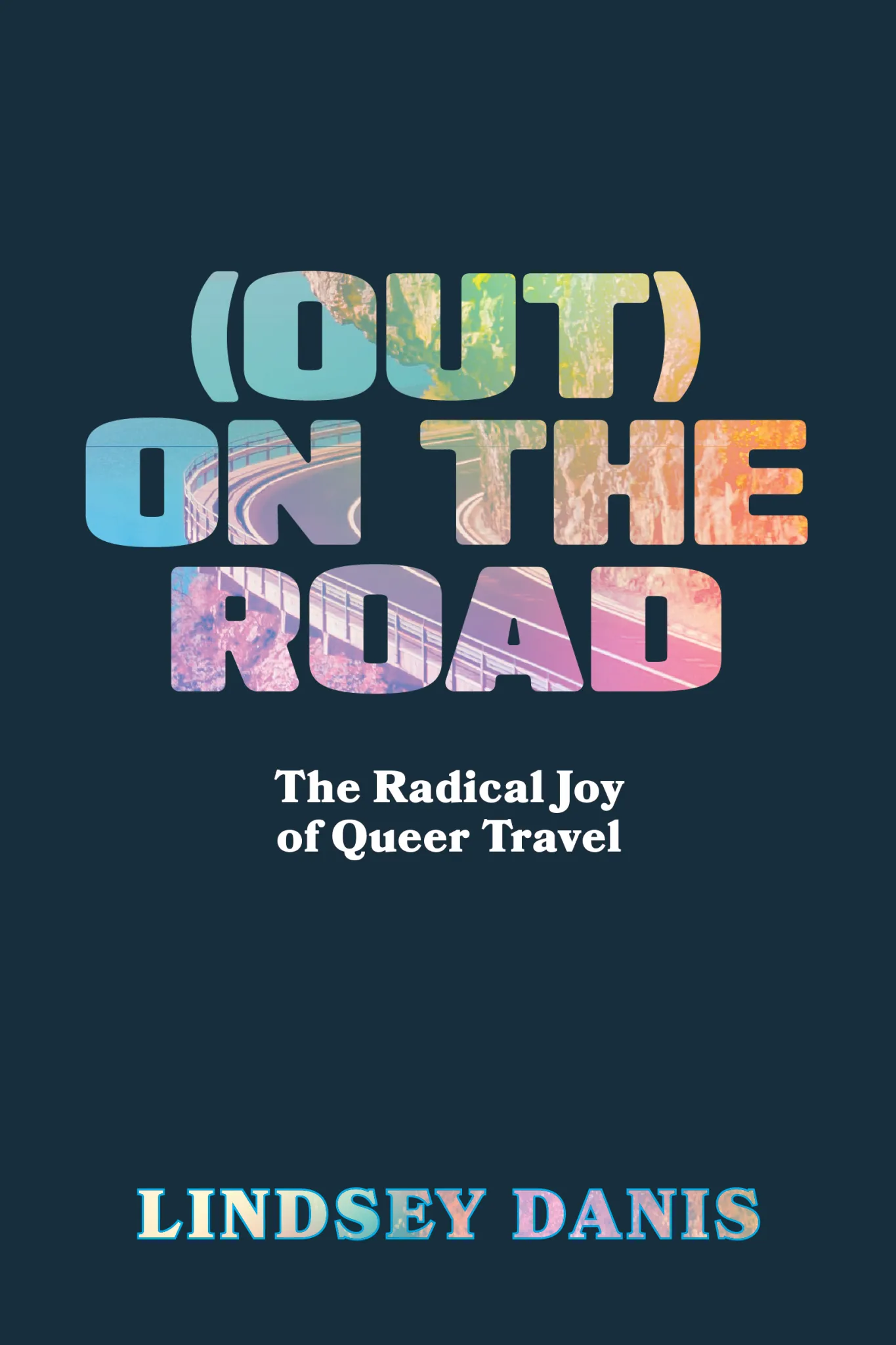
My progressed moon is in Sagittarius—before I lose you, I promise I won’t keep talking about astrology. But I mention it because progressed moons indicate shifting emotional needs and mine is in the sign associated with travel. I’ve been told I’m in a two-and-a-half-year period where I have an increased need for freedom, and may hunger for travel. The prediction appears accurate: The amount of trips I’ve managed to book? An embarrassment of riches. And yet I’m still keeping a close eye on my paid leave bank to see if I can squeeze in another before the end of the year. No surprise, then, when I rushed to read Lindsey Danis’s thoughtful and meticulously researched (Out) On the Road: The Radical Joy of Queer Travel (IG Publishing, May 5, 2026).
Danis offers an abundance of resources, concrete information, and helpful suggestions for queer travelers, but doesn’t propose a one-size-fits all approach. They make space for readers of differing races, ethnicities, abilities, identities, personalities, and values; never getting prescriptive about the “right” way to travel. (Obviously a queer book makes room for possibility.) In fact, each chapter ends with a list of prompts and questions so readers can reflect on what matters most to them as individual travelers. Because some of us, according to Danis, fall into the broad category of travelers who are risk-averse, while others are risk-taking. I don’t think I’m firmly in either camp—I’m definitely more risk-averse than risk-taking, but my adrenaline junkie tendencies can propel me, at times, to throw caution to the wind (like writing this review—as you’ll see).
Whether you’re risk-averse, a risk-taker, or somewhere in between, Danis’s book provides websites and apps for anything from Equaldex, which ranks countries on LGBTQ+ equality, to tips for more affordable travel tips, including an app for couch surfing. They give ample consideration to the topic of safety, for good reason. The world can be a dangerous place for those with marginalized identities. Danis acknowledges the reality of the current moment, under white supremacy and an administration intent on rolling back LGBTQ+ rights. Within a week of returning to office, Donald Trump signed an onslaught of executive orders, including rescinding the right to self-select gender markers on passports. In this political climate, many appropriately acknowledge and reckon with their own privilege and positionality, and Danis does exactly this at the beginning of the book: “I’ve tried to reflect my positionality, acknowledge when privilege has made things easier for me, and advocate for greater equity and inclusion of all marginalized peoples.”
When it comes to safety, Danis’s tips are wide ranging, from using VPNs so usernames, passwords, credit card information can’t be cyber stolen to advising you to consider putting your social media accounts on private mode before traveling to a country with anti-sodomy laws. But Danis also gives consideration to the validity and ethics surrounding travel boycotts to these countries the ILGA cautions against. And yet, they note the travel boycott to North Carolina after HB2 provided evidence that boycotts can indeed be effective. If I haven’t called (Out) On the Road nuanced yet, now is the time. It’s not only that Danis offers multiple sides to arguments, they make space for complexity, contradictions, shifting values and circumstances. Regarding the issue of travel boycotts, they mention anti-LGBTQ+ bills here in the States (you can visit the ACLU’s map to see just how damn prevalent this is), and remind LGBTQ+ travelers of their power to support queer-owned businesses. Because if money talks, shouldn’t we ensure our spending aligns with our values? Danis offers tips on determining a business’s values by looking at their About Page, checking the images they use on websites, and their social media posts.
The book is brilliantly structured, but how it’s done isn’t apparent until the final chapter when Danis reveals how they crafted it. When they explain the structure, in Chapter 11: The Sweetness of Queer Joy, it was one of those beautiful light bulb revelations (as this book is about experiences—I won’t share more about this or it will rob you of the revelation).
Experience is one of the things that travel offers. As is perspective; the chance to escape our daily lives. Many of us find an increasing need for that right now. Escape as self-care, as opportunity for needed relaxation, as freedom. A key word for Sagittarius. (Okay, I lied when I said I’d stop talking about astrology. But stick with me.)
Whether it has anything to do with my progressed moon, I’ve indeed hungered for more freedom lately, and chapter 8: The Allure of Neverending Vacation, had me considering whether I could be a nomad, even for just a year. Danis again offers resources so readers can do their own research as nomadic life is (of course) not for everyone. And while this book is not intended for everyone, but rather for queer and queer-adjacent travellers, on some level this book isn’t even intended for me. You may be thinking, didn’t I say it’s for queer travelers and didn’t I open this review talking about my newfound love of travel?
[Deep breath]
So while I’m queer, I’m not entirely out in my daily life. I’m pushing fifty now, and while my first kiss and first sexual experiences (all with females), are becoming a distant memory, all my romantic relationships with women have been in secret. With women who were also closeted.
I’m definitely not out at work, (which Danis touches on, noting more than half of all LGBTQIA+ workers in the U.S. are closeted on the job.) While my gender identity is fluid, I present fairly feminine, so people looking at me often assume I’m cis. And being closeted, both in my sexuality and gender, I carry a lot of shame. I don’t feel seen or accepted in my daily life.
Which is precisely why, for me, travel is especially alluring: When I’m away from my hometown I have the freedom to just be me.
In fact, the only time I have, so far, kissed a woman, in public, was when I was outside of my home state. One hundred miles away from my neighborhood and city is where I wasn’t afraid of someone I know seeing me. At that distance, I could be myself. Danis speaks directly to this experience in the book:
“When LGBTQ+ people question our right to take up space in our home communities, visiting queer-friendly places reminds us of our inherent belonging. When the cultural tide is shifting beneath our feet and laws strip away hard-won rights, travel reconnects us to community, possibility, and joy.”
Queer joy is something this book gives appropriately vast space to. I’ve also written about queer joy. The book also talks about belonging, about feeling at home when away. I haven’t written (yet) about belonging, because as a closeted queer person, I don’t experience many places where I truly feel I belong. When writing and publishing about being queer, I’m clearly out. So I’m out virtually—I’m out online. So in many ways, I’m out in the larger world. And, I’m out on the road.
But in my daily life, the life where I’m assumed to be hetero, assumed to be cis, I try not to wince noticeably when someone includes me with a group of women and addresses us as “ladies.” I recently cleared my throat to speak up when someone said I didn’t belong to the LGBTQ+ community—but then I couldn’t summon the words to express that I most certainly did. Couple my shame with a hell of a lot of anxiety, and I freeze. I’m rarely good with verbal exchanges in real time. It’s only later that I think of everything I should’ve said. Danis talks about the inherent pain in passing. As someone who spends most days passing, I can tell you that specific, acute pain is real. I think that’s why I’m so drawn to traveling: when I’m away from home, I’m free. As Danis writes, “Travel gives you opportunities to try on new identities—to show up in the world in ways you’re not able to at home, for a variety of reasons.”
As someone who didn’t understand their gender identity until their forties, the opportunity to try on new identities feels like breathing air for the first time. I can’t fully breathe in my daily life as someone passing for a cis straight, but out in the larger world—out on the road—I’m able to exhale.