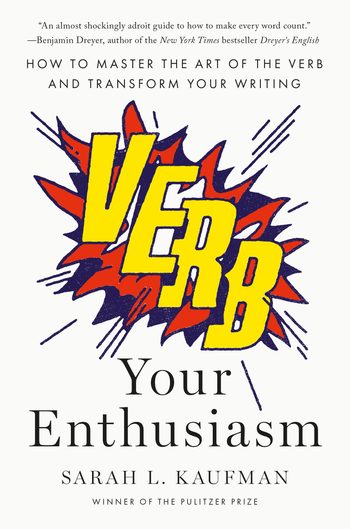
“Dream and truth dance together in the writer’s mind,” as Pulitzer-Prize winning critic Sarah L. Kaufman teaches us in her new book, Verb Your Enthusiasm. Decades of translating dance into language as a critic for The Washington Post drove Kaufman to become an expert observer of detail.
Part style manual and part philosophy of excellent writing, Kaufman focuses in this book on the versatility of verbs, empowering writers to pay closer attention to the world and bring their creativity and perception to the surface. Drawing on a wide variety of examples—from George Orwell to Anton Chekov to Patricia Highsmith—she encourages writers to sharpen and enliven their own work by harnessing the power of verbs, without sacrificing clarity or grace. Across eleven chapters, Kaufman asks us to consider how a single, well-chosen verb can tilt a piece of writing toward precision or possibility, toward clarity or confusion. Verb Your Enthusiasm feels especially resonant now, when so much of our daily language—articles, texts, social media posts, emails—demands not just to be read, but to be understood beneath the surface.
I had the pleasure of speaking with Kaufman over Zoom about writing, neuroscience, and “verbing” as an act of resistance. This interview has been edited for length and clarity.
The Rumpus: How did your time as chief dance critic and senior arts reporter for The Washington Post shape your writing and eventually lead you to writing this book?
Sarah L. Kaufman: I was a reporter and critic for thirty years. As a reporter, you’re telling true stories. You can’t make anything up. As a critic, you’re giving an analysis and an evaluation, but you can bring in your opinion. You have to have a strong opinion. It’s more interesting to read. You need to first observe the world you’re in, think through how you feel about it, and then be able to make a case for those feelings. And generally, as a writer, you want to persuade people that you’re seeing a true picture; you’re giving a true sense of an authentic moment.
Dance is all action, even when there’s no action. There may be slow moments, moments of stillness and quiet, but that’s part of the overall movement picture, the artistic makeup, the choreography. That’s where verbs come in. As a dance critic, one of my goals was to recreate the performance, to give the reader the experience of being there. What unusual verbs could I use to really spark those feelings and instantly give a picture of what was happening?
I didn’t set out to make my mark with verbs. It organically came from what I was trying to do as a critic, from the art form I was working with. I’ve always liked writing manuals, language books, grammar. I’m that kind of a nerd! I thought: “Verbs as a matter of style—has anyone ever written about that? It would be a really interesting challenge,” I thought, “to examine that in a book and convey what I believe is a pillar of good writing.”
Rumpus: I love that you call verbs the “Cate Blanchetts of language.” They’re “flexible, shape-shifting, fascinating all-arounders that take on different roles—action word, adjective, or noun—with grace and energy.”
Kaufman: It’s my dance critic brain. Cate Blanchett is a very physical performer. Her whole aspect of a character is grounded in behaviors and mannerisms: the way she walks, the way she holds her chest, the thrust of her shoulders, the dip of them. There’s so much to her physicality that springs from how she’s prepared, researched, and feels the character she’s embodying. I like the sense of a live performance she conveys, even on film. She’s also so versatile. She can be Bob Dylan. She can be Blanche DuBois. She can be tough and frightening, or tender and vulnerable. She has an enormous amount of range and subtlety.
She seemed a perfect analogy for what I was trying to express with verbs. Verbs are so versatile. They’re about action, existence. They’re the words we use to describe being, becoming, appearing, the state of existing in the world and the whole circus of it. They can become adjectives, nouns. We can invent them at will. We can mush them together. We can make them out of nothing.
Rumpus: You write, “the body speaks its own language,” and that we translate it best through verbs. How does writing about movement impact the reader’s experience?
Kaufman: We have an instinct for movement. Our brains are a motor system. Our brains love to make us move, make our blood beat, our breath go in and out, our muscles move. We’re also keen to look at movement: Our eyes follow it. It’s natural that in the living real world, that’s what we notice.
Movement metaphors are extremely powerful in terms of bringing images to our minds. To bring body language into how you describe someone you’re writing about is a really rich way to show, not tell. The phrases that stay in my mind from books I’ve read are these vivid movement pictures. Like Hemingway in The Sun Also Rises. When Lady Brett Ashley first comes on the scene, he talks about how she walked with a lot of “lateral movement.” He doesn’t overdescribe. It really gives you that first step in understanding her as this wild, free spirit.
We can easily fall into more interiority—what a person’s thinking, how they’re feeling—but how revealing it can be to get them moving! Show us the character being a free spirit, or how they’re an introvert, how they’re observant, how they’re always monitoring everyone in the room. Show us something we can picture in our mind and feel, so we can actually have a part in sculpting that character for ourselves.
Rumpus: Books rich with interiority are popular these days. I’m thinking of novels like My Year of Rest and Relaxation by Ottessa Moshfegh where the narrator lays in bed for an entire year. How can writers successfully balance interiority with movement and action?
Kaufman: I do love interiority. That’s the beautiful gift of the novel, to bring us inside people. I wouldn’t want to throw that away. Think of having a mix. It’s another tool to be able to get a character moving now and then.
One thing I suggest is reading a lot. Flannery O’Connor is one of my favorite writers, and she herself was often bedridden. She had lupus and a lot of joint pain, and eventually died of it far too young. She wrote some stories that were autobiographical in essence. O’Connor had a way of bringing a lot of, if not movement, a sense of energy and dynamics, which is what we’re really talking about. Verbs aren’t just leap, jump, hop. They allow us to explore energy levels, the qualities of a person, quality of thinking, qualities of impressions. Those can be rendered very dynamically, with different kinds of expression that makes them very vivid.
Another thing I suggest is people watching. It’s great fun to eavesdrop and overhear conversations, but also just to watch and observe. That’s the reporter in me, but I’m not the first one to advocate for people watching! It’s what novelists love to do. Sit in a quiet corner of a café, watch how people interact with one another, how they turn the pages of a book while sipping a latte, or scroll on their phone. Sit on a bench and watch people walk down the street, move through a park. Whatever it is, watching those behaviors and putting words to them is a really great exercise.
The third thing is to sit with yourself and think: how can I describe what I’m feeling right now in a way that’s not a cliche or a phrase I’ve heard before, maybe with a verb, to get your mind going through some action terms? The wilder and weirder, the better. Jot it down. Get your mind going, take a moment to think that way.
Rumpus: Can you talk about the power of suggestion, how “harnessing the power of verbs”—writing what a conversation looks and feels like, how the characters behave, and how their bodies respond—makes for the best writing?
Kaufman: Suggestion is so rich and rewarding for a reader, to have what you see on the page light up images in your mind. You’re not pulled through a wordy description that grows dull because it goes on for so long. How wonderful to read a writer who can spark, suggest some things in a minimal way that resonate with you individually because of your own experience. It’s wonderful when an author shows that kind of trust for the reader.
I like the Emily Dickinson poem I use as an example:
To pack the Bud—oppose the Worm—
Obtain its right of Dew—
Adjust the Heat—elude the Wind—
Escape the prowling Bee
Great Nature not to disappoint
Awaiting Her that Day—
To be a Flower, is profound
Responsibility—
Dickinson uses verbs that suggest a lot about this character of a plant, a bee, and a flower. If you slotted in different verbs it would totally change the picture. Her verb choice was so specific and resonant and consistent. She was very controlled in her use of words. It brought such a lovely picture to mind, one that we can put together on our own.
Rumpus: You return often to the idea of restraint—cutting clutter, axing adverbs, paring language to essentials. Why do you think simplicity is challenging for writers, especially new writers?
Kaufman: It does take extra time and willpower to pare down one’s words, but with practice it grows easier. Probably most writers—I know I’m this way—kind of vomit it all out on the page at first and move on, then go back and edit. Spend extra time editing. Cut what distracts from your point, cut out the wordiness. Take that gush of impressions and words, and streamline it into something clean and clear.
To go back to Hemingway, he must also have gushed, because he spoke about his efforts to continuously cut and pare things back to the bone, to simplify and make something as honest and pure as he could. So he had to have started with a mess, one likes to think. It’s something I’ve heard from artists of all stripes: the secret is subtraction, not addition. It’s reducing. Whether you’re a choreographer, playwright, or poet. It’s first getting the impressions out, then seeing what you have and what you can take away to make it even more potent and powerful.
Rumpus: I like the real world examples you provide to illustrate how the passive voice can “soft-pedal reality” and even “hide the truth.” Can you talk about the morality of verbs?
Kaufman: The morality of verbs is very important. The passive voice comes into this.
“Mistakes were made” is a classic example. People keep using it to explain, to excuse themselves really, when they’re caught doing something wrong. The passive voice is used a lot when people want to distance themselves, or whoever is responsible, from responsibility. It’s often used in war contexts. “Villages were bombed.” Who did the bombing? The passive voice doesn’t tell us. It’s like they just dropped out of the sky. That’s not honest reporting. When I talk about the morality of verbs, that’s what I mean. Is this language conveying the facts, conveying who’s responsible? Or is it hiding something? Language is intentional. We choose the words we use. We need to choose them with care if we want to tell the truth.
A lot of us can fall into using the passive voice because it seems sophisticated, scholarly. It gives this distance from the action. But it’s a faux sense of sophistication, because really what we need to do is communicate. We don’t want to obfuscate. We want to communicate something, get it across. That’s what language is there for.
We can’t have a blanket rule that passive voice is bad, though. There are many ways and instances where it’s the best way to say something. It can be used with great effect. I give an example from James Joyce’s Ulysses. Joyce opens with Buck Mulligan striding forth, but then there’s this dressing gown being wafted behind him. It’s descriptive, but it’s also sarcastic from Joyce’s point of view. There’s a slight snarkiness in the sense that this wafting dressing gown is part of this pompous character.
Rumpus: I like that you shine a light on corporate euphemisms to show how various tech and finance companies have used this kind of language to announce layoffs. Personally, phrases like “bandwidth” or “circle back” or “deep dive” haunt me on a daily basis. How do we avoid meaningless, opaque language?
Kaufman: Whenever we find ourselves using a phrase or expression we’ve heard before, unless we want to deliberately plop it into the mouth of some pompous character, we need to rethink it and try to come up with something fresh. In these corporate examples, executives use euphemisms to hide the truth: “planting the seeds” and “right-sizing our operations.” When you’re talking about laying people off, peoples’ jobs, salary cuts, reducing, when you’re talking about people’s lives, you really need to be clear. You end up confusing people, not sounding smart and in charge. You sound vague, untrustworthy. It’s always better to say it straight. You don’t have to be cruel, but you should be honest. That’s showing much more respect for the people you’re talking to.
Rumpus: How did you approach research for this book?
Kaufman: The idea of paying attention to verbs and using them effectively applies to all writing, so I wanted to make sure I had a good variety. Not only great literature, but also emails I’ve gotten, letters to the editor I’ve read, placards on the wall of a museum, journalism, news. A lot of the books come from my own collection, from writers I love. For the longer passages, I was looking at writers whose works are in the public domain. That brought me to the wonderful writer Wilkie Collins, one of the first detective writers in the Victorian age. His work is absolutely delicious, full of a lot of verbs, a lot of beautiful ways he invokes the landscape and the seashore he’s writing about.
When I was at The Washington Post, I came up with a series of stories on the science of the arts from this burgeoning field of neuroaesthetics and all kinds of neuroscience experiments I’d read about on how we perceive beauty, how we perceive action. Why, when we go into a theater, do we see this world of symbols and sometimes unfamiliar language, but we can have this really rich experience? How does that work in the brain? What are the reasons for that? Sharing emotions with other people is a chief reason, and I brought that into my first book, The Art of Grace (W.W. Norton & Co, 2016). There, I also have a section on science in terms of movement. Here, it seemed really apt because I wondered, why is it that verbs can paint such vivid pictures in our mind, make us feel an action we read on the page, feel it in our body? I set out to find linguists, neuroscientists, psychologists who could help me understand that question. My instinct I started with was true—it’s not just a matter of style. Verbs can have a physical resonance in our body.
Rumpus: The book shares the idea that young women drive linguistic innovation. What does “verbing” reveal about gender and authority?
Kaufman: This comes from my interviews with a number of linguists who are the real experts on this. Their research has shown that it’s young women who push the language changes forward. Young women—girls, teenagers—like to play with language. Girls are a little more quick to speak, to learn language, to play with it. Girls use a lot of language jokes, toying with it, stretching it out, throwing in new words. So they’re usually the ones who push these changes forward. That was really interesting to me.
We think of Shakespeare as inventing a lot of words. Well, it’s hard to say for sure. We don’t have tape recordings of what language sounded like in his day. We can only go by what has come down to us in written form. He was extremely inventive, and he may have heard these new words being used in the world around him and then put them on the page, but it’s highly likely it was his wife and her friends that were using these words before he did. We’ll never know.
Rumpus: You write that AI tends toward “numbing obviousness” and lifeless phrasing, and urge writers to “defy AI with poetic use of verbs.” What can human writers do that AI can’t?
Kaufman: Verbs fall into every other part of speech that writers can use infinitely more deftly, imaginatively, and poetically than AI. With our imagination, the creativity we bring to bear, our perception, our ability to see things and translate that into words with freshness and energy, that’s how we can defy AI. It’s really going to be our imagination and creativity that distinguish the human touch.
Rumpus: I love the appendix of vintage verbs worth reviving. What words would you put in your “Word Graveyard?”
Kaufman: I didn’t want to give too long a list of verbs, just a few of the most wonderful ones. There’s a kind of music and a rhythm about them: concatenate, rantipole, tossicate, recrudesce. You can tell they’re a little old-fashioned. It’s like looking at a photograph, you can sort of tell the era. They’re very evocative. They have a sense of music. They almost say what they mean, in the way the word sounds. I love that.
My number one candidate for the “Word Graveyard” is “utilize.” It’s pompous, pretentious. Why not just say use? I dislike “exude.” I often see exude like this: “the smiles they exuded.” To me, it brings to mind oozing, the way it sounds. Just say they smiled!
Rumpus: Anything else you’d like us to know about this book?
Kaufman: I had a great deal of fun writing this book. It’s my love letter to writing, and to a lot of the books I’m looking at here on my shelves. It was an invitation to discover new writers. It’s a book about books, what really makes them come alive.