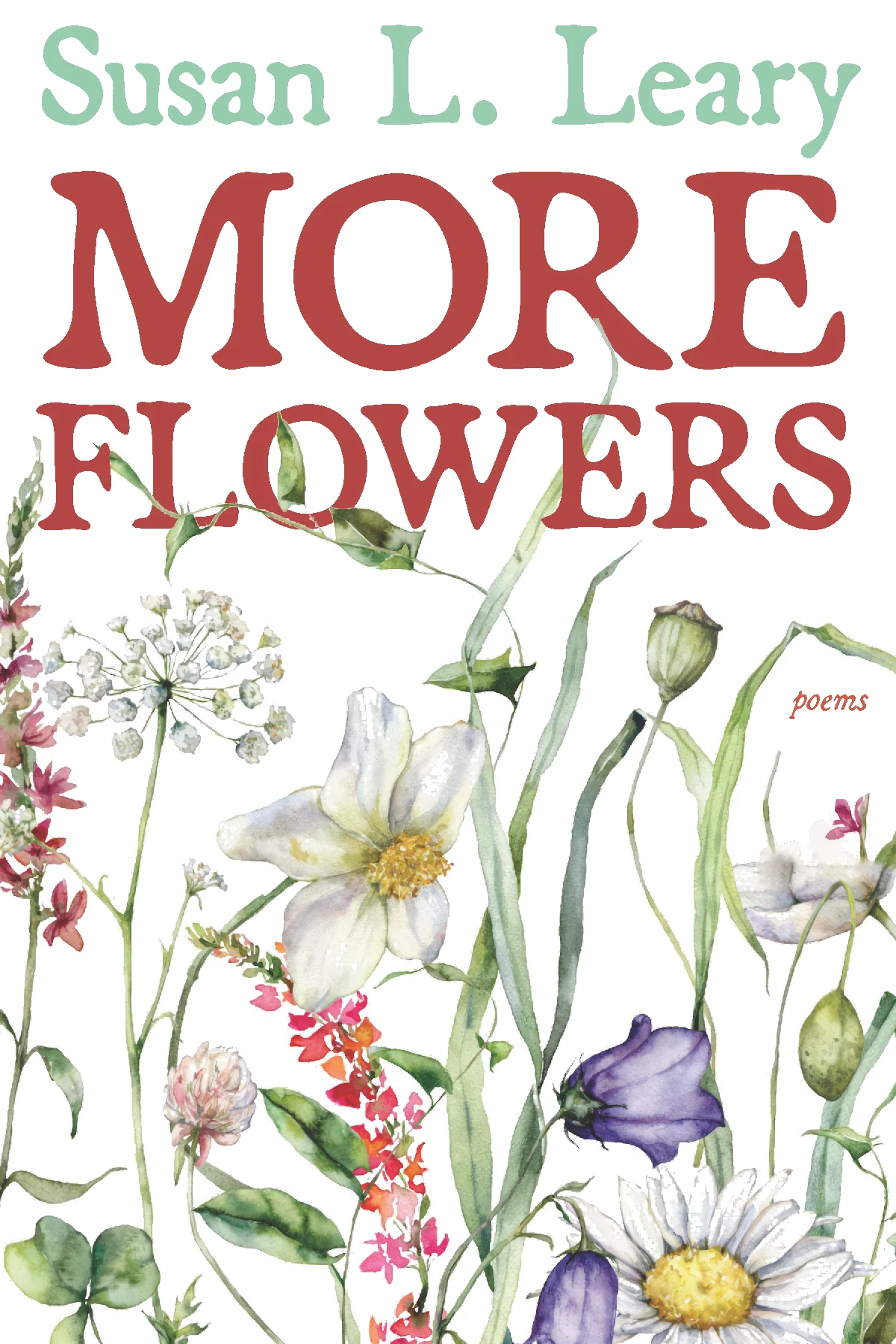
“How does / a self happen when of what we bury / & what we unearth, there’s no / telling the difference?” Susan L. Leary asks in the poem “Uprooted” from her latest collection More Flowers, which is due to be published by Trio House Press in February 2026. This “self” is unsettled and roaming, shaped by grief and gendered inheritance, uncovering past wounds while seeking atonement. Leary is the author of four poetry collections, including Dressing the Bear (2023), a heartfelt elegy of the poet’s brother who struggled with substance abuse. Profound loss and grief are ever-present in this subsequent text’s funeral scenes, hauntings, and lilac bushes—a symbol for mourning and remembrance. Lilacs aren’t the only Whitmanian aspect in More Flowers, though. Whitman’s influence extends not just to botanical imagery but also to ethos: an insistence on abundance despite loss and a turn to the natural world for spiritual restoration. Despite the sorrows of this “interminable elegy,” there is a hunger for excess and plentitude as Leary’s “tumult / of flowers” celebrates the fragility and poignant beauty of living.
More Flowers interrogates how patriarchal authority persists even in its absence, transmitted through maternal caretaking rather than overt dominance. While an authoritative male figure is not present, the mother still governs by his rule, passing down restrictive and traditional expectations of gender to her daughter. In the opening poem, “Pseudo Myth,” our poetic guide and heroine is a character named Girl who is befuddled by her lack of autonomy and why some are mandated control over others:
Again I’ve confused     the horseman for the horse….
What we do in the name     of obedience, not
thinking wonder has     anything to gain over wit.
The wheel at times,     will envy the hands that
clutch it. The horse     the inoperable reigns.

Leary uses the grandiose language of mythology to create an environment where Girl’s experience is universal and timeless. In this way, the mother is not blamed for being an enforcer, but rather, once a Girl herself with inherited limitations. “I am a domesticated / animal” and the “Unruliest Flower” the speaker reminds us later in the collection, calling back to “Pseudo Myth’s” desire for control over the bridle, her inherent wildness and disobedience.

As if flipping through a herbarium, scenes from the speaker’s youth feel like pressed specimens to be studied in adulthood. These preserved moments suggest that survival, like botany, requires classification before discernment. This impulse toward understanding deepens in “We Examined Survival under a Microscope,” which fuses a schoolyard scene of springtime tulips with a funeral for a fly, observing that “death is the supreme invention.” Childhood isn’t just a memory of lived experience, but concrete evidence that the speaker views with emotional distance and scrutiny.

In the development of that detached mode, the child-self is indeterminate, disembodied, and in a state of constant reinvention as a method to endure her adolescence: “I dress in another girl’s arms & legs, / wear her checkered uniform to bed.” Within the world of More Flowers, Girlhood is to be understood as an amorphous, collective, and performative experience. Illustrated in “Encore to Girlmaking,” girls can escape their own “wound costume” by experimenting and imitating a new self to find resilience and renewal. “Pull back / the curtains on our own bodies, say, here’s my sorrow, / let me show it to you,” Leary writes in a gesture to shed all the different identities to share in a more collective sense of grief. Theater and costume motifs present Girlhood not as a stable identity but as an assortment of essential disguises worn not to deceive but to persist.

Raised near “a power plant in the Midwest,” the diction is informed by scientific inquiry (test tubes, nuclear energy), domestic chores (Palmolive, laundry), and violence and neglect as detailed in Leary’s confession, “I left my Girlhood / bleeding at the back door & ignored her letters.” One of the collection’s standout poems is “Brief History of Light,” which begins in a fierce and confident tone to mirror the brutality that exists around her: “If I am monstrous / it is because others tell me I am monstrous. I hone my skills. I sharpen / the blade. I make my enemies the most unforgettable / cup of tea.” Here, monstrosity is viewed as a social construction rather than an intrinsic defect. There is a sense of regret and newfound empathy, though, in the adult’s reflective mode where she shifts into the final lines, stating, “I walk hand-in-hand / with my adult shadow…I survive not because I am an expert in jousting but because I am / loved. Because my mother was the window & she let me be the light.” This progression moves from a weaponized selfhood sharpened for defense toward a gentler, lighter, more visible position. Survival is no longer earned through battle but granted through recognition.

The hyperbolic game of “Telephone, Ad Infinitum” speaks to the “mechanism / of exchange” and the “origin of inheritance” between mother and daughter that is at the root of their relationship and bond. In “Subject(ivity),” storytelling is essential in the accurate preservation of their shared narrative: “The mother, / the healer / & the wound / maker. The child, / the mother’s biographer.” It is a role Leary takes on with earnest exactitude of a painter. This comes forward in the ekphrastic poem “Maternal Caress, 1896,” which is inspired by Mary Cassatt’s work, an intimate portrayal of mother and child. Similar to Leary’s focus on a plant specimen, there’s the desire to examine and conserve the mother figure, and understand the generational struggles of women.

Leary’s contemplative self-portraits reveal self-awareness geared toward her own flaws when she writes, “How deeply / we fail at introspection.” Her inquisitiveness is found in the mode of rhetorical questions: “How many devastations / before spring will it take to sustain us all?” and “Why resolve / this tension?” Carefully treading toward resolution, the speaker declares, “The soul must sit down and make amends.” In the poem, “Now That My Mother Has Apologized,” the poet explores the nature of forgiveness in the wake of an apology, a recognition of the past—something that any child who has been hurt by a parent needs but very seldom receives. Although both view each other with warped perception, the speaker admits how meaningful it is to have a mother to listen and acknowledge her own shortcomings: “In turning from the mirror, I see my / mother, seeing me as I have so badly wanted to be seen.” In More Flowers, the self materializes not through omission of a past harm but through its direct address; the daughter is finally perceived by a mother who once looked elsewhere.