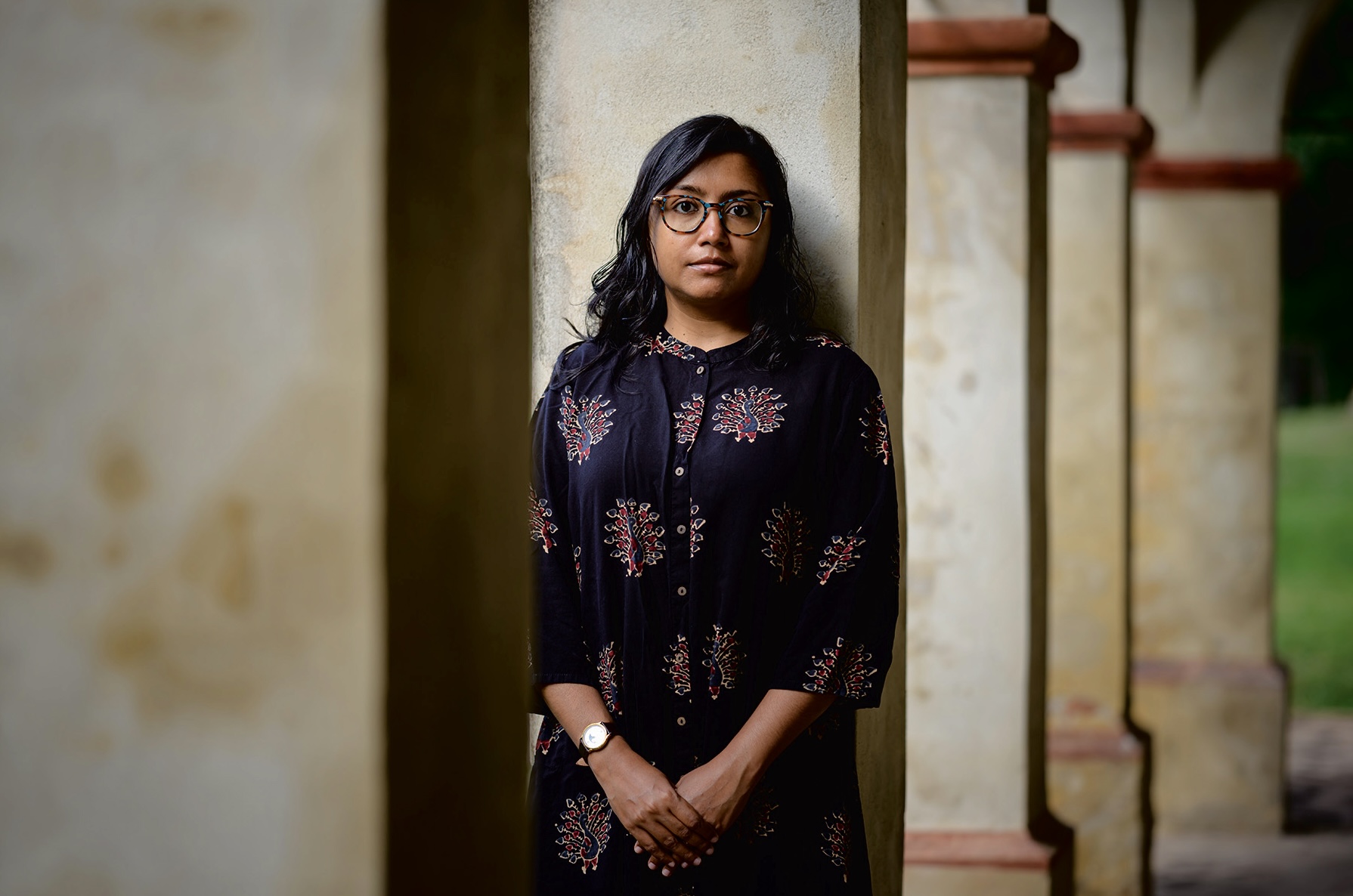
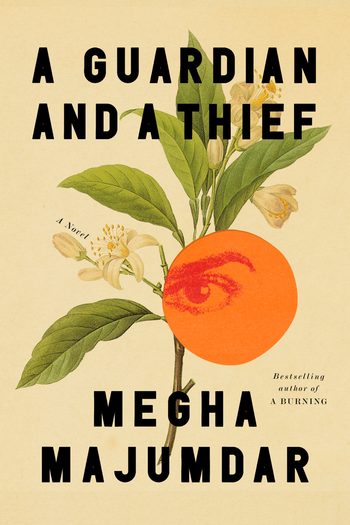
If the past year was one of tenuous accountability—of the things we are doing to our planet, to each other—it was also one of strong writing that sought to disturb, to implicate readers in problems that will not disappear with the turn of a calendar. Shortlisted for the 2025 National Book Award and selected as an Oprah’s Book Club Pick, Megha Majumdar’s A Guardian and a Thief was one of these books—a novel both tender and unsettling.
It is an experience I remember from her debut novel, A Burning (Vintage, 2021), in which a terrorist attack and a misconstrued Facebook post reveal the stealthy, menacing risks of identity politics in India. A Burning was dizzying, a cacophonous account of the aftermath of a violent incident. With A Guardian and a Thief, her second novel, Majumdar once again draws our attention to the parts of a social crisis too ambiguous to depict through reportage. This book feels quieter, ridden with a more deep-seated sadness born of inequalities of class and opportunity.
As with A Burning, we are back in Kolkata, Majumdar’s hometown. This time, it is plagued by a climate crisis and a severe food shortage that have eroded the love of art and community otherwise characteristic of West Bengal’s capital. All our concerns are pinned on Mishti, a two-year-old child, the moral center of Majumdar’s story. Mishti’s mother and grandfather have seven days to get her, and their family, out of the country. In the US, the promise of safety, stability, and happiness awaits. But can we muster up the same sympathy for Boomba? He steals, after all, from this loving, starving middle class family. He may look like a young boy, but he’s no longer a child. To what extent do we equate virtue and innocence with privilege?
Megha Majumdar and I connected over email, two Bengalis reading and writing in the States. Despite the limitations of the medium, and our chaotic schedules, we managed to form a dialogue. On the role of art and community in times of crisis, on the sincerity and performance of philanthropy, on the promises and failures of migration. Our conversation is edited here for length and clarity.
The Rumpus: I started reading this novel and immediately recognised Kolkata, or a version of Kolkata that this book remembers in flashes. You’ve mentioned in other interviews that you wanted to highlight how people there are able to laugh through the toughest circumstances. In addition to this sense of humor, what other faces of Kolkata, real, remembered and imagined, were you trying to depict through this story?
Megha Majumdar: I’m so glad you saw Kolkata in the book! One aspect of the city I wanted to bring into the book is the way in which relationships matter so much. People lay claim to other people’s time. They make requests: “Can you bring me this ghee I like when you go to that shop?” “Can you speak to my nephew who’s considering studying physics, since you studied physics?” You might be reaching out to your neighbor’s teacher’s cousin’s friend—I love that those relationships, no matter how thin they are, exist. They might be dormant, but they can easily be activated. So I wanted to offer glimpses of the networks of relationships that exist in the city, and that in a time of crisis will, I think, be the material of resilience.
A second aspect of Kolkata I wanted to bring into the book was street life. There’s so much happening in the streets. You could go out for a walk and overhear so many conversations, see people playing cards or carrom under a single bulb, see others crowded around a phuchkawala. For instance, in the novel there is a scene with a roadside barber who invites a character to forget his worries and come sit in his chair. And there’s another minor character, a roadside businessman of a kind, who becomes quite important later in the book. That change of status, from someone you observe as part of the life of the street who then becomes personally significant to you, felt interesting and truthful to me.
Rumpus: These are the interactions which reminded me, repeatedly, that this novel is set not in India or even West Bengal (though of course it is), but specifically in Kolkata. There are so many powerful passages about how “the city” treats its inhabitants in a moment of crisis, or how it is experienced differently by Ma and Dadu, two of the main characters. Why is the space of a city a crucial frame for this story? Why a city, not a country? And why, in particular, the city of Kolkata?
Majumdar: Your question makes me think about how the location of the book is in some ways a neighborhood, too. One of the characters is a neighbor, a professor who cares for two parrots, whose neighborliness becomes quite important within the story. But, yes, the city. It’s my hometown. It’s the place I saw with the most clarity and specificity. I saw, as I was writing, the joy and beauty of the city, and I saw, too, its ugliness and difficulty.
The characters of Ma and Dadu allowed me to explore the truth of both of those aspects. Dadu is a character who loves the city. He has enormous affection for it, how it held his childhood, how his boyhood self is known by it, and he has enormous affection for its liveliness, its humor. So he is quite heartbroken about the prospect of leaving. Emigration, for him, is an event of great sorrow. Whereas for Ma, emigration is relief and rescue and excitement. Ma has memories of being harassed by men, strangers, in the city, for example. For her, it is a place where she found it difficult to be a girl, to grow into womanhood. So her perspective on this city is quite different from Dadu’s. That’s one of the fun things about writing a novel, thinking through different experiences and reflections I have and working to compose a character’s brain solely from one or another of those elements.
Of course, the more obvious and perhaps more encompassing answer to your question of “why Kolkata” is that Kolkata is one of the cities in the world which is most severely affected by climate change. It has grown hotter. It is predicted to endure more storms, and more severe storms. How does it feel to read that this is the probable future of your hometown? That particular sorrow is one of the places this book comes from.
Rumpus: We are asked to think of the two main characters in this book as a mother (Ma) and a grandfather (Dadu). Boomba, also, is a young man who comes across as a young boy, until we start to see him as an older brother and a son. You’ve spoken on the First Draft podcast about how this decision was a matter of trusting your intuition. But as a Bengali reader it also made so much sense to me culturally, that their choices and their positions in society are defined by who they are in their family. Could you say more about what framed this decision—why is their age, and their roles in their respective families, the lens through which we meet these characters?
Majumdar: That is such a beautiful read. You know, I always had the belief that at the center of this book, there would be a child. For a while, the child was the main character, and then I discarded those drafts because they weren’t working, and grew more interested in the parent, the grandparent, the older brother. But, a child remains at the center of the book. Her name is Mishti, and she’s a toddler. So I think you’re right that somewhere the book believes that the child is the center of this novelistic world, therefore the characters are named by how she knows them. It’s also true that the child is the person who motivates her mother and grandfather to do what they do, to engage in morally murky acts that would’ve shocked them in a different age. There’s a scene where Dadu steals an orange from a different child, in order to bring it home to his own grandchild, and though he understands that he is giving up something essential about his own humanity in doing that, that he is stepping into a world which is no longer the same, which is altered forever because of this one act of his, he still goes ahead and steals. Why? For his grandchild.
Rumpus: What was it like inhabiting these characters? Ma (who perhaps as a parent yourself, you may have identified with), but also Dadu, an aging grandfather whose youthfulness is such a strong presence in the novel, and Boomba, this ambitious, precocious young boy? What inspired their personalities?
Majumdar: I think of characters as ways for me to ask questions and explore ideas. I see them as instruments. At the same time, they gain lives of their own and gain, hopefully, a certain vitality on the page which exceeds what I’m able to consciously construct. So they are really funny in that way, really beautiful mysteries.
I knew that I wanted to write characters who are complex. I am very drawn to complexity, as it feels truthful to me. I never wanted to write a mother who is a saint, a thief who is a wicked villain, and so on. In this book, Ma steals—this is on page one—Ma steals from the shelter where she works, amid a food shortage, where the city is frantic for fresh food. Right away we know that this is a woman who is capable of great love, great care, as well as selfishness and scheming and perhaps ruthlessness. That mix felt fascinating to me.
I love that you speak of Dadu’s youthfulness. That is so true.
The character I’ve spoken the least about so far is Boomba, so let me speak about him. He is a villager who has made a great mistake in his own life, and now he’s trying to find a foothold in the city to make a better life for himself and his family and fix that mistake. In him, I wanted to write somebody who’s a bit of a dreamer—he dreams of traveling the world, before understanding that such a dream is nearly foolish in a life such as the one he has—and at the same time, somebody who learns that he has to keep his focus on immediate needs: food, shelter, money, his toddler brother’s health, because mosquitoes are abundant in the place where they live, and the little boy’s schooling too. Boomba is motivated by love for his younger brother. He will do anything for his little brother. So what does “anything” look like? What of himself will he surrender? And what of himself will he hold on to even in the process of surrender?
Rumpus: So much is scarce in this story. Food, yes, and sometimes empathy and patience too. I felt like this sense of scarcity was echoed in the book’s sparse prose, too, in the distant, almost clinical tone in the narration. The structure also seems to hold us at a distance, with its fragmented phone calls and the alphabetized scenes that count the number of days making up the novel. What inspired these formal choices? While writing, were you thinking about an experience of scarcity as part of its language and structure?
Majumdar: Oh, that’s so interesting that you read it as scarcity. I’ll have to sit with that and think it over. Isn’t it cool how a book blooms in different ways in different minds? For me, I was actually interested in a certain lushness, a nourished language, sentences which feel full and replete.
What I was also thinking about was the clock of the book. The book is structured over seven days, one last week in the city before one of the main families—Ma, Dadu and Mishti—moves away to Michigan. I found this clock so intriguing to work with. What happens each day? What does progress in the story look like? How do the characters change meaningfully within such a tight period of time?
In fact, it took me a long time to arrive at this structure of seven days. For a while, I was completely convinced this book would unfold over ten days. I tried to make ten days work, but it was always too loose, too wobbly, too unpersuasive. When I finally landed on seven days, it was so satisfying. It sounds incredibly obvious now, but it was hidden from me for quite a while. I also had fun with the alphabet headings… those rose for me from the fact that Mishti the toddler would be about to learn the alphabet.
Rumpus: There is a scene in which Dadu, desperate to find food for Mishti late at night, spends the little money he has on a painting that he hopes to pass on to Mishti for posterity. “As a participant in the city he loved,” Dadu reminds us, “it was up to him to insist on the value of a painter’s work—not the value of a famous painter’s work, the kind of work now being traded for rice and sugar—but the value of an unknown painter’s work.”
It’s a moment that asks us to halt and think about the role of art in moments of crisis, not just as a medium that can speak truth to power or elicit pleasure, but as something that deserves actual currency when currency itself is scarce. What inspired this scene for you? What is this book trying to say about the role of art, of spending on art, in times of severe need?
Majumdar: This is a question I’m curious about, too. I’m still thinking through it. One way into it is to think about the place of art, and the artist, in the city. Kolkata is a city which reveres art, all the way from childhood (I remember so many sit-and-draw competitions) to the professional sphere, with art galleries and murals and of course, branching out a little bit from paintings and photographs, a robust film industry too. I hope that this citywide affection for art remains as strong as it has always been.
But I wonder, too, about what the worth of a painting will be when people are dashing about the city looking for fresh vegetables or clean rice. In many ways this book is about what we consider essential to ourselves, and what we consider extraneous. What do we let go of, in a situation of crisis? What do we refuse to give up?
So I wonder what a painting, by an unknown painter, with no investment value or financial value, would come to mean in such a time. How would we value the moment of transcendence art offers? The moment of beauty? The feeling of rising above our daily selves to meet a truer self?
Rumpus: This scene also feels crucial to me because it says something so nuanced about how the class system works. As a reader you feel genuinely moved by the idea of a starving grandfather wanting to leave behind a work of art for his granddaughter, until you realize that such a touching sentiment would be an unthinkable luxury for someone like Boomba. This point is echoed on a grander scale at the billionaire’s daughter’s wedding. Their wealth allows that family to be benevolent, but only to a degree. I’m curious about how you wanted to complicate our understanding of privilege and benevolence with these interactions.
Majumdar: The billionaire is a fascinating character for me. She lives on a manmade island, called the hexagon, in the middle of a river. She genuinely cares about the city, but has removed herself from its crisis. She loves the children of the city, and wants to shelter them and feed them. At the same time, she is aware of her performance of such care. She is aware of possibilities for profit down the line. She is aware of how the city views her behavior and might then decide to reward her. All of these elements are true—the generosity and the selfishness, the honest adoration and the scheming performance of adoration.
And the billionaire, in my mind, completes a rather narratively satisfying trio of characters who all help ask questions about class. There’s Ma, of course, who belongs to the middle class and has plenty of resources. There’s Boomba, who is quite poor and is struggling to find a place to settle. And there’s the billionaire. In the climate crisis, people of different means will find different paths open for them, and different obstacles. What will relief or escape look like for each of us?
Rumpus: Touch plays such a significant role in these dynamics. A scene I found especially jarring is when Ma is rooting around in the mountain of trash to find their passports, until I realized that my discomfort was informed by certain ideas of cleanliness we associate with class too. Could you talk about some of the ways in which you were thinking about physical touch to highlight or complicate some of the book’s themes?
Majumdar: Fascinating question! As you bring up that scene on the trash mountain, I’m also reminded of another instance where the book focuses on touch, and on Ma. There’s a line about the peace Ma feels when she is holding her child, feeling the weight of her child. So these moments in the book are opposites, and they are kin.
Rumpus: As we root for Ma, Dadu, and Mishti to make it to the US, believing in the power of migration as the ultimate solution or relief to a climate crisis, in Boomba’s experience of moving to Kolkata we also see how much cruelty and misery migration can bring. How were you thinking of migration as a frame for this story?
Majumdar: I migrated from Kolkata to the US, to go to Harvard, when I was nineteen. So I drew quite a bit on that experience. One of the fascinating things about migration is that it can be an event of pride and satisfaction and joy. It’s such an accomplishment to build a new life in a new place. At the same time, it can also be an event of such sorrow. You leave behind your family. You leave behind your mother tongue. You leave behind everything that has so far been obvious about the world—food, manners, what’s okay and what’s not okay.
Take a tiny example that comes to mind. In Kolkata, on hot and sunny days, we would carry umbrellas for shade. Very rarely do I see somebody using an umbrella for shade from the sun here in New York. So that kind of thing—how do you approach a situation? How do you use an object? What is common and what is uncommon?—is suddenly different. I wanted to bring both of these into the book, that migration can be relief and reunification and pride and excitement, and it can also be heartbreak beyond measure, confusion, turbulence, friction.
Rumpus: As a Bengali who writes in English myself, I’m curious about how bilingualism shapes your writing. How much does it involve translation, or a dual mode of thinking? Is Bangla in any way present in your prose in English?
Majumdar: One element of Bengali that I’m always reaching for in my English writing is pathos! I think Bengali writing holds sentiment beautifully. If you think about the pathos of a story like Tagore’s “Chhuti.” Well, I don’t know how it’s translated into English. But you know the story I mean, about the child who is sent from his village home to go live with his uncle in the city, and slowly withers. The incredible pathos of that story is held within the nooks and crannies of the Bengali language. That pathos, I hope, lends some of its texture to my English.