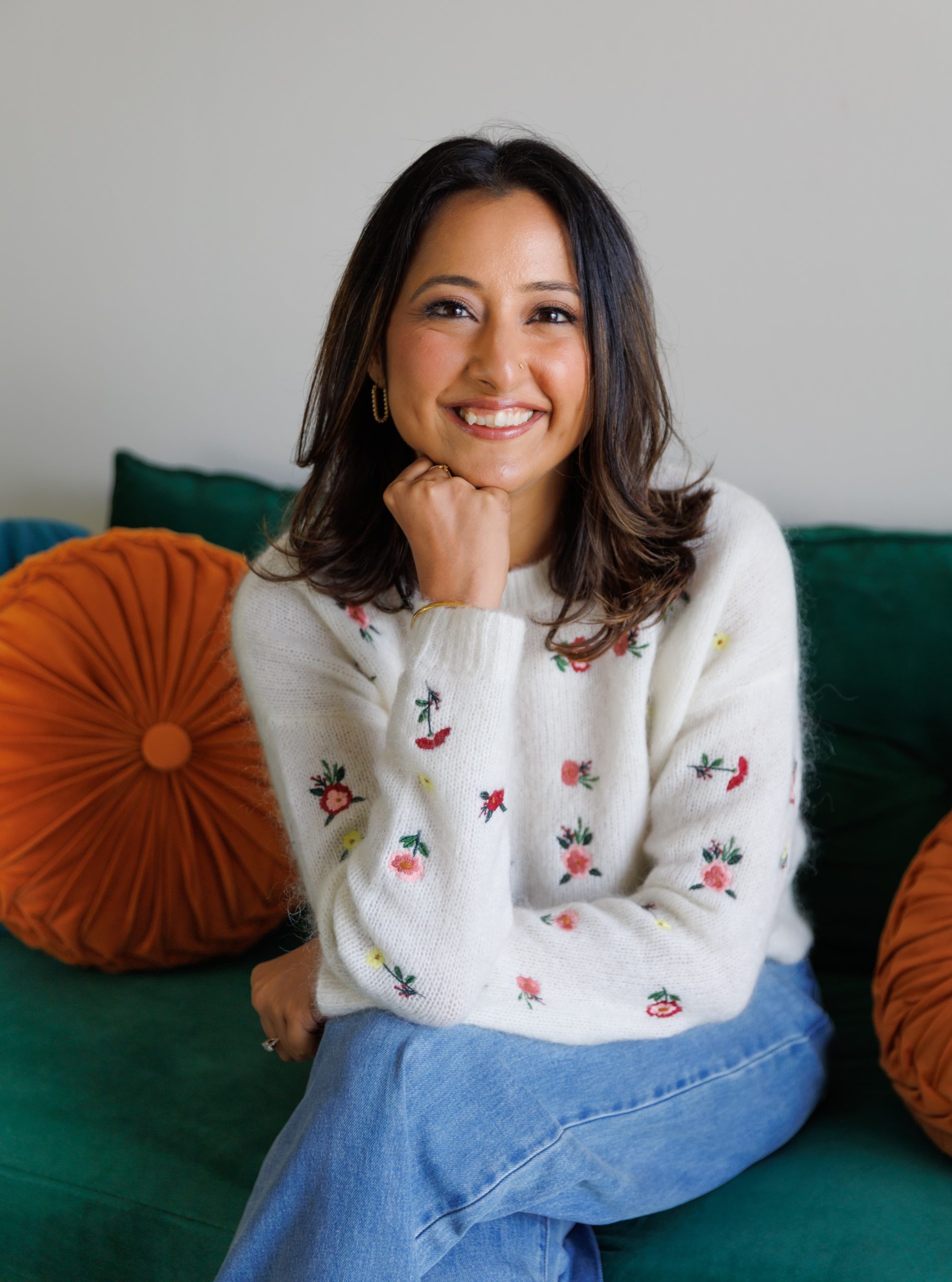
Preeti Vangani ends her poem, “Seyun Patata” with the line, “My mother’s silence clogs my throat.” While this silence permeates her collection, Fifty Mothers, through memories, family recipes, and old Bollywood music, she finds a way to unclog the unsaid and the unspoken. In this collection, Vangani pays tribute to her late mother, celebrating her life not only as a wife and mother, but as a woman who was learning to love herself in a society that fiercely rejects that idea for women. Even though the elegy is at the heart of the collection, Vangani plays with lyricism, repetition, forms, and sounds to make this collection feel alive, almost as if rewriting the narrative of the speaker’s mother’s death, the book a reality in which mother and daughter are very much still in active conversation.
We are introduced to the fifty mothers, the speaker’s aunts, a sea of women finding camaraderie in each other, through gossip, chaos, and sometimes, unkind words during fights between siblings. These fifty mothers appear in echoing vignettes throughout the collection, reminding the reader that the speaker is still surrounded by maternal figures, even though the void of the “original mother” is irreplaceable.
Then comes the body, and how it remembers as well as carries grief. In her poem, “An Apple a Day,” Vangani writes, “and which country do i belong to / if my country begins / with my body.” The poems in this collection map across the literal and figurative countries the speaker has journeyed through, from her childhood, young adulthood, to the narrative present. The body—encompassing chronic pain, embodied memory, laughter, stillness—is the speaker’s most constant companion, yet her biggest nemesis.
In this Zoom interview, we talked about grief, writing from a place of joy, nourishing oneself, and rewriting memories.

The Rumpus: The collection begins and ends with pages from the speaker’s mother’s journal, in a way framing these poems even before the reader has encountered them. What led you toward this choice, and what is your relationship to multimodality?
Preeti Vangani: The kernel of that idea of having images came from a close conversation with another writer friend of mine, Amelia Willoughby. We kept tossing around the word “remember,” “re-member” as in to give another life. I had already written some poems in my Gone Mother’s voice (there were a lot, three made it into the book). I was having a lot of fun doing this, because my mother was an extremely funny person, and that was a way I could bring her to life. Yet, I kept feeling like there was some distance, some aloofness, in the book, it was still sounding like me performing the mother’s narratorial voices. My friend asked me to keep pushing that idea a little bit more and actually bring my mother into the book. One of the keepsakes that I’ve always carried around with me—it’s been eighteen years now since my mother has passed—is one of her college diaries. It’s always been in the very frontal rooms of my memory. So, I thought, “What if I actually invited her into the manuscript?” I was inspired by Dear Memory and Beast Meridian, and started using the contents of the diary as tinder for new poems. There’s a poem in the book called “Unrewarding,” which talks about my father’s coin collection, and that particular erased coin was also part of the photos. But in the final iteration, the poems stood on their own as the image was not doing any nuanced or layered work, except for these two journal entries. The first page of the diary served as a peephole into the parents’ relationship, a woman stepping into a new love.
The first journal entry may have been from when my parents had just gotten back from their honeymoon. My father had corrected the previous entries, which I found whimsical, but also politically charged. It became an entry into setting the world of the book. For example, what is the time it’s set in? What kind of context are we talking about? What kind of marriage did they have? My hope was that this picture conveys to a reader that this is an arranged marriage. We’re looking at the life of this woman as a wife.
The diary entry that closes the book, and reads “You Must Fall in Love With Yourself…” has always struck me as my mother reminding herself to not abandon her own self—
the mother figure leaving us with a spiritual message. My mother was an extremely spiritual person. She would get really upset if she did not get her one hour of chanting every day. Something about me witnessing that, and her having written all of these things in her notebook, made me feel if she ever sends me a message from the other world, it would be one of these very clichéd, but necessary things telling me to move the hell on.
One of my mom’s sisters told me that my mother started having a spiritual understanding of the world pretty early in life. She was attached to a spiritual teacher, not in the commercial way people are now, and she would go to the temple every week for lessons from this teacher. It’s really fascinating; she wrote in her diary, “Vitamin A is Attention; Vitamin E is Endurance.” When I was growing up I thought it was so boring what she did, but now I am often in awe that she found her way into her inner self through these teachings. I love that, at one point, she just decided she must fall in love with herself.
Rumpus: Those photos also provide such important context for the Western audience, because it could be interpreted in many different ways, for example, did the father character literally rewrite his wife’s words?
Vangani: Yes, I wanted to be very explicit about that because at no point, was I trying to make him a bigger villain just for the sake of a narrative impulse. There is a lot of love in that diary—in one of the last pages, they were playing a game of dots and tic-tac-toe. It features a little in my first book, [Mother Tongue Apologize (RLFPA EDITIONS, 2019)] but I could see that they were having fun.
Rumpus: I am interested in the various kinds of sound in this book and how they encapsulate different relationships—from familial noise encapsulated in poems like “Frame,” multiple references to Bollywood songs, speaker’s parents’ relationship defined as an “unmelodious duet” in “Business School,” background sounds capturing the essence of Bombay— how do you approach musicality (or the absence of it) in your work?
Vangani: Because I came to poetry through spoken word and used to perform at open mics in Bombay, I had this imperative that the poem needed to be memorized to take it to the mic. Only then it would sit as a poem inside my body. I think a little bit of that instinct is still alive. After the first few drafts, I try to shut my screen or go away from the page. I try to recite the poem to myself over and over again, and in the reciting, the words often change, because they’re easier to remember that way because of sonic leaps. That’s how some of the sound gets worked in.
In terms of the theme itself, there’s repetition of conflict within the triangle of the mother, the father, and the child. Because it’s such a small nuclear unit, we come upon the same fight or conflict within the poem over and over again. Repetition really becomes important to me. But every time I encounter the same anger towards the same father, something has still changed. That’s where the idea of “unmelodious” comes in. Every time I’m approaching the same story, something is different by virtue of the passage of time or the physical space.
What is so wonderful about your question is the absence of music because the idea of landscape is very closely connected to sound for me, because Bombay is noisy. It’s a hundred pianos and three hundred trumpets playing at the same time, lending itself to a maximalism of sound and chaos. But writing in the landscape that I’m in right now—America appears once or twice in the book—invites the absence of rhyme and refrain. Even the “unmelodious duet” is kind of absent. What I’ve noticed about my poems set in America is that most of them have standalone paratactic lines and they’re clunky in the way they roll off the tongue. It’s a kind of unfamiliarity to this new geography that shows itself.
Rumpus: As a follow up, is there a song you find yourself humming to the most?
Vangani: In the context of this book, I used to listen to, and therefore sing, “Luka Chuppi” a lot. My first book was very haunted by “Fourth of July” by Sufjan Stevens. It’s such a hackneyed thing to say in the context of grief, but it really is one of those landmark songs. I was very attached to the raw heat of grief in “Fourth of July.” With “Luka Chuppi,” I tuned into something that I was not paying attention to previously—the song is a conversation between mother and child, and I became very interested in creating duets in the poems.
There’s a lot of fatigue in the “I” when you’re writing elegies, and I just wanted to disappear from the scene. I thought, “What does the duet of just mother and father look like?” The poem “Placebo” was an easy poem to write as if it had always existed within me, but the “I” was blocking it from existing on the page. When I removed the “I,” many new duets suddenly showed themselves.
Rumpus: There is a lot of conversation with and from the dead in this book, how do you balance writing about reality and reimagined truths?
Vangani: The problem with writing from memory and the gift, is that sometimes I experience “fact” as, I was there when this happened. That, to me, is pure crystalline fact. Reading my mother’s medical reports is a fact, or what the doctor said to my father is a fact. But how it has nested in my body over the years, and how I remember it off of the retellings is very different. Tainted with grief, the passage of time, and the temperature of retelling, the same fact keeps changing. Sometimes I’m interested in the distance between fact and imaginative retelling. But I’m also interested in why this story now. With “Fifty Mothers,” poems which appear in vignettes, I’m blending memoir and elegy. I didn’t want the memoir to sound flat and many vignettes didn’t make the cut because they were too rooted in reality. I don’t think I left them out because they lacked dramatic effect, but there was nothing compelling or entertaining or surprising about them that could handhold me to the tragedy that revealed itself in the final vignette. I think I go into exaggeration, humor, repetition, or taking a fact and then jumping into the imaginative portal to progress the narrative in interesting ways, which reveals something new to me that I perhaps didn’t encounter.
The poet Jan Beatty visited our MFA class several years ago, and somebody had asked a question about truth in the poem. She said, “You can change up any details you want. This is the poem. This is not your life.” She gave a small example: In our class, she was wearing rose tinted glasses, and in the poem she read to us, the glasses were blue. She said she changed it up for the sound of the poem. That was freeing! I think people have started reading poetry as memoir, and I think fiction writers also suffer from that kind of readership, where everything that happened to the character has happened to the writer as well. I want to continuously challenge that or mess that equation up.
Rumpus: I am so fascinated by the way embodied grief and chronic pain are always hovering in the background of the poems, heavily affecting social roles and relationships, even before the passing of the mother. How does grief and pain (both physical and emotional) inform the way you write about daughterhood?
Vangani: That’s a very deep and accurate reading of the book. My earliest memory of being in a house with my parents is somehow linked with the idea that you are not on your own time. There were periods during my early childhood days, when I found myself unrestricted by time, when my father was at work. I’m an only child, so I had the freedom of the accordion of time not even existing. But every time my father came back home, when his footsteps marked the stairs going up to the house, I would sense a kind of haste in my mother. That’s when things would begin to change. As I entered my teens, even a little before that, it was always, “Your dad won’t allow that; your dad won’t be okay with this.” Everything was a theory of constraints. It was not just my father, I think my mother was trying to be a good wife as well, so it would also be her final word. One of the biggest griefs in my personal life, not even as a daughter but just as a little child in this world, was learning that not all my time is mine. In fact, barely any of it is.
I’m a very slow processor and our tedious and competitive exam system in India, as you know, did not allow for that sensibility to thrive. Unfortunately for me, I started doing really well second standard onwards. Our school had the atrocious system of giving numbered ranks, and I was always the first. By the time I was nine, the equation in our house was: “Who feels happy when you come first? You, right?” It was always my mother saying that, because she was grappling with the fact that she’d never been a bright student and she’d come upon this entity who surprisingly loved being in school. So she put in all of her effort into making sure I was academically pushed. That really inverted my relationship with time, which was, “Everything needs to be done by Hour X.” That’s only in the academic context, but school is everything for the first 15-16 years of our life, and as I entered the outside world, it was the same value that got transposed to everything. In the outside world, you had friends, you had a car, but you needed to be back by a certain time to make sure you’re not scolded.
It’s a heavy grief knowing that my mother was bound by the theory of constraints—as long as we don’t piss off your father, I will allow you to be happy in all the ways you want to be. She never said no to me signing up for a dance class, a calligraphy class, or anything I would spectacularly fail at. She made sure I had the money for those. When I saw her struggle with constraints, I always thought, “Oh my God! I’m going to be the same way. This is going to be my future.”
Whenever I sit down to write a poem, it always comes from that constrained house where you cannot just express a desire, you have to know that there are going to be barriers.
Rumpus: How do you practice self-care when re-entering a place of grief for your poems?
Vangani: I genuinely love to write from a place of joy. I came into writing very late, but I read Ross Gay and Aimee Nezhukumatathil’s work very early on. I loved the freedom with which their lines unfolded, never feeling ashamed for excessive description or for taking too much time to get to what you want. That freed me.
In terms of self-care, I go back to the idea of giving yourself permission to take time. The other thing is, I’m very happy as a writer when I’m well-fed. I rejoice in making sure that I have taken care of myself by feeding myself before I start writing and after, too. The pleasures of cooking or going back to a recipe from my roots is as much part of the writing as the actual writing. I learned about being sensorially delighted in creative practice from Jane Wong; she teaches the idea of talking to ancestors via food, and I think of self-care as nourishment, and how I can nourish myself to nourish my creativity. Also, the smell of familiar foods is so wonderful. I think by virtue of not being at home, when I cook something my grandmother did or my mother did, it helps to close in on the distance.
Rumpus: What was a poem in this collection most difficult to write or revise, either emotionally or craft-wise? How was your journey with it?
Vangani: There is a poem called “Seyun Patata,” which is a dish made of vermicelli and potatoes. That poem’s original ghost is “Those Winter Sundays” by Robert Hayden:
“What did I know, what did I know
of love’s austere and lonely offices?”
I struggled a lot with my relationship with my father’s mother, my grandmother. As loving as she was to me before (and after) my mother’s passing, she wasn’t particularly kind to her daughters-in-law, or even her own children, and it’s always been a hard relationship to navigate. My grandmother was also very instrumental and vocally present to push my father to marry again, very immediately after my mom’s passing. I cannot let go of her love because she has also passed, and I cannot let go of my mother’s anger for her, and of course, my anger is entwined in that. In that poem [“Seyun Patata”], there is a section where, once we come out of the kitchen, I contrast the idea of Bollywood being so superfluous with the usage of love and the house by contrast, is so anemic in expressing love.
It had a portion where I kept knocking against the idea—What is the point of writing elegy— and the famous W. S. Merwin poem, “Elegy”—“Who would I show it to.” I kept knocking against this line, “no elegy can make my mother a victor, or winner, or alive.” Then it leapt into the philosophical, with the poet telling the reader about writing elegies, which I think is an instinct every poet has, to knock the reader over with our emotional wisdom. I was sending this poem out and Kirun Kapur, at Beloit Poetry Journal, wrote back to me because I had submitted it to the Adrienne Rich Poetry Award. She told me I hadn’t won but that they loved the poem, and (very respectfully) added, “Might I suggest a minor edit?” She had picked out the parts that were overly prophetic and asked me to consider ending on the line, “My mother’s silence clogs my throat.” It really resonated with me because it’s a poem that has no end, hovering around the same discomfort. That edit, however small, taught me that it’s okay to sit with that discomfort, and that not every poem has to have an epiphany. It’s okay to not drop the mic.
Rumpus: And lastly, what came first—the poems or the title?
Vangani: I love talking about this! “Fifty Mothers” is the last poem I wrote in this book. There were two other versions of this manuscript without “Fifty Mothers,” and it was called something else. I wrote “Fifty Mothers” in my notebook thinking I was writing a short story, and the image in my head was all these women in their balconies, continuously hurling at each other, about each other, and I imagined all my aunts in a chaotic chorus.
Once I finished writing it, it was only about 2200 words, and read more like a lyric essay than a short story. I sent it to AGNI and they published it as nonfiction, and it existed in the center of the book as an essay.
Then I worked with a wonderful editor, Diana Arterian from Noemi Press, who suggested it would be great if I cut these vignettes up and threaded them throughout the collection. Brilliant idea! Now, for me, the book had a silver thread that held it all together.
Even then, the title of the book had not changed. Until I was talking to my teacher and friend, D. A. Powell, about being stuck with a bland title (it used to be called, Ministry of Less) as well as having an essay in the middle, and he said, “Fifty Mothers is a great title for a book!” It was truly collaborative. River River Books must have been the first or second press I had sent this particular iteration to, and it resulted in a “Yes.” In hindsight, that must have made all the difference.