Being half Irish and half Filipino makes you roughly five-thousand percent Catholic, so my parochial school education began in kindergarten. My class was small and tight-knit, the same thirty or so kids all surviving our First Communication, first Confession, and first awkward Spring Social together. And every year, we sat through the same performance by the Sheila Tully School of Irish Dancers.
Most of my classmates were white —not just white, they were Irish, which felt like a very specific kind of white that meant you were God’s secret favorite. I lived in a world of Annes, Bridgets, and Seans, McNallys, MacAuleys, and McConnells. Multiple girls from my class took lessons at the Irish Step dancing school and got to perform in the annual recital held in the school gym on St. Patrick’s Day. As I watched the girls dance across the stage in flouncing skirts, curled hair bouncing on their shoulders, I desperately wanted to learn Irish Step dancing. It was a Popular Girl thing to do at my school, and I ached to be on stage instead of sitting in the audience. I’d do my own made-up version on the kitchen tiles at home, slapping the soles of my feet in a random staccato until one of my parents told me to quit it. When I begged my mom to sign me up for dance lessons, she said it was way too expensive. What I heard instead was “You’re too Asian-looking.”
Year after year, I’d sit cross-legged on the varnished gym floor, waiting for the recital to start. The troupe of dancers streamed through the double doors from where they had been waiting in the hallway; hours later, I’d still smell Aqua Net lingering in the air while headed to homeroom. The girls walked down the aisle toward the stage in perfect synchronization, all in a line with toes pointed and hands delicately clasped as if they each held a precious pearl.
The teacher pressed a button on a boombox, and traditional Irish music filled the gymnasium. The reel began. Matching the upbeat rhythm of the fiddles and pipes, the dancers moved into various formations, arms held stiffly at their sides in contrast to the blur of their feet. They looked like they were floating. I was obsessed with their costumes; I wanted a sash embroidered with Celtic knots and a flared velvet circle skirt. (This is likely when my lifelong obsessions with highly specific uniforms began.) I wanted a headful of bouncy curls and to be able to move my feet in the same light, agile style. I wanted to be Siobhan from my class, who was always the focal point at the head of the reel while the other dancers fanned out behind her in a V. She had the most luxuriantly wavy red hair I’d ever seen and a uniquely Irish name that felt more worldly than my own.
I don’t even know why I wanted these things so badly, other than the chance to dance in the annual recital. Maybe I thought that if I looked and moved uniformly like the other girls, I would feel less awkwardly shy. I was the kid who was first to turn in pop quizzes and last to be picked in gym class. Parents read my quietness as “well-behaved,” but in the eyes of the other kids, I was a nerdy dork. If I could blend into a line of graceful dancers, I would feel like less of a social outcast. Less different.
In my late thirties, I ordered a DNA kit off the internet. As I filled a test tube with spit, the instructions of the DNA kit spread out like a treasure map on the coffee table in my Chicago condo, I wondered if my ancestors were watching. Their DNA traveled for centuries across continents and oceans, threading its way from the Irish countryside, the icy tundra of Sweden and the tropical shores of the Philippines to reach this moment, where I, a nearly middle-aged woman in a Star Wars sweatshirt, have become a vessel for my family’s legacy. This test would confirm where my ancestors first came from and the paths they took before planting their roots near the shore of Lake Michigan. I knew the stories, but I craved some sort of proof.
On my father’s paternal side, an old family letter taught us that my great-great-grandmother Hedwig was born on a farm in the late 1800s in Osby, Sweden, before making her way to America alone at age fifteen. She spoke no English but wore two translated notes pinned to her coat—on the outside, her aunt’s address in Chicago, and inside her jacket’s lining, a warning, “Mind your business.” When I was thirteen I couldn’t figure out how to ride a city bus alone, let alone immigrate to a new continent. The first time I heard this story, I was awestruck; the thought of inheriting even a small bit of that resiliency made me think maybe I’m capable of more than I realize.
I know less about my father’s maternal side other than the family legend that my great-great-grandfather was from Dublin, got involved in the IRA, and fled to America after killing an Englishman, where he settled in Chicago and became a cop. My dad, who has had a lifelong anti-establishment streak since joining a motorcycle gang called Sunday Drunks as a teenager, likes to say that we are descended from a long line of horse thieves.
My mother’s side is easiest to trace; she and her parents resided in Quezon City near Manila in the Philippines until 1960. When my mom was twelve, her uncle took her and her brother to an Elvis Presley movie followed by ice cream. As they enjoyed their ice cream cones, he asked “How’d you like to move to America?” and then dropped them off at the harbor. My grandpa stood waiting for them on the ocean liner, their clothes already packed and stowed aboard. My mom never got to say goodbye to her friends or her childhood home. When I ask her if it was hard, she shrugs it off. Mostly, she was excited to move to the land of Hollywood, winter snow, and Frank Sinatra. The decades have eroded the memories she didn’t want to retain.
A few weeks after I sent in my DNA test, the results that arrived by email confirmed my parents’ stories. I am fifty percent Filipino, thirty-eight percent Irish, and twelve percent Scandinavian. I could have saved myself a hundred bucks, but there was something validating about seeing those results in a color-coded pie chart on my laptop screen, a firm rebuttal for every time I’d been questioned for not looking enough like any of the heritages I claimed. Still, I craved more information. Beyond the chart, bar graph, and genome structure, I wanted the stories. I wanted to feel more connected to a culture and history, just as the Irish-American girls in the Irish Step Dancing show seemed to be.
I stood next to my younger sister Lauren at the check-in desk in the front of her dorm, sweaty, disheveled, and dehydrated after the three-and-a-half-hour flight from Chicago to Phoenix. I was visiting her at Arizona State University for a long weekend and sharing her dorm room while her roommate was away. I had just moved back home to Chicago after spending my junior year of college in Las Vegas; it was the Nelson sisters’ southwest era.
The resident advisor looked at Lauren, then me. “Sorry, only family members are allowed to stay overnight.”
“This is my sister,” Lauren explained.
The resident advisor squinted at our faces in disbelief. “Nice try, but sorry, I can’t let you stay here.”
Lauren and I looked at each other anxiously. We had no contingency plan if I wasn’t allowed to stay in the dorm. “Umm… We are sisters?” I reiterated, my voice rising in panic.
“Do you have any ID?”
I pulled out my wallet and handed over my state ID, which the resident advisor compared to Lauren’s student ID. “I promise you we’re sisters.”
“Oh wow! You two do sound exactly the same,” she said. “And you guys have the same parents?!”
“Yes.” It didn’t occur to us to push back against that inappropriate question, or to point out the multitude of ways family can be created.
At eighteen, Lauren fit the perfect teen millennial aesthetic—highlighted blond hair, an athletic build that could pull off tube tops with low-rise jeans, and a crew of popular friends. Meanwhile, I was three and a half years older, painfully introverted and swarthy, with a body that reacted to young adulthood hormones by thickening through my torso and thighs. My dark brown hair absorbed the Arizona sun, creating a sweaty toupee. I had no clue how to apply liquid eyeliner (still don’t, honestly). I was probably wearing baggy cargo shorts to better conceal my thigh meat.
My three younger siblings and I all land on different points of the ethnically ambiguous scale, like a stock photo of a business meeting. When I was little, I was a photogenic Asian baby—a touch of gold to my skin, black eyebrows over half-moon-shaped eyes, glossy dark hair. My sister Lauren, immediately preceding me, turned out fair, baby blond, and blue-eyed. When our mother answered the door while holding her, strangers would ask if they could speak to the lady of the house.
When we were past toddler age, my mom took us shopping in Chinatown on the south side of Chicago. A store owner marveled over Lauren and said to my mom “She looks like a Chinese movie star!” From a young age, I learned that white beauty standards were the world’s currency. Female representation in pop culture was limited, and representation of girls and women of color was even more sparse. Blue-eyed blonds got to be the heroine, like She-Ra, Rainbow Brite, Barbie, and even Smurfette. I felt increasingly frustrated that there were so few girls on TV who looked like me. When Disney’s The Little Mermaid came out in 1989, I decided I was spiritually a redhead. I’m part Irish, after all.
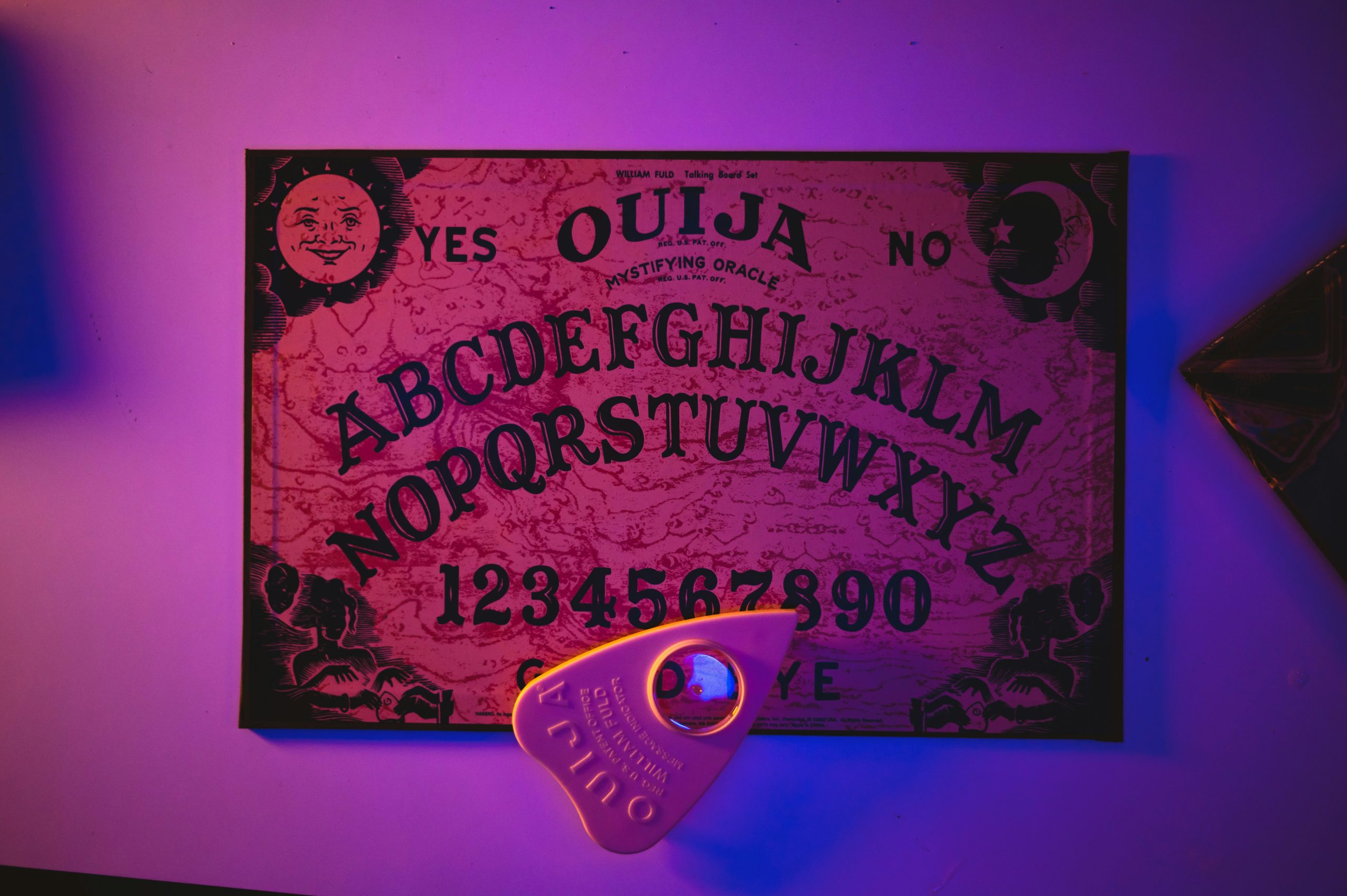
In seventh grade, the girls in my class got really into ouija boards. We gathered around the coffee table at someone’s house—probably Ann’s, Anne’s, or Annie’s—kneeling on the floor with the lights off, our fingertips resting lightly on the plastic planchette. We’d gone around the circle asking the ouija board who had a crush on each of us, and it was my turn. My little rabbit heartbeat pitter-pattered beneath my Gap sweater, my face flushed, glasses slipping on the sweat beading on the bridge of my nose.
“Who from our class likes Kim?” one of the other girls intoned in her spooky psychic voice. Underneath our fingertips, the planchette began to slide across the board. We read aloud each letter in unison: “M….a…”
My heart dropped into my stomach in disappointment. I knew where this was going.
“R…C!….O!… it’s Marco!”
Of course they chose Marco for me. I sat back on my heels, deflated. My friends meant well, but they’d chosen one of the handful of Asian boys from our class as my purported romantic partner when they knew I secretly liked Shaun, a tall, popular jock totally out of my league. Nothing against Marco—he was nice, but just as shy as I was, and I doubted he had any interest in me whatsoever. The girls in my class had a history of pushing me toward the other Asian boys during school dances or Couples Skate at the roller rink. I understand that this was the early ‘90s, when it was normal for blonds to only date other blonds, and ditto for brunettes, or at least this is what was taught to me by movies like Weird Science and Bill & Ted’s Excellent Adventure. But it made me feel pushed into a box by my own friends who were supposed to know me best. It reinforced the fact that I was seen as different, just like the wrinkled noses and side eyes if I brought shrimp chips or puto, a Filipino dessert, instead of Twinkies or Zingers in my lunch bag.
To be more like the other girls, I decided that my type was the most basic all-American white boy in school. I’d lose my mind over a towheaded teenager in a Dave Matthews Band tie-dyed t-shirt and fleece jacket. Does he play lacrosse? Even better! You say he drives a Jeep Cherokee? I’d found my newest dream boy.
Decades later, I’d speak about my basic white boy phase to my mixed-race friends and other women of color and discover that they went through the same thing. We’ve laughed the kind of belly laughs that come from a deeply buried place just peeking its head out now, deciding it’s safe to emerge. We’ve cackled until our eyes water and our abs hurt, sharing our adolescent desires that now seem so clumsy and obvious. We couldn’t help but be drawn to a type we felt rejected by.
Another thing that my biracial friends and I would commiserate about is when strangers insist upon playing the ethnicity guessing game. My ethnic ambiguity acts as a Rorschach test. I’ve had strangers insist to me that I must be part Latina, or Malaysian, or Brazilian, or Native Hawaiian or Alaskan. After a lifetime of comments, I have a visceral reaction to the word “exotic.” Sometimes when I tell people my background, they reply “What a cool mix!” like I was purposely engineered like a labradoodle or a liger. I like to log into my DNA test results just to stare at the highlighted map and wonder how these wildly different parts of my ancestral makeup manifest in me. Is this why I crave the solitude of cold northern climates despite my extraordinary tanning abilities? I yearn for a connection to a homeland, to feel my roots sunk deep into the soil, to tread the same routes as my ancestors. At twenty-five, I emptied my savings account to go backpacking through Ireland with friends. When I walked the cobblestone streets along the River Liffey, I searched for any familiar feeling, as if I could tap into any ancestral memories. Instead, I ended up getting day-drunk in the oldest pub in Dublin to the point I accidentally used the men’s loo.
Sometimes my American name and light skin prompt people to say, “Oh, I didn’t know you were anything.” To be biracial is to be stuck on a seesaw teetering between othering or erasure. Any lack of stereotypical Asianness in my face makes up for itself in my terror of coming across as anything less than polite, so I have always felt the need to fully explain my parental heritage lest anyone think I’m claiming too much. I agonize over which skin tone to select for an emoji. When I played roller derby in my early thirties, I traveled to Philadelphia for a weekend tournament of pickup games where skaters signed up for silly themed challenges. I entered my name for a game of Asian vs. Latina skaters, cheekily dubbed Rice vs. Beans. As I introduced myself to each of my fellow teammates, I blurted “I’m half Filipino,” getting ahead of anyone questioning my right to be there.
Sometimes it feels like the history closest to me is the furthest out of my grasp. I’ve been extremely close to my mom for my entire life, but during my childhood I rarely heard her talk about her life in the Philippines. When I’ve grilled her for stories, her memories are mostly images and emotional vignettes.. She remembers taking weekend trips to the base of an active volcano where she and her family ate picnic lunches off banana leaves. It’s the sensory details that stick with her the most—the feeling of the breeze through the open windows, the sound of birds in the jungle, the ghostly image of bed sheets draped over the mirrors before a thunderstorm. She remembers the American GIs driving their jeeps through town on muddy streets, their gregarious laughter and their tallness. Someday in a city on another continent, she’d meet the tall blond, blue-eyed American man that became my dad.
My mom is perhaps the most resilient, adaptable person I know, unflappable at a near superhero level. I’ve asked her what it was like to be an immigrant at twelve, an already difficult age. For a teenager thrust into a new country and culture, the surest path to social survival meant acclimating as quickly as possible; my mom seized upon American teen culture and became a Beatles fanatic, still her favorite band to this day. In high school, she sewed a secret pocket into her Catholic school uniform skirt so she could hide her transistor radio and listen to the Beatles all day. She chose an American nickname (Tracy), shortened from her given name (Maria Teresa), and different from her family’s Filipino nickname for her (Jing Jing). When I ask her if it was hard to move to a new country, she lightly shrugs it off. The difficult days are sanded down by time. Instead, what she remembers is the thrill—seeing the Beatles play at Comiskey when she was seventeen, roaming the stockyards looking for the band’s limo. Or venturing to a tiny club in the suburbs and seeing The Who before they got astronomically famous. Wearing sixties mod fashion and high heels in the city, before returning home and her mother sneaking her a sweater to cover up before her dad saw her. My mom embraced the culture of her new home with open arms, a love of music and film inherited by all of her children.
Sometimes my friends will ask me the name of a particular Filipino food, and I embarrassingly admit that I don’t know. “Growing up, we just called it Filipino steak.” I’ll then wonder what my mom called it when she grew up eating it in Manila. The gap between the first and second generation can sometimes feel a mile wide. I craved a better understanding of that part of myself, a bridge across the gap.
My most formative culture is American, specifically Midwestern. I’m a child of flat landscapes, cornfields, deciduous forests, and church casseroles. I grew up eating Lunchables and wearing Rainbow Brite t-shirts, following my mom through big box mall stores. I’ve lived a life of suburban comfort, and I shouldn’t be ungrateful about any of it because my grandfather literally hid in caves for months to survive World World II. I didn’t have to overcome a language barrier or make a harrowing trip across an ocean at a young age. I was gifted this existence where I’ve never gone hungry or hidden from enemy soldiers in the jungle, and the most I’ve done with this privilege is secure a mid-level HR manager job and see Britney Spears’ Vegas show twice. I never had to learn a second language but I became fluent in sitcoms. The high school cafeteria, once the bane of my existence, transformed into a safe space where I’d spend my lunch break quoting as many lines as I could remember from the most recent episode of The Simpsons with other like-minded geeks. My ancestors likely didn’t foresee that their perseverance and sacrifice would culminate in a descendent like me whose talents peaked with her Game of Thrones season seven recaps.
The thing we crave the most from our ancestors is their stories, to better understand the way those stories connect to our own. Sometimes the stories are straightforward, penned in heirloom family letters. Other times, they are hints woven into our DNA, things we instinctively learn from our love of water or snow. Sometimes it’s the dark hair that we fight throughout junior high, holding down the front line with stinging bottles of Nair removal cream or Clairol dye, until we grow up and learn to cherish the dark chestnut burnish of it in the sunlight.
In my thirties, I worked in a downtown Chicago highrise office building. Around the holidays, the property management company planned festive events in the lobby for tenants to enjoy as we headed back from lunch or meetings—carolers at Christmastime, a hot dog cart on the first day of summer, candy hearts on Valentine’s Day. One year on St. Patrick’s Day, as I exited the elevator bank, I heard the lively sound of traditional Irish music, accompanied by the rhythmic stamp of a dozen dance shoes against the floor. In the lobby in front of the floor-to-ceiling windows and backdrop of the Chicago River, a dance troupe of middle-schoolers performed a traditional Irish reel. I recognized the name of the dance academy on their display banner—the same troupe that performed in my grade school gymnasium. I could almost smell the Aqua Net again.
Amongst the bouncy blond curls and freckled redheads, a little Asian girl danced in sync with her classmates. Her face reflected intense concentration and her shiny black hair was pulled into a high ponytail hanging pin-straight down her emerald green cape. She looked younger and smaller than most of the other girls and was placed in the back half of the formation, far from the lead, but I couldn’t take my eyes off her. My heart swelled. I felt so proud of this little stranger who had fulfilled my own childhood dream. I wondered how she got into Irish Step Dancing, if she also had a blended heritage. Perhaps she was growing up like me, with a family spread across two sides of the city, holidays spent eating lumpia and adobo on the Northwest side followed by mashed potatoes and Swedish meatballs on the South side. Two cultures bridged by the Kennedy Expressway.