Most vegans have an origin story, usually a series of moments they condense into an explanation as to why they gave up meat and dairy. I was vegan for twenty years, and only recently started eating (local) eggs, but I still have my pat narrative: once upon a time there was a dreamy punk rock barista who taught me about factory farms; I became vegan for the animals, but also for love. It was a life changing decision, one that set me on a path of approaching food with deep and abiding intention. It is no wonder I am drawn to the work of Alicia Kennedy, the vegetarian writer who has built a career examining the many intimate and collective elements of food.
In her new book, On Eating: The Making & Unmaking of My Appetites, Kennedy tells the story of her life—and stories of the lands where she’s lived it— through food. Each chapter explores moments of self-revelation as they relate to different elements of her diet: apples in Long Island taught her that food comes from the ground and not the grocery store; Fair Trade chocolate presented a path to understanding collective politics; mushrooms gave her now-husband an excuse to talk to her for the first time; martinis revealed the labor process of distillation and also offered a portal to talking to her mother about her brother’s death.
With a popular newsletter, From the Desk of Alicia Kennedy, and over a decade of experience in journalism, Kennedy is known for astute criticism that insists on contextualizing food through a political and socioeconomic lens. In On Eating, we get plenty of sharp analysis—a feminist unpacking of domesticity, an anticolonial lens on water consumption, for example—but we also get gorgeously rich prose. This book is a testament to the adage that ‘the personal is political,’ and it is also proof that the telling of a politicized life can be done with lyricism and tenderness. Kennedy reminds us that food doesn’t just appear, and that we have to be accountable to the sources of it: to the hurting Earth, to our loved ones in the kitchen, to the workers in the fields. “I am pessimistic about the future,” she writes, “but I am deeply committed to the present, to making each day and every meal count: delicious, beautiful, and done with care.” This proclamation feels like an invitation for all of us.
I spoke with Kennedy about shifting deeper into memoir writing, how food contributes to the social construction of gender, the nuances of consumer politics, climate denialism, and how she navigates writing about—and being regularly asked about—the grief of losing her brother. This interview has been edited for clarity.
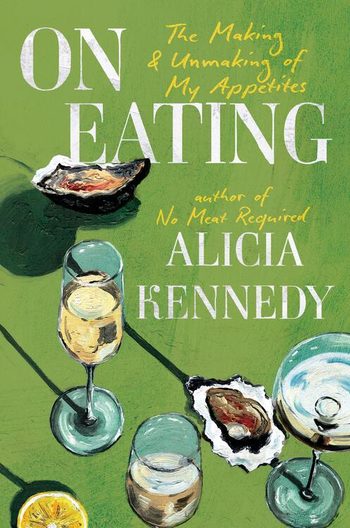
The Rumpus: Your first book, No Meat Required (Beacon Press, 2024), explores a history of vegan and vegetarian culture, with stories from your own life just lightly sprinkled throughout. You mix criticism, analysis, and sometimes personal essays in your newsletter. On Eating is the most memoir writing you’ve done in one place. What did your process look like for shifting into more personal writing?
Alicia Kennedy: I’m always present in my work. My “I” is strong in everything that I write. But I don’t like to be the subject, necessarily, of my own writing. So this book was about merging where I’m present and I’m subject. Memoir isn’t diary, and it’s not confession, but this is the perspective that is more present in my private writing than it is ever present in my public writing. I think it’s useful that I’m doing that in a book that was very rigorously worked on with a great editor who really understood me. I don’t feel “xoJane”-y about it. I gave people a version of the private self that I feel comfortable with, and I also gave them me as a food writer.
The chapter that was the hardest for me to write was the bridge between my childhood and my adulthood, because it’s very much a liminal space of my life that I never processed. I’ve processed my brother’s death more than I have processed the relationship that I was in for eleven years, because my brother’s death was something that was unavoidable to deal with. I couldn’t go on living without constantly thinking about it and writing about it and talking about it. Whereas that relationship… people don’t give us the space to deal with that as much.
So I just hadn’t processed that being a thing I did—to stay in a relationship for eleven years when I was very young. And that being very against all of my instincts and desires as a human being. So that was the most difficult thing for me to untangle in terms of writing memoir—just being like: “This is a thing I don’t even understand myself.” And I’m trying to convey it to people in a way that makes sense, but I still don’t think it makes sense, and it wouldn’t make sense, because a lot of the time, we do things that don’t make sense as human beings. And I think, for me, reconciling that with the memoir was the most interesting thing.
Rumpus: You write beautifully about the role of food in the social construction of gender. Will you share more about how your sort of defiant relationship to eating contributed to how you understood your own girlhood? Also how does food relate to the patriarchal foundation of contemporary politics?
Kennedy: I grew up watching Margaret Cho, Jeneane Garafolo, and Daria. I constantly think about this Jeaneane Garofalo standup special where she says, “a pretty face is in this season…as opposed to last year when back fat was all the rage.” So that’s been in my head forever, like: there is this thing called patriarchy, and it’s bullshit, and we try to kill it. And the people who still uphold its structures are assholes. But then when I got to high school, I remember being in the bathroom and girls talking about their waist sizes and their weight, and I was like, “We’re still doing this?” I thought this was over.
And I also grew up loving food. My happy place was eating. You were never going to convince me that “nothing tastes as good as skinny feels.” That was just never going to happen. And I kind of butted up against the fact that, ”Oh, people do think about these things in gendered terms.” Appetite is gendered: how much you’re allowed to eat, and how much you’re allowed to be seen enjoying your food is gendered. And I thought, “I can sort of break down these patriarchal food norms if I just eat steak all the time or whatever.”
So when I started to explore veganism, it alienated me from all mainstream food culture, and I couldn’t believe that there would be such strong animosity toward that. I’m vegetarian now, but being vegan is one of the most important decisions I have ever made in my entire life. And it determined everything about my life that came after. But I would write about food and just realize that no one in the food media world took vegetarian or veganism seriously. And I also realized it was considered feminized to be vegetarian or vegan. Trying to untangle all of that was really generative for me.
It’s always been a constant uphill battle to get people to take it seriously, and especially in the US where we have a lot of climate change denial that is mainstreamed. I don’t think a lot of progressive people understand just how deep their climate denialism is because they have this sort of imperialist mindset around how they live. It’s still gendered, and it’s still alienating me from other people in food media, and it is still just abnormal to write about not eating meat.
There is something about this consumption of meat, obsession with masculinity, obsession with domination, and dominion over land and animals—and the way in which that’s entwined with patriarchy—that people are just so unwilling to grapple with. It’s very American, too, because when I’ve been in Europe, there’s just a sense that they know this is real. But in the US, climate denialism is part of everything.
Rumpus: Between the genocide in Palestine and ICE raids in the US, there has been a resurgence of attention to consumer politics through boycotts. Some people critique the idea of “voting with your dollar” as putting too much responsibility on individuals when it’s really corporations and larger systems of power to blame. I really value how you write about this question in this book. Can you talk about how you approach individual responsibility alongside the need for structural change?
Kennedy: The thing is that your individual behaviors are part of how you perceive your role as a member of our collective human race. I hope we’re getting away from the idea that there’s no ethical consumption under capitalism. I think we’re starting to understand these behaviors are concentrating wealth in a very dangerous fashion, and they are not good for us. They’re not good for workers, et cetera. I think the visibility of Amazon workers and their specific struggles are having a real impact on people, I hope. People are starting to realize that it’s not harmless for me to say “I need this laundry detergent at four in the morning.” People are realizing that we have to have some sort of solidarity as human beings with each other, and we have to be thinking about class struggle. We’re also in an economic moment where even people who are making what used to be good money are—I know this is not a sympathetic point—but things are getting so expensive that it’s just absolutely horrifyingly difficult.
So you have a decision to make: you can go full nihilist about it, and just be like, “I need to get mine, whatever it takes,” or we say, “Hey, actually, all of us who aren’t fucking millionaires or billionaires have to have some solidarity with each other.” What forms that solidarity takes, and what it looks like, are going to be different for everybody, but at the same time, the choices that we make every single day add up to something. Anyone who has ever been vegan understands that. The choices we make every day are about trying, however fruitlessly, to do less harm.
I am not a perfect person. I have so many plastic pens! And Apple products and makeup from Dior. But I think people are also coming to this understanding that it’s an over-consumption issue. I don’t think individual behavior is the end-all, be-all, but I do think individual behavior doesn’t occur in a vacuum. So how can we just take a step back and say, ”Oh, hey, do I actually need this?” Or, “How can I buy things in a slightly better way?” It sounds silly, but it’s also just the easiest way to start people’s mindset shift toward that solidarity and toward thinking more collectively.
When people make a decision that is in alignment with the world they want to live in, that
feeling of being in alignment is politically useful. We have a small grocery store in the neighborhood that actually sells local produce, and it’s nice, you know? I can support local farmers and support a small business; I go there and I see people I know, whereas in the supermarket, I mostly see tourists. I think that’s an undersung element of this: when I go to the farmer’s market every week, I know those farmers, they know us—they know that we like the squash blossoms, so they throw us a bag of them in, on occasion. You’ll get told that these things don’t matter in terms of sustainability, but in terms of creating community around our choices and what we do…It does matter, and it does have an effect.
Rumpus: This also reminds me of how you talk about coffee in the book. After describing the sweet daily coffee routine you have with Israel and Benny at your neighborhood kiosk, you write: “Caffeine might make adult life and productivity under capitalism possible, but it also makes for moments of slow serenity and spontaneous community. Rituals have purpose; we just have to own their narratives and our time.” Can you talk more about the value of ritual?
Kennedy: I really wanted to write about the feeling of fear that comes with the impending loss of these things that are so essential to life. I just saw someone say they thought alcohol and caffeine will start to become irrelevant in the future. And I’m like, ”No, they won’t, because we’ve had them for centuries, and we love them.” I think being in Puerto Rico has changed my perspective on the significance of getting coffee in the morning, because of course I could save money if I didn’t go get coffee every morning. But I also wouldn’t see the people who serve me the coffee and the neighbors who are at the cafe every morning. So it’s just changed my relationship to these spaces and these acts—not purely just about the function of them, but about the ways in which they root me and deepen my relationship to my neighborhood and to where I live.
Being rooted in my neighborhood has made my writing better because I listen to other people who aren’t on the internet. I listen to people who have very different perspectives on the world, and sometimes I hate people that I’m neighbors with, who I see at brunch or at the bar, because they’re assholes. But a lot of the time, it’s useful for me to be having friction with people who are just coming at life so differently. That’s so useful and so necessary.
And that’s a thing I fear people are losing, just that ability to be around people who are different from you. Where you can have a good relationship with a neighbor, even though you don’t see eye to eye on political things. Those are important things to have, and I think that I have them so much because of the nature of the neighborhood where I’ve been living for the last six years, but I also have them because of the rituals of coffee and the rituals of going out for a drink. And the ritual of walking my dog is very important to all of this.
This is why I have such strong feelings about making consumer choices in alignment with the world we want to live in, because for me, making those choices has made my life a million times better, and has made my thinking a million times better, and has made every small day of my life a million times better. I think we have to find the thing that makes us be rooted and connected to other people.
Rumpus: So much of this book is about grief. You write about losing your grandmother, your brother, and also about climate grief. Can you talk about navigating writing about loss and also knowing that you’re going to be asked to talk about loss over and over while you’re promoting the book? Are there things you’re doing to take care of yourself or take care of your relationship to those losses?
Kennedy: I understand that people are going to ask about it. When people die, you don’t stop having a relationship with them and a conversation with them. I’ve never actually said this, but my mom went to a medium after my brother had passed, and I had just published an essay about my brother and oysters, and I’d gotten an oyster tattooed on my arm. The medium said to my mother, “Someone is writing about someone, and there’s something about oysters.” And who knows about the reality of these things, but that did happen, and that for me, felt like permission from my brother. Not that I needed it, because also, he’s my brother, so I would be like, “Fuck you!” And that’s the relationship I miss having—the TikToks that are most likely to make me cry are about how brothers will just randomly throw you against the wall. That sounds very violent, but for people who have brothers, it’s like, ”Oh, he randomly put me in a headlock,” or whatever, because that’s how boys are taught to show their affection.
So I have a good relationship with the fact of writing about my brother, and I’m never going to be done with that. But I also think it’s really important because so many other people have lost siblings, and they have lost siblings to overdose. Once, someone who teaches teenagers told me she had a student who didn’t know how to talk about losing her brother, and she gave her my first oyster essay. And she wrote about food and grief, and she wrote me a very nice email about how she didn’t know how to do this, and she didn’t know how to talk about it, and then food gave her a way of talking about it. And I get a lot of feedback on that essay still, where people are like, ”This adjusted how I think about grief.”
So I want other people to feel comfortable talking about their loss, and I don’t feel ashamed that my brother passed from an overdose, and I don’t want anyone else to feel that way either. It’s such a common thing. So I just want to make it feel possible to talk about and for people to feel less alone: It’s very important to me.