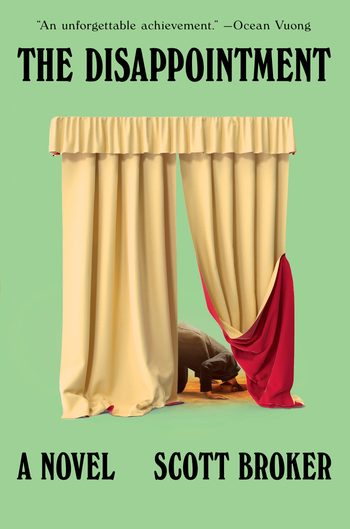
What exactly is “the disappointment” in Scott Broker’s debut, the equally dreamlike and bracingly insightful The Disappointment? On first read, it might be Jack himself, who has given up his career as a playwright, after deciding he’s incapable of achieving his artistic or commercial ambitions. This decision plunges Jack into a terrible, destabilizing grief—until his mother-in-law dies, and his husband Randy, a famous photographer, is overcome with despair. Now Jack must take the reluctant lead, even though he doesn’t know how to help Randy, who carries his mother’s ashes everywhere.
The two agree to a vacation in Florence, a small town on the Oregon coast, where they borrow a home of Randy’s devoted-fans-turned friends. Jack hopes to renew their intimacy, but Randy insists on bringing his mother’s ashes—and trying to communicate with her. As they move through the strange town—with its tantric-cult graduates, a neighbor always trying on new identities, the tunnel under the house—Jack is ultimately forced to confront his own fears, desires, and mistakes.
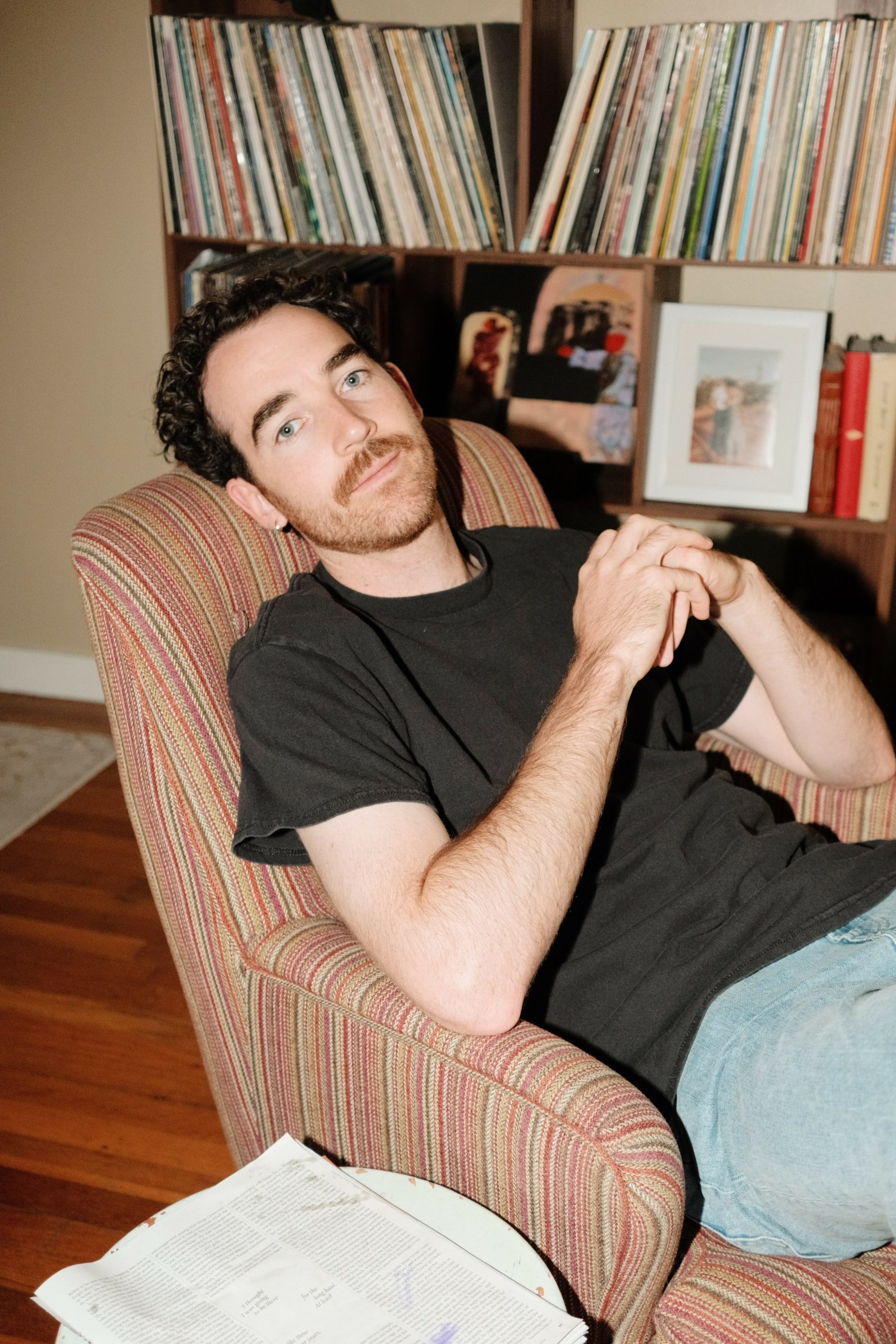
I caught up with Scott Broker over email to talk about structuring a character’s inward journey; how to have a healthy relationship with our own art; and if we can ever really know the people we love.
The Rumpus: The setting is grounded in physical reality—everything that happens in Florence could happen in real life—yet Jack’s experience there becomes increasingly dream-like, giving the novel a mythic tone. Some characters in particular feel like archetypes: Abigail, who’s always in or near water, and can speak to the dead; Carolina and Shelby, who reappear throughout, to serve Jack with stories and food and transportation; and Mr. Steve, who looms over the town. How did you develop these characters, and how do they fit into Jack’s journey?
Scott Broker: I wanted the novel to feel like it was in constant flux between reality and unreality, as this state felt truest to the conditions of grief. One way toward this effect (and my favorite, possibly) was through creating a cast of characters who are themselves liminal, teetering right at the edge of plausibility. At times they feel archetypal, as you note, feeling as if they’ve been plucked out of a fairy tale, and carrying with them all the wonderful (il)logic of that form. Elsewhere, their interior lives get yanked open, reminding us that their existence is not merely in service to Jack and Randy’s story, nor is it purely “flat” in the way that fairy tale characters can be. They, too, suffer (and thrive!) at the hands of the legible world. Both ends of this spectrum generate possible calamity and possible fortune for Jack—sometimes at the same exact time—and I love the precarity this dichotomy brings to each encounter.
Rumpus: I call Jack’s experience a journey, and it feels like one, though the story is mostly after a journey: Jack arrives in Florence and just sinks deeper into it, as he and Randy face more intimate encounters with the neighbors. Maybe instead of following an arc or a line, Jack is circling toward something. How did you envision the story’s structure, either when you began or during revision?
Broker: I’m so thankful for this question because it has revealed an aspect of the novel I hadn’t been all that conscious of before. I knew two things at the outset of my draft: 1) I’m not much of a plot person or outliner, typically knowing three or four events I want to have happen and stumbling my way toward those events in a way that ideally begets interesting episodes and 2) I’d chosen a story that is largely set in the aftermath of major moments, thus reducing my possible “narrative beats” even more. So what kind of structure forms? You’re spot on about the idea of having a story that circles rather than arcs. In a way, Jack enters into a funhouse already bearing the weight of his “journey.” Now what he wants is to find what comes next, except there is no next just yet, and this is where the funhouse comes in. As the story progresses, Jack enters into dozens of rooms that can only tell him something about himself and his relationship at a warp. Some rooms might seem to push him forward and some rooms might seem to pull him back, but the novel is curious above all in the ongoing process of seeking resolution rather than finding resolution. I’m sure this will drive some readers crazy, but I’m partial to writing that is more swept up in the unknown than the known.
Rumpus: Jack and Randy are the novel’s central pair, but so many other characters appear and function as pairs: the aforementioned Carolina and Shelby, teenaged best friends who have picked up every odd job in town; Fran and Sally, who loaned the vacation house, and are devoted to Randy; Paul and Polly, the neighbors with a hot tub and tantric-cult past; even Clarence, the method actor, and Claude, the character he often appears as. Are relationships another kind of character in the novel?
Broker: Yes! Relationships are another dichotomous force in the book. Our encounters with others can be the thing that makes us feel entirely a part of the world, and the thing that makes us feel entirely alien to the world. Really, our closest relationships are sometimes the ones that can make us feel loneliest—when they aren’t making us feel completely on top of the world. I find this duality both frightening and fascinating, and hope that the various couplings in the book honor how wonderfully alive the space between any two people can be.
Rumpus: Dorothy Allison once wrote that “place is character,” and especially a character’s desire. Can you tell us more about creating Florence, the world Jack inhabits, and the world Jack needs as a character?
Broker: My grandparents built a lake house in Florence in 1990, and I’ve gone there every summer since I was born—save the last two, since a Douglas fir crushed the house. Beyond the advantage of its familiarity, Florence felt right for Jack and Randy for several reasons. Tourist towns can have a certain flatness to them, at least at first glance, which helps build the mythic or fairy tale effect discussed above. I also wanted them to be in a place diametrically opposed to New York City, which is where they live. In this case, that meant a place ruled much more by nature. Sometimes a change in external geography is a way to prompt a change in internal geography, whether you’re prepared for it or not. I suppose the world Jack needs as a character is a world that helps diminish him, not in the sense of social standing or professional success, but in a deeper, more cosmic sense. The natural world can do that for all of us.
Rumpus Jack describes his post-writing life: “In a life built upon a single track, all else is wilderness.” Later, Randy has a vision of his dead mother moving through a forest. How does “wilderness” inform the novel, its themes, setting, and structure? What’s the difference between wilderness, purgatory, and a trap?
Broker: I liked the idea of the reader always feeling wilderness pressing in from the margins, both literally and figuratively. Wilderness contains so many contradictory feelings—beauty and menace, tranquility and disorientation—and sometimes we don’t know what feeling we’re going to get until we’re already neck deep in the woods. With someone like Jack, who is desperate for clarity, salvation, or both, every wild space (again both literal or figurative) holds the promise of deliverance and the potential for doom. The hope for the former is always contending with the fear of the latter. I also think wilderness is a good way to describe the landscape of grief: white buds growing alongside barbed thorns, blue sky seen only through a cage of branches. It’s a landscape built equally by pain and wonder.
Rumpus: Jack has declared himself a failure, while Randy is quite successful. At one point, Jack laments that Randy has a healthy relationship with his art. What is a healthy relationship with one’s art? (Asking for a friend.)
Broker: God, I wish I knew. This book hopes to challenge the myth that there is any one right way to be an artist, primarily by showing how many contradictory answers people try to give you to that question. What works for any one person is invariably going to be different from what works for the next, so there’s no real use in comparison, tempting as comparison might be. If I’m willing to stake a claim on anything on this matter, it might be about what makes for an unhealthy relationship to art: if the suffering outweighs the joy, you might want to cut the cord, or reevaluate it in some major way. The rewards are too few to justify a perpetually miserable process. And even if the rewards were high, shouldn’t we want to be rid of anything we think of as perpetually miserable?
Rumpus: Despite quitting, Jack can’t help but begin envisioning a new play. Meanwhile, Randy, the photographer, gets the idea to work in a new medium. What does this tell us about the creative impulse? Jack declares himself a “failed, finished playwright,” but has he got the idea of “playwright” all wrong?
Broker: Maybe creativity follows similar rules to the law of conservation of energy, where it is neither created nor destroyed, only changed. It felt inevitable that both Jack and Randy’s imaginations would kick into gear eventually, because imagination is one of the primary places where we try to make sense of our lives, and these two are certainly trying to do just that. What was fun for me was to wonder about what directions their imaginations might reach that felt reflective of their internal processing without being too on the nose. I like when our problems manifest in our art in slanted ways. As for Jack, I suspect he turns to a play because that is what’s familiar to him, not as a sign that his return to playwriting is imminent—much as our initial instinct might hope for that sort of trajectory. My wish is that he can revel in the joy of creativity that exists outside of a career, and to see what new frontiers might be out there for him.
Rumpus: The novel announces initial conflicts around grief—Randy, for his mother, Jack, for his career—but, to me, the novel is ultimately about whether one person can ever really know another. Early in the story, Shelby says that, because matter is mostly space, it’s possible for a human to pass through a wall, if their molecules were to line up correctly. The story brings us back to this idea again and again, until finally Polly claims that “humans gather in search of porous borders.” What kind of boundaries does Jack find himself against, or create for himself? If there’s a healthy relationship with art, is there also a healthy relationship with borders to be discovered?
Broker: You’re spot on again here. This question about knowability is central to the book, and probably to everything I write. How close can one actually get to another? What gaps invariably exist within even the most intimate of relationships? I suspect most people like to believe there are ways to bypass all boundaries, whether with our partners, friends, or family members. I’m more dubious, but I’m fascinated by the ways (conscious and otherwise) in which we try to dismantle these fences with one hand while building new ones with the other. Jack is a perfect example of this. He wants desperately to be known, and also forges private territories within himself all the time. He wants to bypass Randy’s borders, then finds himself completely ill-equipped for what’s inside when he does slip through. I’m sure there is a healthy relationship to interpersonal borders out there for all of us. This novel hasn’t found it, as it may be the quest of a lifetime, but I’d guess it begins with reframing our understanding of these remote parts. You don’t need to know everything about someone in order to care for them. And maybe that’s the fallacy I’m pushing against, that full intimacy, full love, necessitates total exposure in both directions. We ought to care for others not in spite of their mystery but including their mystery.
Rumpus: Jack observes that art can “strip someone of their real life humanity, and imbue them with an abstract kind of humanity, one built by whomever is seeing the work.” But does this describe all of Jack’s relationships—everyone’s relationships?
Broker: To a certain extent, I’d say yes. Maybe on account of our desire to know others we end up falling into the trap of doing a lot of guesswork, often filling in gaps for the answers we might not actually have. It’s so easy to make a hero or villain of someone who is ultimately just a stranger. You fall in love at a coffee shop; you think the bus driver hates you. Jack is especially guilty of thinking that everyone is out to get him. (He gets this trait from me.) More realistically, they aren’t thinking about him all that much. He’s the one who is trying to force them into his story. The more he gets to know someone—and we see this happen with almost everyone he meets—the harder it is for him to relegate them to what he wants them to be. And that, ultimately, is a great thing. Everyone should be liberated from the constraints of what others imagine them to be.
Rumpus: Is there a central “disappointment” to the novel? Did you write with it in mind from the beginning, or did your view change as you wrote and revised?
Broker: I don’t want to overdetermine anyone’s experience, so will just say that every time I’ve read the book, which has been an ungodly number, my feeling about what the primary disappointment is changes. Suffice to say disappointments abound in all directions, so multidirectional as to become a weather system. I’ll leave things with a pertinent quote from Jack, who would undoubtedly be happy to be given the final word: “If the play is about [my father], it is about anyone who I have wanted more from in my life, which is everyone.” So it goes for the book more broadly: if it is disappointed in anything in particular, it is also disappointed in everything.
Rumpus: Were there any books or authors that guided how you told this story, or books and authors you were working against?
Broker: I’m sure a hundred or more books inspired aspects of mine, but there are a few that come to mind most immediately. I love Marie Ndiaye’s work, and don’t see it getting its laurels as often as it should. My Heart Hemmed In was an amazing guide for me when it came to the feeling of collective persecution Jack experiences. In that novel, an entire neighborhood inexplicably turns against a couple one day. Things start bad and get worse, wonderfully. In terms of books that blur the line between reality and unreality, I was especially drawn to Laura van den Berg’s The Third Hotel, Patrick Cottrell’s Sorry to Disrupt the Peace, and Marie-Helene Bertino’s Parakeet. Each of these books is a marvel for how the familiar and outlandish can, and probably should, be brought together. Regarding sex? Garth Greenwell. Regarding sentences? Joy Williams.
Rumpus: You also write short stories and poetry. Did those forms influence your novel?
Broker: Absolutely. Short stories were my primary genre for the first decade of my writing life. I read them all the time, wrote them all the time, and vowed to never succumb to the literary market’s demand for novels. Looking back, this was partially virtuous (short fiction should have a treasured place in publishing!) and partially fear-based. Novels seemed long, daunting, and incredibly time intensive. When I decided to try one out, it wasn’t because I’d finally surrendered to what the market wanted. I just had a premise that I knew wouldn’t work in short form. Somewhat ironically, the experience of drafting that book—which was not, I should note, The Disappointment—made me realize that I had been beholden to the market, but not the market I realized. I’d become obsessed with the literary journal circuit, often imagining where I could place a story before I’d written its first line. This was its own curse that novel writing largely freed me from. When working on something that requires so much time, I stay much more focused on the project more than what will become of it.
Regarding influence, I had to unlearn the economy of short stories, often catching myself leaping out of scenes that actually needed more time to grow. But I do feel that my sense of pacing remains indebted to stories. What else? Caution around exposition, love of scene, comfort in confined amounts of time (there’s a reason the novel only spans three days…), delight in beguilement, and attention to image. This last point might be where I nod at poetry, too, a form I revere as a reader, humbly approach as a writer, and wish for everyone to incorporate somehow into their daily life.
Rumpus: How does your work as a teacher, editor, and bookseller interact with your writing life?
Broker: I’m lucky to have the work life I do. I’ve built an ecosystem of mutually informative parts where everything is constantly speaking to everything else. The bookstore introduces me to books both new and old, and serves as a consistent reminder (however localized) that the love of literature is alive and well. The editing makes me attentive to craft in a way that I might not always be with my own work, and proves time and again that every story needs to be approached on its own terms. And the teaching—well, it’s hard to put to words exactly how meaningful the teaching has been. To get to talk about projects in their most malleable stages, to play any part in someone unlocking a story, or even just a single sentence, and to get the chance to bring my favorite authors to a room full of incredibly thoughtful readers and to hear their thoughts, which invariably deepen my own tenfold—it is the greatest job.