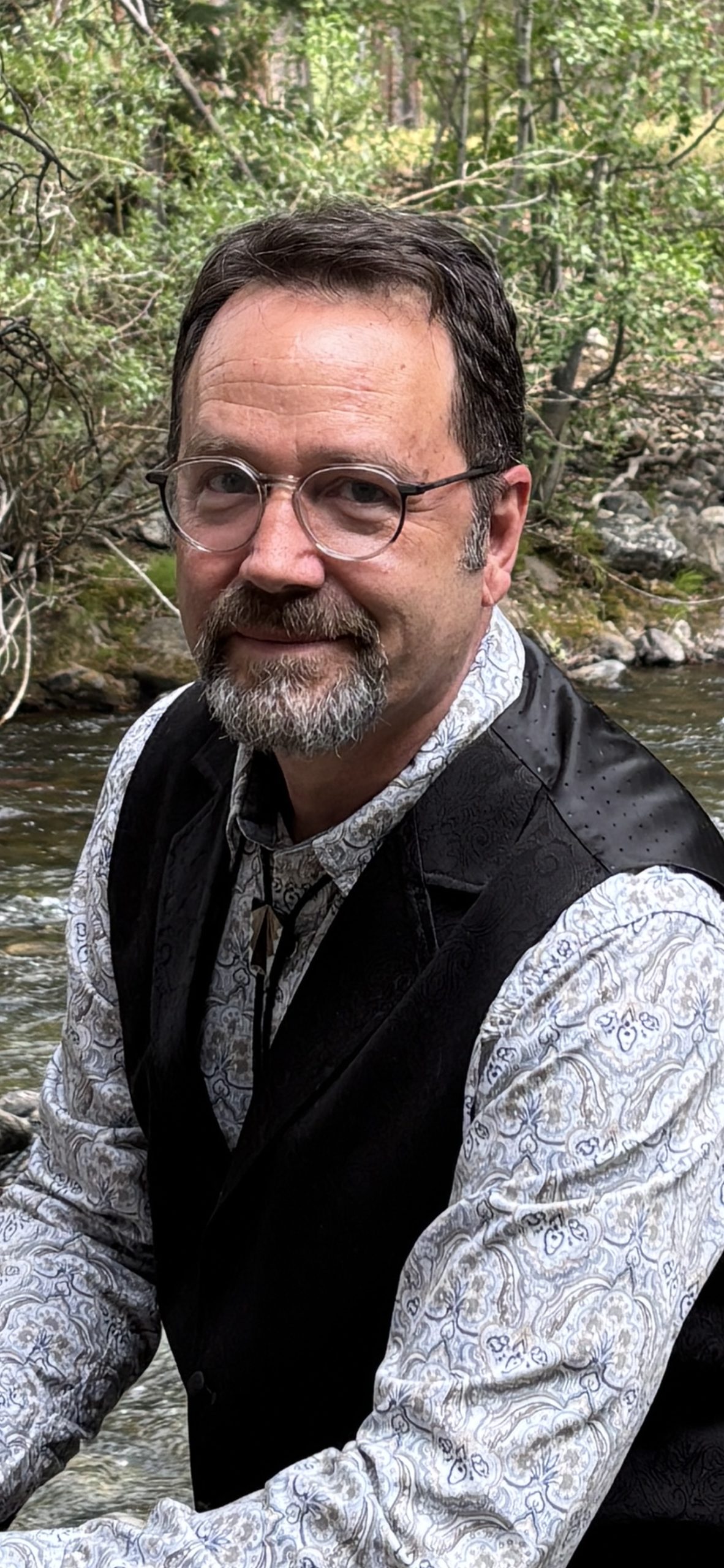
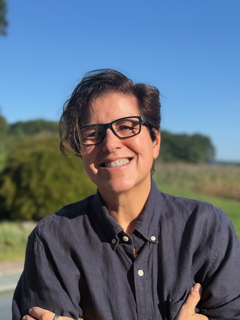
The Author: J Brooke
The Book: I Can Tell You The Version That Will Make You Take My Side (Driftwood Press, 2026)
The Elevator Pitch: In 25 words or less, what is your book about? A themed collection of linked poems tracing my queer/trans/nonbinary journey from early childhood until about a week ago

The Rumpus: Where did the idea of your book come from?
J Brooke: I write a lot about gender and family, most often in prose but sporadically in poetry. As (largely) an essayist, conceptually telling my story through that lens has long floated about, (like a bloated dirigible-shaped cartoon bubble hovering above me), and in 2024 I decided to tell it through linked (or somewhat linked) poems as a form that would impose a tighter constraint on my storytelling.
Rumpus: How long did it take to write the book?
Brooke: With the exception of two of the poems, it took all of 2024 to write (revise, write, revise, write, revise, write) it. The other two poems, both political and reaction poems to the 2025 USA inauguration and its heralding immediate dismantling of Trans and Nonbinary rights (along with myriad other inhumanities) were written in January 2025. So that’s a fairly long way of saying: It took me 13 months to write this book.
Rumpus: Is this the first book you’ve written? If not, what made it the first to be published?
Brooke: When I was twenty, in order to fulfill my undergrad college degree requirements, I handed in a putrid thesis masquerading as a book that I disposed of in entirety moments following my graduation (where Toni Morrison was the speaker… when I recall those garbage pages once existed within the same mile radius as Morrison, I self-induce nausea.) So yes, this is the first book I have written.
Rumpus: In submitting the book, how many nos did you get before your yes?
Brooke: Wow GREAT question. Obviously, many… SO many. But more interesting were the “maybes” and there were bunches of those too. I shared a first draft with a big deal publisher a friend of mine knew, who said, in a previous time they would have taken it on and assigned an editor for me to work with in developing it to fruition, but they no longer had those budgets. I really appreciated that candor, it set me up for the current landscape of poetry books needing to be publisher-ready when they first are being considered. So, I didn’t really take things like that as a “no.” One publisher I really like that I met at AWP in 2025, after reading my book said they could publish it because they liked it, but to trust them and publish with someone bigger, with greater resources. So that “no” I kept in my back pocket as a “maybe.” When I entered my book into various poetry book contests and was sometimes a finalist, or even down to the final two or three being considered, I viewed those as “maybes,” not “nos.” For instance, my book was selected as one of 10 finalists for Ashland Poetry Press’s Richard Snyder Memorial Book Prize. The final judge, Kim Addonizio, was to make a decision during July and August—so I imagined my book carted about in a well-worn rucksack of this writer I admire (Bukowski in a Sundress is a book of hers I really love) to Martha’s Vineyard or the Jersey Shore or someplace else sandy and drinky and its pages undergoing sun-soaked literary baptisms via splashed salt water and cocktail condensation. I mean, my book (along with eight others) didn’t win, but I didn’t really absorb this as a “no.” I think this mindset helped.
Rumpus: Which authors / writers buoyed you along the way? How?
Brooke: I’m fortunate to have had many writers support and encourage me on this journey— friends from grad school like Morgan Talty (we worked on the school’s lit mag together) who had recently published their first book and were very encouraging. Jennifer Franklin, at the time, was in my reviews department at The Rumpus (she headed up the poetry side and I was and still am the prose editor)— and honestly the fact that she wasn’t queer affiliated in any way and was a phenomenal poet and judge of poetry and really believed in this book was significant. My cousin Susan Stamberg was a renowned journalist (a founding mother of NPR, she died last October) and I had consummate respect for her intellect and interpretation of both culture and literature, and we would correspond a lot and I would share my work and she always said my voice reminded her of Nora Ephron’s. That was a big buoy during hard patches of seeking a publisher.
Rumpus: How did your book change over the course of working on it?
Brooke: The book was always meant as political in its simple existence— the adding my voice to the annals of Trans/Nonbinary collective is an act of anti-erasure. While writing this, though, the incoming administration became even more vile in its attempt to assault marginalized groups like mine, so my book became more outwardly political; poems were added that, instead of peaceful protest, made fists and swung back.
Rumpus: Before your first book, where has your work been published?
Brooke: Before I ever worked for The Rumpus, they published some of my work. Columbia Journal chose an essay of mine for a big prize in 2020, and I’ve been fortunate with other places I regularly read also publishing me including Electric Lit, The Normal School, Beyond Queer Words, ROOM Magazine, The Fiddlehead, Bangalore Review, Maine Review, Massachusetts Review, Harvard Review, The Southampton Review, Mom Egg Review, Patterson Literary Review, Slippery Elm, The Sun, Dash, Streetlight Magazine.
Rumpus: What is the best advice someone gave you about publishing?
Brooke: Courtney Maum’s Before and After the Book Deal: A Writer’s Guide to Finishing, Publishing, Promoting, and Surviving Your First Book was phenomenally helpful (and its title is even longer than mine so that was additionally instructive.)
Rumpus: Who’s the reader you’re writing to—or tell us about your target audience and how you cultivated or found it?
Brooke: I’m always writing to the student who sits in the second row… you know, not the wall-to-wall notetaker in the front or the ambivalent yawner in the back row. The reader who jots down thoughts here and there but otherwise listens with their head cocked slightly to the side to learn more about something that has already touched their life. In this way, mine is a queer book not in that you have to be queer to be its audience, (to the contrary!) but you have to have some curiosity about the often-dangerous outsider status queerness imbues. One of my most ardent readers is a cis hetero married mother of one who is smart, accomplished, imaginative, and undocumented… I am absolutely writing for trans and nonbinary and queer folx, but I’m also very much writing directly to her.
Rumpus: What is one completely unexpected thing that surprised you about the process of getting your book published?
Brooke: That it happened. I don’t get this manifesting thing… it’s unfortunately not how I’m wired.