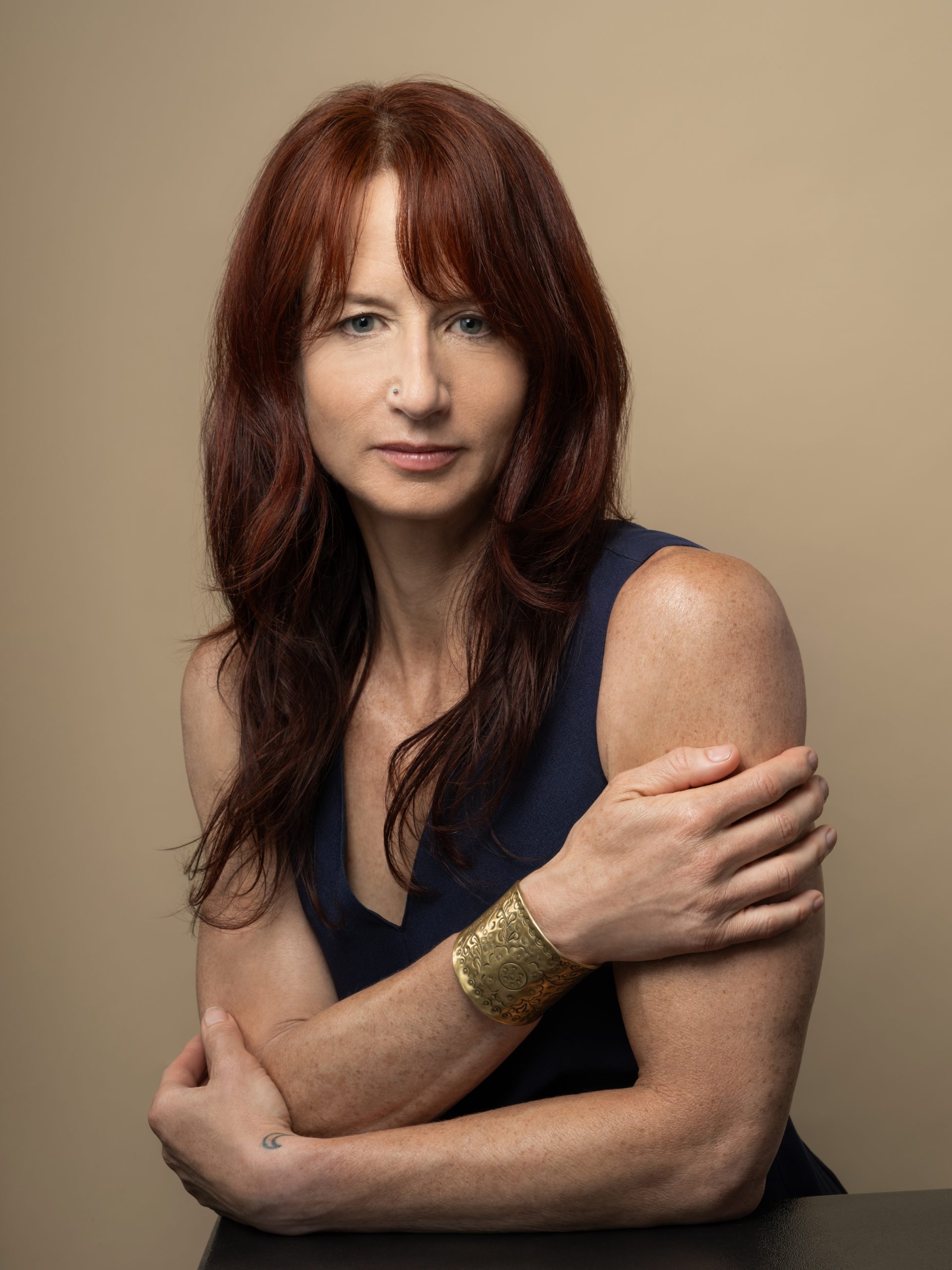
Every morning, survivors of sexual violence wake up to a landscape shaped by entitlement and greed. The harm done to their bodies is echoed in stories of whales starved in plastic-filled oceans, rainforests clearcut for timber, countries bombed indiscriminately.
Poet Diana Whitney, a survivor herself, captures through her new book, Girl Trouble, what so many of us feel in our bodies: that the array of problems we’re facing–the degradation of our earth, the theft of personal sovereignty—are all a single problem.
Traveling through eras and landscapes, Whitney maps specific sites of violation—moments when men claim women’s autonomy as a prize, and moments when women find themselves unnervingly voiceless. The gift of the book is not just Whitney’s ability to render these moments with clarity, but also her effort to revise each of these losses, to stake out a new space on the terrain of the page.
Many of the poems in this collection are remarkably intimate, grounded in the author’s vivid memories of troubling sexual encounters. Others take on community dynamics, exploring the ways that casual misogyny unfolds across a rural Vermont landscape. At times, the lens goes even wider. In a three-part poem, “Dominion,” Whitney examines the environmental debasement of Epstein’s Island and asks:
“How long / to obliterate the predator’s footprint? / How long to break down / the citadel to bedrock?”
I’ve been following Whitney’s work since 2021, when an anthology she edited, You Don’t Have to Be Everything (Workman Publishing) offered a range of strong and honest voices to young women. Her subsequent collection, Dark Beds (June Road Press, 2023) captured the sensual longing of middle age better than anything I’d read.
We met over Zoom to talk about reclamation, resilience, and the transformative powers of invasive species. This interview has been edited for clarity.

The Rumpus: The poem “Dominion” feels like the pinnacle of the collection. Is there a story behind it?
Diana Whitney: I was writing these deeply personal poems about my own experience as a survivor, and remembering my own childhood. At the same time I was obsessively researching Epstein and his crimes. In particular I was reading about the island—Little St. Jeff’s he called it—and I kept looking on Google Earth to imagine the experience of being a girl trapped on that island. I came across a news article about the crimes he committed against the island itself, and I had this of course moment: his domination expanded beyond the bodies of girls and women to the physical body of the earth. That is, I think, the basis of sexual violence— this patriarchal domination where we we conquer land and we exploit the resources. It was uncanny, because it was almost something I’d already known.
I don’t know if you’ve seen images; he razed the whole island, so all of the native species were just clear cut. The story of Epstein, it’s like an alien form that keeps expanding and growing on itself. Just today, I saw an interview with an architect who had worked on the island, and he talked [about] how ominous the buildings were. The windows had light-blocking shades. There were bunk rooms for the girls. It was very sterile. So the poem “Dominion” was thinking about the plundering of resources that happens under patriarchy—but in this very specific place, Little St. Jeff’s—and then imagining what happens now.
How long does it take to recover? Because all of these invasive species come up, and they’re effective at breaking down what humans have done, if you let them. So by the end of the poem, I was imagining the species that are gone, especially the night blooming cereus, which is such a delicate and feminine flower. But now he’s gone. And it was satisfying to imagine the invasives coming back and taking over and reclaiming. That reclamation is something poetry can do.
Rumpus: Can we talk about your use of space and blackouts in this series?
Whitney: A rule that I set was to never use the names of the perpetrators in the book. I feel they have been given enough air time for eternity, and I wanted to tell a different story—one of the survivors and the island. So, there’s that blackout at the beginning in the quote.
Mr. Epstein’s properties had “a long history of egregious and blatant disregard for
environmental regulations”
—Wildlife Chief, Virgin Islands Department of Planning and Natural
Resources
I wanted the poems to work graphically; I didn’t want them fluid or seamless. I wanted to have that choppy feeling, because that’s what was happening: chopping down, bulldozing, razing. As this first section progresses, it gets increasingly horrible. I wanted to end with a drum beat: tax haven, massage parlor, prison camp, morgue. Those descriptors just sit there in the white space.
Part two of “Dominion” is a blackout poem, where I took the mission statement of the US Virgin Islands, blacked it out to create a sort of motto for Epstein’s dominion. When I read it now, I think “God, where was my mind?” There was a fair amount of blackout poetry that was in the initial manuscript. And so I was working pretty regularly with pieces of writing from institutions—for example, an abuse investigation in my school district into historic abuses by teachers at the high school. And so I took a letter from the principal, an email to the community, which was, of course, just some bullshit talking points. And I was able to use the blackouts to find the trail through it. It’s quite satisfying, a way of playing. Anyways, even just the name, the Virgin Islands—it’s ominous and disturbing. I felt I just had to work with that.
So then we get there, and then the last poem in the series is a reclaiming and a reckoning. I imagined a silent island being reclaimed—re-wilded, I think, is the phrase. I imagined all of these invasives who are going to take it over. And then there’s that question of, “how long does it take to obliterate the predator’s footprint?”
I wrote the poem in tercets which create a cascading effect on the page. I just like it; I like how it looks, how it leads the eye. I’m thinking of ivy, all these creeping plants finally taking over.
Rumpus: You mentioned a moment ago that poetry can be a tool for reclamation. I’m thinking of the poem “Take It Back” in particular, where the speaker seems to reclaim her own history by reimagining it. I’m curious to what extent you experience poetry as something beyond imagination, almost like magic or spell casting.
Whitney: I have a couple of poems in the book that could be read as spells, particularly the poem “Nightshade.” I went in very deliberately to write a feminist curse poem. I was in a stage of writing where rage was boiling through me. I’m not a practicing witch, but the more I feel comfortable in my crone era, the more empowering I find it to take on that mantle. And so my tools are words, and also I’m a backyard gardener. The poem came with the realization: “Oh, there are all these poisonous things growing in my garden.” I imagined creating a hex on a perpetrator who had violated someone I loved. It was both specific and also a general curse. So I felt that spell-casting happening, very much.
I wrote that poem “Take It Back” as more of an elegy mourning the girl that I was at 18 and that wish to do it over while knowing that’s not possible. So it felt like it was important to openly grieve. And at the same time, I feel like that poem knows that you can’t—you can’t take it back.
I’m going to visit a college tomorrow, and I’m planning which poems I’m going to read. And I’m choosing poems from this time period that revisit and reimagine the past. There’s the one,“My 18-Year-Old Self Tells Chris Warren to Wear a Condom,” that remembers a stupid hookup and the girl I was who did not insist on the guy wearing a condom. Instead of feeling shame and berating myself, I revise what happened. There’s a line at the end that I find moving: “I can draw a line / around my body. I can get up and walk away.” And I think that some of the poems try to do that, yes, to draw that boundary.
Rumpus: What do we do with the rage so that it doesn’t kill us? Do you see these poems as a way to open the space for different things to happen?
Whitney: Yes, absolutely. Telling the stories of our bodies can change things. And maybe that feels like a big claim when we look out and we see the world as it is, but I believe in the power of storytelling as an ancient form that connects us to other people.
So what do we do with the rage? We can make meaning from it. We can shape it into some form where it’s manageable, whether that’s a form on the page in a poem, whether it’s a story we can tell, whether it’s an essay or a longer book. And I think if you’re an artist, that’s a pretty effective channel for the rage. It’s not the only one. I think the more private work of writing poems is the companion to physically putting my body out in places like protests. Holding a sign and screaming in community can be cathartic.
The poems in this collection are poems I didn’t feel I had permission to write when I was younger. It took me decades to even use the phrase sexual assault for what had happened to me, and that was thanks to the #metoo movement and the work of other survivors who had come forward with their stories. So that’s an example of how storytelling creates change. Maybe it’s slow; maybe it’s more of an ecological glacier pace. But I do believe in it.
Rumpus: Was there something guiding you aesthetically in this collection?
Whitney: I was very called to explore this material with that guidance of the traditional forms, to help me so I didn’t feel like I was alone, swimming in the murk of the trauma.
Rumpus: That’s so interesting—do you see those forms as tied to patriarchy, for better, for worse?
Whitney: Well, there was a part of me in the past who was like, “I’m not gonna do that. You can’t put your poetic rules on me.” But then I read contemporary poets, especially women poets, queer poets, who were doing all kinds of subversive things with form. And I realized you can choose to reject it completely, or you can reclaim it.
Rumpus: I wanted to talk to you about the Steubenville poem, which is a sestina.
Whitney: I’m so glad you brought up that poem, because the Steubenville rape case was one that I knew I could only write about if I had a blueprint to follow. And that’s what the sestina does, you have your six words, and then you’re locked in, right? It’s a very claustrophobic form.
Rumpus: It feels like the story somehow.
Whitney: The horrific violence is one thing, but that’s compounded by the viral online response. So I was trying to capture that feeling—not just of being trapped in the actual landscape of the poem and what happened on one night, but having to relive it again and again every time there’s a new comment online. You can never really break free, and that’s what the form does. The stanzas are relentless until the end.
Rumpus: Another poem from the book that haunts me is the poem “Playdate,” which centers around a father, who’s a friend of yours, making a misogynistic comment about Barbie.
“That’s OK, he grins, we just / need her lying down.”
For me, there’s a trail through the book from this friend to Epstein and “Little St. Jeff’s.” They’re on a different scale, but they’re the same pattern. It’s all part of the same ecosystem.
Whitney: “Playdate” almost didn’t make it into the book. People told me not to include it; they thought it was sort of trivial. Like, “Oh, it’s just a stupid Barbie poem.”
But I’ve always liked the poem personally, because it was a place to put my anger. I had felt shame [that] I was silent. At least now I can say something through this poem.
And then there’s the story [of] having small children and witnessing their sense of body freedom. The first section of the book really tries to capture the experience of innocence, for lack of a better word. But no matter what, there’s this specter of exploitation, there’s a man making a sexist comment right in front of the girls.
Rumpus: The book, from beginning to end, conveys a clear pattern of oppression and sexual violence that is chronically dismissed. But somehow the word “dismissed” seems insufficient because it doesn’t convey the violence of willfully ignoring harm. Do you have a better word?
Whitney: Dismissed is one part of the pattern; I think it’s more than that. It’s often conscious and strategic, this practice of disbelieving survivors. One of the concepts that really illuminated things for me is this concept of DARVO: Deny, Attack, Reverse Victim and Offender. Within the realm of sexual violence, that tactic is used again and again, not just to dismiss the stories of survivors, but to completely discredit and silence them. And we see that on a micro level too, with casual victim blaming, as in: she was asking for it, what she was wearing. That kind of silencing is age-old, right? And it’s very effective. It has a chilling effect.
As I mentioned, there was this years-long investigation into sexual abuse in our school district and no accountability happened. Then you look at the Epstein case, and it’s just the same thing on a larger scale, the question of who counts, who really matters. Epstein preyed specifically on foster kids, runaways, and girls who were already victims of sexual violence. I think there’s over 1000 victims of Epstein. And it took years and years and years for their stories to come forward. For me the antidote is to actually listen to the voices of the survivors. How do we center the survivors? And that’s what the third section of the book, “Open Secret,” tried to do. “Villanelle,” a poem from that section has a repeated line that’s a direct quote from a woman named Sarah Ransome, who survived Epstein’s abuse and went on to write her own memoir called Silenced No More, and it’s a tribute to her. I wanted her to have the last word.
Rumpus: Based on the response to Girl Trouble so far, is there anything readers have missed?
Whitney: I do want to talk about resilience. People have told me that this is a really heavy book. And yes—it’s a heavy book. And yet, I believe there is a throughline of resilience through the darkness and the heaviness. Some of what sustains me is nature and being out in nature. For example, the last poem in the book is a sonnet, an ode to my own practices of hiking alone and swimming in rivers. It’s my way of saying, “I’m not broken. I’m here, and I’m telling the stories and I’m writing them, and we’re sharing them, and sometimes we’re screaming them.”
Rumpus: When you talk about resilience, it makes me think back to what you were saying about invasive species. I want to read these poems as an invasive species, just doing their thing and clearing the space.
Whitney: They’re kind of unstoppable, creeping and taking on a life of their own. I don’t know if you’ve ever grown twining vines. They don’t have sight but they manage to twine and cover. They can cover an entire porch. You can think of poems as things that move forward by feel, and they’ll go out into the world and find the places that they need to go.
I’m actually going back to my college, the site where I was assaulted, and I’m working with a student Committee on Sexual Assault. There’s a magic for me, in returning to the site—but returning as a 52-year-old woman with a book in my hand. I’m going to speak on sexual violence using these poems. And I want them to be little seeds. I want to offer the message that your story is your own, and you get to choose how you want to tend it. You can tend it quietly in the dark, like in your journal, or you share it in therapy [as] a private thing, or maybe you feel ready to bring it out into the sunlight. To tell your story and to have it recognized and respected is very powerful medicine. It’s a form of healing.
For this part of the conversation, Whitney shared her screen with me and I couldn’t help but notice that, uninvited, an A.I. prompt appeared in the upper left corner to ask if we’d like a summary of this “long document.” Somehow this felt like an extension of everything we were talking about, A.I. trying to usurp these essential poems.