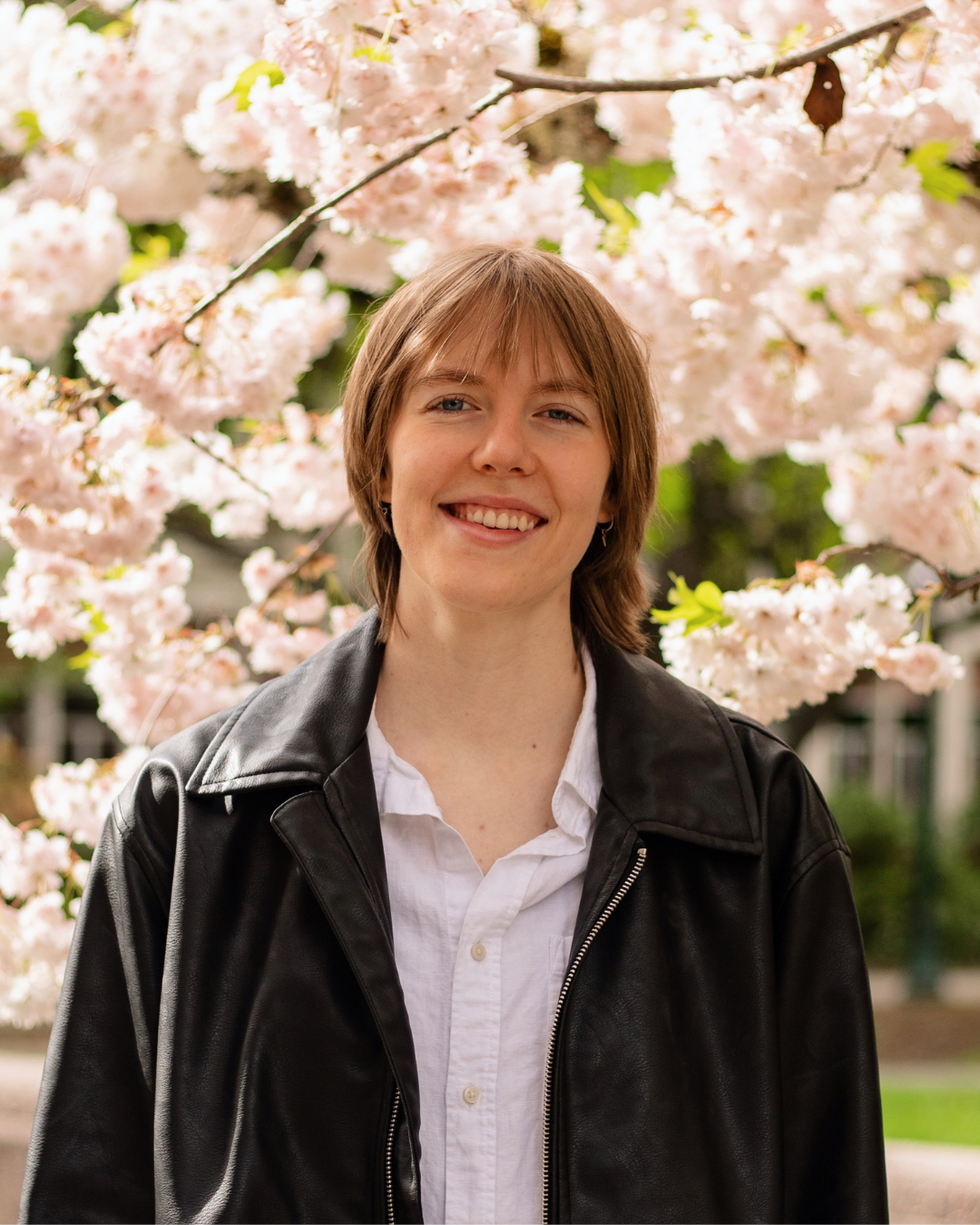

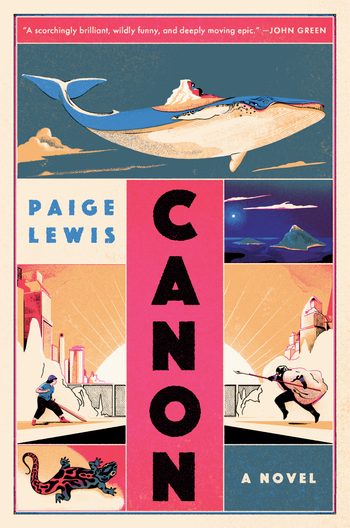
Paige Lewis’s new novel, Canon, is in many ways a romp. It’s fun—a newt that is also a lie detector, characters dodging skin care consultants at the mall. But it’s also a deep meditation on war, abuse, and murder. The prophet-warrior Adrena has always had a direct link to God—an absurd version of the Christian God who wears an Alf mask, who is all-powerful, who never learned to ride a bike—but now she’s told to sit out the final battle. Well, she won’t! Meanwhile, Yara is the gentlest soul imaginable, but God wants them to kill his enemy, the terrifying warrior Dominic. To prepare for the ordeal, Yara must ride a talking whale named HOWBIG! across the ocean.
Epic in its adventures but playful in its structure, Canon unsettles in a way that feels deeply personal. And so it was a joy to talk with them on the phone about OCD, Catholic shame, and the profound way Canon deals with violence and other trauma.
This interview has been edited for length and clarity.
The Rumpus: I’m struck by how the story scrambles references to The Odyssey and Greek mythology with Christian mythology and Bible stories.
Paige Lewis: I was raised extremely Catholic. When I was very young, I told my mother one time—once!—that it might be cool to be a nun, and she still brings it up. I grew up reading the Bible, and the stories in there are wild and hard to forget. One of the stories, of Yael, stuck with me so much that it sparked the creation of Canon.
The Bible is filled with myths and stories in the same ways that an epic like Ovid’s Metamorphoses is filled with origin stories. Many of the religious encounters and miracles that exist in Canon are ones that members of my family claimed to witness. My grandfather, before he died, tried to write out every miracle he ever witnessed on some college-ruled paper. He gave up after just a few pages. But I still hold a lot of those stories, and now Canon holds them, too.
There are a lot of references to the Homeric epics in Canon partly because I love those epics and partly because I knew that readers, who don’t necessarily love epic poems the way I do, would still pick up on those references. There are also images and obstacles and characters based on epics including, but not limited to: the Popol Vuh, or the Táin Bó Cúailnge, Evangeline, or Aurora Leigh, or The Tale of Kieu, or the Kalevala, or Aniara, or “The Anniad” or Helen in Egypt, or Midwinter Day, or or or!
Rumpus: I love that we’re talking about epics. You’re primarily a poet, but you’ve written a novel. What parts of this book are poetry for you?
Lewis: The whole book is, to me, a poem. But certain sections are more poem-y than others when it comes to associative leaping or playing with empty space on the page. There is a section where oysters talk to Yara, and that is just a straight-up poem. A lot of the dreams that appear in the book originated as poems, as well. But maybe the clearest connection is in the titles that open every section—they often work the way that the titles of poems do, in that they complicate or respond to what comes next in the body of the section. I don’t think it’s possible to escape poetry once you’ve written poetry, so Canon is absolutely loaded with it.
Rumpus: The chapter titles are so much fun. Examples include: “Oh, You Want to Know What Yara Looks Like?” “Let’s Fast-Forward Past the Boring Parts,” “What does it Mean to Give the Horses Names But not the Soldiers?” They often speak directly to the reader.
Lewis: For me, the chapter titles are a way to provide space, to give the reader a second to catch their breath if they need to. I’m terrible at running long distances. I need to stop often to breathe so I don’t pass out. I do most things in small doses. I absorb things better this way, and so I projected that onto imagined readers while I was writing Canon—I believed that they, too, would like to absorb the narrative in small chunks broken up by these chapter titles.
Rumpus: They also strike me as a release valve for the difficult parts. Your characters really go through a lot.
Yara can’t bear hurting even the humblest creature. God says that’s more or less why he chooses them. It seems like the story then needs to torture Yara until they’re capable of cold-blooded, close-range murder with their own hands. Adrena, on the other hand, is not gentle. Yet I know from the start she will be frustrated in her quest. This seems like a different sort of torture.
Lewis: I feel like a character that isn’t in some ways already hurting isn’t a very realistic character to start a story with. But I hope I haven’t tormented Yara. That was never my intention. I’m just trying to tell their story.
Adrena is learning, to some extent, what Yara is learning—how to actively exist, when left alone. Adrena has spent a good deal of her life in direct communication with God, and Yara has gone from living under the eyes of their father to living with Lawrence. What sort of choices do Adrena and Yara make when they don’t have these male figures hovering over them?
I’d love to write a book where everyone is happy and no one experiences violence or grief or death or embarrassment, but I don’t think that this would make for a compelling book. I don’t think I’ve been cruel to any of my characters. I’ve given them backstories and challenges that, sadly, a lot of people can relate to. And there is, in some ways, hope involved. A reader sees a character who grieves AND continues moving forward. A reader sees a character who has been banished by their family AND finds comfort in the natural world. It would be hard for a reader to believe in a character that has never suffered.
Rumpus: So it’s more like you’re discovering their trauma than giving it to them?
Lewis: That’s a good distinction to make. The horrible things that happened to the characters are often in the past, and we get memories. Then we have moments like on Gen’s Island, where Yara has to experience the thing that really sucks in real time.
Rumpus: And later on, Yara is made to kill Dominic over and over again.
Lewis: That was rough. I was like, what would be a surreal experience that there’s no escape from. Because Yara got diverted on their journey, this was the only way to prepare them for what they needed to do in God’s eyes.
When I had that idea, as a poet, I wanted the violence to be in the letters themselves, on the page, where there is a version of Dominic coming into the text of the page, the word Dominic coming in from the side and exploding the text of the rest of Yara’s experience on the page. It was getting a little bit too poet-ty. And so it ended up being a literal person coming into this world ready to battle. That was hard to write because I did not enjoy writing violence.
Rumpus: Often, in other books, when I read violence, it feels glorified, like some part of the writer does relish it. But this book is the opposite. It makes me sit with difficult feelings as I watch the characters experience horrendous things. How did you make that happen?
Lewis: I’ve had OCD since I was really young. A big part of that is thinking terrible thoughts, and not being able to stop them. If you try to stop them, they get worse. So I had to grapple with that as a kid, and being like, “No, that is a bad thought” and having to figure out a way to neutralize that thought or figure out a way to be forgiven for that thought as if the thought made it real, or as if, because I thought it, I wanted that to happen. Most of growing up was trying to remind myself that the thought is not the action.
That has always been something that I’ve grappled with when thinking about violent acts. That’s a bad thought or that’s a bad action and we need to pay attention to the fact that it’s bad and it doesn’t get to be forgiven just because we are connected to this character.
I hate, hate violence. I can’t watch violent things. They really stress me out and then trigger that thought process. So having to write it because of where the story ended up going was stressful.
I loved what you said about the titles being a release valve, because it gives us a second to step out of the violence and reminds us we are reading a thing that is constructed.
A friend wrote a book and killed horses in it. I was like, ”You didn’t need to do that. Now that horse is dead forever.” I think about books as their own universe where the thing actually happens. I don’t want to hurt these sea creatures. I don’t want to hurt these characters.
The titles were also talking to me. If they were talking to the reader, that’s great, but they were challenging me as a writer to be like, “Why are you doing this?”
I tried to hold both thoughts at once—that it’s wrong to be written down, but also it’s part of the story and needs to be said.
Rumpus: Some of what you’re saying feels, to me, like a very Catholic preoccupation. I also grew up Catholic. The idea that a thought can be a sin…
Lewis: Yeah, you gotta go to confession. Until you do, it’s like your soul is dirty. I think that my OCD is closely tied to my being raised Catholic. What happens a lot with OCD is that it gets tied to religion because there are rituals and routine.
For so long, the idea of God was I had someone in my brain saying, “Oh, you thought a bad thing. I’m adding that to your list.”
Praying was a way to prevent dangerous things. So I used to have lists that would grow every night that I would ask God not to let happen. And if I didn’t think them in time for the prayer, then that thing would happen. So my prayers got really out of control. At one point I tried to solve it by writing everything down and putting it under my pillow as if that would expedite the process. It’s so tied to Catholicism. Sorry you had to read a book that is so heavily based in Catholic shame.
Rumpus: No, it’s validating.
Lewis: Oh, good. It’s not fun, because I wish no one had the experience, but I’m also like, “Okay, cool, I’m not the only person that grew up this way.”
Rumpus: You said earlier that the book is what happens when Yara and Adrena are suddenly out from under the thumb of controlling male characters.
Lewis: Okay, through no intention on my part, it happened that the characters had some shitty people in their lives and then those people often ended up being men. I don’t know that I was planning that.
God is man adjacent and threatens or offers a sort of control that doesn’t allow for Adrena to do much with her life. There’s always this fear that God is going to pop into her head and skew some of her decisions or make intimate moments impossible. That would be the worst sort of thing to experience as a person. It’s also kind of what I thought growing up, not that I was getting cool thoughts from God, but that there was always the chance of him seeing me doing a thing and then having to be embarrassed or go to confession. Have you been to confession?
Rumpus: Yes.
Lewis: There are ways in which you expect it to be freeing, but then it just adds more shame. I remember telling a priest about having sex when I was younger, and he started asking very specific questions about it that made it not feel like he was trying to get me to really come clean. It was more of a weird voyeuristic experience.
And who knows what other people are experiencing with their priests in a moment of vulnerability. So God was kind of like that in my mind when I was writing this. He’s not flawless. He’s very human in that way. He feels more like a Greek god and is kind of a creep sometimes, and yet he has a lot of power.
That was how I felt about the men in Yara’s life. We’ve got real people who have real thoughts and experiences, right? We’ve got Yara’s dad who also has OCD but isn’t really doing anything for it. So it comes out as anger, and that need to control ends up being really suffocating for Yara. But the only way to escape that household is to be thrown into another form of control with Lawrence. It has not been great for Yara, and we just finally got out from under the thumb of these characters, and we finally have a place of our own at the start of the story, and then that’s when God comes and is like, “Nope, we’ve got more things to tell you, including what to do and how you’re going to move through the world.”
It was really important for me to have HOWBIG! (a talking whale that Yara rides on their adventures) be a male figure. He tries to guide Yara, not in a controlling way, but in a way of like, “Hey, maybe you need to really think about what you’re doing.” I didn’t want it to seem shallow, like all men are bad in this book. But also I think that there are plenty of really great male role models. It’s a lot of bad control happening from the men in the book, but I wanted HOWBIG! to be open and freeing for Yara.
Rumpus: I want a whole novel about HOWBIG!
Lewis: He’s a joy to write, and I want him to find happiness—in my brain, he does. Of all of the characters, that’s the one I am like, “Yes, he’s doing great.” It’s so much harder to let go of animal characters. I’m more worried about them, partly because I feel like there’s a vulnerability that we don’t necessarily have in the human characters, because they really did not ask for any of this. They’re getting all their shit destroyed by us, and I feel more protective of animals in general. I’m still trying to figure out why that’s how my brain works, but it is.
It’s been really strange to live in the world of the book for so many years and now be outside of it. It feels a little bit unfair. I want to be back in the throes of the book. I haven’t figured out how to move past the world of Canon yet. Trying to write other things, I’m like, “Yeah, but what about HOWBIG!? What about any of the stuff that’s happening in Canon?”
Rumpus: As I read, I do feel like you love your characters, regardless of the bad things that happen. Even Dominic, the enemy that God sends Yara to kill, who commits war crimes, is sympathetic by the end because we understand God has been manipulating him too. How does this aspect of the book reflect on the greater world?
Lewis: Dominic is as human as the rest of the characters in the book. Even Bad Guys have people they love and reasons to be doing whatever they’re doing. It doesn’t mean they are good or moral or even logical, but there are reasons. The God in Canon is not necessarily the God that my beloveds believe in. The God in Canon is more likely a representation of current human leaders and politicians who are laughably incapable and terrifyingly armed.
At the heart of Canon, maybe there is a very simple lesson of “Don’t listen to someone in power just because they are in power.” We need to be constantly questioning leaders at every level. And we need to look beyond our own interests and see what harm we are causing every other creature that exists on the planet. People in power aren’t being shamed enough, to be honest.
Rumpus: I’m sorry I said earlier that you were mean to your characters.
Lewis: It’s a good take. It’s just that it makes me have to question my own brain. It’s something that I can have in mind for when I write, hopefully, another book.
Rumpus: Maybe people who aren’t writers don’t spend as much time worrying about how their own brain works.
Lewis: Yeah. It must be nice.