The story of trans experience has been told in many ways—as memoir, as drama, even as a reality show starring a clueless former Olympian—and yet it may be poetry, with its powers of evocation and association, that tells our stories best. The poems of J Brooke avoid the familiar tropes of transition and instead revel in the messy, the uncertain, and the beloved.
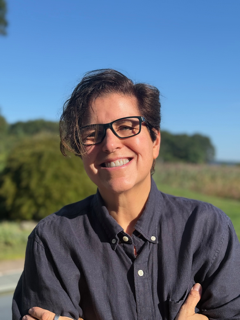
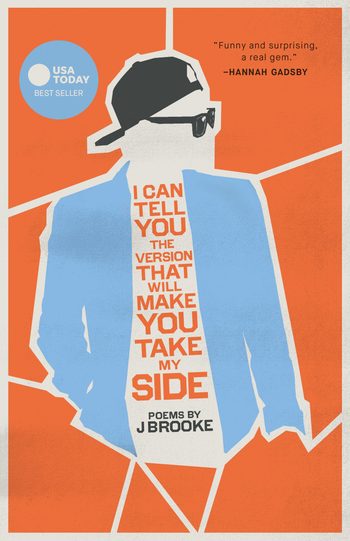
J Brooke was raised in “affluent dysfunction” in New York City. Their first book of poems, I Can Tell You The Version That Will Make You Take My Side, just published by Driftwood Press, debuted at #17 on USA Today’s Bestseller List.
These are hard days for trans folks, but to see a book of poems about a trans person’s life on that list is surely a sign that all is not lost. Indeed, I Can Tell You The Version That Will Make You Take My Side raised my spirits, even as the poet grappled with the gruesome reality of our current moment in time.
In June of 2026 they talked with me about trans literature, nonbinary identity, passing, privilege, and the desire to be loved.
This interview has been edited for length and clarity.
The Rumpus: So you were, wait, what—childhood friends with J.D. Salinger?
J Brooke: I was a child. He was not. I wrote him a note on his 60th birthday saying “Happy birthday. No one does or ever will understand you.”
When he saw my return address, he realized that he had a good buddy who lived in my building, Lillian Ross from The New Yorker. She was always hanging around the lobby with (The New Yorker editor) William Shawn, who was her long-term partner (although they were secretive about their relationship because Shawn was married) so I was familiar with her. She’d let me play with her dog. So shortly after Salinger received and wrote back to my letter, he had her wait around the lobby to tell me “Jerry really liked your note.” Salinger and I continued to be pen pals and Ross continued to check in with me.
Twenty years later, of course, I saw it as grooming.
Rumpus: Did you talk about writing with Ross or Salinger?
Brooke: I really wish I had. I just… I didn’t feel permission to be a writer when I was growing up.
Rumpus: So what gave you permission?
Brooke: I guess growing up and realizing you can’t be defined by what your parents tell you.
Boylan: Well listen, congratulations on this remarkable book of poems, which Rosie O’Donnell calls, “beautiful, and inspiring, and insightful.” Can I ask you about the title? By calling it I Can Tell You the Version That Will Make You Take My Side, it feels to me as if you are saying, “Look, I have the language of argument and persuasion if it’s so bloody important to you. But maybe what’s more important to me is image, and heart, and word.” Like you’re done explaining.
Brooke: Yeah. I don’t especially care about winning anyone over. I want to let the story—of transition, and everything else—just let it resonate, let it clang around in people’s brains. I’m not trying to apologize through the poems.
Rumpus: When I recently reread She’s Not There—the memoir of trans experience I wrote 25 years ago—I definitely picked up on an air of apology, like I was trying to win cis people over, like I was begging them to understand me. Maybe that’s what that moment called for. Or maybe it was just me.
Brooke: Well, like you, I enter most rooms sort of apologizing. And I shouldn’t. But I have written that way historically. You know, “make the greater community comfortable…” I mean, how else was same-sex marriage even passed? Only because we made enough allies comfortable or enough of them not uncomfortable.
Rumpus: I think there’s a tension in the movement right now between people who want to assimilate, people who want to “go stealth,” and other people, who kick cisnormativity to the curb and instead celebrate our fabulous weirdness. I mean—I don’t care all that much about passing as cis at this point, and yet, when I get misgendered by strangers—
Brooke: Seriously? You get misgendered?
Rumpus: Yeah. It’ll happen if I’m just on the phone because my voice is still a mostly boyish voice, or so people tell me.
Brooke: It throws you, right?
Rumpus: Yeah, it pisses me off a lot. But why? I mean, one person getting it wrong isn’t going to undo my life. It amazes me that those feelings are still so close to the surface.
Brooke: That’s a great title for a book: “One Person Getting It Wrong Isn’t Going to Undo My Life.”
Rumpus: I’ll see if I can’t fit that into my next book, which (I think) is about pizza.
Brooke: That should be relatively easy.
Rumpus: Do you feel freer in the poems to not have to perform gender? Like, on the page, people are seeing words rather than a body? Does that mean you feel freer to—as Ray Charles sang, “Do the mess around?”
Brooke: I don’t know. I mean, I—again, I move the way I move, speak the way I speak. I never think about it until someone reacts. If I’m in a sweater in winter, I’m often misgendered as a man, and I think that’s funny because… is it just about one’s chest? Is that it? But in the poems, I’m myself, just writing. They’re neither intentionally imbued with gender nor not.
Rumpus: It does make me wonder whether everything in our creative lives goes through a filter of gender in some ways? When you create something, do you feel that it gets masculinized or feminized or non-binary-ized?
Brooke: [Laughs] Nonbinary-ized! I love that. I don’t know. I mean, well, what do you think when you write? When you write, do you feel you’re writing through gender?
Rumpus: Well, at this hour, I don’t know what people even mean about men or women’s writing. Like, men write about submarines and steak, and women write about our feelings, and Waldorf salad?
I remember when I was in transition, I remember I went to a voice therapist who would tell me things like, “A female voice should rise at the end of sentences, like your sentences should end with a question. And if you’re at the drive-in—I remember this specifically—you’re at the drive-in window at a Burger King or something and you say, “Can I please have a Whopper Junior?” As opposed to a man, just barking out, “Just gimme a fuckin’ burger.”
I think when I started writing about trans stuff maybe I was trying to prove that I was so a woman, goddamn it. So maybe some of that infiltrated my prose. That’s one of the titles of Laverne Cox’s talks she used to give, “Ain’t I a Woman?”, channeling Sojourner Truth. I guess I was still trying to win people over. I mean—I have this desire, even now, to be loved. Although, given that, choosing to be a public voice of transgender people seems like an odd career choice.
Brooke: I think whatever I put onto the page, if someone assigns gender to it—whatever gender someone reads it as—they hopefully read it as me, as whatever gender I am writing from within. You know what I mean? It’s just me.
I have this one poem I like to open with when I do a reading—it doesn’t apologize as much as explain that we all have this same thing going on at various times.
Rumpus: Can you read it to me?
Brooke: Sure. It’s called “Mistaken Identity.” I think this is where everyone can most easily relate to the experience of being trans or of being queer.
Dear Orangutan. I am
sorry I called out
 	“baboon” eyeing you
 at the zoo. You must be
 	bothered being mistaken
 	for another
 	other than yourself.
Like me, you are
vegetarian, loner, devoid
A tail -
I do not know enough
though I suppose
when it got decided
that we get divided
by a single glass
pane -
someone mistook you
again.
Rumpus: Thank you so much for that! Wow. What do you hear when you read that poem? Or what do you feel?
Brooke: Well, usually I’m standing when I read. I was at KGB Monday night and I put my hand to the side of my mouth and I yelled out, “Baboon!” and I felt like this was actually happening in some weird floaty way. I usually gesture to a tail at the part where I say I don’t have a tail. I think others relate to this because I think we all have a dysmorphia at times. And while most people don’t label it “dysmorphia”—and I think that people can’t necessarily bring themselves to call it that—but I think that’s what it is. And I really do think that it runs deeper for those of us trans and queer, I don’t mean to minimize its severity for us, but I think it runs across all kinds of folks.
Rumpus: Well, we were talking about assimilation and passing before. That phrase, “Love is love,” seemed to connect to straight people, back in the day, because everybody knows what it’s like to be loved. Maybe the universality of love made straight people think—when it came to gay men and lesbians—“Well, I don’t know what it’s like to love someone who’s the same sex as me, but I do know what it’s like to love someone, I reckon. So, okay, god bless ya folks!”
Brooke: Right. Right.
Rumpus: Then the T came along as the little pink caboose on that train, drafting behind—when, to use my favorite cliché, is not about who we want to go to bed with, but who we want to go to bed as.
Brooke: As. Right. Yes.
Rumpus: So when the inevitable blowback started up, it was okay for folks to say, “Well, I know what it’s like to love, for Pete’s sake, but these trans folks, they want something else.” For us it’s not about love; it’s about identity, which is a harder argument to make, supposedly. But it shouldn’t be a harder argument. We all have a sense of dysmorphia, don’t we? I mean, it is more pronounced in our case, but you don’t have to be trans to look in the mirror and think, “Who the hell is that?”
Brooke: Exactly! I am hoping these poems make that sense of confusion feel more universal. Do you know the Walt Whitman poem, “When I Heard the Learn’d Astronomer?” Whitman is hearing this scientist spewing out all the facts and the figures and formulas. He gets all agitated, so he goes outside and looks up at the stars.
I think a good poem just leaves you there staring up at the universe like that. I hope these poems inspire people to go out and stare at the stars because there are much bigger mysteries than this Trans thing some politicians are forefronting for all the wrong reasons. There’s a much bigger universe.
Rumpus: J Brooke, you’re singing the body electric.
Brooke: Well, we’re all singing, Jenny.
Rumpus: Okay, so last question: What do you think your man J.D. Salinger would think of the poems in your book?
Brooke: So I don’t think J.D. would relate to most of these poems or find them to be his flavor, even leaving aside the question of how J.D. might view gender as we now write and reference it.
But I think he’d like “Mistaken Identity.” You know, the one about the orangutan mistaken for a baboon.
Rumpus: Really? Why that one?
Brooke: Because, Jenny, it takes place at the zoo.