It’s the early 1960s in small town Monroe, New York, about an hour’s drive from Manhattan. The Arrington’s, a professional Black family, have just purchased a home in a picturesque, leafy, all-white neighborhood. Some are welcoming, others, less so. Dr. Phillip Arrington—a practicing psychologist—might rather play tennis and have affairs with the white women of the town, while Velma, his wife, has her own childhood issues to deal with, all while raising daughters in a place that rejects them. This might all seem cut-and-dry, But Where’s Home, Toni Ann Johnson’s new collection of linked short stories, explores the painful, and occasionally, humorous experiences of being an upper-middle class Black family from the 1960s to 2022.
This multifaceted portrait of an American family is a brilliant blending of form, dazzling readers with both psychological depth and historical scope, and shows an author at the height of her powers. But Where’s Home, selected and edited by Crystal Wilkinson, follows Johnson’s previous collection, Light Skin Gone to Waste (selected and edited by Roxane Gay, University of Georgia Press, 2022), which won the 2021 Flannery O’Connor Award. Told through multiple perspectives and moments in time, readers are invited into the lives of the oldest daughter, Livia, who longs for her father’s affection but feels marginalized as the youngest daughter, Maddie, seeks to overcome trauma through music and acting. Yet the ancillary characters remind readers that we are not alone in our narrative, it’s all interwoven throughout our DNA.
I was drawn to the title, But Where’s Home, mostly because my own work is deeply rooted in home, place, and belonging. As I read more, I found a plethora of similarities between my own life and those of Johnson’s characters. I worked as a child/adolescent psychiatric R.N. I have a vintage shop. Like Livia, I was the first-born daughter with a sister born eight years later; our parents divorced. My mother read my diary. I believe art and writing saved me. I always knew who I was, but I couldn’t fully be myself because my mother was mentally ill and narcissistic. Johnson offers deep gentle clarity in this collection, one which is both specific, yet universal.
I was overjoyed to talk with Johnson more closely about her collection through an exchange in April of emails in conversation. This interview has been edited for clarity and length.
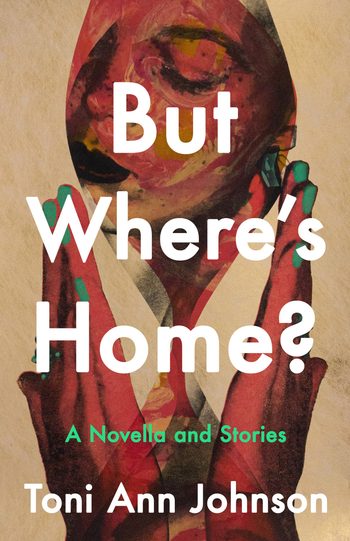
The Rumpus: I always want to start with covers; they tell such a story. But Where’s Home has a beautiful, somewhat abstract painting of a woman on the cover. She has green nails and her hands are held to her face so that the white space creates a sort of illusion of a butterfly.
Toni Ann Johnson: I love the cover, designed by Dominique Jones. The artwork is by Christian Noelle Charles, an African-American artist living in Scotland. It’s all them. I can’t take any credit for it. It’s interesting that you see a butterfly. I see an hourglass, and the face seems to be about to pour through it, perhaps into something new. It makes me think of rebirth and the impermanence of the human experience.
Rumpus: Does the color green hold any significance?
Johnson: I didn’t choose the color, though I love it! And I do associate green with Monroe. In spring and summer, it was lush with trees.
Rumpus: The very first story in this collection, “Getting There,” hints at “being green,” as in “new and fresh.” This was the most perfect beginning for me, a beautiful rendering of reincarnation, how children choose their parents from another realm, and this is so lovingly and thoughtfully done. How did you decide on this opening, when there must have been so many options!
Johnson: The draft I submitted to Screen Door Press didn’t include “Getting There.” My editor, Crystal Wilkinson, asked for an opening story to introduce the family and why they’re in the white town of Monroe. I went through a phase where I believed I was my own mother’s mother in a past life. That’s where that comes from. But I always thought it was too odd to write about. When I was asked for this story, Crystal also said to keep in mind the balance of the kinds of stories in the collection. The last story in the book is narrated by Phil’s mother after her death. So, I used the idea of Maddie narrating from before she was born.
Rumpus: I love hearing about how a collection started! I always felt like we human souls are floating in the ether watching the humans on Earth and saying, “That one. I pick her/him/them to be my parent,” but sometimes (often), our parents are not what we hoped for, but always what we needed. Can you speak into this, please?
Johnson: I believe we’re energetically drawn to certain souls to further our development. We might not want to learn the lessons we’re meant to learn from these experiences, but often the difficulty helps us evolve into wiser versions of ourselves. I had deeply flawed parents, and that was not pleasant. It did, however, help me develop compassion, self-love, self-reliance, and grit, which led to creating “home” within myself.
Rumpus: I understand But Where’s Home is an autobiographical fiction, which really deepens the interiority of these characters. I’m curious about your process. Do you start with a line, an image, an event, or an emotion when mining truth for fiction? Maybe all of the above, or something else?
Johnson: I usually start with a memory. There’s only one story that was initially inspired by a fictional prompt. Within that story, though, there are numerous real events. And, yes, there are authentic emotions, images, and even bits of dialogue that play into the work, so “all of the above” is correct. But the stories are almost always inspired by real events that I’ve fictionalized.
Rumpus: I love that you are upfront with your identification with fictional Maddie. She’s Phil’s second-born daughter, and this is his second marriage to Velma. I want to talk about both characters, but let’s start with Maddie. I love this passage:
“For years I wanted to stand up for myself. Now, I was big enough, and the fear in that woman’s face sent a surge of fear and excitement through me like a current. I was bolstered by my power. At last, Velma was getting a taste of what she’d been serving all these years.”
Maddie’s parents (Phil and Velma) are self-serving and carry deep layers of emotional toxicity. But Maddie has her own trauma to process. Did one inform the other? Are they separate?
Johnson: Maddie’s trauma comes from being raised by a set of parents who have their own traumas. Their ill-thought-out choices and negative behaviors borne of their unresolved issues lead to her traumas. Within the household, she’s physically and emotionally abused by Velma, who’s being emotionally abused by Phil. And within the community, Maddie suffers racial abuse. For Maddie, both the racial and domestic abuse are linked to Phil and Velma. It’s their choice to raise her in an area where she’s isolated as a Black child. The childhood sexual assault is also the result of a poor decision made by her parents. A set of parents with more secure childhoods might have been better equipped to give Maddie an emotionally and physically secure childhood. To their credit, they gave her a financially secure childhood, but they couldn’t provide emotional and physical security.
Rumpus: Velma and Phil are so complex. I found it hard to sympathize with them, yet I wanted to know more. How might writers treat their characters whose behaviors may be challenging to condone? And might readers hold them in their minds and hearts?
Johnson: I wasn’t concerned with making every character lovable. Narcissists are not lovable from their victims’ POV. This book offers a look at how to survive narcissistic parents, not how to love them. I show the reader the wounds that reveal why Phil and Velma are the way they are. If I had not referred to their traumas, that would be unfair to them. It is my job to be fair. I don’t dictate to readers how to hold difficult characters in their minds and hearts. That’s for them to decide.
Rumpus: Even though Phil is a psychologist, we never “see” him in a session. We glimpse him in many other situations—in his underpants, without his underpants, at fancy dinners in New York City, playing tennis, getting things thrown at him, driving his RX-7—was this intentional on your part?
Johnson: Focusing on Phil’s work with his patients would be a different book. This book is about family and relationships. In Light Skin Gone to Waste, there is a reference to Phil becoming sexually involved with one of his patients, Abby Goldberg, and that is relevant because of what it reveals about his marriage. Abby is also mentioned in this book. And there is a scene in the previous book, where Phil questions Maddie the way he might treat a young patient, after he suspects that she was harmed by a babysitter. But then he takes her to another psychologist. For these stories, I wasn’t compelled to see Phil treat a patient as a way to reveal his character. We see his office and how he inappropriately exposes his patients to his personal life via his sexualized art, the photo of his naked girlfriend, and the chaos of the screeching bird. But his actual work with patients isn’t relevant to what I was exploring. The moments you mention: underpants, no underpants, et cetera include Maddie. That’s why they’re explored, because of how they affect that relationship.
Rumpus: Phil does share a tiny bit with Livia about why her stepmother, Velma, is the way she is, but when it comes to telling Maddie, their daughter together, he stays tight-lipped. He certainly “knows better,” being a psychologist, but his professional and personal boundaries are very blurred, or blind, or both.
Johnson: Yes, he reveals it to Livia in the story “Pride,” about [why] Velma is the way she is. And it helps Livia. She’s clear that Velma is crazy, and she proceeds accordingly by not provoking her. This includes withholding the truth about Velma’s origin from Maddie. Phil doesn’t reveal it to Maddie because Velma explicitly forbids it. And he doesn’t help Maddie navigate that relationship, because he’s part of the dysfunction. He is just as emotionally immature as Velma. In personal relationships (as opposed to professional), narcissistic parents are too self-involved to care for their child’s emotional well-being.
Rumpus: Phil’s eldest daughter is Livia, who has a different mother. The girls are half-siblings and of course, bring different DNA and experiences to the table. Livia feels marginalized, slightly displaced. She didn’t get the “nice house,” or all the trappings of that lifestyle. She was made to “adjust,” to create her own life. I like to think of it as Phil gave her the foundation, then handed her tools and said, “you figure out the rest.” She goes to Harvard. She’s an attorney. She sets boundaries. When the story ends, she’s about to have her own child. Phil shows up at her apartment with a list of feminized names, Philimena, Phillipa, but Livia doesn’t want any part of that. Let’s talk about her for a moment. How do you think she survived and made something of herself, despite the situation?
Johnson: Livia suffered less of the insanity of living in the dysfunctional home and in that racist town. Phil’s infidelity wasn’t in her face. Livia’s mother was long separated from Phil, so she wasn’t constantly triggered by his behavior and taking it out on Livia the way Velma takes her rage out on Maddie. Also, Livia had the foundation of an early childhood spent around family, and as the first, most adored grandchild of Emily. She felt special. She was educated in an integrated environment and didn’t have the racial struggle Maddie experienced. Livia attends an elite high school and college. She’s around high-achieving kids, where “making something of oneself” is expected. She also has parents to model success. Phil is a professional, and Livia’s mother is a teacher. Livia develops (albeit reluctantly) a sense of independence. She’s given no choice. She can’t depend on the family as a source of sustenance. She becomes a planner who decides what she wants and creates it. I don’t think any of this means she’s fully healed. But she is clear about her needs and what she’ll no longer accept.
Rumpus: I want to turn to the family heirloom of the 1920s Schaeffer fountain pen. Phil gives this to Livia but says she can only keep it at his house, in the guest room where she stays when she visits. This moment simultaneously endears me, yet scratches me like sandpaper to a sunburn. And then the pen goes missing. Was this an autobiographical moment or something you invented for the narrative?
Johnson: You’ve identified the story element that came from a prompt. I studied with author Jacinda Townsend at the Callaloo Writing Workshop in 2016. The title of her prompt was “The Absence of the Object.” I chose the pen idea, which is fictional, because I owned one of those Schaeffer pens, and it was from the 1920s, so the grandfather could have had one. It also fits with Livia’s interest in sketching and art. The other events and elements of that story are autobiographical, though heightened dramatically for the story.
Rumpus: As a writer, does it carry a metaphor for you, the pen? Like, maybe your powers are being taken away? Something else?
Johnson: As an heirloom, the grandfather’s pen carries the idea of family connection that Livia craves and never receives to her satisfaction. And it feels specific to her because when we meet Livia as a child, she’s sketching as a means of self-soothing. To lose the pen when she’s a teenager carries forward the idea that she becomes dysregulated when she can’t self-soothe due to the missing pen.
Rumpus: But what really struck me is the whole idea that our past traumas can inform one’s own parenting. In the 1960s, there was no term “parenting;” it wasn’t a verb. But Livia, always wise said, “Don’t take your childhood into your motherhood.” And her grandmother, Emily said, “There is no making up for the love you don’t give. What you do or don’t do with your offspring makes the mold that shapes them.”
I’ve read that mothers subconsciously have a troublesome period when their children—daughters, especially—turn the same age the mother was when a significant event happened. For example, if the mother was eight when she was sexually abused, when her own daughter is eight, the mother often has a visceral reaction she can’t understand, even if the daughter is never abused. It’s a fascinating theory. What do you make of it?
Johnson: Yes, I’ve observed something similar, which is that parents with unresolved trauma sometimes unconsciously treat their children the way they were treated as children. Phil “abandons” Livia, leaving her in the Bronx. He felt abandoned when his father suddenly died. And Velma was neglected as a young child, ending up a ward of the state. She, in turn, emotionally neglects Maddie and mistreats her. It’s as if she wants Maddie to suffer as she did.
Rumpus: In many ways, I felt But Where’s Home is about breaking cycles. What more would you add?
Johnson: Agreed. Both Livia and Maddie realize they must separate from their parents emotionally to have a good life.
Rumpus: Is it also about race and class? Or is it more about people behaving badly because of their complex, multifaceted pasts?
Johnson: All my books touch upon race and class and family dysfunction due to my experience growing up Black and upper-middle-class in a white-working-class environment and in a narcissistic family. It’s about both. It also explores how racism and classism exacerbate family dysfunction. Phil’s pursuit of what’s socially forbidden (due to racism), including proximity to whiteness, and the pursuit of white women, causes a lot of this family’s problems, as does his anger toward women because of his mother’s unkindness.
Rumpus: I’m sending these characters of Monroe, New York so much love and care. I’m there, in the pew, in the ICU, on the moist cobblestone streets of Bermuda and in that other realm, wherever that may be, hoping for the best. What moment made you cry as you wrote But Where’s Home? What do you hope readers take away from this collection?
Johnson: I cried when Velma called Maddie a quitter and said she wouldn’t amount to anything. And I cried again when Maddie received comfort from her adult self. I can’t control what readers take away. Some people find it healing, and I love that. But it’s up to them.