Picture this: You awake to get ready for a cricket tournament. You have been excited for this particular cricket tournament, it’s a special event, a star-studded one. You are going to be on the field and play against sports stars whose faces you have only seen winning trophies and smiling in advertisements on the TV. Last night, you slept in a five-star hotel, courtesy of the tournament. All while soldiers walked the streets with their guns. But for now you can focus on the cricket tournament. On social media, there’s an image of a group of fans cheering loudly while paramilitary forces stand around them. Joy in the middle of surveillance. It’s meant to give a sense of normalcy.
Soon, however, you learn that there is no tournament. The organizers have vanished into thin air. You wake up in a five-star hotel no one has paid for and now they are asking you to settle the fees. There’s no tournament, the organizers are not to be found (if they even existed in the first place), there are no cricket stars, only a frowning front desk guy with a bill. The front desk guy doesn’t care that you were supposed to face an international cricket star on the field today. After all, there’s no longer an actual cricket tournament, or international cricket stars, there’s just you in this hotel.
If this were fiction, we might remark on the absurdity of a cricket tournament held in a military-occupied state, as well as on the failure of the pretense of normalcy; we’d wonder what our protagonist is up against, maybe even anticipate the world becoming more strange, maybe someone would show up and accuse the protagonist of treason, of being unlawfully present at this hotel. It would be almost anticlimactic of me to admit this incident occurred last November, in Srinagar, Kashmir’s largest city. That the proposed Indian Heaven Premier League was built and collapsed within months. To point out that this is just another failed promise in the string of political and economical promises given to the people of Srinagar, another reminder of the everyday disappointment of living in Kashmir.
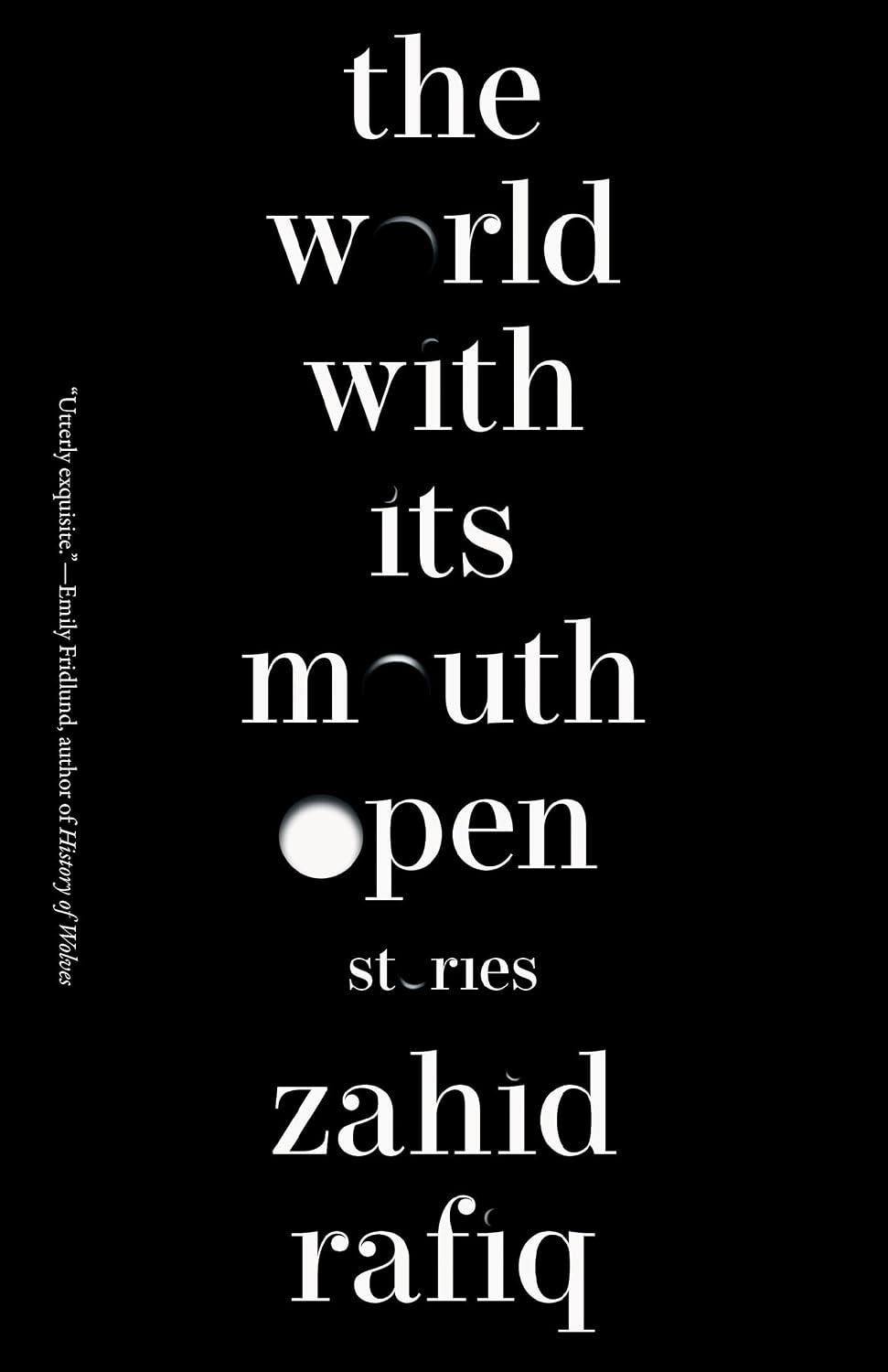
When I read about this incident in the news, I couldn’t help but imagine it could have been the premise of a short story from Zahid Rafiq’s collection, The World With Its Mouth Open (Tin House, 2024). Rafiq’s narrators, similar to the aspirational cricketers, are dreamers misplaced within their realities. Largely set in Srinagar, Rafiq’s stories focus on the inner life of ordinary citizens set against dysfunctional politics simmering in the background. These characters exist within their own worlds, barely registering the soldiers patrolling the streets. When they do register them, they do so in an almost offhanded manner. But their reality soon catches up with them, and their lives become interrupted by the political unrest in often surreal and bizarre ways reminiscent of the work of Franz Kafka. Much like Kafka’s narrators, often up against nightmarish circumstances and bureaucratic hellscapes and experiencing profound alienation and powerlessness, Rafiq’s characters face the indescribable, the unrecoverable, and the impossible, within a state powered by surveillance, corruption, and economic and social suppression.
***
Mired in conflict since being declared an undisputed territory following the partition of India and Pakistan in 1947, Kashmir is a divided land, the site of three wars and multiple armed insurgencies. Longstanding movements and demands for autonomy have been met with an increased military presence by the Indian government. Political disenfranchisement and the ensuing alienation have also led to civil unrest, corruption and poverty, enforced disappearances, extrajudicial killings, torture, and sexual violence. Indian armed forces have impunity in Indian-administered Kashmir under a 1958 counterterrorism law protecting soldiers committing human rights violations. In 2019, Indian prime minister Narendra Modi removed the region’s right to semi-autonomy, which was followed by a lockdown and communications blackout in the region until 2021. More than six years after this ruling, the region remains alienated, which affects its inhabitants’ civil participation and economic freedom.
When Kashmir appears in South Asian literature, it’s often as a call to action, like in Arundhati Roy’s Azadi: Freedom, Fascism, Fiction (Haymarket Books, 2020). Or, it’s pictured as an isolated region where the everyday is blanketed in melancholy, as seen in Madhuri Vijay’s debut novel, The Far Field (Grove Atlantic, 2019). There’s a strange romanticization of its snowy mountains and perpetual political unrest, especially by outsiders. But Rafiq takes us along desolate roads patrolled by soldiers and into crowded neighborhoods with rowdy children and stray dogs (in a story titled “Dogs,” the stray dogs are the narrators), to capture Kashmir’s everyday strangeness. A shopkeeper develops a peculiar obsession with a new mannequin (“The Mannequin”), a man monologues about the state of Kashmir to an unwilling listener (“Frog in the Mouth”), and an unfamiliar severed hand is found on a construction site (“The House”).
Rafiq begins his collection with an epigraph from Kafka’s The Metamorphosis, where Gregor Samsa, after waking up as an insect, thinks to himself, “How about I sleep a little bit longer and forget all this nonsense.” This positions the reader to view the entire collection as an escapist fantasy; a desire to close one’s eyes and forget, at least for a little while, the truth about Kashmir. This is in fact the reality of Rafiq’s characters, who often attempt to respond to the mystery of their situations by reaching for a momentary reprieve; no matter how much they wish to avoid their realities, they are incapable of doing so, much the way Samsa is physically incapable of escaping the truth of his transformation: the words that follow immediately in The Metamorphosis, “but it could not be done, for he was accustomed to sleep on his right side and in his present condition he could not turn himself over.”
In “Crows,” a boy daydreams during an exam, his mind leaping from an imaginary football game to the taste of lamb on his tongue, as he thinks of distractions that might save him from his teacher’s wrath. He wonders what could happen if the teacher’s sister entered the classroom with her sick baby, or soldiers barged in, “turning everything upside down, poking even into their schoolbags with long guns.” It seems almost absurd that the boy would wish for soldiers to interrupt the exam, inviting violence into the classroom, but in so many ways the story captures the essence of a childhood born in war, where soldiers and their sudden interruptions are so frequent they become normal. To the boy, the soldiers don’t pose as frightening a threat as his teacher does. His fear feels almost exaggerated until the teacher brutally beats the boy after reading his incorrect answers on the exam. “A thousand sticks fall sharp” on his arms and bare back, and the teacher kicks him repeatedly until the boy is left whimpering like a dog in the corner of the room. To further extend the boy’s suffering, the teacher rubs nettle on the boy’s wounds. In the boy’s mind, the violence of the teacher far surpasses any violence possible at the hands of a soldier.
It is this terror of the everyday, this fear of adults looming over him from which he seeks the escape he is incapable of manifesting. The story’s surreality exists within this reality; everyday terrors mirror larger evil. The lines between the public and the private become blurred, the public mirrors the private, the private reflects the public. This is distinctly Kafkaesque, which Czech writer Milan Kundera described as “not restricted to either the private or the public domain,” but encompassing both.
At the end of “Crows,” the boy walks home and watches a flight of crows, wondering out loud why the birds return to their nests every evening instead of continuing to fly. But where else can the birds go? The realization dawns on him, and on us, that he himself has nowhere to go.The boy will surely be beaten again at home if he confesses what happened. This is a distinctly South Asian conflict, immediately recognizable to me as a reader from Sri Lanka. Educational discipline is enforced in a highly problematic way, with teachers and educators allowed to dole out harsh punishments without repercussion, similar impunity given to soldiers. The boy’s poverty traps him in his circumstances: education is his “way out,” while his physical and mental strife are negligible. There’s a culture of stoicism prevalent in this region, requiring children to suppress their feelings and handle adversity as if they were adults. The teacher too, is a recognizable figure: We learn he missed becoming a doctor by a couple of marks, fueling both his desire for power and use of violence—a consequence of fierce educational competition and ensuing corruption, and the way state-mandated exams dictate people’s livelihood in many parts of South Asia. This cycle of disappointment and violence is heightened by the story’s use of a child narrator; highlighting the harshness of the world through the eyes of a young boy who cannot escape and becomes resigned to his fate.
***
A man, let’s call him “the poet,” for he is a poet, returns to Kashmir after escaping its realities by making a place for himself in the United States. He returns reluctantly to Srinagar, the city he left behind, following his mother’s death to help his father, who has retreated into himself. The poet mourns the mother, he mourns the recluse his father has become, the decay of his childhood home, and his life back in the US. The poet is surprised to find the streets the way they are; it feels not like his city but rather like “some other unfortunate city.” The terror of the witness shakes the poet. He is transformed by the uncanny horror of seeing a familiar image return to him in such an unfamiliar way.
One night, a dead man visits the poet in his dream. He begs the poet to go find the dead man’s family and tell them about seeing this encounter, to tell them “something that eases their pain.” The poet wakes up confused; he doesn’t recognize the ghost and he doesn’t understand why he has to be the ghost’s messenger. All the poet knows is that the man was killed, and his house is located by a narrow lane with ivy on its walls. His request is an impossible task, but one that pushes the poet into action, however reluctantly. This is the premise of Rafiq’s story, “Bare Feet,” which starts off similarly to Kafka’s “A Country Doctor.” In both stories, a man is asked to perform a duty, which takes him through a dreamlike journey, ending with him incapable of meeting the challenge. The country doctor is called to treat a sick patient and is faced with a set of nightmarish obstacles, and when the doctor actually makes it to the patient, the boy wants to die instead of being saved. The country doctor’s final humiliation happens at the hands of the patient’s family, who take off his clothes and make him return to his house naked. The poet from “Bare Feet” goes around the city looking for the house with ivy on its walls, and at every turn, he is met with the utter destruction of the place he’d left behind. He is forced to face his moral impotence and passivity, as well as the guilt of having escaped while everyone else has continued to live through his hometown’s decay. When he asks kids playing on the road if someone was killed or went missing in their house, everyone raises their hand, reminding us of the impossible search for a murdered man in a city where no death is accounted for. As the poet goes from house to house and is welcomed by the people who live in each one, an old man asks him what he does and the poet is ashamed to admit that he is a poet. He feels useless to the old man and “useless to the important things in life, to what has become of life.” If Kafka’s country doctor must face the futility of science, absurd events, and a wound oozing maggots from the side of a boy’s body, the poet must face the futility of words and language and education as he also faces a city shaped by war. The poet feels betrayed by his mission, becoming angry at the ghost, and wanting to escape once again from “these faces and these eyes and this burdened silence.” When he abandons his task, he encounters humiliation at the hands of patrolling soldiers who force him to take off his shoes and make him walk barefoot along the road. The sudden demand is not expected or explained, but it is also not questioned by the poet. “No longer a poet, no longer a teacher, no longer anything, I am just a man stripping barefoot,” he says. In an anonymous personal essay published by Himal South Asian, the nameless writer opens with a similar scenario during the blackout in 2019, where a man is asked for his ID by a random soldier, yet “Why, it never occurs to the man to ask.” He goes on to elaborate: “The irony of this ritual, of a man from hundreds of miles away demanding you prove your identity to him, in your own homeland, no less, may no longer register for many Kashmiris.” The nameless writer could very well be Rafiq’s poet.
***
Kafka’s stories are often populated by paranoid narrators, whose solitude is violated by an authoritarian world demanding the lives of its citizens be accessible and transparent. Rafiq’s narrators are always watched and surveilled, they are never alone, which is a constant hell. They are also controlled by religious and social codes, their movements watched and analyzed by acquaintances and strangers while they are burdened with additional cultural surveillance—the moral policing and conditioning that is baked into South Asian societies. We are all constantly perceived, judged, and asked to keep our stories of trauma and injustice to ourselves. Much like the badger in Kafka’s “The Burrow,” we are on the lookout for unnamed and unfamiliar foes in our everyday lives. In “Small Boxes,” a man’s obituary is published while he’s still alive, driving him to paranoid delusions about his enemies, including a journalist he accuses of plotting against him. In “Beauty,” the narrator is the surveillor, shaken by his own act of voyeurism as he becomes a spectator to a girl’s inner sufferings and paranoia. In “The Bridge,” a pregnant woman behaves erratically as she worries about being judged for walking in public with a man: “What would someone think if they saw them walking together? What would her husband think?” Her worries, however, are not entirely unfounded. It’s a paranoia I know well as a South Asian woman. What would someone think? In Rafiq’s stories, surveillance isn’t always political; in many instances it’s cultural; the surveillors are everyday people, neighbours, family members and strangers. But cultural surveillance in South Asia is deeply rooted in religious, military, social, and class dynamics. Who gets to look at who, and how their judgement affects the other is shaped by hierarchies of power, while culture and religion are deeply intertwined, permeating personal, professional, and social relationships and interactions. While Kafka creates a new world that is strange and dreamlike, Rafiq accentuates the strangeness of the world that he already inhabits. In Rafiq’s stories, Kashmir itself is Kafkaesque, even in its most realist depictions. What is more surreal and inconceivable than the everyday happenings in a place shaped by violence, corruption, media crackdowns, and surveillance? In Kafka’s world, the institution obeys its own laws, and no one knows who created or programmed those laws or when—they are almost unintelligible. In Rafiq’s stories, the institution is the deified militarized state whose power has seeped into every facet of life, poisoning the simple teacher with a desire for violent punishment.
***
Rafiq’s stories may be centered on Kashmir, but many of the Kafkaesque associations he draws also apply to other South Asian regions with shared political histories and cultural experiences. He has cited Kafka as an influence in interviews, and so have other contemporary South Asian writers–like Jamil Jan Kochai, whose short story collection, The Haunting of Hajji Hottak and Other Stories (Viking, 2022) brings the Kafkaesque to the War in Afghanistan, interrogating questions of surveillance, the stench and inevitability of violence, media depictions of Afghanistan and its people, and generational trauma. Pakistani writer Mohsin Hamid’s The Last White Man (Riverhead Books, 2022) follows a plotline much like that of The Metamorphosis, featuring a white man who wakes up to find himself turned into a brown one. Shehan Karunatilake’s clever, Booker Prize-winning satire The Seven Moons of Maali Almeida (Sort of Books, 2022) takes the reader through a feverish nightmare sequence of events during the Sri Lankan Civil War, narrated by a dead man in the afterlife. Bangladeshi writer Mojaffor Hossain’s essay, “The Kafkaesque and the Stories of Our K and Samsa,” (translated from Bengali by Mohammad Shafiqul Islam) compares the country’s judicial system to Kafka’s works, using real life case studies and examples. He starts the essay with the question, “Nowadays, are we all Kafka’s K and Samsa?” While working on my own short story collection centered around the Sri Lankan Civil War, I came across an office that records disappearances. The Office of Missing Persons, established in 2018, (almost nine years after the end of the war in 2009), if you are lucky, will give you a certificate of disappearance, declaring you to be officially missing. There are lists and lists of names of missing people in the office’s public records, and one could spend hours looking at the names of these ghosts, for they are ghosts, officially missing—not alive, not dead. Many disappeared decades before they were even declared missing. When I first described this to a fellow writer, they called it (you guessed it) “Kafkaesque.” Having personally grown up during the Sri Lankan Civil War, I can only reckon with the reality of conflict by leaning on its absurdity.
Rafiq was a journalist for ten years before his turn to fiction, and many of his stories seem to stem from the bleak strangeness of what he encountered and reported on. One of his own headlines read, “No One Killed Three Civilians in Kashmir,” a rather absurd-sounding line, but the perfect representation of the lack of accountability by the military. In “In Small Boxes,” his story about a man’s obituary being published while he is still alive, the journalist narrator claims that he sneaks some beautiful lines into his stories, but that “these lines, however, never made it to the page the next morning, the stories reduced to a skeletal form that robbed them of every trace of me.” Rafiq’s fiction is an attempt to tell the stories of Kashmir while retaining his beautiful lines and traces of himself, the journalist reaching for fiction to further underscore the reality that frames the bizarreness of his stories. He asks, What if I present you with a Kafkaesque world, and then what if I tell you that this is not too far from my reality? To which you could reply, What’s the difference?
Kafka’s stories are always ripe for further interpretation, especially as allegorical frameworks in the South Asian sociopolitical context. Jorge Luis Borges once claimed that “each writer creates his precursors” while attempting to track Kafka’s own, and it is true in the context of Rafiq, and for writers like me, who in our adoption and appropriation of Franz Kafka, have created a specific lineage of our own, where South Asia itself is the Kafkaesque, its strange cultural and political machinations only further accentuated and amplified by the literary framework.