
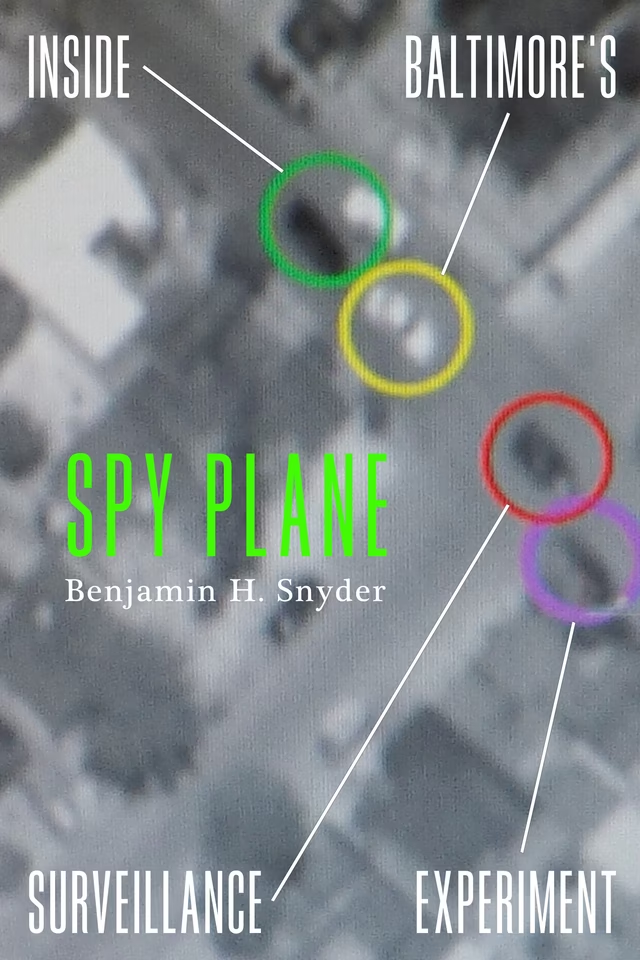
Sometime in the mid-2000s, years before it would circle Baltimore, a surveillance plane was photographing a patch of desert near the Mexico-United States border. In service of the U.S. Border Patrol, the plane was capturing second-by-second images of movement on the ground. The footage revealed a long, single-file line of people moving toward the border. Analysts flagged it as a train of drug smugglers and quickly dispatched border agents to their location. The agents arrived on the scene to discover a herd of cattle, grazing in a line. This minor tale of technological ineptitude paired with aggressive border policing exemplifies the glitchy history of Wide-Area Motion Imagery (WAMI) surveillance. This history shapes the case study of Spy Plane: Inside Baltimore’s Surveillance Experiment by Benjamin H. Snyder, an insider account of the technology’s brief time above one U.S. city.
The plane above the border used an experimental technology called Wide-Area Motion Imagery (WAMI). The surveillance relies on a camera-covered aircraft taking wide-angle photographs of thirty square miles of ground below. Every second, it snaps one gigantic photo. The footage is then stitched together for analysts in a distant control room. They use proprietary software to identify a target and track their movements forward or backward in time. Once they’ve made an ID, the analysts dispatch state agents to the target’s exact location. The technology promised a new era of power and efficiency in modern surveillance. It was “Google Earth with a TiVo capability.” Others compared it to a time machine. But, in practice, the tech would never match the hype.
The spy plane was created inside military bureaucracy, but the project was led by an extremely un-bureaucratic man named Ross McNutt. The main character in Spy Plane, McNutt was a believer in the philosophy of “move fast and break things” (a Mark Zuckerberg “core value” and eventual cliché of tech startup culture). If it worked for Silicon Valley, why not for the military? With an M.I.T. doctorate in “Rapid Product Development,” McNutt was primed to reject testing in a controlled setting in favor of real-life experimentation. Naturally, his test subjects for the surveillance prototypes would be people.
During the U.S. invasion of Iraq, McNutt was teaching at The Air Force Institute of Technology. He and his students partnered with the marines to test a new surveillance plane on the people of Fallujah. It was, in his words, “a class project that had actually run amok.” Around this time, McNutt also worked on the previously mentioned experiment with the U.S. Border Patrol. But in 2007, he decided to leave the military and take his exciting new tech to the private sector. His new start up, Persistent Surveillance Systems (PSS), would employ the same “fast failure” philosophy and leverage his technical experience with WAMI to sell spy planes on the North American market. McNutt’s primary customers would be city police departments.
It’s a familiar story: metropole police tactics are first refined through imperial violence on international populations. City cops often receive the military’s hand-me-downs in the form of weapons, vehicles, and training. And according to McNutt, this tech would be good for Baltimore, an eye in the sky to aid detective work.
PSS initially obtained (very brief) contracts in Juárez, Dayton, Compton, and Philadelphia. But skepticism from city officials and resistance from community members shut the project down each time. Undeterred by these failures, McNutt continued to make a public case for police departments to use his WAMI technology. Appearing on a 2015 episode of the Radiolab podcast, he argued: “U.S. cities have just as large a problem as we do in Afghanistan and Iraq, only it’s not IEDs, it’s crime.”
After his podcast pitch, McNutt received a phone call from an interested listener: Texas billionaire John Arnold. “If you can find a place to try this out, I’ll fund it,” Arnold told him. With the billionaire’s backing, the spy plane experiment could now proceed without the need for public funding or even public awareness. All they needed was a police department willing to turn their city into a surveillance lab. The place they found was Baltimore.
McNutt’s PSS formed a “public-private partnership” with the Baltimore Police Department (BPD) called the Aerial Investigation Research (AIR) program. As an untested experiment in city surveillance, the corporation’s planes would film a second-by-second composite image of Baltimore from above (during daylight, if the weather was clear). Then, their analysts at the PSS offices would review the footage and relay the locations of suspects to BPD.
The spy plane began flying over Baltimore in January 2016. When the story eventually broke in August, negative reaction was swift. “SECRET CAMERAS RECORD BALTIMORE’S EVERY MOVE FROM ABOVE” warned the first headline to bring public attention to the program. Widespread criticism followed and the AIR program was quickly grounded.
In response, McNutt changed tactics. His tech firm shifted from secrecy to a marketing offensive, promising to address the economic and safety needs in West Baltimore. This time around, PSS framed the plane as a helpful tool for stopping police misconduct. It could create community empowerment (“turn the cameras around”), accountability (“we’re big brother’s bigger brother”), and most importantly, economic opportunity (“jobs and career development”). Their reformist pitch was enough to win a second trial. After shoring up greater community buy-in, the spy plane was back in Baltimore with another contract beginning December 2019. As part of the new arrangement, PSS agreed to let external evaluators come in and monitor the program. In their new era of transparency, PSS granted researcher Benjamin H. Snyder “total access to the inner workings of the program… an unprecedented look at how a small startup develops and deploys a new tool in the exploding market for law enforcement technology.” Snyder’s peek behind the scenes of a private firm collaborating with local police would reveal significant flaws and become the basis for Spy Plane.
Less than a year later, the program was shut down for good and a federal court deemed the technology unconstitutional. Though short-lived, those cameras above Baltimore were an instructive example of an increasingly common style of collaboration. These partnerships produce a hazardous union of philosophies: “move fast” meets “broken windows.” The story of Spy Plane exemplifies the trend of police departments and technology capital collaborating to experiment with surveillance, in order to harden the racialized borders of urban space.
*
By the time PSS arrived with a spy plane, Baltimore police already had a reputation in the industry as eager collaborators. For decades, BPD had been partnering with the city’s business class to protect key investments, primarily via increased surveillance of downtown real estate.
In 1990, a group of business owners calling themselves the Downtown Partnership were concerned. They worried about the presence of poor and unhoused people deterring shoppers in their commercial district, so they created the “Clean and Safe Program” (paid for by a surcharge on association members’ property taxes). This program funded a private police force and led trainings for city police to employ a “broken windows” strategy.
In his notable book on the impact of Baltimore’s racial segregation, Lawrence T. Brown describes a divided city: a central north-south corridor connected to a stretch of downtown waterfront creating a “White L” and two large “wings” spreading out on either side forming the “Black Butterfly.” The two places are “remarkably good proxies,” Snyder explains, “for understanding the spatial distribution of just about everything in the city. Property values, private lending patterns, public transportation infrastructure, abandoned buildings, structure fires, toxic lead exposure, access to safe cycling lanes,” you name it. Centuries of institutionalized racial segregation had deeply cleaved the city, the Downtown Partnership was interested in guarding the dividing line.
Snyder also employs George Lipsitz’s concept of the “White Spatial Imaginary” to explain the kind of “cultural paranoia” from segregation, which “taught well-off communities to hoard amenities and resources, to exclude allegedly undesirable populations, and to seek to maximize their own property values in competition with other communities.” Ongoing segregation fuels the White Spatial Imaginary, which demands policing toward an ever-elusive sense of security. This Imaginary was at work in the “Clean and Safe Program,” one step in the ongoing experiment to make “the city ‘feel safe’ for those living in the White L by monitoring and regulating the movement of Black bodies in White spaces.” Snyder convincingly argues that it’s the racial borderlands between the two Baltimores where the experimenters chose to concentrate the surveillance.
As Harsha Walia explains in the collection Resisting Borders and Technologies of Violence:
“Borders are an ordering regime, both assembling and assembled through racial-capitalist accumulation and colonial relations that create migrants yet criminalize migration. Borders function to maintain asymmetric relations of wealth accrued from colonial impoverishment and racial capitalism, ensuring mobility for some and mass immobility and containment for most—essentially, a divided working class and system of global apartheid determining who can live where and under what conditions […] The border, the prison, the sweatshop floor, the refugee camp, the reservation, and the gentrified gated community are all part of the same bordering, carceral system operating through dispossession, capture, containment, and immobility. The fight to abolish border surveillance is thus better understood as a fight to abolish the border itself.”
These border fights (including those visibly and invisibly within cities) are not new. It was 1995 when the same Downtown Partnership in Baltimore was inspired by a surveillance camera system in London. “Monitoring in Britain has had a dramatic impact on crime and has helped assist in arrests. We’re hoping to emulate a lot of those things here,” said the public safety director for the Downtown Partnership. They funded a pilot program for closed-circuit television (CCTV) surveillance with sixteen security cameras called Video Patrol. The goal was to “monitor the border between the edge of the White L and the edge of the Butterfly’s western wing, which runs along Martin Luther King Jr. boulevard.” The BPD Commissioner himself succinctly explained the role of the police surveillance between borders: “We are doing what we can to provide a safe and prosperous financial district.”
The number of cameras quickly ballooned. Then, in 2005, Mayor Martin O’Malley and the newly-created Department of Homeland Security (DHS) expanded the program with CitiWatch, a massive network of 400 CCTV cameras concentrated along the borders of the city’s majority white areas. Snyder contrasts the “camera deserts” in the East and West neighborhoods where more fatal shootings occur (despite gun violence prevention often being the stated reason for increased surveillance in Baltimore) with the heavy concentration of cameras marking the borders of downtown. CitiWatch doesn’t stop violence in Baltimore, it follows the logic of the White Spatial Imaginary in pursuit of preventing “violence from ‘spreading’ into areas where it ‘shouldn’t’ be allowed to go.”
Snyder’s account of the spy plane shows how these CCTVs, more than just prelude to aerial surveillance, actually remained crucial to the day-to-day operations of the program. The plane could track the movement of dots on the map, but analysts relied on on-the-ground cameras to make identifications of cars and people for the police. The supposedly futuristic tool was ultimately dependent on the same old video cameras at the gas station or corner bank. As you’d expect, PSS mostly watched people where the cameras were. Despite new experiments, the project of police surveillance to serve the White Spatial Imaginary in downtown Baltimore was a decades-long constant.
The 2015 Freddie Gray uprising, however, ruptured Baltimore’s segregation regime. Righteous Black rage spilled over the borders into the downtown Inner Harbor. The cover of TIME magazine showed a mob of cops in riot gear chasing a young Black person down the street in front of Oriole Park. It was an historic anti-police rebellion in a Black city long forced to be a policing lab. It was also bad for business. Suddenly the Downtown Partnership and their guards no longer had total control of the commercial district. The spy plane arrived, then, in a tense lull between the massive popular rebellions against police in 2015 and 2020. It was a time of heightened panic for both real estate capital and BPD, mostly unfamiliar with losing their grip over coveted real estate.
With his Silicon Valley-style of overpromising and a U.S. military resumé, McNutt was an easy partnership choice. But far from the only game in town, PSS is part of a growing industry of surveillance firms that have given cops and soldiers new tech in recent years. Companies like PredPol, ShotSpotter, Axon, and Palantir have signed contracts with city police departments to test new tools for monitoring and predicting behavior. As a trend, they embody capital’s impulse to experiment with surveillance policing to restrict movement in response to ever-growing instability.
What comes through in Snyder’s depiction of this ‘experimentation’ is not any kind of scientific method, but a clumsy process of guesswork. The mistakes of Baltimore cops are a familiar mixture of banal, moronic, and harmful. The mistakes of tech capital aren’t mistakes at all, they are just steps in an experiment. This framework also helps Snyder avoid the common pitfalls of surveillance discussion. As he takes pains to show, the spy plane technology was not an all-seeing eye, but a prototype with blurry video. The pixelated footage is deeply reliant on human interpretation (not to mention that aging CCTV network) and therefore susceptible to human error. This fallibility does not render the program harmless, but it creates a different kind of harm than an Orwellian imagination may conjure. In reality, the plane is not “watching us all.” But its groping reach into Black neighborhoods is still cause for alarm.
During his observations at the PSS office, Snyder witnessed multiple false identifications. The spy plane analysts frequently sent cops chasing after the wrong car shape, the wrong human dot. The footage made for deeply ineffective detective work, but it did increase the likelihood of police contact for the residents of East and West Baltimore near the White L. By characterizing the spy plane as a glitchy tool that nonetheless brought harm to race-class subjugated neighborhoods, he sidesteps the accidental hype that Big Brother fears can generate for surveillance tech, while acknowledging the real, negative, impacts for people caught in its dragnet.
From the Baltimore cops’ perspective, the spy plane came free. For PSS, the experiment provided valuable data, a potential future customer, and a boost of legitimacy. The true cost of the project was felt by the surveilled, though the public was given no say in the creation of the AIR program. Their uprising had violated the racial-spatial logic of the city, so the capitalists stepped in to give the police a shove in the right direction. Their message was not new: secure the borders.
Though the PSS technology had glitches, its focus on the racial borderlands was not one of them. In their excellent report, Automating Banishment: The Surveillance and Policing of Looted Lands the Stop LAPD Spying Coalition contextualizes data-driven policing tactics in another U.S. city: “Together, the systems that comprise surveillance and policing of land in Los Angeles extend and defend the power of the U.S. settler state.” By similarly understanding the spy plane as a strategy of urban conquest, we can make sense of the experiment’s purpose. Now, situated at the altitude of colonialism, we can also see that Baltimore’s lab is just one of many dotting the world map.
*
Though not the focus of the book, Snyder’s findings imply key connections between the Black Butterfly and other heavily policed, race-class subjugated communities across the globe. Several key sites are mentioned: England was a 1990s lab for CCTV surveillance. Iraq was a lab for the WAMI plane in 2007. U.S. Border Patrol lets McNutt test it over the Mexican border. Los Angeles and Gaza are likewise referenced as places where “surveillance became privatized, and thus big business for tech firms hungry to demonstrate their tools.” The invocation of these surveillance “labs” connects Baltimore to other sites of imperial violence across the globe.
These connections are also direct collaborations. A U.S.-backed Israel has conducted decades of settler experiments, becoming a “global leader in spying technology and defence hardware,” thanks to their tests on Palestinian people. Baltimore police have traveled to Israel, along with “nearly every major police agency in the United States,” to receive training in counterinsurgency and occupation enforcement. Tech capital has been an active participant in this experimentation and Israel has long been branded the “startup nation.” From above, the local alliances of tech capital and cops reveal themselves in a connected, international web.
In this web, border regimes exist at multiple levels simultaneously. State agents guard the lines between nation states, primarily to restrict Global South migrants and refugees. Within nations, even within cities, related agents guard lines of racial space. We can see the White Spatial Imaginary at work across all these levels. And as escalating crises (in particular, climate) push more of us into motion, these border regimes are growing. Private firms are eager to offer untested tools to restrict and capture, billionaires are ready to fund the experiments, and police are happy to test them.
Unfortunately, the book stops short of taking an internationalist approach to this global problem. Nor does it call for the abolition of the unreformable: the “public-private partnership” (a contradiction when profit accumulation threatens public well-being) and police surveillance itself (in place to guard that accumulation). The activists who challenged the AIR program (and first branded it “spy plane”) receive only passing mention. Campaigns like #NoTechForICE don’t feature here, but could offer instructive examples of popular resistance to the aligned threat of tech capital and state repression. This challenge, according to organizer Jacinta Gonzalez, requires “a multi-sector movement” that includes, for example, the migrant workers most vulnerable to ICE capture and the tech industry workers connected to their surveillance tools.
Still, Spy Plane’s focused account of one experiment is an instructive story of contemporary policing, in all its inhumanity and heartening limitations. The book’s conclusion also frames an important question: How do we create real conditions of community safety that police only claim to offer? “The most promising experiments I see are happening parallel to or even outside the traditional legal system, within public health approaches to violence reduction,” writes Snyder. Here, we’re reminded that not all experiments are bad. While the spy plane pseudoscientists are looking for ways to more efficiently wield state violence, regular people all over are refining tactics of prevention and community care.
While police and capital experiment with their tools of enclosure and capture, we are called to collaborate on shared resistance, to experiment with our own care networks and expansive ideas of freedom. The spy plane’s time in the air reminds us that the future of the Black Butterfly is linked with the future of border labs everywhere. While the spy plane has been grounded, new experiments continue. But more than just settler surveillance connects Baltimore and Gaza. A shared dream transcends artificial boundaries: freedom of movement for all, beneath a clear and quiet sky.