WARNING: Subjects in the mirror are closer than appeared.
before—
“This Barbie’s going to be a doctor,” my Instagram caption read. Yet as I walked across the stage of my white coat ceremony at Harvard Medical School, I felt the opposite of a Barbie.
“Wow, all your classmates are so… fit,” my partner whispered earlier that day as we all trickled in under the giant white tent on the med school quad. Sizing up my peers for the first time, you didn’t need to tell me twice—one of these is not like the others.
***
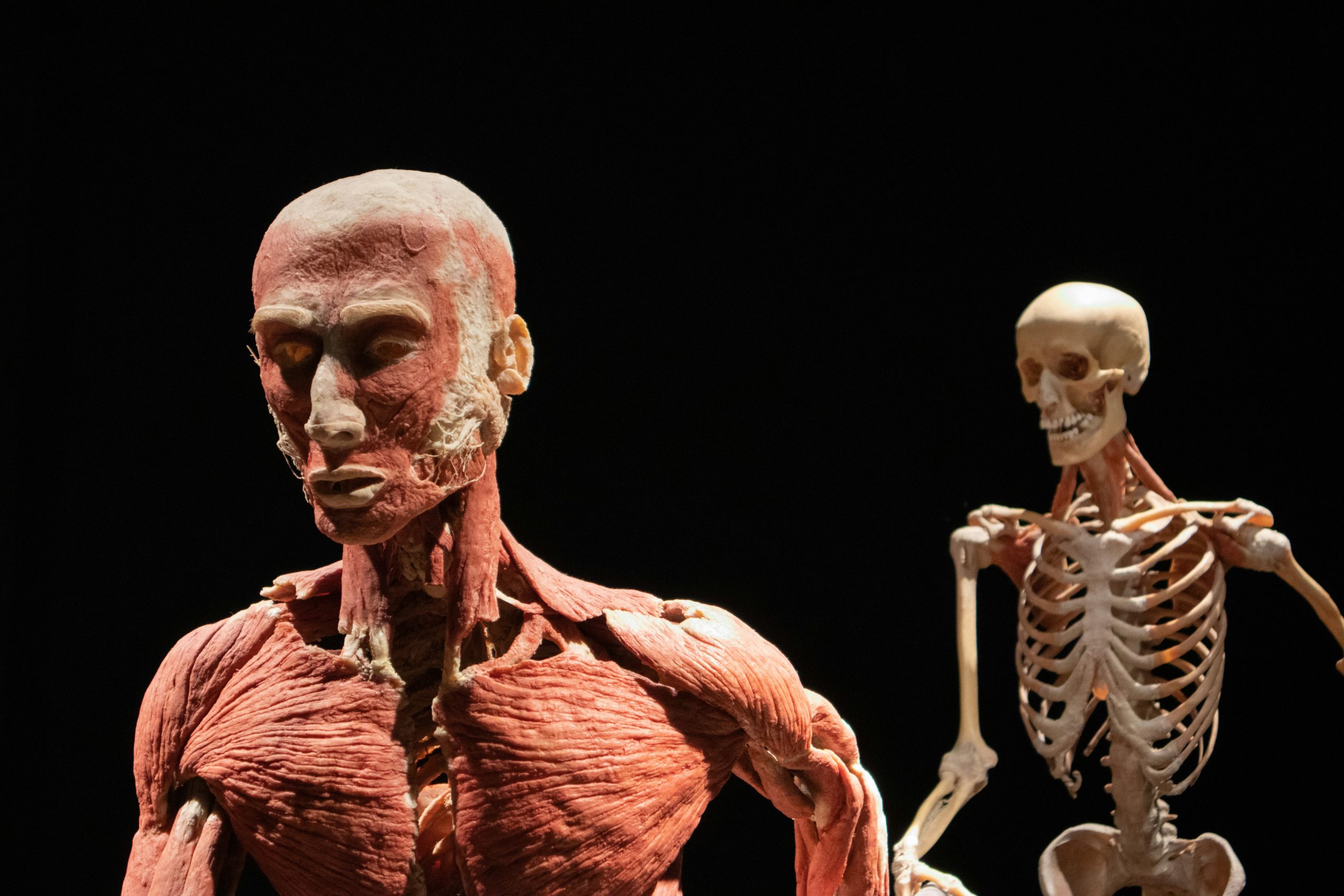
I was fourteen when I saw my first skinned human. It was an exhibit, you see: the traveling anatomical circus, Body Worlds. As I walked through the maze of petrified people—flesh removed, ribeye red muscles on display—I was fascinated.
Each full-bodied specimen was frozen mid-motion in an everlasting story: a fossilized figure skater here, plasticized poker player there. It was cool but horrifying, how the result created a being both dead and alive—Schrödinger’s humans? Still, there was something pleasing to my eye, a beauty in this gallery of grotesque.
Other specimens were bits of bodies, carved and diced in different ways. A pair of lungs paired with a warning on the dangers of smoking, tarry black, shriveled lobes beside a perfect pink pair. Most striking, though, were the slivers of humans, the cross-sectional slices that splayed their insides open.
Looking at the laminated cold cut of a man’s torso—later I’d learn, cut along the transverse or axial body plane—my own stomach squelched. The layers were distinct, yellow pudding fat enveloping the muted browns and taut reds of the inner body cavity. Compared to its lean twin—fraternal, of course—the thick ring of butter-colored flesh was stark, stretched as wide as my hand. It made me uneasy. For years after, I couldn’t purge the image from my mind.
Worse, I couldn’t help but wonder—how thick would my fat slab be?
*
*
*
after—
She peers in the mirror, the image reflected back familiar but wrong, warped like a funhouse gimmick. Head tilted, she stares intently at the creature before her, this clever body snatcher.
Secretly, she never thought she’d meet you, did she?
Her collarbones cast new shadows over new concavities, contours born of new proportions. A figure she cultivated so carefully that the mirage almost feels real. Running her fingers along the stretch marks of her hips, you pause, cringing at the cottage cheese texture. He’s right, her father—I’d once been told she looks like a stuffed sausage; the marks, veneers, living testaments she’s been stretched beyond her casing.
She’s lusted for you for years, did you know?
Every morning, she crawls out of bed to check on the double, ensures her wily one hasn’t gotten away. Face painted one evening, ready to preen at her product, she looked for you, but you had vanished. Replaced with an imposter—almost had us fooled. But that’s just the thing when you’re careless like that. You miss dead giveaways, like the taste of self-loathing still slick on our lips.
Better luck next time.
***
Dry ice is frozen carbon dioxide (CO2) that “sublimates”—morphs directly from solid to gas, skipping liquid entirely. Dense, ceramic-brittle, and bone-chillingly white, this transient substance sears skin to the touch.
***
“But like, what even is a boundary?” I asked my therapist, half-rhetorically.
Doing the therapist thing, he blinked back, “What do you think a boundary is?”
I groaned.
People think losing weight feels natural and glorious, like a snake finally shedding its skin. That’s what I’d imagined: the victorious satisfaction of squishing out the last toothpaste from my tube. Oh, how it’d feel to finally be free of my fat—fucking delicious.
But instead of minty smoothness, the transformation was jarring. I felt like a Russian nesting doll shrinking in lopsided jolts, each mother doll splitting open to reveal the daughters I’d devoured. I had an app, actually, that tracked this mass of digested daughters—helped me visualize my baby bump growing in reverse. Every five pounds, a new milestone awaited me: a bass guitar, fifteen soccer balls, and my personal favorite, “Now that you’re twenty pounds down, you can say that you’ve lost the weight of a corgi!” I’ve always loved dogs—just didn’t know I’d eaten one.
I’ll lament, some of the later milestones were anticlimactic. Sixty pounds was twelve red clay bricks and my grand finale of 75 came as “nearly the same weight as 310,000 honeybees!” I prefer my methods of conceptualization. If you laid out the total inches of adipose tissue I’d lost across all body axes end-to-end, I’d whittled off nearly two feet in body circumference—the height of an average toddler. Birthing an entire two-year-old? Now that’s a milestone.

As my cheeks deflated, I saw less of myself from my passenger mirrors. A toothy smile compressed less visual field. Less peripherally self-conscious, I felt more settled, less restlessly aware of my space.
Yet other parts of me came more into focus. I gawked at my face gains, born from face losses. Noticed my new formed silhouette. The shadow pooled at my feet had shifted, elbow dimples less prominent.
This negative stalked me, walked the concrete at my side.
“Do you know what you look like from the side?” my father once asked. Turns out, his question was rhetorical. Whipping out his phone, he revealed my profile receipts.
“Fuck off!” I lashed, my stomach dropping six inches.
But it was too late. The rendering left a residue that couldn’t be carved away.
According to Google, the answer is simple:
Boundary (noun): a line that marks the limit of an area.
***
Phantom limb pain (PLP), affecting sixty to eighty percent of patients with acquired limb loss, remains difficult to manage and often requires multimodal treatment approaches. The phenomenon arises from maladaptive brain remapping—a mismatch between sensory and motor cortices—following profound anatomical loss.
Historically, a simple and cost-effective treatment has been mirror therapy, where the reflection of the intact limb’s movement creates an illusion of movement in the phantom limb. I formally learned of these mechanics during college, from V. S. Ramachandran’s Phantoms in the Brain.
Way back in middle school, though, I’d tried out this illusion myself. We were assigned an at-home science project, and I’d recently seen a news article describing mirror therapy for stroke rehab—the set-up seemed simple enough. With a full-length mirror and a couple stacks of books, I mimicked the conditions: sat at a table, arms outstretched and straddling each side of an upright mirror. The trick is to ensure the arm behind the mirror is fully obscured.
I first tried it the correct way, peeking in the mirror, wiggling my visible fingers, watching the mirror wiggle back. Nothing. So then I tried the opposite, moving my obstructed arm while keeping my visible arm still.
The clammy flash of death—instant rigor mortis. Completely ineffable, the sensation, a perceptual vertigo that split my consciousness in two. Watching my arm lie stone-still but knowing I’d moved it felt like pulling my spirit straight out of my bones.
I’d forgotten about that memory till recently. Imagine my surprise when I stumbled on the concept phantom fat.12
***
Lately I’ve been thinking about the differences between the words “savor” and “indulge.” Inherently, neither definition is tied to quantity or length of time. Someone could savor a chocolate buttercream cake or indulge in a slice. The true distinction lies in permission.
Skinny women savor food, fat women indulge.
***
My first winter in Boston, we didn’t get much snow. There was a little, enough that I still galloped in the snowflakes, snapping shots of the occasion. My second winter solstice came with the bells and whistles of a typical Boston season. Amidst the white mist, I took a frenzy of photos—some of my favorites from the year. It was good snow, the flawless, fluffy-blanket kind. A lot had changed but my propensity for photo documentation hadn’t.
Almost a year apart, with conditions presenting picturesque, I snapped a snowy selfie in the HMS quad. More recently, I made a mash-up of these look-alike shots—tried to subtract my difference. Seeking an impartial perspective, I fed this before-after Frankenstein to an AI platform, alongside the prompt, “Describe these photos.” Here’s what it regurgitated back:
These are two cheerful winter photos of young women enjoying snowy weather.
In the left photo, a woman wearing clear glasses and a knit beanie labeled “BOSTON 1630” is smiling warmly at the camera. In the right photo, another blonde woman is wearing clear-framed glasses pushed up on her head. Both photos appear to be taken in the same snowy location with historic-looking stone buildings visible in the background.
Both women appear happy and are enjoying the winter weather, creating a lovely pair of candid winter portraits.
Naturally, I then became a bit obsessed with testing the limits of modern facial recognition technology; within minutes, I sent off another dozen n=1 image analysis requests. Result: AI correctly identified the photo subjects as the same person around half the time—if the resemblance conditions were just right. This echoes how I often feel: stuck in the middle.
I’m double exposed.
*
*
*
forevermore—
If you think about it, isn’t it ironic? A human conquering self-control while losing control of themselves. Though I guess that’s how it must work. After all,
energy cannot be created or destroyed.
Simply displaced.
***
At the end of my triumph, I feel mostly fear.
I’d been expecting some compliments. Or maybe, I wanted them. But when I came home for Christmas, the comments were uncanny:
“You look so hot, so skinny!”
“Holy shit—I almost didn’t recognize you.”
“Wow, you really lost your ass!”
“So, how much do you weigh?”
It was mortifying, any and all attention. I became enamored with the idea of people who only knew me after, who never witnessed the self-split. If I’m so hot now, then what exactly was I before?
Invisible. I remember around 160 lbs., toggling the line to be seen: it was summer, and I was in a body that might finally be caught dead in a swimsuit. Sun beating down, I donned a black one-piece and a red cover-wrap skirt. When a man whistled, “Nice outfit!” as I walked by, I paused to double check—had he meant me?
Six months later, further dissolved, I tried on the swimsuit again; relished the pride at finding it too big. Peeking down at my body, peeling the suit off, I wondered what to do with my discarded skins. Should I donate the evidence or keep the mementos? At the least, they could be maternity outfits.
The decision has been sticky, especially when I think of my odds—most patients gain back all their weight. Regain is an unfair statistic, a metabolic prophecy for all who’ve indulged. One day in class, I found myself skimming a Nature article that distilled this fate: adipocytes retain long-term epigenetic “memory” of prior obesity that persists even after dramatic weight loss3. Squinting at the figures, sifting through the discussion, my answer became clear: obesity is a lifetime sentence.
I was reminded of this recently when I went to visit mi familia in Texas. The version of me who visited last had been 60 pounds heavier—I remember her vividly. At my mami’s 60th birthday party, she sat with mi prima, María Alejandra, earnestly listening to her weight loss story. Method: sleeve gastrectomy.
Marveling at her result, she’d asked her cousin a slew of questions. María Alejandra leaned in close, detailing the wins and woes of surgically shrinking her stomach. Eating three bites of a hamburger and feeling stuffed full; not actually being too hungry anymore. But one thing, she said, never changed: “Todavía me provoca la comida… We will always still have a gordita mind.”
I know all this now.
Now, I’m wide and fully awake.
***
A concept I find fascinating is matter.
What is matter?
Matter is any physical substance that has mass and takes up space. Everything in the world around us is made of matter, including us. So, if a person loses mass, do they matter less?
Why yes, they do.
Energy deficits shift the body to break down “fat matter.” Specifically, triglycerides in adipose tissue are cleaved into free fatty acids, move to energy-hungry cells, and enter their mitochondrial powerhouses. Here’s where the vanishing act happens, folks: mini combustion reactions chop these fatty acid chains into 2-carbon compounds that enter (remember high school bio?) the Krebs Cycle™. From here—goriest details spared—the carbon changes form a ton, electrons are passed around, cellular energy is made, and carbon dioxide and water are excreted as waste.
Wait. Have I lost you? Allow me to trace the full path of fat so we might visualize this matter: “fat matter” → fat cells → long fatty chains → 2-carbon links → magic biochemical conversion → ATP + CO2 + H2O. For every pound of fat loss, eighty-four percent is exhaled as carbon dioxide while sixteen percent leaves the body as water (pee, sweat, tears, saliva).
It’s wild—we literally breathe-pee ourselves out.
What does my mass loss look like, you wonder? I was curious too, so I crunched some stats. Assuming standard body conditions: 75 lb → 34 kg fat → 28.6 kg CO2 → 16,500 L CO2 → 989,000 breaths ≈ 57.3 days of normal, resting breathing.
I find the math rather beautiful. Wouldn’t you agree?
75 lb
× (0.4536 kg / 1 lb)
× (0.84 kg CO2 / 1 kg fat)
× (1000 g / 1 kg)
× (1 mol / 44.01 g)
× (25.4 L / 1 mol)
× (1000 mL / 1 L)
× (1 breath / 16.7 mL CO2)
× (1 day / 17,280 breaths)
≈ 57 days of ordinary exhales
Of course, I didn’t breathe out all my matter at once.
She dissipated gradually, like whispers of me.
But if you did contain my emissions, used them to fill, say
average party balloons
the carbons of my fat breath could’ve filled a thousand.
Perhaps they’d be yellow.
Endnotes
- ) T. O. Perdue et al., “Majority of Female Bariatric Patients Retain an Obese Identity 18–30 Months After Surgery,” Eating & Weight Disorders 25, no. 2 (2020): 357–364, https://doi.org/10.1007/s40519-018-0601-3.
↩︎ - ) Katariina Kyrölä and Harri Harjunen, “Phantom/Liminal Fat and Feminist Theories of the Body,” Feminist Theory 18, no. 2 (2017): 99–117, https://doi.org/10.1177/1464700117700035.
↩︎ - L. C. Hinte et al., “Adipose Tissue Retains an Epigenetic Memory of Obesity after Weight Loss,” Nature (2024), https://doi.org/10.1038/s41586-024-08165-7.
↩︎