“This is racist,” Helen hissed, eyeing the moon-faced portraits strung up on the stone walls with disdain. A group of us had gone to Segovia for the day and, though there was nothing else to do in the city we’d traveled two hours by bus to see, we had all argued extensively over whether or not it was worth it to pay the eleven euros for a tour of the famed castle. It wasn’t. “Why are they all white?” She demanded to know. Helen was wearing a green tube top—sans bra—and the coolness of the day enticed her nipples into buds from under the thin material. Men on city tours with their families glanced once, twice at her as we passed, perhaps hoping to see if they’d flower. Thrice.
“Spanish people are white,” Yara told her, not unkindly, as she continued her perusal of the 12th-century Spanish noblemen who had once inhabited the medieval structure we now walked with feigned interest. They stared back at her with blank eyes—eyes stuck on canvas that wouldn’t know the precise and well-shaded brushstroke capable of an artist until Europe’s popularization of oil paints in just a few hundred years.
“Huh,” Helen breathed, pinched expression falling with this newfound knowledge. “Who knew?”
Helen and I had been friends since the first year of our ex-patriatism—friends in the way that twenty-something women could be: seemingly out of the thin air in which we flew and flocked together like birds, the loudest caw-er organizing brunches that took unwitting restaurants an hour to make room for. And suddenly at one of these brunches, mimosas held aloft for the group photo—“pass it around and tag yourselves, girls”—you found yourself seated next to someone who would probably be your best friend in six months’ time. All you had to do was chat. “You know they’re now saying that living in a new country changes your brain chemicals and enhances plasticity.” Each of us had read articles about it (read, as in: we all saw the same TikTok.)
I took to Helen because she was somewhat of an anomaly amongst the group: her Instagram hadn’t seen life in years, and she wasn’t dishing out generic and utterly falsified fashion compliments to make friends, foaming at the mouth and grinning at potential roommates like they were the last croqueta de jamon and you weren’t sure if another complementary tapa would come any time soon—the service was slow in Europe, and the Spanish equivalent to “the customer is always right” was “sal de mi puto restaurante.”
Anyway, I’d sat next to Helen at one of these fever-dream brunches and we’d gotten to know each other rather quickly—she had, in fact, also read that article. And, like the rest of us, Helen was in the process of reinventing herself—something I would soon come to find Helen did very often.
Unlike all of our other it’s-too-early-to-say-we’re-friends-but-we-do-anyways who had watched Money Heist on the flight over and were eager to meet a cigarette-scented European beau that would perfect our ceceo, Helen barely bothered to learn the language—instead utilizing her keen ability to facially express her needs to grocers and skeptical metro attendants when she took to the streets of the Madrid. And if that didn’t work:
“Guava,” Helen deadpanned into the butt of her iPhone 9. She’d had the 15 when she first moved to Spain, but she kept getting them stolen. Helen downgraded herself as punishment every time she fell victim to the potent stench of tourist wafting from her unzipped purse.
“Guayaba,” her home button replied.
Helen looked up at the Mercadona worker she was now keeping from sweeping the dairy aisle.
“¿Tienes guayabas?”
“No,” he said, in perfect English.
In our second year as English language assistants when—through an unknown force in our placement program—Helen was sentenced to mandatory Spanish lessons, I watched her take long pulls from her bong, bingeing reality television over the screen of her requisite Zoom classes with an indifference I craved for myself. Helen hadn’t seen Kourtney and Khloe Take Miami in nearly a decade, and she spent that autumn telling me how much joy this nostalgic rekindling was bringing her, actively ignoring WhatsApp invitations to language exchanges, flamenco festivals, even the annual Hispanidad parade on Gran Via. Helen’s entire brand was wrapped up in being reclusive and hot. Marijuana ash topping over-turned Dickens. I hadn’t read any Dickens, and it pissed me off that Helen had, that her copy was spine-lined with use. Probably highlighted, too. Not a single blank space in the margins.
Unlike Helen, I actually wanted to utilize my sole opportunity living abroad. But by the time I got home from the extra English tutorings I’d agreed to teach in order to make enough money for my portion of the rent, I was too tired to convey my own television preferences, and I, too, could admit that Kourtney and Scott’s tumultuous relationship (especially after Mason’s arrival in season two) was providing me with enough serotonin to never have need for venturing outside again. I, too, wanted to nosh on the seven euro box of Cheez-Its Helen purchased bi-weekly from the Taste of America two blocks over. Be reclusive and hot.
But I wasn’t like Helen. And despite the fact that we’d crossed paths, we were from different worlds, entirely.
We’d become roommates by happenstance. I’d found a three bedroom close to Sol for only fifteen hundred euros a month, and I’d already extended the offer of one of the bedrooms to Yara. Yara was Canadian and I liked telling people that I had friends that weren’t American. The snag was that one of the bedrooms was significantly shittier than the other two, so finding a third was going to be tricky. But when Helen had first walked in the place, expertly ducking under the lone rafter that threatened cranial contusion on unwitting guests, she’d immediately called dibs on the aforementioned shitty bedroom, marveling at its lack of windows and the mattress that lifted to reveal storage within the hollow of the frame.
Helen was a good roommate. She never came home loud and late, and she never left her dishes in the sink for more than a night. Not that I was picky about that sort of thing. Even better, she didn’t mind that I was a bad roommate: Jorge, the tip-frosted Spaniard from Bumble I was seeing, was always over, always using all the hot water, and always eating her walnuts. But Helen was nice to him and I was glad for it because he was cute and he always had ecstasy and I liked that about him—his consistency, not the MDMA. I wasn’t known to dabble.
Helen coughed—thick—when she laughed, and she phone-ordered sushi from Dragón Rojo several times a week, always sharing her shrimp tempura rolls and saving the soy sauce in the fridge, declaring it communal. She went to bed early most nights and her door was usually closed before nine, the soft whirring of her fan whispering within. If she flicked her fan on in the winter months, we knew she was masturbating before bed. In summer, who knew how often she partook.
Helen was a good friend. She’d recently been getting back in contact with lots of her old pals from the States, thanks to the hurricane. Many of Helen’s friends from home had beach houses in Tampa—her mother reminded her of this on their sporadic five-minute FaceTime calls that Helen groaned about into the ether of the apartment after a hurried and rude hang up—and she’d rekindled lots of relationships in the past few weeks by calling around to make sure insurance was covering all the damage. She’d bemoaned her devastation at not having joined-in on one last hurrah at said beach houses with them this past summer. But most of her friends from home were working big-girl jobs by now, so she knew that lounging around in the weighted heat and slumming it with me in Madrid would be better than subjecting herself to the reality that she was not, in fact, quite yet elevated to the same big-girl status of her employed friends back in Connecticut. Yara was interning somewhere prestigious and medical. I’d wanted to go home to visit my mother, but neither she nor I had had the funds to buy a flight.
On the few occasions I’d agreed to splurge two euros on a ticket, Helen and I would pack books we wouldn’t read into our new environmentally-friendly European habit of carrying cloth totes everywhere and metro to the public pool in the hot months of August when madrileños scattered and segregated: the wealthy Spaniards jetting to the Canaries for summer holiday while the rest fled to their pueblos to see in-laws. In turn, the Americans that now inhabited the Spanish cities—much to the chagrin of the weekly tourist apartment protesters—either traveled home on their parents’ sky miles or strategically placed standing fans around their stifling city apartments. All three times we went to the pool that August, Helen and I would bronze under the sun while we feigned summer slumber, the both of us eyeing naked Spanish women from behind darkened lenses, her and I tan with envy over their large breasts and the confidence that the nudity rules (or lack thereof) in their country had instilled in them since birth.
That summer, she truly was my best friend. And I fucking hated her.
I harbored hate for Helen simply because Helen was rich. And I was proud of myself for being able to admit this, though I only did so within the confines of my inner monologue.
I knew Helen was rich because anyone could spot a rich girl by watching how much weed she let fall to the floor. If she hadn’t been a profligate stoner, then I’d have known after a glance at her arsenal of organic tampons, the stockpile she kept in her collection taunting my tainted uterus from the next room, a constant reminder that I was liable to post-tampon-use diseases per recent information that had come to light about Tampax. Sometimes I stole some of her rich-people tampons out of spite, but—seeing as how she was both rich and blessed with a light flow—I don’t think she noticed her supply waning.
I’d gleaned enough information to know that her father had made their family fortune from breaking into a famous person’s private estate and stealing personal correspondence to sell to a sleazy tabloid back when Helen was in grade school. The letters were never released, per a settlement agreement with the press, but his pay-off had gone through. Now, the whole family summered in St. Barts and their dogs had dermatologists. Helen spoke of Cece’s dermatitis often.
Helen, I’m sure, was similar to the pompous kin I’d envisioned for her back in New England—or, at least, she used to be. As she was wont to do, Helen had changed, metamorphosed: a fact she further emphasized with her mane of two-toned, tangled hair—tawny now and twisted into a French plait, tamed taut by an elastic scrunchie four decades too late. Once dyed buoyantly blonde, Helen was now letting her tresses grow out in their natural color, the blunt line seemingly spray-painted at too close a range like a crown, the golden-blonde hues dissecting noticeably against the muted beige that sprouted from her root—both an homage to her quarter-life crisis and a symbol of her newfound identity. If it was true that hair grew half an inch every month, then every month you could deduce how long it had been since the Exodus of her former self, the growth of not-quite-brown stretching from her scalp, emitting the truth in wake of the former platinum dye she’d enforced bi-annually since her thirteenth birthday. But now, the bleaching was over, and she talked—with a whimsical and far-off look in her eye—about cutting her hair short, dreaming of the ease with which she could put on a hoodie.
Though I respected her statement and what it meant for her, I had to admit—again, only to myself—that the platinum coloring suited her better.
Helen was going to be a writer—a detail that irked me because I, in fact, was going to be a writer, too, but she’d said it first so now it just sounded like I was copying her. Helen was five years my junior but I still somehow felt like she was always outdoing me. We’d both decided it was our last year abroad. “Time to grow up,” we’d agreed solemnly, my eyelid twitching of its own accord—a defect of the subconscious reminder that she was young, spry, getting her shit together right before she hit peak fertility while my own fecundity was already in rapid decline. I was avoiding job-hunting, considering going back on my word to Helen and moving to Hungary. Helen was in the process of finding a book agent for her manuscript and if she didn’t find one before the end of the Community of Madrid 2024-2025 School calendar year, then she was going home to live in her mother’s basement until she got something published. I pictured her mother’s basement with a movie theater, complete with the red-lacquered aluminum popcorn cart in the back corner that hadn’t been used since the first Christmas they got it. I pictured gargoyles. “But,” Helen said with a wrinkled nose, a dismissive wave of her ash-stained fingernails, a confidence I never had at twenty-three percolating from her ginormous pores—the one silver lining in being her friend. “It doesn’t matter, anyway, because I’ll find an agent before then.” I didn’t mention that, book agent or not, she would probably still be in her mother’s basement come fall.
She was good, too. At writing. As much as I hated to admit it. She was cutting with her words, eloquent. She mostly wrote about people she saw on the street or people who were long dead, rendering her safe from legal repercussions of likeness licensing—anyone’s story could potentially be up for grabs for her to gild with her own Googled synonyms, whittling witticisms, and weaving anecdotal wonder along the edges of someone else’s elegy. Even mine.
Once—once—I’d asked Helen for writing advice.
“The quantity breeds the quality,” she’d told me sagely.
“What?”
“The quantity makes the quality,” she adjusted.
Um, no. I fucking know what breeds means. But I had an inkling that she was telling me something else. Being intentionally cryptic. I wasn’t writing enough and she saw it—noticed it by happenstance, really—and now she couldn’t not notice it to the point where she had the audacity to verbalize this observation even though I’d technically asked her to. Perhaps I was projecting. Or perhaps I wasn’t writing enough.
But—daily—I was typing scintillating one-liners in my notes app. Great tidbits, biting quips that had suddenly emerged to me from the intricate recesses of my chewy pink brain matter that would fit perfectly in a future story. She smelled earthy, like carrots, I wrote, smiling into my phone screen while I waited in line at the vegetable stand.
Unlike myself, Helen was always writing. Sometimes I would wake up in the middle of the night to pee and hear her incessant typing. Juices flowing. I’d thought that writers were all procrastinators that never really found the time to write. They talked about this. Openly. Often—on podcasts I’d seen clipped into TikToks. It crossed my mind that writers were maybe just saying they weren’t writing to fool the rest of us so we felt like it was okay, thus holding us naive ones back while they made their way to publications and recognition. Their incessant type to the top. Genius.
Helen worshipped Anne Rice and she had a keen interest in metaphysics, though she preferred to call it “casting.” We would cast every night, the event made more or less sacred depending on the phases of the moon, which Helen checked religiously in her Moon Phases app. One evening, after she’d gotten a phone nabbed in the street, she ran to the windows and huffed in defeat about the fogginess of the night sky. If she’d looked out the windows on the opposite side of the apartment, she could see the moon just fine, but I kept this to myself. For some reason, it felt like mine.
Our casting sessions were manifestations of things we wanted to happen in our lives. Mine never came true, but Helen’s always somehow seemed to.
In roundabout ways.
Helen would skip home gratefully, electrified and full of reverence after a “vibration in the universe” had bought her cup of coffee. She hadn’t noticed the man in front of her in line, who’d been giving her eyes since her wind-blown entrance; or she blatantly ignored the fact that she’d merely collected enough points in her rewards account. If the elevator was already on the first floor when we arrived back at the flat—our drastically differently priced coffees in hand—she would gasp, swearing that she was the luckiest person in the world, though it was more likely that no one had last used the elevator since we had. Ten minutes prior.
“Perspective,” Helen had once instructed, somberly, after she’d manifested a free pedicure and my wish for my mother’s sarcoma to go away hadn’t come to fruition.
She was delusional, but in an inspiring way.
Helen had her vices, though. Her pot-smoking habit, in particular, was of great personal shame to her, and she was often recruiting Yara and I to help her break it. Originally, she’d tried hiding her addiction from us, embarrassed and unsure if we would approve. But, once we re-signed our contract and added another year to the lease, she stopped caring entirely, whistling clouds of smoke into the air as she gabbed about skincare trends, subjecting us to relentless diatribes over regulating your hormones with herbal teas and foods that wouldn’t spike your glucose.
Sometimes, in a state of onset cannabinoid paranoia, Helen would fall back into her old ways of hiding her affliction from us. She masked the smell well with open windows and Zara home sprays but—even if I hadn’t noticed the damning cubes that would cool the smoke in her stem, now discarded and lying culprit in the kitchen sink, wedged, mid-melt, in the top of the drain—I knew her well enough to know when she was high. Which was always. I had, after all, spent the entire summer watching Helen’s lips pull smoke from the cylindrical glass, lounging on the sofa, kicking her dainty, venous feet. Feet she regularly used to solicit the internet for extra spending money so her father’s credit card statement wouldn’t see the Venmo charges to her dealer. I’d asked her once for help getting my arches on the internet—I could always use the extra cash. But Morton’s toe was apparently more common than advertised—more common than the webbed feet Helen herself boasted. “The demand’s not there,” she’d dismissed without a second (or first) glance, delving into a diatribe about the oversaturation of the market.
A few weeks into the fall semester, Helen was in one of her cannabis-induced bouts.
“If it’s in the apartment, I have to have it,” she whispered feverishly, pacing back and forth in the living room. “So I can’t do anything until I smoke it all.”
Yara and I’s rooms both opened to the living room, where Helen often did her pacing, and we watched her from our respective beds as she verbally planned out her next detox. It was early October, and street-goers that I spied from the balcony of our fourth-floor walk-up were bundled in winter coats.
“But once I do finish this batch”—she pointed a determined finger at me—“it’s over.”
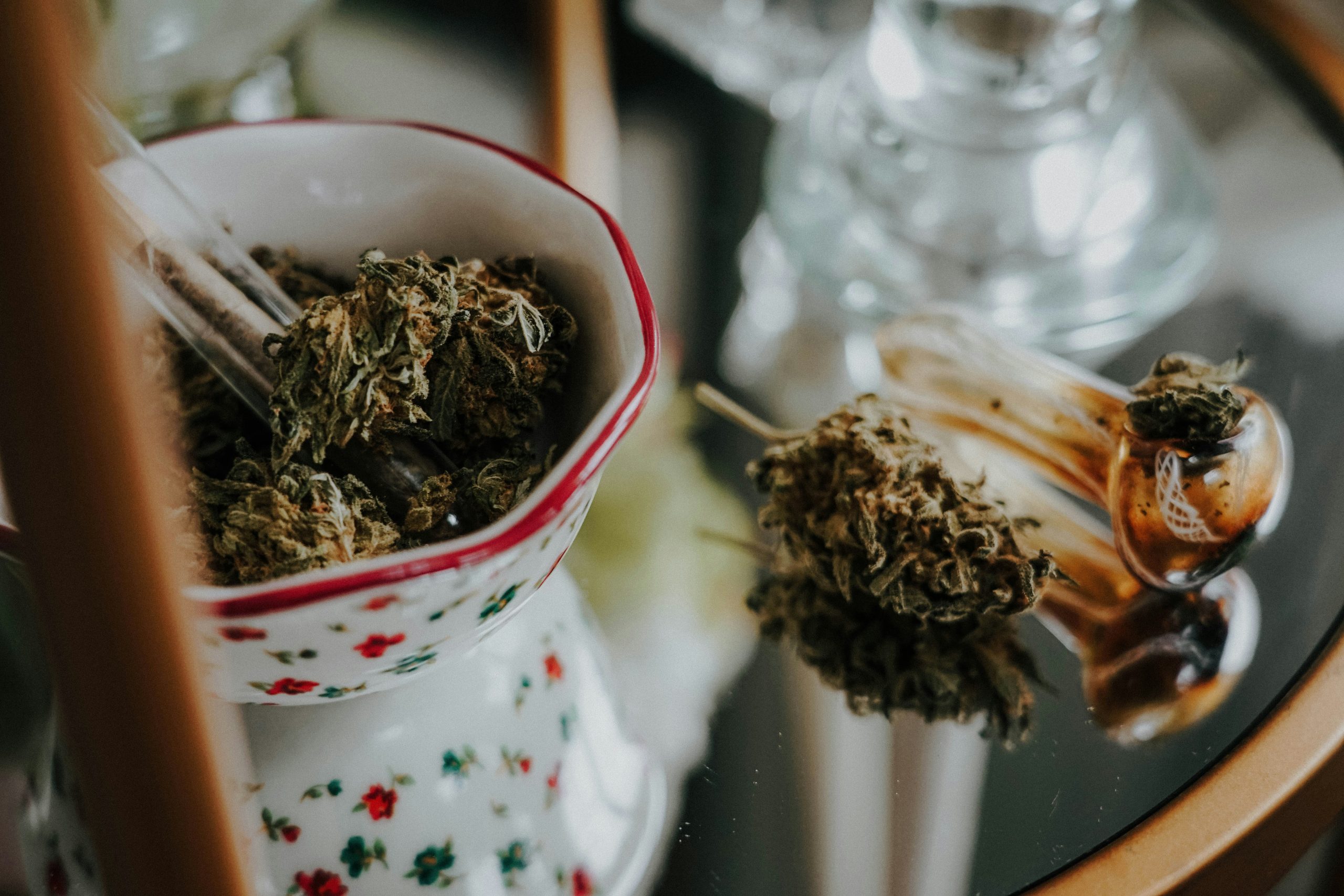
She brought her mouth to the rim of the bong, sparking life into the candy-pink BIC lighter I knew as an extension of her arm, tethered to her palm by the inked florets wrapping up the sleeve of her skin. Each indulgent puff only deepening her dependency. Helen’s teeth had yet to jaundice from her nasty habit and, blinded by her perfect, pearlescent fangs, I tried to focus on her pores while I watched her scrape the felt lining of her “Special Box” for fallen herb, joyously retrieving lint-speckled bud with great ceremony—like one might after discovering hidden bag fries lurking at the bottom of their takeout post drive-back-home binge.
“I need to clean myself of this habit for good,” she continued on a vaporous exhale. I could tell from Helen’s hairline that it had been almost two years—to the day—of the start of her most recent phase. Her scalp was just itching for a fresh start. “We need to sacrifice it.”
“Sacrifice what?” Yara asked from her room. From my lounging position at the foot of my bed, I could see the perfectly symmetrical placement of postcards Yara had collected from all of her spontaneous weekend trips since moving to Europe. She had quite a collection pinned above her bed. Her mom was a doctor.
“My bong, obviously.”
Helen’s realizations were never as insightful as she depicted them to be: her face alight with epiphany, emphatic and animated nodding, perpetually gesticulating palms—palms that had shattered her first bong with an enthusiastic flick of the wrist three months prior.
“It will be symbolic.”
Helen herself was symbolic.
A fact she proved only two days later when, on a full moon night, we sacrificed her bong.
Now hooded, faces lit from the quivering flames of Yara’s tea candle bulk-buy, the three of us stood in a circle in our living room, a sinister chant on the television behind us. Helen had demanded ominous attire: dark fabrics, long skirts, as many rings as we could fit on our fingers. Helen had gone so far as to take an eye liner pencil and draw an optic globe in the middle of her forehead, the green iris she’d stenciled there an exact replica of the two bloodshot orbs resting below it. Helen’s seven euro bubbler glowed in the center of our circle—linked by our pinkies. Helen had initially tried pouring salt, a circumference big enough for all three of us to stand in, but Yara had intervened, claiming that we had just gotten rid of the summer roaches, and she didn’t want to bring them back.
“This shall be the last pull ever taken from you, my sweet child,” Helen declared, voice deep, deity-adjacent. “The last pull—” Helen raised her head to look at us, three green eyes glowing under the shadowed rim of her SKIMS hoodie, “—we all take from you.”
“No,” Yara said, breaking from her commitment to whispering.
“Yes,” Helen insisted, the baleful inflection of her baritone forgotten. “We all have to, it’s symbolic.”
I had to work in the morning so I caved quicker than Yara, allowing Helen to torch and pull the glass stem for me, relaxing into the tightness that surged behind my scalp, pressurizing and then softening down my jawbone. Helen’s third eye winked knowingly at me as I faded further into myself, releasing a breath of smog. Yara leaned over next, permitting Helen to symbolically light an offering of weed that turned to white ash.
The television we’d picked up on Wallapop for thirty euros danced with classical music notes, crescendoing within the walls of my eardrums. I was removed now, but I registered Yara’s refusal to draw blood from her palm, Helen’s disgruntled dissatisfaction. I was floating on a cloud, smiling to myself when I heard the shattering of glass, Yara’s interjection. They bickered for a bit with me standing there in stoned silence until Helen finally blew out the candles, turned on the lights, and made for the broom closet to sweep up the symbolically sacrificed glass shards off the laminate flooring while Yara tutted and shook her head.
I went to bed that night, exhausted from all the drug consumption my roommates required of me, Helen’s fan whirring in the next room. I tucked underneath the folds of my comforter, wiggling in the warmth as a smile that tasted of metal on my tongue tugged at the lines which had already started to settle around my mouth after a sunscreen-less summer under the Spanish sun. I was so warm, so cozy.
Wait. Too warm?
Internal gasp. My smile rolled off my cheek, a gelatinous mass flopping onto the bedsheets and flipping on its side, staring back at me like an unsatisfied lover.
Did I leave my tampon in?
It was warm in here—wasn’t fever the first sign of TSS? I could feel my left leg going numb. That was how it started for that one girl I’d read an article (seen a TikTok) about, wasn’t it? I couldn’t be sure. There were so many conflicting articles.
And it wasn’t just any tampon wedged up there, but a pilfered one. A Helen tampon, I reminded myself, fever turning to cold sweat. I remembered sneaking into her room that morning, hands itching to grab on to something expensive and not mine, momentarily brought back to my glory days before I could drive, when my friends and I would steal lipstick from the unmanned Dillard’s Sephora at the mall. I’d tip-toed over discarded cashmere, bending at the waist to rumple through her eco-friendly toiletry stash in search of a coveted Super-Plus. I remembered putting it in, but I couldn’t remember taking it out.
This was just my luck, of course. My body was too cozy (probably from the onset TSS fever), my brain too high to do anything but hypothesize over how I was going to die of Toxic Shock Syndrome and they were going to fish the killer cotton from the depths of my hoo-hah, showing it to Helen just before releasing her from the interrogation room. “You’re free to go,” they’d tell her, gloved fingers pinching the bloodied string and holding it aloft to prove her pardon. But they’d tell her in Spanish—we were in Spain, after all—and she’d hesitate, not immediately jumping up from the metal chair to seize her freedom, not immediately understanding. And, in her confusion, she’d look closer at the murder weapon, recognize the 100% certified organic textile as her own purchase, the poor absorption palpable as it pendulated in front of her face, and know that I had been stealing the treasured hygiene products. She’d hate me, never forgive me for my theft. Thank God I was long dead. All because I was too lazy to get up and check. But… Getting up? Now? When I was this comfortable, this warm—this feverish? Instead, palsied from the THC, I barely managed to set my alarm for ten minutes earlier than my usual wake up, allotting plenty of time before work for me to swirl my finger along my inner edges—just like the inexperienced third digit of Dean D’Angelo, freshman year of high school—and fish out the tampon that maybe was or maybe wasn’t up there.
If I woke up.
And I did. I woke to the smell of onions. Or… Blood? Yes, it was blood. I was pleasantly surprised to find that I’d bled all over my bedsheets because I had, indeed, removed the pilfered plug and forgotten to stopple another in its place.
When I emerged from my room at six-thirty in the morning, I found Helen, hair: chopped and head: hooded, hunched over a makeshift bong fashioned from a plastic water bottle and the bolt she’d unscrewed from the side of our ceiling fan. Smoke poured from her mouth as she grinned at me. “Call in sick and watch the new Love Is Blind season with me,” she demanded.
I did.